
Best Mindbody Alternative for Salons & Spas 2026

In short
The best Mindbody alternative for a salon or spa is an appointment-first platform. Vagaro, Bookeo, Square Appointments, Boulevard and Twizzlo are built for one-to-one appointments; WellnessLiving suits class-first studios. Mindbody sells plans by quote from $79 a month per location, while each of these alternatives publishes a price (vendor pages read September 25, 2026).
In this article13 sections

Your software bill usually becomes a problem long before you switch. It starts when a salon owner, spa manager, or studio operator looks at the monthly charge and realizes the platform is asking the business to absorb more complexity than the operation needs. That’s when the search for a Mindbody alternative begins.
For many appointment-based businesses, the main issue isn’t whether the software can do more. It’s whether the extra layers help the business run better, protect margin, and keep staff efficient.
A simpler financial structure often solves more than a longer feature list. If online scheduling and integrated payment processing are already core workflows, the smarter move is usually the platform that fits your revenue model without adding new billing surprises. Mindbody sells every plan through its sales team, from $79 a month per location with unlimited users, according to its pricing page (read September 25, 2026). Our Mindbody pricing breakdown covers its plans and fees.
Key Takeaways
- Mindbody is class-first. It built its reputation on fitness and wellness operations, so salons and spas that sell one-to-one appointments often pay for membership and class complexity they never use.
- Compare pricing models, not monthly prices. Vagaro adds $10 a month for each extra calendar up to seven licenses, and Bookeo and WellnessLiving move you to a higher plan as you add staff (vendor pages, read September 25, 2026).
- Sort alternatives by business model. Bookeo fits lower-complexity appointment operations, Vagaro fits mixed beauty and wellness needs, and WellnessLiving fits class-heavy studios that want administrative depth.
- Check whether the bill counts people or places. Mindbody lists unlimited users and prices each location, and Square Appointments and Boulevard Premier also bill per location (vendor pages, read September 25, 2026); Twizzlo bills per business on both of its plans.
- Migration is an operations project. Export client data, document services, set booking rules, and update every booking entry point before going live.
Is Your Booking Software Costing More Than It’s Worth?
Software stops paying for itself when its billing unit grows faster than your revenue: per location on Mindbody, per extra calendar on Vagaro, per plan tier on Bookeo and WellnessLiving.
A common scenario looks like this. A salon adds a second location, hires two more service providers, and sees revenue rise. Then the software bill rises too, along with extra charges tied to plan level or feature access. The platform still works, but the economics no longer line up with the business.
That is why many operators start reviewing a Mindbody alternative before the software has failed. They are not reacting to downtime. They are reacting to a cost structure that gets harder to justify as the operating model becomes clearer.
Mindbody built its reputation serving fitness and wellness businesses with broader operational needs. That background matters because a class-first platform often solves a different problem than an appointment-first business has. A yoga studio managing memberships, recurring class schedules, attendance rules, and pack balances may accept more system complexity. A salon or spa usually needs fast booking, staff calendars, checkout, reminders, and clean client records. Paying class-platform prices for appointment-led workflows is often where waste starts.
Mindbody also owns Booker, a spa and salon platform. If Booker is the system you are replacing, our Booker alternative shortlist compares Booker’s competitors, priced from each vendor's own pricing page where one is published.
The deeper issue is pricing architecture
Software cost affects margin in two ways. The obvious one is the monthly fee. The less obvious one is how the pricing model behaves when the business changes.
Tiered software can look reasonable at the start and become expensive at exactly the point when an operator is trying to grow carefully. Another provider added to payroll, another room opened for bookings, or another location brought online can trigger a higher software spend without creating equal operational value. For an owner managing labor, occupancy, and rebooking rates, that weakens forecasting.
Mindbody’s pricing page lists unlimited users on every plan and a price per location, so its printed billing unit is the location, not the person: hiring adds no login fee, and each new location adds another location price (read September 25, 2026).
Practical rule: If your booking platform becomes more expensive each time you add capacity, software starts acting like a variable tax on growth.
Why appointment-based teams feel this faster
Appointment businesses usually win on throughput and consistency. Front-desk speed matters. Calendar clarity matters. Low-friction checkout matters. So does having integrated payment processing for service businesses inside the same workflow, rather than spread across disconnected tools.
The mismatch appears when operators buy software designed for heavier class administration and membership logic, then use only a narrow portion of what they are paying for. The result is not just feature waste. It is slower onboarding, more settings to manage, and a pricing model that can outgrow the business before the business outgrows the software.
For many salons, spas, and other one-to-one service teams, the smarter choice is not the platform with the longest feature list. It is the one whose operating logic and pricing structure match how the business makes money.
Mindbody Alternatives at a Glance
Mindbody alternatives split into appointment-first platforms (Bookeo, Vagaro, Square Appointments, Boulevard and Twizzlo) and class-first platforms (WellnessLiving), and the table below compares them by billing model and fit.
A salon with six stylists, a yoga studio running memberships, and a day spa selling provider time all book appointments. They do not share the same operating logic. The first earns from staff utilization and rebooking. The second depends on class capacity and recurring member access. The third balances rooms, practitioners, and higher-ticket services. Comparing their software on one generic feature checklist leads to expensive mistakes.
The faster way to sort Mindbody alternatives is to look at two variables first. Start with the business model the software was built around. Then look at how pricing behaves as volume, staff, or locations increase.
| Software | Pricing model | Best fit | Core value | Published price (vendor pages read September 25, 2026) |
|---|---|---|---|---|
| Mindbody | Quote-based plans priced per location, unlimited users | Fitness, wellness, and studio operators with broader class, membership, and business-management needs | Mature platform with wide category coverage | From $79 a month per location, by quote |
| Bookeo | Lower-cost entry pricing | Solo operators and small teams with straightforward appointment booking | Simple setup for basic scheduling needs | $14.95 to $79.95 a month, by consultant count |
| Vagaro | Lower starting price with broad service-business coverage | Beauty, wellness, and mixed-service businesses | Wide feature set at an accessible entry point | $23.99 a month, a limited-time rate, plus $10 per extra calendar; list price not printed |
| WellnessLiving | Mid-market pricing with stronger studio and membership orientation | Studios and operators that need more administrative depth | Business-management coverage for class-heavy models | Starter $69 a month; Business $199 ($39 for the first two months on an offer) |
| Square Appointments | Per location: Free, Plus or Premium | Appointment businesses that want to start on a $0 plan | Free plan with unlimited staff calendars | $0, $49 or $149 a month per location |
| Boulevard | Essentials up to five providers; Premier and Prestige priced per location | Salons and spas (its Salon & Spa plans) | A five-provider entry plan, then per-location plans | Essentials $159 a month; Premier $325 per location normally ($260 on a limited-time offer for new customers) |
| Twizzlo | Flat-rate pricing, no per-seat fees | Appointment-based salons, spas, and multi-location service businesses | Booking, reminders, client records, staff schedules and online payments; the price does not change with staff or location count | Free $0; Business Pro $29.99 a month per business |
Prices are monthly, before tax and card processing, as printed on each vendor’s own page, read September 25, 2026: Mindbody, Bookeo, Vagaro’s US help center, WellnessLiving, Square Appointments and Boulevard. Twizzlo’s prices are from twizzlo.com/pricing/, read September 27, 2026.
The important distinction is not feature count. It is operational fit.
Appointment-first businesses usually need speed at the front desk, clear staff calendars, low-friction checkout, and stable software spend as they add providers or locations. Class-first businesses care more about recurring memberships, attendance management, package rules, and capacity controls. A platform can be strong for one model and inefficient for the other.
For operators who want a narrower shortlist, this review of salon booking software options is usually more useful than a mixed fitness-and-wellness comparison.
Software usually looks efficient in a demo. The bill and the workflow reveal whether it matches the business model.
What Mindbody alternatives cost as you add providers and locations
On vendor pricing pages read September 25, 2026, a one-location salon with three providers pays $0 a month on Square Appointments Free, $29.95 on Bookeo, $43.99 on Vagaro’s limited-time rate, $159 on Boulevard and $199 on WellnessLiving, while Mindbody quotes every plan from $79 a month per location.
Software like Mindbody bills by different units: the location, the calendar, a consultant or staff limit, or the business. Table A prices each platform at one location for one, three and eight providers, and shows what a second location adds.
Table A. Monthly software price at one location, before tax and card processing
| Platform | Billing unit | 1 provider | 3 providers | 8 providers | Second location |
|---|---|---|---|---|---|
| Mindbody | Per location; unlimited users; plans by quote | From $79 | From $79 | From $79 | Another location price, from $79 by quote |
| Booker (a Mindbody company) | Quote; “Starting at $139” with no billing unit printed | Starting at $139 | Starting at $139 | Starting at $139 | Not printed |
| Bookeo | Per account, by consultants and bookings | $14.95 (Solo) | $29.95 (Small) | $39.95 (Standard) | Not printed; multi-branch businesses are asked to contact Bookeo |
| Vagaro | Base plan with one calendar; $10 for each extra calendar up to seven licenses | $23.99* | $43.99* | $83.99* | Not printed |
| WellnessLiving | Starter covers one staff member; Business has unlimited staff | $69 (Starter) | $199 (Business)** | $199 (Business)** | Not printed |
| Square Appointments | Per location | $0 (Free) or $49 (Plus) | $0 or $49 | $0 or $49 | The same plan price again for each location |
| Boulevard (Salon & Spa) | Essentials up to five providers; Premier per location | $159 (Essentials) | $159 (Essentials) | $325 (Premier, normally)** | A Premier price for each location |
| Twizzlo | Per business; unlimited staff and locations | $0 (Free, up to 150 bookings a month, no SMS) or $29.99 (Business Pro) | $0 or $29.99 | $0 or $29.99 | No change |
* Vagaro’s US help center labels the $23.99 base “Only for a limited time” and does not print the regular price, a subscription price for an added location or how calendar licenses count across locations. ** Current offers: WellnessLiving Business is $39 a month for the first two months, and Boulevard Premier is $260 a month per location on a limited-time offer for new customers. “Not printed” means the vendor’s page does not say. Sources: each vendor’s own pricing page or help center, read September 25, 2026 (linked under the first table and in the sources list); Twizzlo from twizzlo.com/pricing/, read September 27, 2026.
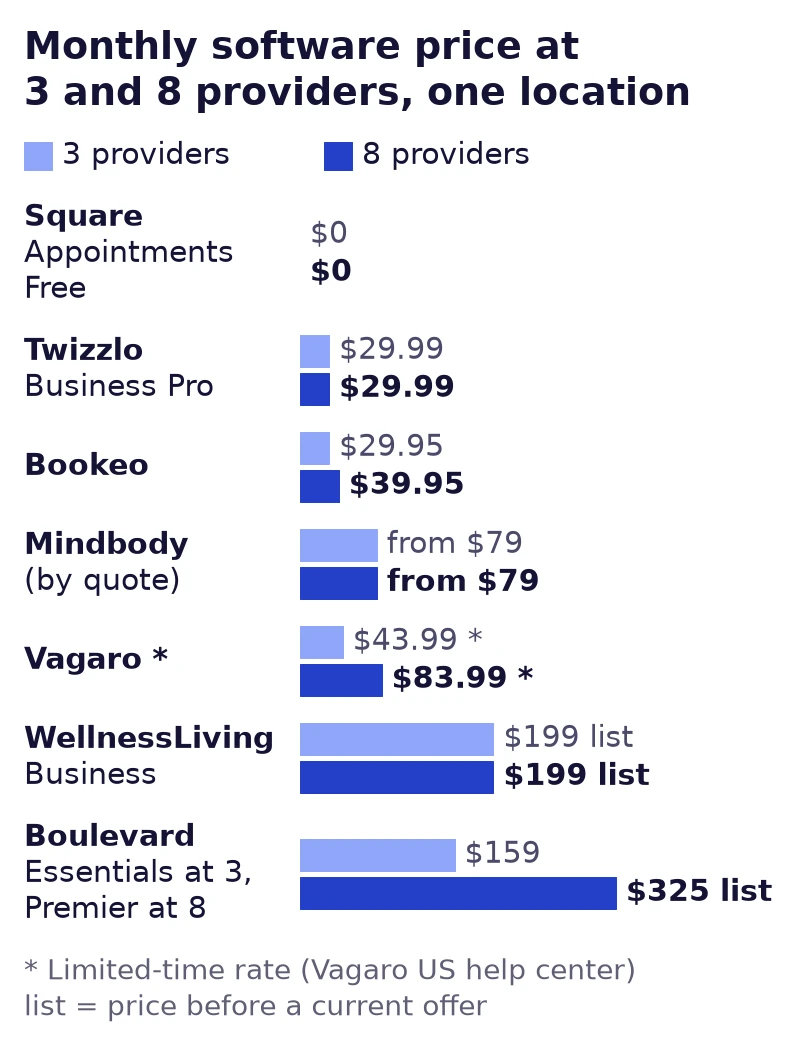
Worked example: three providers become six across two locations
Example: a salon with three providers at one location grows to six providers across two locations. The totals below are arithmetic on the printed prices in Table A; where a vendor does not print how it bills a second location, the cell says so. Vagaro’s figures use its limited-time $23.99 base.
| Platform | 3 providers, 1 location | 6 providers, 2 locations |
|---|---|---|
| Mindbody | From $79 | From $158 (two location prices, by quote) |
| Vagaro | $43.99 | $73.99 for six calendars; location billing not printed |
| Square Appointments | $0 (Free) or $49 (Plus) | $0 (Free) or $98 (Plus) |
| Boulevard | $159 (Essentials) | $650 on Premier at $325 normally, or $520 on the offer; six providers exceed Essentials’ five |
| Bookeo | $29.95 (Small) | $39.95 (Standard); location billing not printed |
| WellnessLiving | $199 (Business) | $199 (Business); location billing not printed |
| Twizzlo | $0 (Free) or $29.99 (Business Pro) | $0 (Free) or $29.99 (Business Pro), per business |
Read across the rows: the per-location prices double (Mindbody from $79 to $158, Square Appointments Plus from $49 to $98), Boulevard moves from Essentials to two Premier prices, Vagaro’s price rises with each calendar, Bookeo moves from Small to Standard, and Twizzlo’s per-business price does not change.
Why Business Operators Are Evaluating Mindbody Alternatives
Two reasons usually push an appointment business toward a Mindbody alternative: it pays for class and membership tools it does not use, or per-location pricing makes the next location hard to budget.
A two-location salon adds three providers, bookings rise, and revenue should improve. Instead, the owner starts questioning software spend. The problem is rarely a missing feature. It is usually a pricing model and workflow model that no longer match how the business earns money.
Operators reviewing Mindbody alternatives are often reacting to that mismatch. Mindbody built its reputation serving studios and wellness businesses with broader operational complexity. That can work well for class-heavy businesses that need memberships, attendance controls, and layered package rules. For appointment-first operators, the same architecture can create extra steps at the front desk, more configuration than the team needs, and software costs that feel disconnected from daily service delivery.
The financial issue is easy to miss during evaluation. A platform may look acceptable at the starting tier, then become harder to justify once the operator adds staff, locations, or admin needs. For businesses planning growth, predictable software spend matters because it affects hiring math, margin targets, and expansion timing. Teams comparing options for multi-location scheduling software are usually not asking for more software sophistication. They are asking whether the cost structure stays sensible as the business adds bookable hours.
The downstream effect shows up in ordinary decisions:
- Owners become more cautious about adding providers because software overhead rises with operational complexity.
- Managers spend more time explaining workflows and permissions that the team barely uses.
- Front desk staff work around screens and rules designed for a different service model.
- Multi-site operators struggle to forecast software cost as cleanly as payroll, rent, and marketing.
That is why many evaluations start with cost, then move quickly into operational fit.
Overpayment usually starts with a familiar mistake. Operators buy for theoretical future complexity instead of the workflows that produce revenue now.
How Do I Choose the Right Scheduling Software for My Business?
Choose a Mindbody alternative by revenue model first: appointment businesses need calendars, reminders and payments; class businesses need memberships, packs and capacity rules.
The strongest buying decision starts with one question most comparison pages barely address. Are you appointment-first or class-first?
What percentage of your revenue comes from appointments versus classes?
If most revenue comes from individual services, your platform should be optimized around time-slot booking, staff calendars, reminders, client history, and payments.
If most revenue comes from memberships, recurring classes, attendance management, and waitlists, you need a different system logic. A salon that occasionally hosts events isn’t suddenly a studio business. A yoga studio that also sells a few private sessions still lives in a class-first model.
A useful operator exercise is to list the workflows that generate most revenue and the workflows that consume most admin time. If those two lists mostly involve providers, appointments, and checkout, a class-centric platform may be overbuilt for your actual operation.
Do you need membership depth or booking precision?
Fitness-oriented systems often shine when the business depends on recurring memberships, access control, attendance patterns, and higher-volume class management. Appointment-first businesses usually get more value from clean scheduling, reliable reminders, client records, and straightforward payment flow.
Ask your managers and front desk team where time is lost today. If the answer is reschedules, provider availability, service duration mismatches, missed reminders, and payment handoff, then you need precision in core workflows rather than more modules.
A software demo can distract you with what’s possible. Your operation needs you to focus on what’s frequent.
What features do multi-location franchises need?
Multi-location operators should be careful here. They often assume they need enterprise-style complexity when they really need shared visibility and consistent controls.
The basics matter most:
- Unified calendars: Managers need to see staff and appointment load by location.
- Centralized client records: Returning clients shouldn’t feel like first-time visitors at another branch.
- Role-based access: Staff should see what they need, not everything.
- Consistent payments and reminders: Clients should get the same experience across locations.
A flat-cost, multi-site capable system such as multi-location scheduling software for service businesses can make more sense than a platform designed around class complexity if your revenue still comes mostly from appointments.
How much complexity will your staff actually use?
Owners often buy software based on strategic aspirations. Staff use software based on repetition.
A practical example: a spa with several service providers may think it wants advanced studio-style controls because the business intends to grow. But if the current front desk team only needs booking, rebooking, reminders, check-in notes, and payment collection, then software complexity becomes another training problem.
Use this quick internal checklist:
- List daily tasks your front desk completes most often.
- Mark the revenue-critical workflows that can’t fail.
- Remove features tied to rare use cases.
- Separate growth tools from complexity traps.
- Choose the system that handles common work with the fewest clicks.
Mindbody alternatives compared: who each platform fits
Bookeo, Vagaro, Square Appointments and Boulevard fit salons and spas that sell one-to-one appointments, WellnessLiving fits class-heavy studios, and Mindbody still fits businesses that earn mostly from classes and memberships; each is matched below with its published price and billing unit.
A salon owner with four providers and a growing rebooking base often reaches the same point. The software still works, but the pricing logic no longer matches how the business makes money. That is why comparing Mindbody alternatives by feature count alone leads to bad buying decisions. The core question is whether the platform is built for class volume or appointment flow, and whether its pricing rises with complexity you will use.
Three alternatives come up often in that review set: Bookeo, Vagaro, and WellnessLiving. Each can cost less at entry than legacy platforms. The more useful distinction is operational fit. Appointment-first businesses usually need fast calendar control, client history, reminders, and payments. Class-first operators put more value on packages, attendance management, capacity rules, and schedule structures that behave more like inventory.
If your shortlist also includes other salon and spa suites, our best Phorest salon software alternatives, Timely alternatives for salons and Salon Iris alternative guides cover those switches.
Bookeo fits lower-complexity appointment operations
Bookeo positions itself as a lower-cost option for businesses that need online booking without a large management layer. Its Appointments pricing page (read September 25, 2026) lists Solo at $14.95 a month for one consultant and 200 bookings a month, Small at $29.95 for three consultants and Standard at $39.95 for up to 20, with SMS credits sold separately from $0.09 each.
That matters for small operators because low software overhead protects margin early. It also reveals the ceiling. If your front desk mostly books one-to-one services and your reporting needs are basic, Bookeo can be financially rational. If you expect multi-location coordination, heavier automation, or more operational controls, the savings can narrow once workarounds start appearing in staff process.
Choose Bookeo if you have one to three providers and mainly need online booking at a low published price.
Vagaro fits beauty and wellness businesses with mixed needs
Vagaro tends to attract salons, spas, and independent professionals who want more than a basic scheduler but do not want to start at enterprise-style pricing. The product often appeals to businesses that sell appointments first and add retail, memberships, or marketing tools over time.
The catch is not the starting price. It is expansion math. A system can look economical for a two-person team and become harder to justify once add-ons, more users, or extra workflows enter the picture. Operators should model total monthly spend against revenue per provider, not just compare the headline plan.
Vagaro’s US help center (read September 25, 2026) lists the base plan at $23.99 a month, a limited-time rate, with one calendar; the regular price is not printed. Extra calendars cost $10 a month each up to seven licenses, and add-ons such as Forms and the Online Shopping Cart cost $10 a month each. The help center prints no subscription price for an added location. Our Vagaro pricing page tracks those rates.
Choose Vagaro if you want a low base price and are ready to pay for each extra calendar and add-on as you need it.
WellnessLiving fits businesses that want broader operational depth
WellnessLiving usually makes more sense for operators who want a wider business management layer from the start. That can be a reasonable fit for studios or hybrid businesses where classes, memberships, and recurring client programs carry meaningful revenue weight.
For appointment-first businesses, that depth is not automatically a win. More platform surface area often means more setup, more training, and more chances for staff to work around the system instead of through it. The businesses that benefit most are the ones whose revenue model already depends on that added structure.
WellnessLiving’s pricing page (read September 25, 2026) lists Starter at $69 a month for one staff member and Business at $199 a month with unlimited staff; on its current offer, Business is $39 a month for the first two months.
Choose WellnessLiving if classes, memberships or recurring programs bring in a large share of your revenue and you want those tools in the same system as your appointments.
A more useful comparison framework is to review appointment scheduling software for small businesses by business model first, then by price architecture. Operators who sell hours on a calendar usually get better returns from software designed around appointments and flat operating costs. Operators who sell capacity across classes, memberships, and recurring attendance may accept more layered pricing because the underlying business model is more layered too.
Square Appointments fits teams that want a $0 plan per location
Square Appointments bills per location: Free is $0 a month, Plus $49 and Premium $149, and the Free plan lists unlimited staff calendars (pricing page, read September 25, 2026). Card rates are printed by plan; on Free they are 2.6% plus 15 cents in person and 3.3% plus 30 cents online. Square lists cancellation policy and no-show fees among the Plus features (plan grid captured September 27, 2026). Our Square Appointments pricing page covers the plan differences.
Choose Square Appointments if you want to start at $0 per location and can work with Square’s card rates, or will pay for Plus when you need no-show fees.
Boulevard fits salons and spas with up to five providers
Boulevard’s Salon & Spa pricing (read September 25, 2026) starts with Essentials at $159 a month for up to five providers (bookable calendars). Premier is priced per location at $325 a month normally, or $260 on a limited-time offer for new customers. Card processing starts at 2.65%, as the page prints it.
Choose Boulevard if you run a salon or spa with up to five providers, or can budget for a Premier price at each location as you grow.
When staying on Mindbody makes sense
Staying on Mindbody can be the better call when classes, memberships and class packs bring in much of your revenue. Mindbody’s site calls it fitness and wellness management software and also lists hair salons, nail salons and day spas (read September 27, 2026). Its pricing page lists unlimited users on every plan and prices per location from $79 a month, through sales (read September 25, 2026), so a large team at one location adds no login fees.
Stay on Mindbody if most of your revenue comes from classes, memberships or packs, or if many staff work from one or two locations and the quote you get fits your budget.
Mindbody alternatives for service businesses that book appointments, not classes
Short answer: for service businesses that sell one-to-one appointments, sort Mindbody alternatives by business model first. Bookeo suits simple appointment booking, Vagaro suits beauty and wellness businesses with mixed needs, WellnessLiving suits class-heavy studios that want more admin depth, and Twizzlo suits appointment-first teams that add staff and locations.
A service business here means one that sells provider time in slots: a barbershop, hair or nail salon, day spa, tattoo studio or cleaning company. Its daily work is the calendar, reminders, client records and payments, not class capacity or member access. Check four things on any shortlist:
- Booking rules. Service durations, buffer times, walk-ins and client self-rescheduling.
- No-show protection. Prepaid bookings or no-show fees, plus automated reminders.
- Staff scheduling. Individual schedules, shifts and time off, and whether each added provider raises the bill.
- Client records. Visit history, notes and preferences in one client profile.
Twizzlo for appointment-first salons and spas: plans and fit
Twizzlo is web-based online booking and appointment scheduling software for appointment-based service businesses, and it fits salons and spas that sell one-to-one appointments rather than classes.
For appointment-first operators, the strongest alternative is usually the one that removes pricing ambiguity and keeps the workflow centered on the essentials.
Twizzlo has two plans. Free is $0 a month for up to 150 bookings, with no SMS, and it is free forever, not a trial. Business Pro is $29.99 a month per business for unlimited bookings, with 50 SMS a month included, then $0.03 each, and a 30-day money-back guarantee. Both plans include unlimited staff and locations. Online payments carry your Stripe processing rate plus a 1.5% Twizzlo platform fee.
That pricing model directly addresses the issue many salon and spa operators are trying to escape. The question isn’t whether software can be cheap at the beginning. It’s whether the platform stays financially sensible when you add staff, locations, and booking volume.
At one provider, Square Appointments Free ($0) and Bookeo Solo ($14.95 a month) cost less than Business Pro (vendor pages, read September 25, 2026); Twizzlo Free is also $0, up to 150 bookings a month.
Why appointment-first teams often need less software, not more
For a salon or spa, the daily work is the calendar, the client record and the payment. Twizzlo covers that work with a 24/7 online booking page that shows real-time availability; automated email confirmations and reminders, with SMS reminders on Business Pro; one client profile with visit history, notes and preferences; individual staff schedules and Employee Shifts across one or several locations; prepaid bookings for the full service price and tips at checkout; no-show fees applied at the business’s discretion; walk-in bookings; and client self-rescheduling.
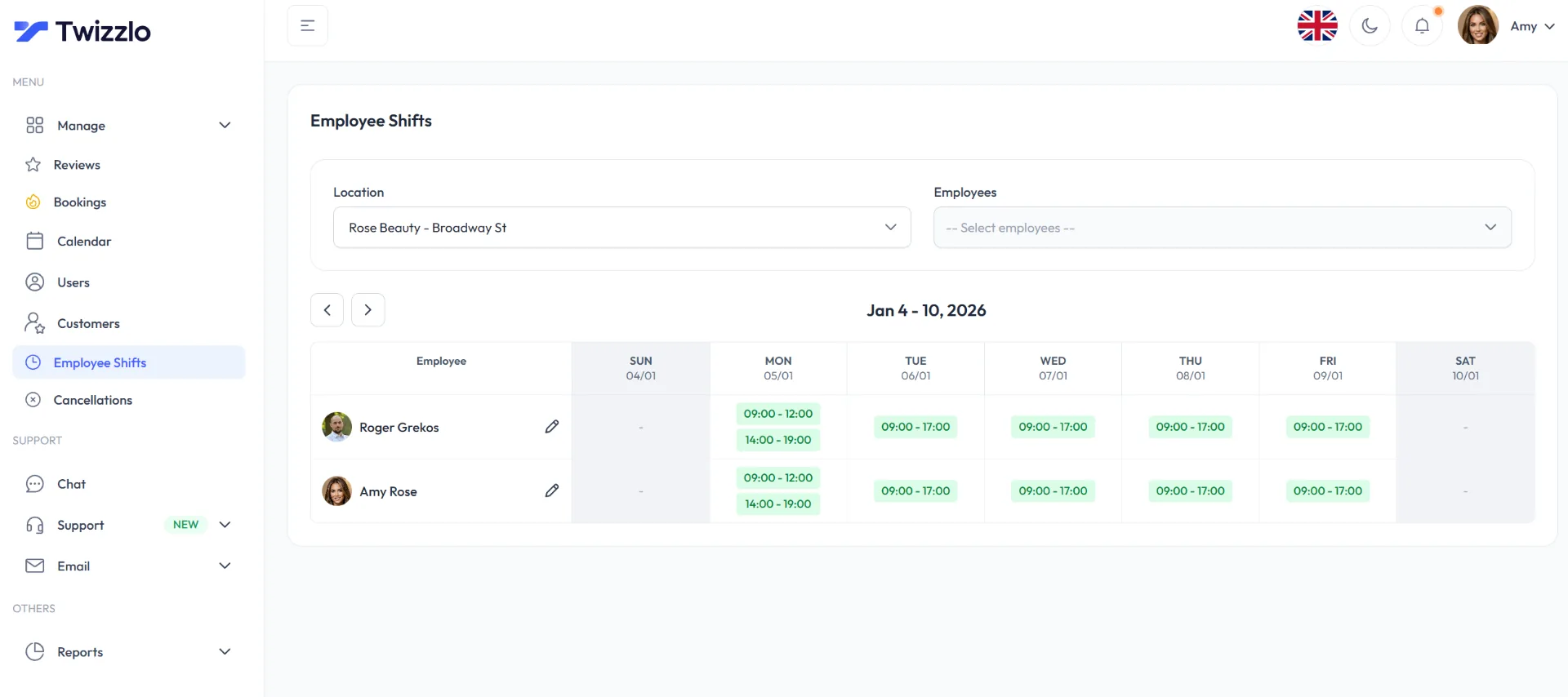
Twizzlo does not sell memberships or class packs, so a business that earns mainly from classes or memberships is better served by a class-first platform such as Mindbody or WellnessLiving.
Where the fit is strongest
This model works best for operators who want:
- Two plans: Free for up to 150 bookings a month and Business Pro for unlimited bookings, so the choice comes down to booking volume and SMS.
- Unlimited staff access: Hiring doesn’t trigger another software rethink.
- Multi-location support: Expansion doesn’t require a pricing reset.
- Core workflow focus: Booking, reminders, staff management, payments, and client records in one system.
For businesses evaluating function and cost together, the most relevant place to review the operational stack is the appointment scheduling and business management feature set.
A Simple Checklist for Migrating Your Booking System
Moving off Mindbody takes six tasks: export client data, document services, rebuild staff permissions, set booking rules, update every booking link and tell clients.
Switching platforms feels risky when the calendar is full. In practice, migration becomes manageable when you treat it like an operations project instead of a technical event.
The six tasks that matter most
-
Export your client data
Pull your client list, appointment history, staff records, and any service notes you need to keep. Review the export before moving anything. -
Document services and pricing
Write down service names, durations, buffers, assigned staff, and pricing. This prevents setup drift in the new system. -
Rebuild staff permissions carefully
Don’t just recreate old access settings automatically. Use the switch to clean up who needs admin control and who only needs calendar visibility. -
Set booking rules before launch
Confirm cancellation windows, reminder timing, appointment buffers, and payment collection logic before clients start booking. -
Update every booking entry point
Replace old links on your website, social profiles, confirmation messages, and QR materials at the same time. -
Communicate the change straightforwardly
Tell clients the new process is live, why it’s better, and what they need to do next. Keep the message short and operational.
Run both systems briefly if your schedule is packed
The safest migration pattern for a busy salon or spa is a short overlap period. Keep the old platform available for verification while the new system goes live, then shut the old one down once bookings and reminders are behaving as expected.
Don’t make launch day your first real test. Validate staff logins, services, reminders, and payment flow before clients discover the new booking path.
A practical example is a spa moving during a quieter part of the week, setting up client records first, rebuilding provider schedules second, and only then changing the public booking link. That order reduces confusion for both staff and clients.
If your team wants a cleaner rollout process, user onboarding best practices for scheduling software can help operators structure training, access control, and go-live planning.
Frequently Asked Questions
What is the best Mindbody alternative for salons and spas
The best option depends on how your business earns money. A salon or spa that runs mostly one-to-one appointments usually needs strong booking, reminders, client records, staff scheduling, and payments. It usually doesn’t need the same complexity as a membership-heavy studio. That’s why the best fit is often the platform with the simplest financial model and the strongest appointment workflow.
Is Mindbody better for classes than appointments
In many cases, yes. Mindbody has long been associated with broader fitness and wellness operations, especially where classes, memberships, and more layered business logic matter. Appointment-based businesses can still use it, but operators often find that class-oriented depth introduces cost or complexity that doesn’t improve the daily workflow of a salon, spa, or barbershop.
Why do small businesses switch from Mindbody
Most small businesses don’t switch because they suddenly need more software. They switch because they want a better fit. The common pattern is that pricing complexity, feature gating, or a mismatch between the platform and the business model starts to affect margin, staff efficiency, or expansion planning. At that point, a simpler alternative becomes easier to justify.
What should I compare besides monthly price
Compare the pricing model, not just the monthly number. A low entry price can still become expensive if costs rise with staff, locations, or added functions. Also compare setup friction, staff usability, booking flow, reminders, payment handling, and reporting. The right question is whether the system stays efficient as your operation grows, not whether it looks cheapest on day one.
Is a flat-rate scheduling platform better for growing teams
It often is for appointment-based businesses because flat-rate pricing improves predictability. Owners can hire, add providers, or expand location count without treating software costs as a moving target. That matters for budgeting and margin control. It’s less important if the business needs deep class or membership functionality, but it can be a major advantage for salons, spas, and similar service operators.
How hard is it to migrate from one booking system to another
It’s usually easier than owners expect if the project is planned properly. The key steps are exporting current data, documenting services and staff rules, setting up booking policies, training the team, and updating all public booking links together. Businesses with packed calendars often reduce risk by running the old and new systems briefly in parallel before fully switching over.
What software is similar to Mindbody
The alternatives that come up most often are Bookeo, Vagaro, WellnessLiving, and Twizzlo. The more useful comparison is business model, not brand. Bookeo targets lower-complexity appointment booking, Vagaro covers beauty and wellness businesses with mixed needs, WellnessLiving leans toward class and membership administration, and Twizzlo focuses on flat-rate scheduling for appointment-first teams. Start from how your business earns revenue, then shortlist the platforms built around that model.
Is there a Mindbody alternative for businesses that don’t run classes
Yes. Appointment-first platforms skip the class inventory, membership logic, and access-control layers that fitness software carries. If your revenue comes from provider time booked in slots, you mainly need staff calendars, reminders, client records, and payments in one workflow. Flat-rate booking software that scales keeps that stack affordable because the price doesn’t rise as you add providers or locations.
How do I shortlist Mindbody competitors before booking demos
Work through four questions from this guide. What share of revenue comes from appointments versus classes? Which daily front-desk workflows are revenue-critical? How much complexity will your staff actually use? And how does each platform’s pricing behave when you add staff, rooms, or locations? Those answers usually narrow the field to one or two systems before you sit through a single demo.
Which Mindbody alternatives publish their prices?
Bookeo, Vagaro, WellnessLiving, Square Appointments and Boulevard print prices on their own pages, read September 25, 2026; Vagaro’s US help center shows its $23.99 monthly base as a limited-time rate. Mindbody prints only a starting price of $79 a month per location and sells every plan through sales, and Booker, a Mindbody company, prints “Starting at $139” with no billing unit (both read September 25, 2026). Twizzlo prints its prices on twizzlo.com/pricing/.
Which Mindbody alternatives charge more as you add providers or locations?
On vendor pages read September 25, 2026, Vagaro adds $10 a month per extra calendar up to seven licenses; Bookeo moves you up a plan by consultant count ($14.95 for one, $29.95 for three, $39.95 for up to 20); WellnessLiving’s $69 Starter plan covers one staff member; and Mindbody, Square Appointments and Boulevard Premier charge per location. Twizzlo’s price does not change with staff or location count.
What does a Mindbody alternative cost for a salon with three providers?
For three providers at one location, vendor pages read September 25, 2026, list $0 a month on Square Appointments Free ($49 on Plus), $29.95 on Bookeo Small, $43.99 on Vagaro’s limited-time rate, $159 on Boulevard Essentials and $199 on WellnessLiving Business ($39 a month for the first two months on its offer), while Mindbody quotes from $79 a month per location. Twizzlo Free is $0 for up to 150 bookings a month, and Business Pro is $29.99 a month per business (twizzlo.com/pricing/, read September 27, 2026). Online payments carry your Stripe processing rate plus a 1.5% Twizzlo platform fee, and each other vendor’s card rates are extra.
Try Twizzlo’s Free plan before you switch
If most of your revenue comes from one-to-one appointments, set up Twizzlo’s Free plan first: it is $0 a month for up to 150 bookings, with no SMS, and it is not a trial. Test booking, reminders and payments with your own services before you move every client. When you need unlimited bookings, Business Pro is $29.99 a month per business, with 50 SMS a month included and a 30-day money-back guarantee. Online payments carry your Stripe processing rate plus a 1.5% Twizzlo platform fee. Our salon appointment software page covers Twizzlo for salons.
Sources and methodology
Prices read
- Mindbody pricing page (opens in a new tab)Read . Supports: starting price per location, plans sold by quote, unlimited users on every plan; re-read September 27, 2026 with the same figures
- Mindbody business homepage (opens in a new tab)Read . Supports: Mindbody's fitness and wellness positioning and the salon and day spa business types it lists
- Booker pricing page (opens in a new tab)Read . Supports: Booker's starting price, printed without a billing unit
- Bookeo Appointments pricing page (opens in a new tab)Read . Supports: Bookeo plan prices, consultant and booking limits, SMS credits, multi-branch contact
- Vagaro plans and pricing help article (US) (opens in a new tab)Read . Supports: Vagaro limited-time base rate, extra calendar fees and add-on prices
- Vagaro membership management page (opens in a new tab)Read . Supports: Vagaro sells a memberships feature
- WellnessLiving pricing page (opens in a new tab)Read . Supports: WellnessLiving Starter and Business prices, staff limits and the two-month offer
- Square Appointments pricing page (US) (opens in a new tab)Read . Supports: Square plans per location, unlimited staff calendars on Free, card rates; Plus features (cancellation policy and no-show fees) captured September 27, 2026
- Boulevard pricing page (opens in a new tab)Read . Supports: Boulevard Salon & Spa plans, provider limit, per-location Premier price and offer, card processing rate
- Twizzlo pricing page (opens in a new tab)Read . Supports: Twizzlo plans, booking cap, SMS allowance, money-back guarantee and online payment fee
- Twizzlo features page (opens in a new tab)Read . Supports: Twizzlo booking, reminder, client record, staff and payment features; Employee Shifts screenshot (same image)
From our editorial policy
- Twizzlo sells online booking and appointment scheduling software, the same category we write about. Twizzlo appears in our comparisons and roundups, and we have a commercial interest in you choosing it.
- We do not publish invented quotes, studies, statistics, customer stories or product tests, and we do not imply hands-on use of a product when the research came from the vendor's public documentation.
- To report an error, email support@twizzlo.com with the subject line "Correction: [page URL]". Tell us what is wrong and, if you can, link a source.
Update history
- : Priced Mindbody and seven alternatives from their own pages (September 25, 2026) in a table by team size, a two-location example and a chart; corrected how Mindbody bills (per location, unlimited users); added three FAQs; removed three outside citations and three illustrations.
Start free, upgrade when you grow
Flat-rate booking software. No per-seat, per-chair or per-location fees.
- Free plan up to 150 bookings a month, not a trial
- Business Pro is $29.99 a month per business for unlimited bookings, with a 30-day money-back guarantee
- 24/7 support by email