
Multi Location Scheduling Guide: Centralize Ops

In short
Multi location scheduling software runs every site's bookings, staff shifts, client records and reports from one account, while each location keeps its own hours and booking link. Platforms bill extra sites differently: Square Appointments charges $49 a month per location on its Plus plan (read September 25, 2026); others bill per user, per business or by quote.
- Check the billing unit before the demo: per location, per user or per business pricing grows differently with every new site.
- Give each location its own hours and booking link, but keep one client record and one staff schedule across every site.
- Roll out at one pilot location first, then add the others once staff and clients book there without help.
Source: Square Appointments pricing page (US) (opens in a new tab), read
In this article9 sections
Running two or more locations on separate calendars leads to double-bookings, staff nobody can find and reports stitched together by hand. This guide explains what multi location scheduling software does, the features each site needs, what a second location costs on eight platforms and how to roll a new system out.
Twizzlo, which publishes this guide, makes a free appointment scheduling app with a paid Business Pro plan and is one of the platforms compared. Competitor prices come from each vendor's own pricing page or help center, read September 25, 2026 (GlossGenius September 27, 2026).
What Is Multi-Location Scheduling Software?
Multi-location scheduling software is one booking system for several business sites: a shared calendar view, staff schedules that follow people between branches, one client record and combined reports, while each site keeps its own hours, services and booking page. Salon groups, franchises and home-service teams usually need it once a second location opens.
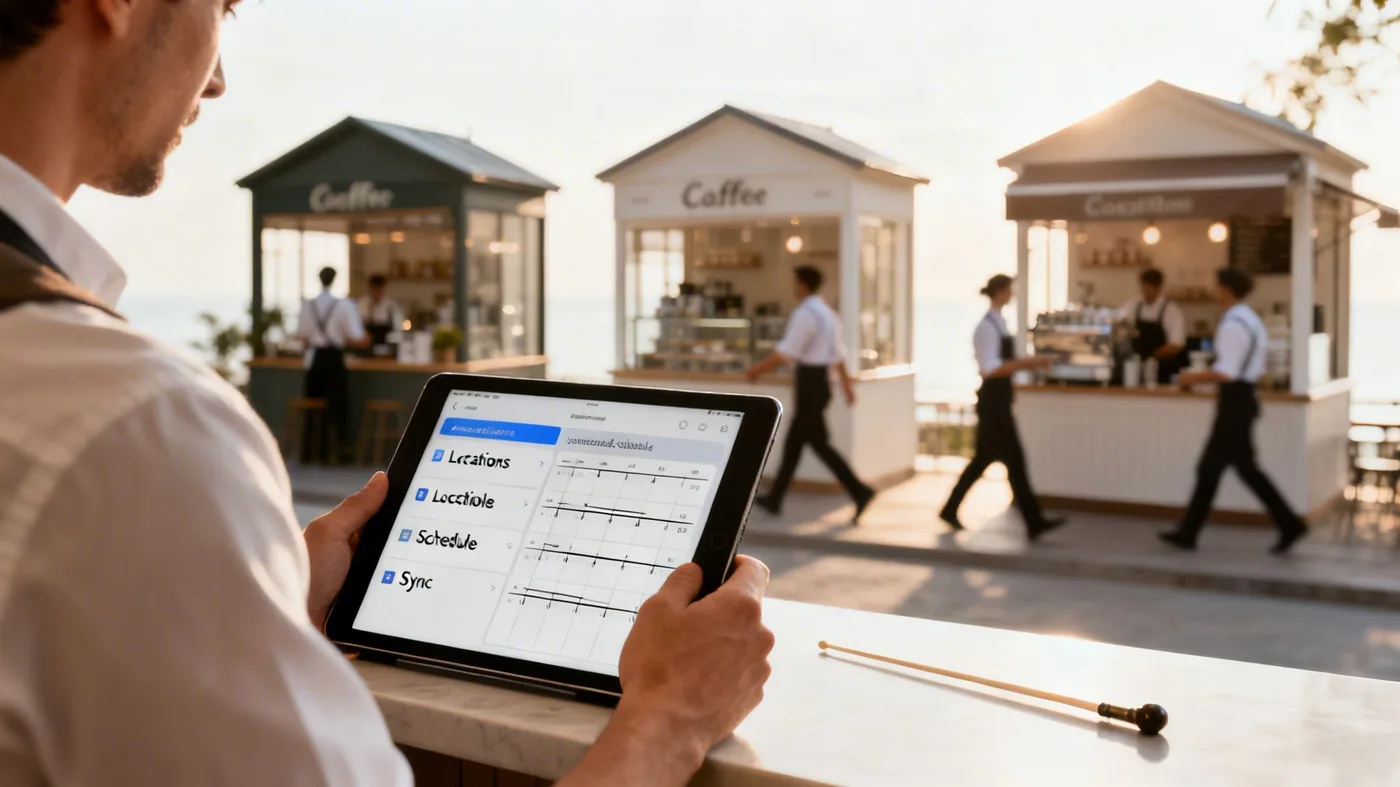
When your systems are disconnected, friction is inevitable. A client calls to book with their favorite stylist, but the receptionist has no clue that stylist is covering a shift at another branch. That’s a frustrated client and a lost sale. Double-bookings become a daily headache, you can never get a clear picture of staff availability, and a unified view of business performance is just a fantasy.
Multi-location scheduling software is the answer. It’s a centralized platform that acts as the command center for your entire operation, bringing all your appointments, staff, and resources across every branch into one single, synchronized dashboard.
From Silos To Synergy
Think about a small business, like a single coffee shop. A simple calendar works just fine. But what happens when that shop expands to a second, then a third location across town? The owner is suddenly flying blind.
They can’t see which location is busiest, who is available to cover a shift at another branch, or even how many total appointments the business handled last week. This is the exact pain point that multi-location scheduling software is built to solve.
It transforms scheduling from a scattered, location-by-location chore into a streamlined, strategic operation. It provides a “bird’s-eye view” of your entire business, enabling you to make smarter decisions about staffing, resource allocation, and growth.
More Than Just A Booking Calendar
This isn’t just about letting customers book online; it’s a tool for taking back control of your operations. It tackles the core challenges that growing businesses face head-on.
If one person's booking page is all you need, the Google appointment scheduler in Google Calendar may be enough; the features below are what a second location adds.
To understand the shift, let’s compare the old way of doing things with the new, centralized approach.
Manual Vs. Centralized Scheduling At A Glance
| Challenge | Manual Method (Per Location) | Multi-Location Software Solution |
|---|---|---|
| Booking Conflicts | Frequent double-bookings and resource clashes. Staff manually coordinate via phone or text. | Real-time, unified calendars prevent any staff member or resource from being booked twice. |
| Staff Management | No central view of who is working where. Managing “floating” staff is a constant struggle. | A single dashboard shows all staff schedules across all locations, simplifying shift assignments. |
| Client Experience | Inconsistent booking process. Clients can only book at one location at a time. | Clients see all available times, services, and staff across all locations in one booking portal. |
| Business Reporting | Data is fragmented. Must manually combine reports from each site for a company-wide view. | Consolidated, automated reports show bookings, revenue, and other KPIs for the entire business. |
As the table shows, the software provides a clear, organized solution to the messy problems that come with manual management.
With a unified system, you gain the control needed to run every location from one view.
To learn more about centralized scheduling, you can read up on the broader world of appointment scheduling software. The bottom line is simple: centralizing your scheduling is no longer a luxury, but a necessity for growth.
Key Benefits Of A Centralized Booking System
A centralized booking system gives every location one shared view of bookings, staff and clients, which prevents double-bookings and lets a client book a favorite provider at whichever branch has time.
Moving to a unified scheduling system is about so much more than just tidying up your calendar. It’s a fundamental shift in how your business runs, breathes, and grows. When you ditch the patchwork of separate schedules for each location and embrace a single source of truth, you’ll see real, measurable improvements, from your bottom line to your team’s happiness and your clients’ loyalty.
The first thing you’ll notice is the clarity that comes from a bird’s-eye view of your entire company. No more calling another branch to see if a certain technician is free. No more guessing which location has an open treatment room. It’s all right there.
This complete oversight is your launchpad for making smarter, faster decisions based on what’s actually happening across your business, not just what you think is happening.
Achieve Operational Excellence From A Single Dashboard
With all your operations visible on one screen, you can suddenly spot problems and opportunities that were completely hidden before. You’ll see which locations are slammed and which are quiet. You can identify team members or equipment sitting idle and put them to work where they’re needed most, right now.
Let’s say a regular client wants to book with her favorite stylist, Sarah. She checks your booking portal and sees Sarah is swamped at your downtown salon all week. But instead of giving up, the system automatically shows her that Sarah is working at the uptown branch tomorrow and has a 3 p.m. opening.
The client snags the appointment at the other location without ever picking up the phone. This isn’t just convenient for her; it’s a way to capture revenue you would otherwise have lost.
That simple interaction showcases a few benefits working together:
- Maximized Staff Utilization: You can “float” talented staff between locations to handle rushes or cover shifts, ensuring your best people are always generating revenue.
- Enhanced Customer Loyalty: Clients get to stay with the providers they love, even if they have to visit a different branch. That personal connection keeps them coming back to your brand.
- Increased Booking Conversions: By showing every single available slot across all your locations, you make it less likely that a motivated customer leaves without booking.
This level of connectivity makes your business far more agile and resilient, ready to adapt to whatever the day throws at you.
Slash Administrative Work And Empower Your Staff
One of the biggest headaches in a multi-site business is the sheer volume of admin work. A centralized system gets a ton of that off your plate through smart automation, freeing up your team to do their real job: taking care of clients.
Think about appointment reminders. Automating them via text and email drastically cuts down on the hours your front desk spends making confirmation calls. Pair them with prepaid bookings on your longer services and fewer clients skip their slot. That’s not just time saved; it’s revenue protected. To get the most out of your automated messages, you might want to look into some proven client communication best practices.
Self-service features also give your staff more control and responsibility. Instead of a manager spending an hour on the phone trying to cover a sick call, an employee can simply log in, see an open shift at another location, and claim it themselves. This kind of autonomy is a morale booster and gives your managers precious time back.
Create A Seamless And Consistent Customer Journey
Your brand’s reputation is built on delivering a consistent experience. A client should feel the same level of care and professionalism whether they walk into your very first location or your newest one. Multi location scheduling software is the technology that makes this possible.
When a customer can use a single login to book, reschedule, and pay for appointments at any of your branches, you’re removing all the annoying little bumps in their journey. Their appointment history, notes and preferences follow them from site to site. It feels effortless to them, and that’s what creates a unified brand experience that encourages repeat business and turns happy customers into your biggest fans.
Essential Features For Multi-Location Scheduling Software
Four features separate multi-location scheduling software from a single-site calendar: a central dashboard, settings for each location, one client database and consolidated reports.
When you’re choosing a multi-location scheduling software, you’re doing a lot more than just picking a digital calendar. It’s a common trap to assume all platforms are built the same, but the reality is that most basic tools just can’t keep up with the demands of a business split across multiple sites. To genuinely bring your operations under one roof and pave the way for growth, you need a system built with specific, non-negotiable features for managing that complexity.
Let’s break down the essential features you should be looking for.
The Centralized Command Center
The cornerstone of any effective system is a centralized administrative dashboard. This is your mission control, giving you a single, unified view of your entire business in real time. Without it, you’re not unifying your operation; you’re just juggling separate calendars in different browser tabs.
From this one dashboard, a regional manager or owner should be able to see everything at a glance:
- Overall Appointment Volume: Instantly see which locations are slammed and which have open chairs or rooms.
- Staff Availability: Get a complete view of every employee’s schedule across all branches, making it simple to cover shifts or move team members where they’re needed most.
- Revenue and Performance: Track high-level metrics for the whole company without having to export and mash together a dozen different spreadsheets.
This single source of truth is what separates real multi-location scheduling software from basic booking apps. It’s the difference between guessing how your business is doing and knowing for sure.
Granular Location-Specific Settings
While a unified, top-down view is critical, your software must also zoom in and allow for location-specific customization. Each of your branches is unique. They have their own hours, staff, services, and maybe even different pricing. A rigid, one-size-fits-all system will only create new headaches.
Your platform must let you:
- Set Unique Business Hours: Manage different opening times, holiday schedules, and staff shifts for each location.
- Customize Service Menus: Offer specific services or packages that are exclusive to certain branches. For example, your flagship salon might offer extensions or color correction that aren’t available at your smaller satellite shops.
- Adjust Pricing by Location: Account for different market conditions or operating costs by setting unique prices for the same service at each site.
This kind of flexibility ensures your software actually adapts to how your business runs on the ground, rather than forcing your teams to work around software limitations.
A Unified Client Database
A scattered client database is a massive roadblock to providing a consistent brand experience. If a loyal customer’s history, preferences, and payment details are stuck at one location, they’re basically a brand-new client every time they walk into a different branch. That’s not a great feeling.
An essential feature, then, is a unified client database that follows the customer wherever they go. This means their entire history (every past appointment, service note, product purchase, and their contact info) is instantly accessible to your staff at any location. This doesn’t just improve the quality of service; it makes your clients feel recognized and valued across your entire brand.
Consolidated Reporting and Analytics
How can you possibly make smart, strategic decisions without a clear picture of your overall performance? Trying to manually compile reports from multiple locations is a time-consuming nightmare, not to mention it’s prone to human error.
Proper multi-location scheduling software automates this entire process. It should provide consolidated reports that let you analyze key performance indicators (KPIs) at any level you need. You should be able to:
- View total revenue for the entire company.
- Compare booking trends between two specific locations.
- Track the performance of a single staff member who floats between multiple branches.
This ability to zoom in and out, from a 30,000-foot company view right down to a single location’s daily numbers, is invaluable. It’s how you spot growth opportunities and fix operational weak spots before they turn into major problems.
What a Second Location Costs on Each Scheduling Platform
Most of the scheduling software for multiple locations compared here bills more for a second site. On vendors' pages read September 25 and 27, 2026, two locations with six staff cost $98 on Square Appointments Plus, $103.60 on GlossGenius Gold, $300 on Mangomint and $650 on Boulevard Premier at list price. Mindbody and Zenoti price plans by quote, and Vagaro's help center prints no subscription price for an added location.
| Platform | How a location is billed | Two locations, six staff, per month | Source and read date |
|---|---|---|---|
| Twizzlo | Per business; unlimited locations and staff on both plans | $0 on Free (up to 150 bookings a month, no SMS); $29.99 on Business Pro | Twizzlo pricing page, September 28, 2026 |
| Square Appointments | Square Appointments pricing is per location: Free $0, Plus $49 and Premium $149 a month; unlimited staff calendars | $0 on Free, $98 on Plus, $298 on Premium | Pricing page, September 25, 2026; plan grid, September 27, 2026 |
| GlossGenius | GlossGenius pricing is per business by plan: Standard has no staff management and Gold covers up to nine staff; each added location costs the plan price less 15% | $103.60 on Gold | Pricing page, September 27, 2026 |
| Mangomint | $120 a month per location plus $10 a month per user; “Anyone with a profile in Mangomint counts as a user” | $300 ($240 for two locations plus $60 for six users) | Pricing page, September 25, 2026 |
| Boulevard | Essentials is flat for up to five providers; multi-location support is on Premier and Prestige, billed per location with unlimited professionals | $650 on Premier ($325 a month per location, normally); $520 on a limited-time offer for new customers | Pricing page, September 25, 2026 |
| Mindbody | Mindbody pricing is “Starting at $79” a month per location; plans by quote | Quote | Pricing page, September 25, 2026 |
| Vagaro | Vagaro pricing is $23.99 a month, a limited-time rate, with one calendar; $10 a month per added employee calendar up to seven licenses | Not printed: the help center prints no subscription price for an added location | US help center, September 25, 2026 |
| Zenoti | Quote; “Multi-location pricing is customized” | Quote | Pricing page, September 25, 2026 |
Totals are monthly subscriptions on monthly billing, before tax, card processing, texts and add-ons. Mangomint does not say whether a person who works at two locations counts as one user or two; the total counts each person once. Vagaro's help center prints no regular price after its limited-time rate.
This table covers location billing only; our best appointment scheduling software guide ranks the wider field.
Multi-location scheduling software: how Twizzlo runs every location from one account
Short answer: multi-location scheduling software puts every site's calendar, staff shifts, client records and reports in one account, while each location keeps its own hours and booking link. In Twizzlo, both plans include unlimited locations and unlimited staff, and Business Pro is $29.99 a month per business whether you run one site or ten.
Twizzlo is web-based online booking and appointment scheduling software for appointment-based service businesses. Here is how the multi-location scheduling pieces in this guide map to Twizzlo's multi-location features:
- A booking link per location. Clients book 24/7 at the site they want, against real-time availability.
- Per-location working hours. Each site sets its own working hours, time off and blackout dates keep closed days off the calendar, and locations in different time zones are supported.
- Staff shifts across sites. Employee Shifts sets where each team member works on each day, so a stylist who splits the week between two branches keeps one schedule.
- One client record. Client profiles, visit history, notes and total spend sit in one place, so a regular is known at every branch.
- Role-based access. Owners and managers control what each team member can see and change.
- Insights for every site. Booking volume, revenue, staff utilization and forecasts, by day, week or month, across all locations.
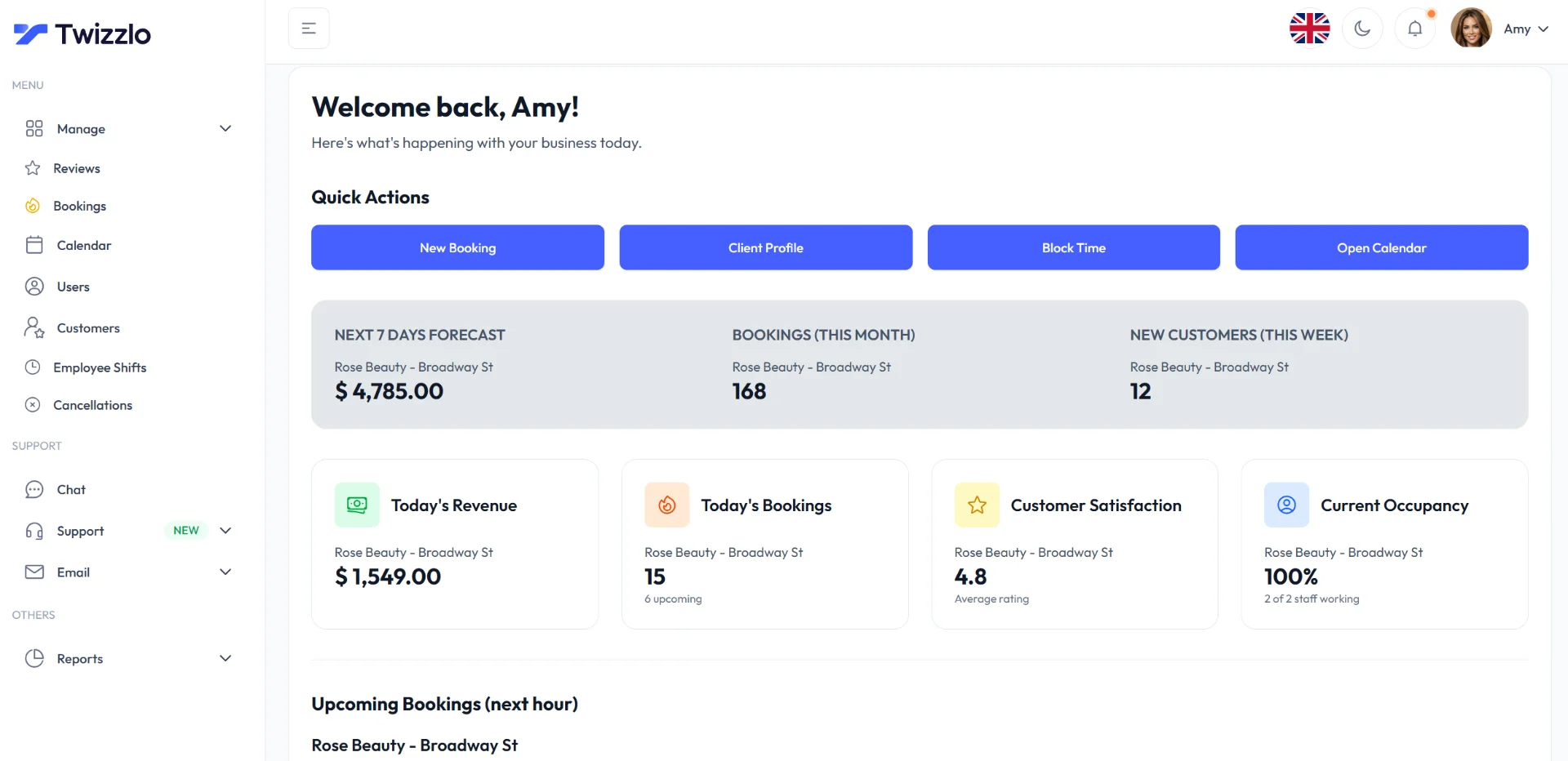
The price does not move with your footprint. Free is $0 for up to 150 bookings a month, without SMS. Business Pro is $29.99 a month per business ($359.88 over 12 months), with unlimited bookings, 50 SMS a month (then $0.03 each) and a 30-day money-back guarantee, and staff and location counts never raise it. The full plan detail is on the Free plan and Business Pro pricing page.
Online payments carry your Stripe processing rate plus a 1.5% Twizzlo platform fee. Support runs 24/7 by email at support@twizzlo.com.
Twizzlo does not run payroll, commission tracking or memberships. A multi-location business that runs any of these inside its scheduling system should compare the platforms in the table above.
How Different Industries Benefit From Unified Scheduling

Unified scheduling pays off most where staff or clients move between sites, as in salon and spa groups and in home-service teams dispatched from one office. While any growing business can appreciate a centralized system, the software’s true value shines when it solves the unique, everyday headaches of specific industries. This isn’t a one-size-fits-all tool; it’s a flexible platform that adapts to very different ways of doing business.
Let’s dive into how this technology helps various service-based companies turn their biggest scheduling bottlenecks into genuine opportunities for growth. These examples show how the theory translates into tangible results, giving you a blueprint for your own success.
Salons And Spas
The beauty and wellness world thrives on the personal connection between a client and their trusted provider. But when you have multiple locations, managing those relationships gets complicated. It’s common for talented stylists, estheticians, or massage therapists to “float” between branches to cover shifts or meet pockets of high demand.
Without a unified system, booking these floating professionals is hard to coordinate. A client might call your downtown spot to book with their favorite stylist, only to be told she’s not there. The receptionist has no clue that the stylist is actually at the uptown branch with an open slot. The result? A lost booking and a frustrated customer.
Multi-location scheduling software cuts through this confusion. It gives your staff and your clients a single, unified view of every provider’s schedule across all locations. That client can now see their favorite stylist is available at another branch and book the appointment right then and there, capturing revenue that would have simply walked away.
A central system also makes brand-wide initiatives simpler to run.
- One booking link per location: Each branch gets its own booking link, so clients book the right location while you see every branch in one account.
- Consistent Client Profiles: A client’s service history, color formulas, and product preferences are instantly accessible at any site, ensuring they get the same five-star service no matter which door they walk through.
This deep level of connectivity creates a cohesive brand experience that builds loyalty to your entire business, not just one physical location.
Home Services And Field Operations
For any business where your team is on the move (think cleaning companies, HVAC technicians, or mobile pet groomers), scheduling is a logistical game of chess. The goal is always to minimize travel time and maximize the number of jobs completed each day. Dispatching technicians from a central office without real-time data is a recipe for inefficiency.
Imagine sending a technician from the north side of town to a job on the south side, only to realize another team member was just a few blocks away from that same job. That wasted time and fuel directly eats into your profit margins.
Field-service dispatch software adds map-based tools to this kind of scheduling. Depending on the product, it can:
- Suggest Routes: Some dispatch tools assign each job to the nearest available technician, which cuts travel time.
- Balance Workloads: You get a bird’s-eye view of who has a full day and who has gaps, letting you reassign jobs on the fly to keep everyone productive.
- Improve Client Communication: Automatically send customers a text with a precise ETA, which is a small touch that improves their experience.
Your Guide to Choosing and Implementing the Right Software
Choose multi-location scheduling software against a written checklist, then roll it out at one pilot location before the others.
Making the jump to a new software platform can feel like a massive undertaking. But with the right game plan, what seems like a stressful project can become your next big strategic win. Think of this as your practical guide to picking the right multi-location scheduling software and rolling it out without the headaches.
Our goal here is to cut through the noise and give you a clear, step-by-step process. By breaking it all down into manageable chunks, you can ensure a smooth transition.
Creating Your Vendor Evaluation Checklist
Not all scheduling software is built the same, especially when you’re trying to wrangle multiple business locations. Before you even think about sitting through a product demo, the first step is to build a checklist of your must-haves. This simple document will be your North Star, keeping you from getting distracted by flashy features that don’t actually solve your core operational problems.
A business still at one site can start with our small business booking software checklist; the items below add what a second location needs.
Treat this checklist like a scorecard for every vendor you look at. Here are the essentials to include:
- Pricing Model: Does their pricing structure punish you for growing? You want to find simple, transparent pricing that won’t skyrocket every time you hire a new employee or open another site. Predictable costs are a must for any scaling business. When comparing scheduling software for multiple locations, ask whether the price is per business, per location or per user; the cost table above shows how far those models drift apart at two sites.
- Integration Capabilities: Your scheduling tool can’t operate in a silo. Make sure it plays nice with the other software you already rely on, like your point-of-sale (POS) system, payroll software, and email marketing tools.
- Customer Support: When something goes wrong (and it will), you need to know you can get help, fast. Dig into their support options. What are their hours? What’s the average response time? Will you get a dedicated person to help you? Never underestimate the value of great support.
By defining your needs upfront, you shift from being sold to, to actively buying the right solution. You control the conversation and ensure the platform you choose is a perfect fit for your operational reality.
A Phased Implementation for Smooth Adoption
Trying to launch new software across all your locations at once (the “big bang” approach) spreads every setup mistake to every site. A much smarter strategy is a phased implementation. This allows you to work out the kinks in a controlled environment, gather real-world feedback, and build positive momentum.
Think of it as a blueprint for a successful, low-stress launch:
- Phase 1: Data Migration and Initial Setup: First things first, work with your new software partner to get all your existing data moved over. This includes your client lists, service menus, and staff profiles. This is also when you’ll configure the unique settings for each location, like their specific hours and pricing.
- Phase 2: Staff Training and Pilot Launch: Now it’s time to train the team. Start with the managers and staff at just one pilot location. Go live with the software at that single site to see how it performs in the real world. This is your chance to get invaluable feedback from the people who will use it every day.
- Phase 3: Full Rollout and Go-Live: With lessons learned from your pilot, you can tweak your training materials and fine-tune your process. Now you’re ready to confidently roll out the software to all your remaining locations, backed by a proven strategy.
This methodical approach minimizes disruption and makes sure your team feels ready and confident right from day one. For more ideas on managing your client data effectively, you might find our guide on simple client management software helpful.
Measuring Your Return on Investment
The whole point of getting new software is to make your business better. The good news is that the impact of multi-location scheduling software is easy to measure.
To prove it’s working, start tracking a few key performance indicators (KPIs) from before and after you make the switch:
- Reduction in No-Shows: Keep an eye on your no-show rate. Compare the rate before and after automated reminders.
- Staff Utilization Rate: Are your team members’ schedules full? Measure how effectively you’re booking their time, especially for staff who might float between locations.
- Administrative Time Saved: Survey your location managers and front-desk staff to get a real number on how many hours they’re saving now that they aren’t bogged down with manual scheduling tasks.
Your Top Questions About Multi-Location Scheduling, Answered
The answers below cover data access, floating staff, per-location pricing, setup and booking links for owners running several sites.
Bringing in any new technology can feel like a big leap. You’ve got legitimate concerns, and when it comes to multi-location scheduling software, you need to know it will solve problems, not create new ones. We’ve heard all the questions, and we’re here to walk through the most common ones so you can feel confident about your next steps.
A common worry for many business owners is data security. How do you keep client information safe when it’s being accessed across multiple branches? It’s a valid concern. Reputable platforms are built from the ground up with security in mind, often using a system of role-based permissions.
Think of it like a tiered keycard system. Your front-desk employee at one salon has access only to the information they need for that specific location. Meanwhile, you or your regional manager have a master key to see the complete picture. Ask each vendor how client data is encrypted and who can see each location's records.
How Does the Software Handle Complex Staffing?
What about managing staff who float between locations or wear multiple hats? This is a question we get all the time. What happens when your star stylist splits her week between your downtown and suburban salons? Or when a stylist is trained for color correction, but not for extensions?
This is exactly where a purpose-built platform proves its worth. It’s designed for these real-world scenarios.
- Create “Floating” Staff Profiles: You can assign team members to multiple locations and manage their entire schedule from one central calendar. This completely eliminates the risk of accidentally double-booking them.
- Set Skill-Based Permissions: You can tie specific services directly to the staff who are certified to perform them. When a client goes to book online, the system will only show them the employees who are actually qualified for that service.
This level of granular control ensures your most valuable assets, your people, are managed efficiently and accurately, no matter how complicated your scheduling gets.
Does multi-location scheduling software charge per location?
It depends on the vendor. On vendors' own pages read September 25, 2026, Square Appointments charges $49 a month per location on Plus, Mangomint $120 a month per location plus $10 a month per user, Boulevard Premier $325 a month per location at list price and Mindbody “Starting at $79” a month per location. GlossGenius bills each added location at its plan price less 15% (read September 27, 2026). Twizzlo does not: both plans include unlimited locations and unlimited staff, and Business Pro stays at $29.99 a month per business at any number of sites (Twizzlo pricing page, read September 28, 2026). Ask every vendor whether the quoted price is per business, per location or per user, and what happens to it when you open the next site.
What Is the Setup Process Really Like?
The idea of migrating years of client data, service menus, and staff profiles can feel overwhelming. But a good software partner won’t just hand you the keys and walk away. They should have a dedicated support team to guide you through the entire data import process, making the transition as smooth as possible.
The initial setup is a one-time effort. It builds the foundation for smoother daily operations, a less-stressed team, and a consistent, professional experience for your clients at every single location.
At the end of the day, these platforms are designed to tackle the very challenges that make you hesitate. They bring order to the chaos of growth, turning your biggest operational headaches into solved problems.
What is the difference between multi-location staff scheduling and appointment scheduling?
Staff scheduling, also called employee or shift scheduling, decides who works at which location and when. Appointment scheduling lets clients book services against that staff time. Multi-location appointment scheduling software should hold both, so each site's bookable hours match the people working there. In Twizzlo, Employee Shifts sets where each team member works on each day, and clients book through each location's own link.
Does each location need its own booking link?
It helps. Multi location booking software sends each client to the right site, either with one booking link per location or with a location choice at the start, so each site shows only its own hours, services and staff. The business still manages every location from one account. In Twizzlo, each location has its own booking link and its own working hours.
Twizzlo has two plans, Free and Business Pro, and both include unlimited staff and locations, so opening another site never changes the price. Start with Twizzlo.
Sources and methodology
Prices read
- Square Appointments pricing page (US) (opens in a new tab)Read . Supports: Square Free, Plus and Premium prices per location; unlimited staff calendars on every plan (plan grid captured September 27, 2026)
- GlossGenius pricing page (opens in a new tab)Read . Supports: GlossGenius plans per business, Gold up to nine staff, Standard without staff management, each added location at the plan price less 15%
- Mangomint pricing page (opens in a new tab)Read . Supports: Mangomint $120 a month per location plus $10 a month per user; anyone with a profile counts as a user
- Boulevard pricing page (opens in a new tab)Read . Supports: Boulevard Essentials for up to five providers; Premier per location (list price and the limited-time offer for new customers); multi-location support on Premier and Prestige
- Mindbody pricing page (opens in a new tab)Read . Supports: Mindbody 'Starting at $79' a month per location; plans by quote
- Vagaro plans and pricing (US help center) (opens in a new tab)Read . Supports: Vagaro limited-time base rate with one calendar and the price per added employee calendar; no subscription price printed for an added location
- Zenoti pricing page (opens in a new tab)Read . Supports: Zenoti quote only; multi-location pricing customized
- Twizzlo pricing page (opens in a new tab)Read . Supports: Twizzlo plans, booking cap, SMS allowance, unlimited staff and locations, money-back guarantee, 24/7 support and the online payment fee
- Twizzlo features page (opens in a new tab)Read . Supports: Per-location booking links and working hours, multi-location staff shifts, and the Insights dashboard screenshot (same image)
From our editorial policy
- Twizzlo sells online booking and appointment scheduling software, the same category we write about. Twizzlo appears in our comparisons and roundups, and we have a commercial interest in you choosing it.
- We do not publish invented quotes, studies, statistics, customer stories or product tests, and we do not imply hands-on use of a product when the research came from the vendor's public documentation.
- To report an error, email support@twizzlo.com with the subject line "Correction: [page URL]". Tell us what is wrong and, if you can, link a source.
Update history
- : Added a dated table of how eight platforms bill an added location, two FAQs and Twizzlo's fee details; removed unverified statistics, an off-topic video and a section on gym classes.
Start free, upgrade when you grow
Flat-rate booking software. No per-seat, per-chair or per-location fees.
- Free plan up to 150 bookings a month, not a trial
- Business Pro is $29.99 a month per business for unlimited bookings, with a 30-day money-back guarantee
- 24/7 support by email