
Tattoo Deposits: 2026 Online Setup Guide

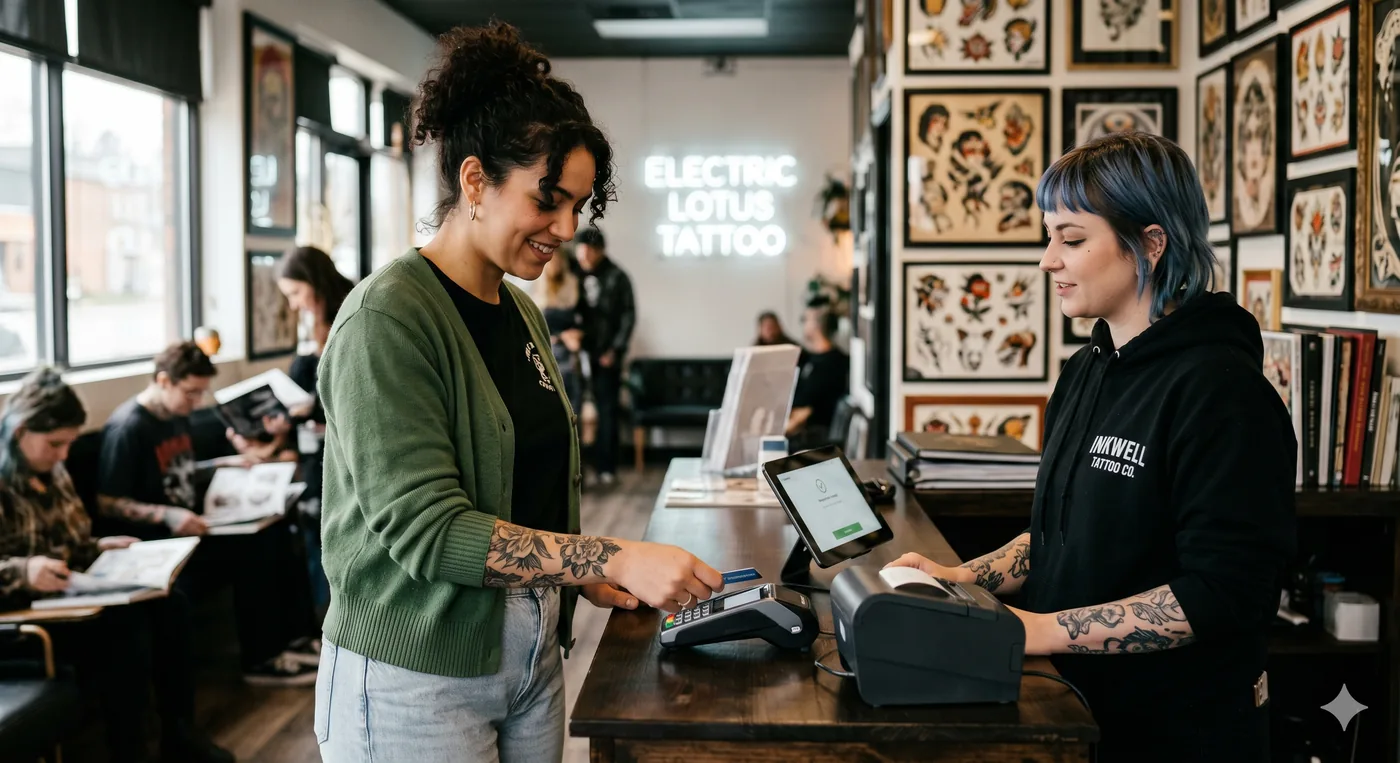

Tattoo deposits are the difference between a profitable studio and a calendar full of no-shows. If you’re still chasing payments through Venmo, getting ghosted on consultations, or eating the cost of last-minute cancellations, you’re not alone — most studios get this wrong because nobody taught them how to set it up properly. This guide walks through how to take tattoo deposits online in 2026: what to charge, how to handle refunds, and which tools actually work for solo artists and multi-artist studios.
Why tattoo deposits matter (and why most studios still get it wrong)
A tattoo deposit isn’t just a no-show fee. It’s a commitment device, a scheduling lock, and a baseline for the artist’s time. For a six-hour back piece, the consultation alone can take an hour. If the client ghosts, you’ve lost an entire morning that could have been booked.
The most common mistakes:
- No deposit at all. “I trust my clients” works until it doesn’t.
- Cash-only deposits. You’re now the bank. And the courier.
- Venmo or Cash App deposits. No paper trail, no automated refund logic, awkward when refunds get disputed.
- Deposits that don’t apply to the final price. Clients hate this. It feels punitive.
What a tattoo deposit policy should include
Every studio needs a written deposit policy that clients agree to before the booking is confirmed. At minimum:
- Amount or percentage — flat fee ($50–100) or percentage of estimated total (typically 20–30%)
- What it covers — booking lock plus applied to final price (most common) or non-applied retainer
- Refund window — usually 48–72 hours before appointment
- Reschedule policy — most studios allow one free reschedule with 48-hour notice
- No-show or late-cancel forfeit — deposit is forfeited
- Design changes — major changes after consultation may require a new deposit
Put this on your booking page. Clients agree at checkout. No ambiguity later.
How to take tattoo deposits online: 4 methods compared
1. Manual payment apps (Venmo, Cash App, Zelle, PayPal)
Pros: Free, fast to set up. Cons: No automated booking link, no calendar sync, no refund logic, no agreement at checkout. You’re manually verifying every payment and chasing receipts. Workable for one solo artist doing two bookings a week. Falls apart at any volume.
2. Generic payment links (Stripe Payment Links, Square)
Pros: Real payment processor, receipts, basic refund handling. For partial-refund logic, see Stripe’s documentation on refunds. Cons: Disconnected from your calendar. Client pays the deposit, then you still have to manually book them. Two systems, two points of failure.
3. Booking software with built-in tattoo deposits
Pros: Deposit collected at the moment of booking. Client picks slot, pays deposit, gets confirmation, lands on your calendar. One flow, one system. Refunds, reschedules, and no-show forfeits all handled by the software. Cons: Some platforms charge per-artist fees that scale painfully. Make sure you pick one that doesn’t.
This is what most multi-artist studios end up needing. If you’re going this route, tattoo booking software like Twizzlo lets every artist take deposits at the moment of booking with no per-artist fees.
4. Hybrid (booking app + separate payment processor)
Pros: Customizable. Cons: Maximum complexity. Best avoided unless you have a specific edge case.
Setting your tattoo deposit amount and refund policy
There’s no universal answer, but the working ranges in 2026:
| Session size | Typical deposit |
|---|---|
| Small flash piece (under 2 hr) | $50–75 |
| Medium custom (2–4 hr) | $100–150 |
| Half-day (4–6 hr) | $150–250 or 20% |
| Full-day or multi-session | 25–30% upfront |
Refund window: 72 hours is industry standard. Anything shorter is fine if you communicate it clearly. Anything longer eats your scheduling buffer.
Common tattoo deposit mistakes to avoid
- Forgetting to apply the deposit to the final invoice. Clients remember. They tell other clients.
- Inconsistent policies between artists in the same studio. Pick one studio policy or you’ll have arguments.
- Refunding “as a courtesy” too often. Your policy means nothing if you override it half the time.
- Not putting the policy in writing before checkout. Disputes will go against you on chargebacks.
- Charging deposits but not enforcing the forfeit. Same problem in reverse.
How Twizzlo handles tattoo deposits
Twizzlo is tattoo booking software built for solo artists and multi-artist studios. Deposits are part of the booking flow, not a separate payment process:
- Set deposit amount per service or per artist
- Client pays at the moment of booking; appointment is confirmed only after payment
- Built-in refund logic respects your cancellation window
- No-show forfeit is automatic
- Deposits applied to the final invoice or held as retainer — your choice
And because Twizzlo is flat-rate, it doesn’t charge per artist. Every artist in your studio gets full deposit functionality on one plan.
FAQ
Can I take tattoo deposits without a booking system?
Yes — but it doesn’t scale. Manual deposits work if you’re a solo artist doing a handful of appointments a week. The moment you have multiple artists or 20+ bookings a month, the manual workload eats your time.
What’s a fair tattoo deposit amount?
Flat $50–100 for small pieces, 20–30% for larger sessions. The deposit should sting enough that clients don’t ghost, but not so much that it scares off legitimate inquiries.
Should tattoo deposits be refundable?
The industry standard is non-refundable inside the cancellation window (typically 48–72 hours), refundable outside it. Make this explicit in your policy.
What happens to tattoo deposits if the artist cancels?
Always refunded. If you reschedule on the client, you eat the loss — that’s the cost of being professional.
Are tattoo deposits taxable?
Yes, in most jurisdictions deposits are taxable income at the time received, even if the service hasn’t been performed. Consult an accountant for your specific situation.
What does a tattoo deposit actually mean?
It means the appointment is real. A deposit is the client’s financial commitment to show up and the studio’s guarantee that the slot — and the prep time behind it — is reserved for them. In most studios it isn’t a fee on top of the tattoo; it’s the first part of the payment, held under the conditions in your written policy.
Does the deposit go toward the price of the tattoo?
Usually, yes. Applying the deposit to the final invoice is the most common setup and the one clients expect. The alternative is a non-applied retainer that pays separately for the booking commitment. Either works, but state which one you use in the written policy before checkout — surprise non-applied deposits are one of the fastest ways to lose repeat clients.
How long does a tattoo deposit last if the client reschedules?
Let it carry over once. The standard approach is one free reschedule inside your notice window, with the deposit transferring to the new date. Cap it there — repeated reschedules or an appointment pushed out indefinitely turns the deposit into a dead booking. Treat further changes, or major design changes after consultation, as a new booking with a new deposit.
Try Twizzlo’s tattoo booking software free — every artist, every feature, one flat price.
Try Twizzlo free
Flat-rate booking software. No per-seat, per-chair or per-location fees.