
Tattoo Shop Business Plan: A Copy-and-Paste Template With the Money Math

In short
A tattoo shop business plan covers seven parts: summary, concept, market, artist pay, licensing, marketing and money. What makes it a tattoo plan is the money section: whether artists rent booths or split commission, how deposits sit in cash flow, and how consults take chair hours from sessions. Copy the template below and fill in your figures.
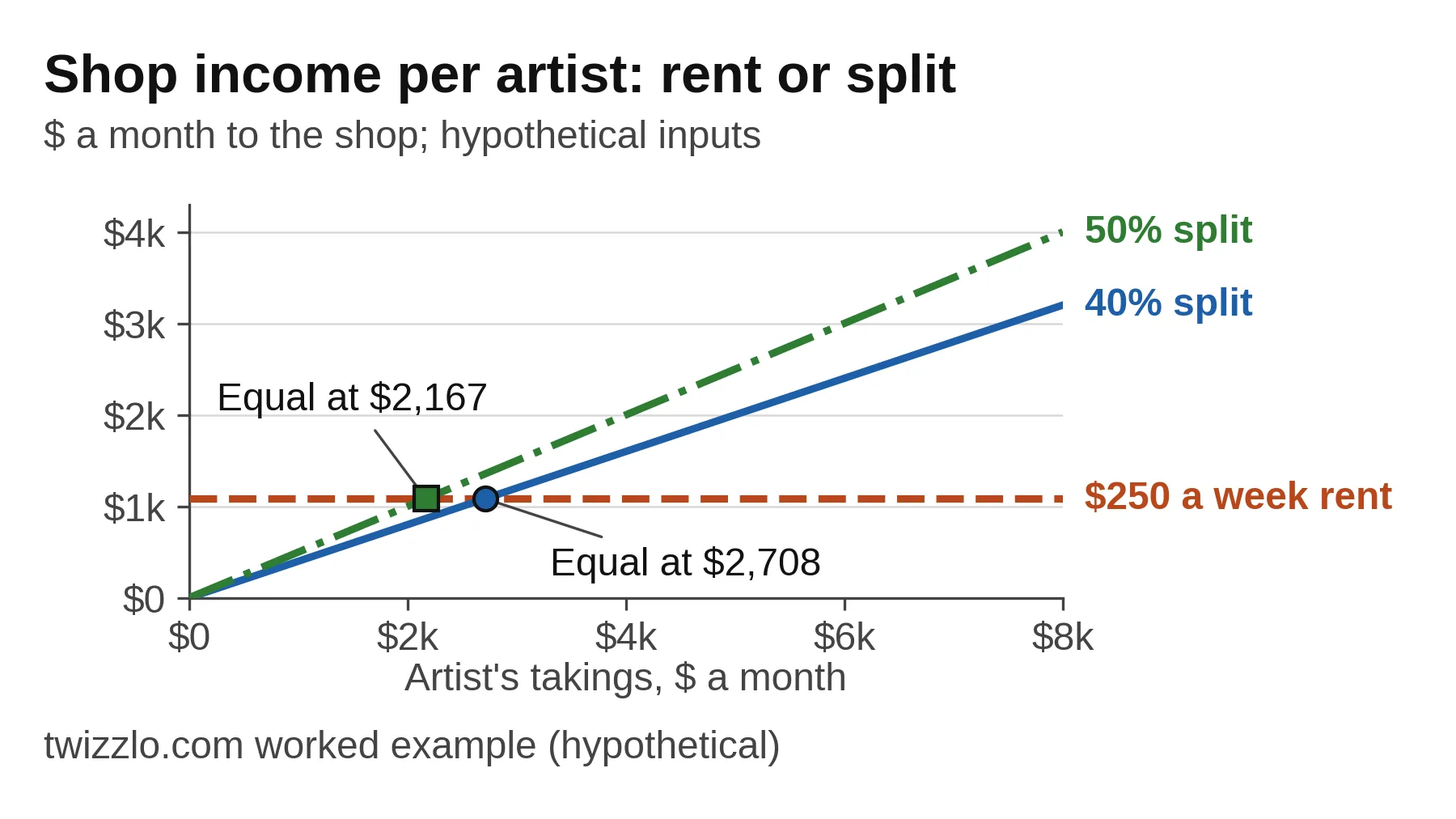
- In our hypothetical example, $250 a week of booth rent beats a 40% shop share until an artist takes in about $2,708 a month.
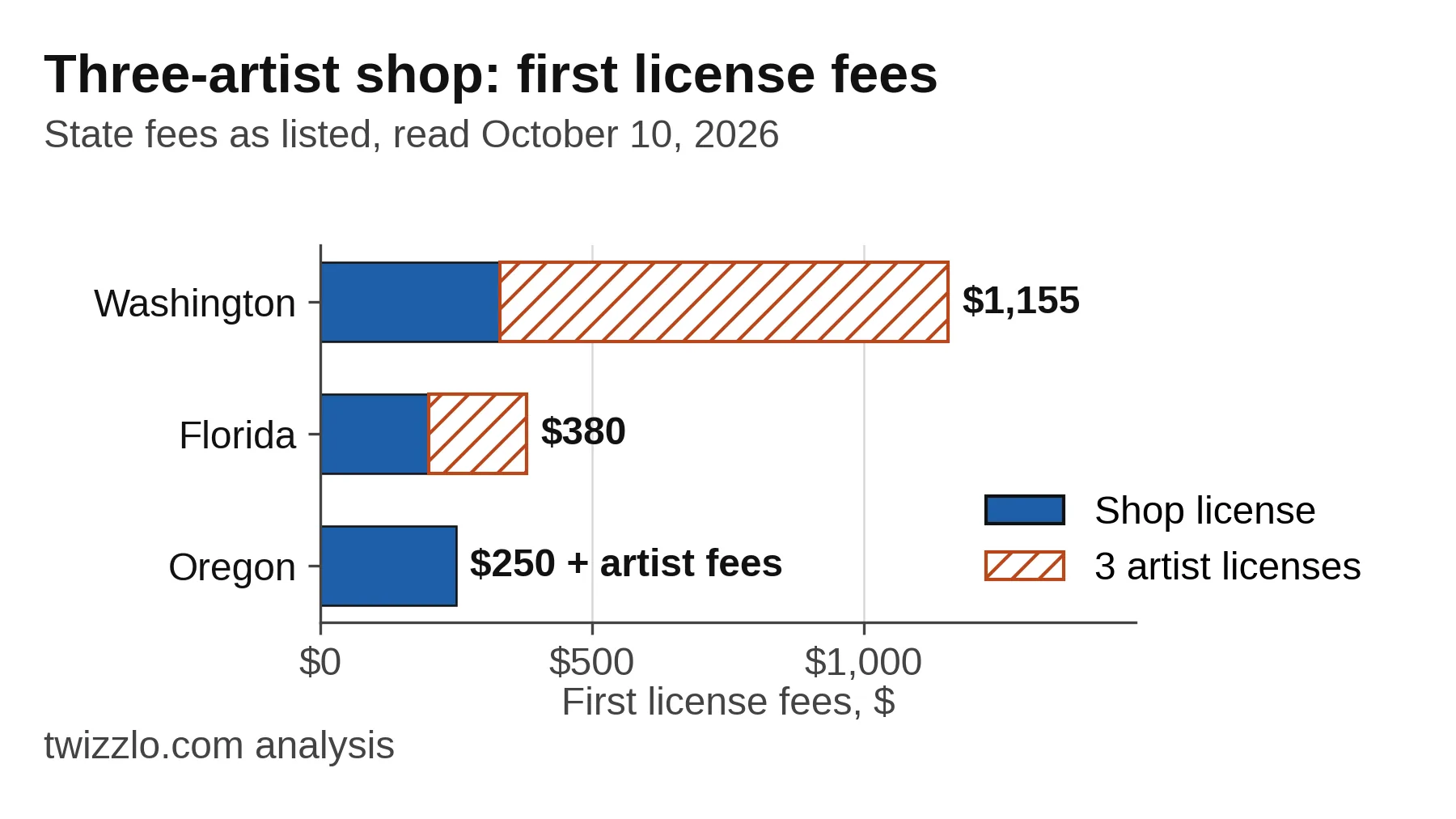
- Washington listed $330 per shop and $275 per artist; Florida $200 per establishment and a $60 artist application fee (read October 10, 2026).
- Book consults into one fixed weekly block so they do not split a long session day.
In this article10 sections
A landlord, a lender or a future partner will ask the same things before you sign. What will the shop be known for, who will tattoo in it, how will the artists get paid and how will the rent get covered in a slow month? A business plan answers those questions on paper first. This one is written for a tattoo shop, with a template to copy and worked examples for the money questions that tattoo shops face.
We read the plan pages that ranked for this search and a close variant on October 10, 2026, from a Canadian connection. They were plan templates and sample plans from Planbuildr, Sharpsheets and OGS Capital, a web agency's worked example and a DaySmart blog post. Most give generic plan headings or a sample shop with made-up numbers. The license fees below come from state agency pages read the same day, and every other figure is a labelled hypothetical, so swap in your own quotes. Twizzlo, which publishes this guide, sells booking software, so its product details and prices appear only in its own section, after one pointer below.
When your plan reaches the line for bookings and payments, our tattoo booking software page shows how a studio books consults, sessions and touch-ups from one link. It also shows a calendar for each artist and prepaid bookings for the full session price.
What a tattoo shop business plan covers
A tattoo shop business plan uses the usual business plan sections plus licensing, and each one has a question that only a tattoo shop needs to settle.
| Section | What it answers | The tattoo question to settle |
|---|---|---|
| 1. Executive summary | What the shop is, where it is and what it needs to open | Your styles and how many chairs you will fill |
| 2. Concept and services | What you tattoo and how clients book | Custom work, flash, walk-ins, piercing and your consult policy |
| 3. Market and competition | Who else tattoos nearby and what is missing | Nearby shops, their styles and how far ahead they are booked |
| 4. Artists and pay model | Who tattoos and how they are paid | Employees, a commission split or booth rent |
| 5. Licensing and compliance | Which permits you need before the first session | Shop and artist licenses, inspections and insurance |
| 6. Marketing | How clients find you | Portfolio channels, your Google Business Profile and reviews |
| 7. Money | Startup cost, monthly cost and break-even | Deposits held, chair hours and slow-month cover |
Table 1. Sections 1 to 4, 6 and 7 appear in most plan templates we read on October 10, 2026; we add licensing because a shop cannot open without it. The third column is this guide's tattoo question for each.
A salon plan follows the same frame with different numbers; if you also run chairs for hair, compare it with our salon business plan template.
Copy-and-paste tattoo shop business plan template
Copy the template below into a document and replace each bracket with your own details. It is text to copy, not a file to download. Write the executive summary last, once the other sections have numbers in them.
1. Executive summary
- [Shop name] is a [number]-chair tattoo shop in [neighborhood, city], opening in [month, year].
- We will be known for [styles, for example fine line, traditional or black and grey] and [custom work, flash or both].
- To open we need $[total startup amount], funded by [savings, a loan, a partner or a mix].
- We expect to cover monthly costs by month [number], with [number] artists booked [hours] a week.
2. Concept and services
- Pricing basis: [hourly rate, half-day rate, day rate or price per piece] for each service.
- Consults: [free or paid], [length] minutes, booked in [day and time block].
- Walk-ins and flash: [days, hours and which artists cover them].
- Other services: [piercing, aftercare products or none].
3. Market and competition
- [Number] tattoo shops within [distance or drive time], with their main styles and listed rates where they publish them.
- The gap we fill: [a style, price point, opening hours or booking access the others do not offer].
- Our clients: [age range, where they find artists and typical piece size].
4. Artists and pay model
- Artists at opening: [names or roles], [years tattooing] and [styles].
- Pay model: [employees on wages], [a commission split with a shop share of (number)%] or [booth rent of $(amount) a week].
- Who supplies what under that model: [ink, needles, chair, booking and card payments].
- Guest artists: [terms and how many weeks a year].
5. Licensing and compliance
- Shop license from [agency]: fee $[amount], renewal due [date].
- Artist licenses from [agency]: $[amount] each for [number] artists.
- Training, sterilization, waste disposal and inspection steps that [agency] requires: [list].
- Insurance: [general and professional liability], quoted at $[amount] a year.
- Consent and aftercare paperwork: [who prepares it and where signed copies are kept].
6. Marketing
- Portfolio channels: [Instagram, website or others], posting [how often].
- Google Business Profile, booking link and a request for a review after every session.
- Launch plan: [opening event, flash day or guest spot] on [date].
7. Money
- Startup costs: buildout $[ ], equipment and sterilization $[ ], furniture $[ ], licenses and permits $[ ], insurance $[ ], first month's rent and lease deposit $[ ], opening reserve $[ ].
- Monthly fixed costs: rent $[ ], utilities $[ ], insurance $[ ], software $[ ], supplies $[ ].
- Shop income per artist a month: $[ ] (use the rent or split math in the next section).
- Deposits held for future sessions: $[ ] (see the deposits section).
- Break-even: monthly fixed costs $[ ] divided by shop income per artist $[ ] = [number] artists.
Commission split or booth rent: which pays the shop more?
In our hypothetical example, booth rent pays the shop more until an artist takes in about $2,708 a month under a 40% shop share, or $2,167 under 50%. Above those takings, the commission split pays more.
The arithmetic: $250 a week of booth rent is $1,083.33 a month ($250 times 52 weeks, divided by 12). A 40% shop share reaches $1,083.33 when the artist takes in $2,708.33 ($1,083.33 divided by 0.4), and a 50% share at $2,166.67.
| Artist's takings a month | Booth rent, $250 a week | 40% shop share | 50% shop share |
|---|---|---|---|
| $2,000 | $1,083 | $800 | $1,000 |
| $4,000 | $1,083 | $1,600 | $2,000 |
| $6,000 | $1,083 | $2,400 | $3,000 |
| $8,000 | $1,083 | $3,200 | $4,000 |
Table 2. Shop income from one artist a month under each model. All inputs are hypothetical; use your own rent and split.
The crossover is only part of the choice. Booth rent is due in a slow month too, so the shop's income is steadier, but artists with thin books carry that risk and may struggle to pay. A split moves with each artist's bookings, so the shop shares the risk and the busy months. Write down who supplies ink, needles and card processing under each model, because that changes the real margin. Whether an artist is an employee or a contractor is a legal and tax question; settle it with an accountant before the model goes into the plan.
License fees to budget: three state examples
On October 10, 2026, first license fees were $330 per shop and $275 per artist in Washington, and $250 for a body art facility in Oregon. Florida listed $200 for the shop and a $60 artist application fee, before local fees.
| State and agency | Shop or facility license | Artist license | Shop plus three artists | Notes from the agency page |
|---|---|---|---|---|
| Washington, Department of Licensing | $330 per location | $275 | $1,155 | Renewal $330 ($440 if late); $5 license print fee |
| Florida, Department of Health | $200 initial | $60 application fee | $380 | Additional fees may vary by location; apply through the county health department |
| Oregon, Health Licensing Office | $250 ($100 application plus $150 license) | Set by licensing pathway, listed on the artist application | Not totaled | The facility license holder must be a natural person |
Table 3. Fees as listed on each agency's page, read October 10, 2026. Florida's establishment fee is from its establishment license application.
Some states leave tattoo licensing to counties or cities, and many add inspection or business license fees, so put your own health department's figures in the licensing section of the template. Budget the renewal dates too, because each license must be renewed; check the renewal period on your agency's page.
Deposits in the cash-flow forecast
Treat tattoo deposits as cash held for sessions that have not happened yet: show it coming in when paid, but keep it apart from earned income until the session takes place.
A shop that books weeks ahead always holds clients' money for future work. In our hypothetical example, an artist who books seven sessions a week with a $100 deposit each holds $4,200 when booked six weeks out. That money is not spare cash: some of it goes back if the shop moves or cancels a session, under the policy you write.
| Booked ahead | Future sessions | Deposits held |
|---|---|---|
| 2 weeks | 14 | $1,400 |
| 4 weeks | 28 | $2,800 |
| 6 weeks | 42 | $4,200 |
Table 4. Deposits held by one artist at seven sessions a week and $100 a session. Hypothetical inputs.
In the plan, show deposits held as a separate line, state your refund and rescheduling terms, and ask an accountant how to record deposits a client forfeits. The same rule applies if you take the full session price up front. For sample policy wording and how studios choose an amount, see our guide to tattoo deposits.
Consults and sessions: planning chair hours
Every 30-minute consult uses half an hour that could be paid session time, so a plan should cap consults per artist each week and book them into one fixed block.
| Consults a week | Consult hours | Session hours left | Session takings at $150 an hour |
|---|---|---|---|
| 4 | 2 | 30 | $4,500 |
| 8 | 4 | 28 | $4,200 |
| 12 | 6 | 26 | $3,900 |
Table 5. One artist's 32-hour chair week with 30-minute consults. Hypothetical inputs.
Each consult in this example costs $75 of session time. Placement matters as much as the count. A single consult at 1 p.m. in a 10 a.m. to 6 p.m. day leaves three hours before it and four and a half after, so a six-hour piece no longer fits that day. Holding consults online, outside chair hours, also keeps long-session days whole. Some shops charge for consults or credit the fee to the tattoo; state your choice in the concept section of the template. For how a client's request becomes a confirmed session, see our guide to setting up a tattoo booking system.
Startup and monthly cost lines to price
Price each cost line from a quote, a lease offer or a published fee rather than from a sample plan, because the sample plans we read use invented shops.
| Cost line | When it is paid | Where the number comes from |
|---|---|---|
| Buildout and signage | Startup | Contractor quotes for your space |
| Tattoo equipment, autoclave and furniture | Startup | Supplier price lists |
| Shop and artist licenses | Startup, then at each renewal | Your state, county or city health agency |
| General and professional liability insurance | Yearly | Broker quotes |
| Rent and lease deposit | Startup, then monthly | The lease offer |
| Ink, needles, gloves and barrier film | Monthly | Supplier prices times expected sessions |
| Booking and payment software | Monthly | Plan price plus card processing on sessions paid online; see our booking software comparisons |
| Opening reserve | Startup | The months of fixed costs you want covered |
Table 6. Cost lines to price for section 7 of the template.
With fixed costs known, break-even is a division. In a hypothetical shop with $5,000 a month of fixed costs, $250 a week of booth rent ($1,083 a month) needs 4.6 artists, so five chairs. At a 50% split on $6,000 of takings each ($3,000 to the shop), it needs 1.67, so two busy artists. Under a split, subtract the supplies the shop provides before dividing.
Where Twizzlo fits
Twizzlo is web-based online booking and appointment scheduling software for appointment-based service businesses, and in a tattoo shop plan it fills the booking and payments line.
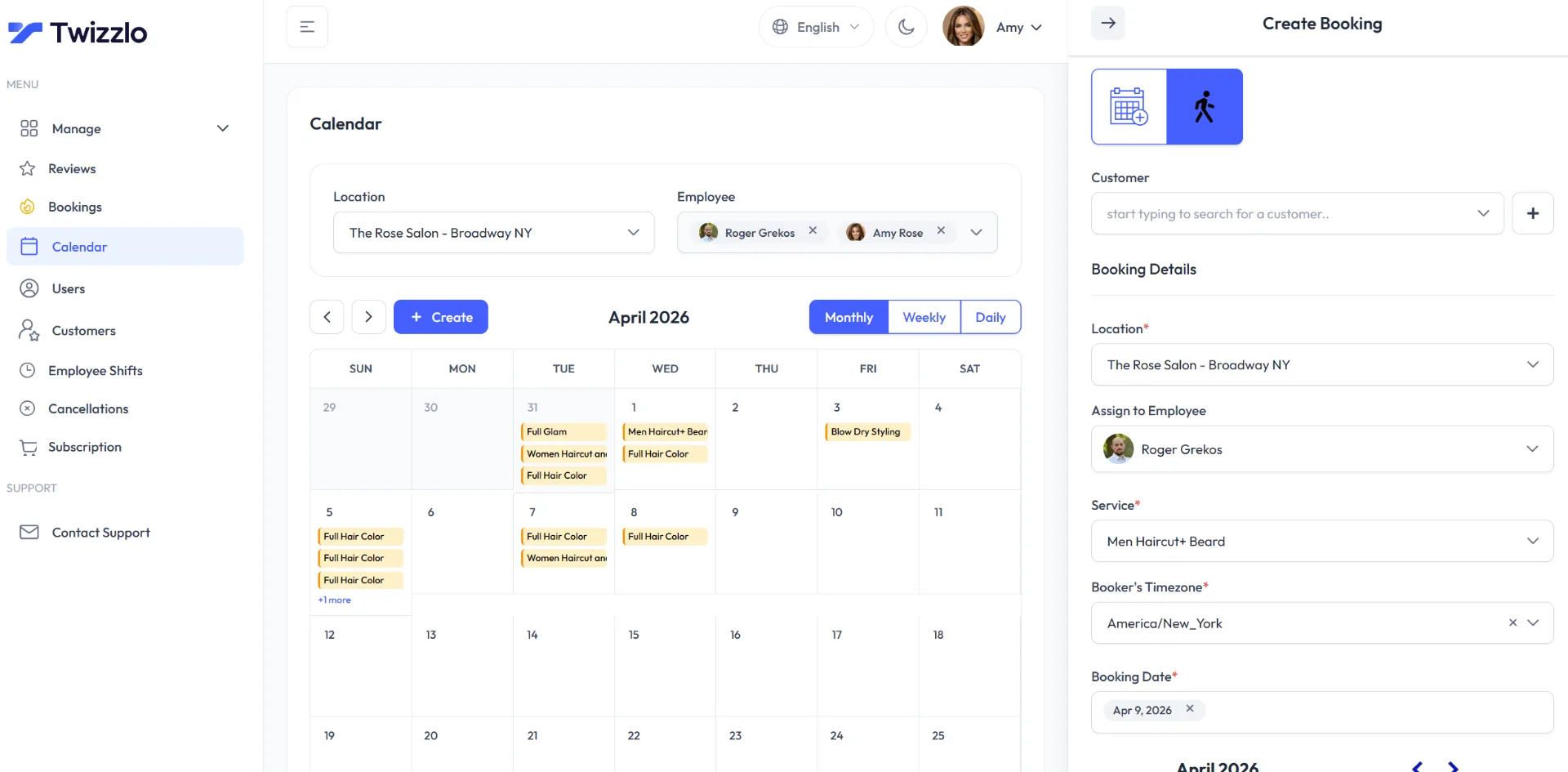
Each artist gets a calendar, consults and sessions are separate services with their own length and price, and buffer times leave room to clean down between clients. Clients book from one link, and a guest artist can get a profile and a shift for the dates they work. Prepaid bookings take the full session price through Stripe. Twizzlo's features page does not list partial deposits or consent forms, so a shop that wants either inside its booking tool should compare the options in our tattoo shop management software guide.
Free is $0 a month for up to 150 bookings a month, free forever and not a trial, with no SMS. Business Pro is $29.99 a month per business for unlimited bookings, with 50 SMS a month included, then $0.03 each, and a 30-day money-back guarantee. Both plans include unlimited staff and locations. Online payments carry your Stripe processing rate plus a 1.5% Twizzlo platform fee. Details are on the Twizzlo pricing page.
Using the chair-hour example, an artist with eight consults and seven four-hour sessions a week makes 15 bookings, about 65 a month (15 times 52, divided by 12). Two artists, about 130 a month, fit within Free's 150 bookings with email reminders. Three artists, about 195, need Business Pro: one text reminder per booking uses the 50 included and 145 more at $0.03, or $4.35, for $34.34 a month. If clients prepay 20 four-hour sessions online at $600, the $12,000 carries $180 in platform fees before Stripe's rate.
To test it with your own services before opening day, you can start on the Free plan and move to Business Pro when you pass 150 bookings a month or want text reminders.
Frequently asked questions
Do I need a business plan to open a tattoo shop?
You need one when someone else commits money or space: a lender, an investor or a landlord choosing a tenant may ask for it. Even when you fund the shop yourself, the money section shows whether your chairs can cover the rent before you sign a lease.
How to open a tattoo shop: what comes first?
Settle the artist pay model and check your licensing and zoning rules first, because both set your costs. Then price a location, write the plan, arrange funding, apply for the shop and artist licenses, and open consult bookings before the first session date.
Is booth rent or a commission split better for a new tattoo shop?
Booth rent gives the shop steadier income if artists can cover it in slow months, and a split earns the shop more once they are busy. In our hypothetical numbers, $250 a week of rent stayed ahead of a 40% shop share until an artist's monthly takings passed about $2,708.
How much are tattoo shop license fees?
They depend on the state, county or city. Read on October 10, 2026: Washington lists $330 for each shop location and $275 for each artist. Florida lists $200 for an establishment and a $60 artist application fee, plus any county fees. Oregon lists $250 for a body art facility license.
How should a tattoo shop business plan handle deposits?
List deposits held as a separate line, apart from earned session income. Write your refund and rescheduling terms into the plan, and ask an accountant how to record deposits that clients forfeit.
Sources and methodology
Prices read
- Washington State Department of Licensing: fees for tattoos, body piercing, body art and permanent cosmetics (opens in a new tab)Read . Supports: Artist license $275; artist shop license $330 per location; renewal $330 ($440 if late); $5 print fee (Table 3, Figure 2, FAQ 4)
- Florida Department of Health: tattoo artist licensure (opens in a new tab)Read . Supports: Tattoo artist license $60 application fee, additional fees may vary by location; county health department applications (Table 3, Figure 2, FAQ 4)
- Florida Department of Health: application for tattoo establishment license (opens in a new tab)Read . Supports: Initial establishment license $200 (Table 3, Figure 2, FAQ 4)
- Oregon Health Licensing Office: body art facility license application (opens in a new tab)Read . Supports: Application fee $100 plus license fee $150, total $250; holder must be a natural person (Table 3, Figure 2, FAQ 4)
- Twizzlo pricing page (opens in a new tab)Read . Supports: Free and Business Pro plans, SMS, guarantee, 1.5% platform fee
- Twizzlo features page (opens in a new tab)Read . Supports: Calendar per staff member, services with length and price, buffer times, Employee Shifts, prepaid bookings through Stripe; screenshot source
From our editorial policy
- Our templates, such as consent forms, contracts and confirmation messages, are text to copy and adapt to your business. They are not legal advice. Have a qualified local professional review anything you rely on.
- We do not publish invented quotes, studies, statistics, customer stories or product tests, and we do not imply hands-on use of a product when the research came from the vendor's public documentation.
- To report an error, email support@twizzlo.com with the subject line "Correction: [page URL]". Tell us what is wrong and, if you can, link a source.
Start free, upgrade when you grow
Flat-rate booking software. No per-seat, per-chair or per-location fees.
- Free plan up to 150 bookings a month, not a trial
- Business Pro is $29.99 a month per business for unlimited bookings, with a 30-day money-back guarantee
- 24/7 support by email