
Square Appointments for Tattoo Artists: What Fits and What Does Not

By Roger Grekos, founder and editor, Twizzlo. Prices were read first-hand from each vendor's own website on September 16, 2026.
Twizzlo publishes this page and competes with the products priced on it. Every competitor price stated here as current is read from that vendor's own website, its pricing page or help center, with the qualifier printed there, or recorded as not published.
Quick answer: Square Appointments for tattoo artists works well for shops already running Square hardware, because booking and payments share one system. It falls down on full prepayment for hourly work, a two-week cap on cancellation windows, and no consent or health screening. Deposits are the sticking point, not the calendar.
Is Square Appointments for tattoo artists a good fit?
Square Appointments for tattoo artists is a fit in one specific shape: a shop that already takes money on Square hardware, books mostly by appointment, and wants the calendar and the card reader to stop being two separate problems. Square itself sells to the category directly, and its tattoo and piercing page names walk-ins, touch-ups and custom pieces, assigns bookings to specific stations and artists, and points shops with chair leases at what it calls chair rental capabilities for organising availability per chair or collecting rent.
Where it stops being a fit is narrower than most of the roundups suggest, and it has almost nothing to do with the calendar. Square's scheduling is genuinely good. The friction shows up in how a tattoo shop takes money before the needle goes in, and in how far ahead a large piece gets booked. Both of those run into rules that Square publishes but that nobody reading a comparison post is likely to find.
Two things are worth separating before anything else. Square's free tier and its paid tiers are very different products for a tattoo shop, and the line between them falls exactly on the feature most shops came for. And Square's marketing pages and its support documentation do not always agree with each other about what sits on which plan. Both points are covered below with the dates they were read.
What does Square Appointments cost a tattoo shop in 2026?
Read first-party from Square's Appointments pricing page on 16 September 2026, the plans are Square Free at $0 a month per location, Square Plus at $49 a month per location and Square Premium at $149 a month per location. A fourth tier, Square Pro, is custom priced and gated on processing more than $250,000 a year, so no figure can be quoted for it. Staff count never enters the plan fee, which matters for a six-artist shop at one address.
Card processing is charged on top and is not flat across the plans. Tap, dip or swipe is 2.6% plus 15 cents on Free, 2.5% plus 15 cents on Plus and 2.4% plus 15 cents on Premium. Online, which covers a deposit taken through the booking page, is 3.3% plus 30 cents on Free and 2.9% plus 30 cents on both paid plans. Manual entry or a card on file is 3.5% plus 15 cents on all three. The same figures with the per-location arithmetic worked out for two, three and five shops sit on the full breakdown of Square Appointments pricing.
A correction worth having, because it changes a buying decision. Two of the pages currently ranking for tattoo booking software print Square Plus at $35 a month and processing at 2.6% plus 10 cents. Square's own pricing page on 16 September 2026 says $49 a month per location and 2.6% plus 15 cents. That is a 40% understatement of the subscription. To be fair where fairness is owed, the Tattoo Studio Pro comparison page prints $0, $49 and $149 and the correct per-tier processing rates, and dates its check to 10 August 2026. It is accurate.
One more thing to flag rather than gloss. Square's Appointments pricing page and its tattoo and piercing page both render the literal string for the trial length instead of a number, so the hero reads as an unresolved template variable. The number is published, just elsewhere: the pricing page FAQ states that Square Plus and Square Premium each offer a free 30-day trial.
Can you take a tattoo deposit through Square Appointments?
This is where the honest answer is more complicated than yes or no, and it is the single most consequential thing on this page for a tattoo shop.
Square's support article on booking cancellations and prepayment policies, read on 16 September 2026, sets out three options for online booking. No requirement to book. Require full prepayment. Hold card in case of no-show. The first is the default. The second and third are the ones a tattoo shop wants.
The catch is in the wording of the second. Require full prepayment, in Square's own description, requires clients to prepay for fixed price services. Tattoo work is usually priced by the hour, by the day, or by a quote for the piece. A four-hour custom back piece is not a fixed price service. So the option that sounds like it collects the money at booking is the one that fits tattooing least well, and the shops that make it work generally do so by creating a separate fixed-price item, a deposit, as its own bookable service.
The third option, holding a card, does work for tattooing, and Square documents three fee shapes for it: a flat fee per appointment, a flat fee per service, or a percentage of the service price. Square also states that when no-show protection is enabled the card is held for a single appointment and is not saved on file for later charges, unless the client chooses to save it at booking. For a shop used to keeping a card on file across a multi-session project, that is a real behavioural difference and it is worth knowing before you migrate.
Then there is the plan question, and here Square contradicts itself. Its Appointments pricing grid shows appointment deposits as included on Square Free, Plus and Premium alike. Its support article for prepayment and cancellation policies lists its audience as Square Appointments Plus and Premium subscribers. The two statements cannot both be a complete description. This page does not resolve that silently. Treat Plus as the safe floor if the deposit is the reason you are buying, and confirm it in your own dashboard before you commit.
How do Square's cancellation windows line up with tattoo booking lead times?
Three numbers in Square's own documentation set the edges of what a tattoo shop can enforce, and all three were read on 16 September 2026. No ranking page mentions any of them.
The cancellation cut-off window can be set from one hour up to two weeks, or none at all. Two weeks is the ceiling.
A cancellation fee can be charged up to 14 days after the appointment.
Refunds for cancellations more than 60 days from the date of booking have to be issued outside Square.
Put those beside how tattoo work actually books. A sought-after artist opens books and fills three to six months out. A large custom piece takes a deposit at booking and the session sits well past the 60-day mark. A shop that wants 30 days' notice on a full-day session cannot set that as an automatic cut-off, because the field stops at two weeks. And if that client cancels four months after they booked, the refund is a manual job in the bank, not a button in Square.
None of this makes Square unusable. Plenty of shops run on it happily. It does mean that a shop booking long lead times should write its deposit policy to match what the software can enforce rather than assuming the software will enforce what the policy says. Our guide to setting a no-show charge covers the policy language that survives a chargeback, which is the part Square does not write for you.
What does Square Appointments not do for a tattoo shop?
Square publishes Contracts with reusable templates and e-signature on every Appointments tier, which is more than several competitors, and it is fair to say so. What it does not publish is anything tattoo-specific. There is no health screening questionnaire, no minor consent handling, no read-only access for a health inspector, and no artist portfolio attached to the booking page.
That last one matters more than the compliance gap for a lot of shops. Tattoo clients choose an artist by style. A booking page that lists Alex, Sam and Jordan with no work attached puts the client back in the direct messages asking who does colour realism, which is the exact loop the booking page was supposed to close. Tattoo Studio Pro's comparison makes this point and it is a fair one.
Two Square-side limits are also worth naming because they are easy to trip over. Text message marketing is not available on Square Free at all, and runs at 3 cents or 1.5 cents per text on the paid plans, with the included allowance counted per account rather than per location. And Square's tattoo page carries a footnote saying that the automated email and text campaigns it describes require a separate subscription to Square Marketing, while the Appointments pricing grid shows email marketing as a checked feature on the plans. Those two statements do not sit comfortably together, and the conflict is recorded here rather than resolved on Square's behalf.
When does Square Plus actually pay for itself?
The usual way this gets answered is with a single break-even number, which is misleading for tattooing because it depends entirely on where the money lands. A tattoo shop that takes a deposit online and the balance in the chair has a very different mix from a barbershop that takes everything at the counter.
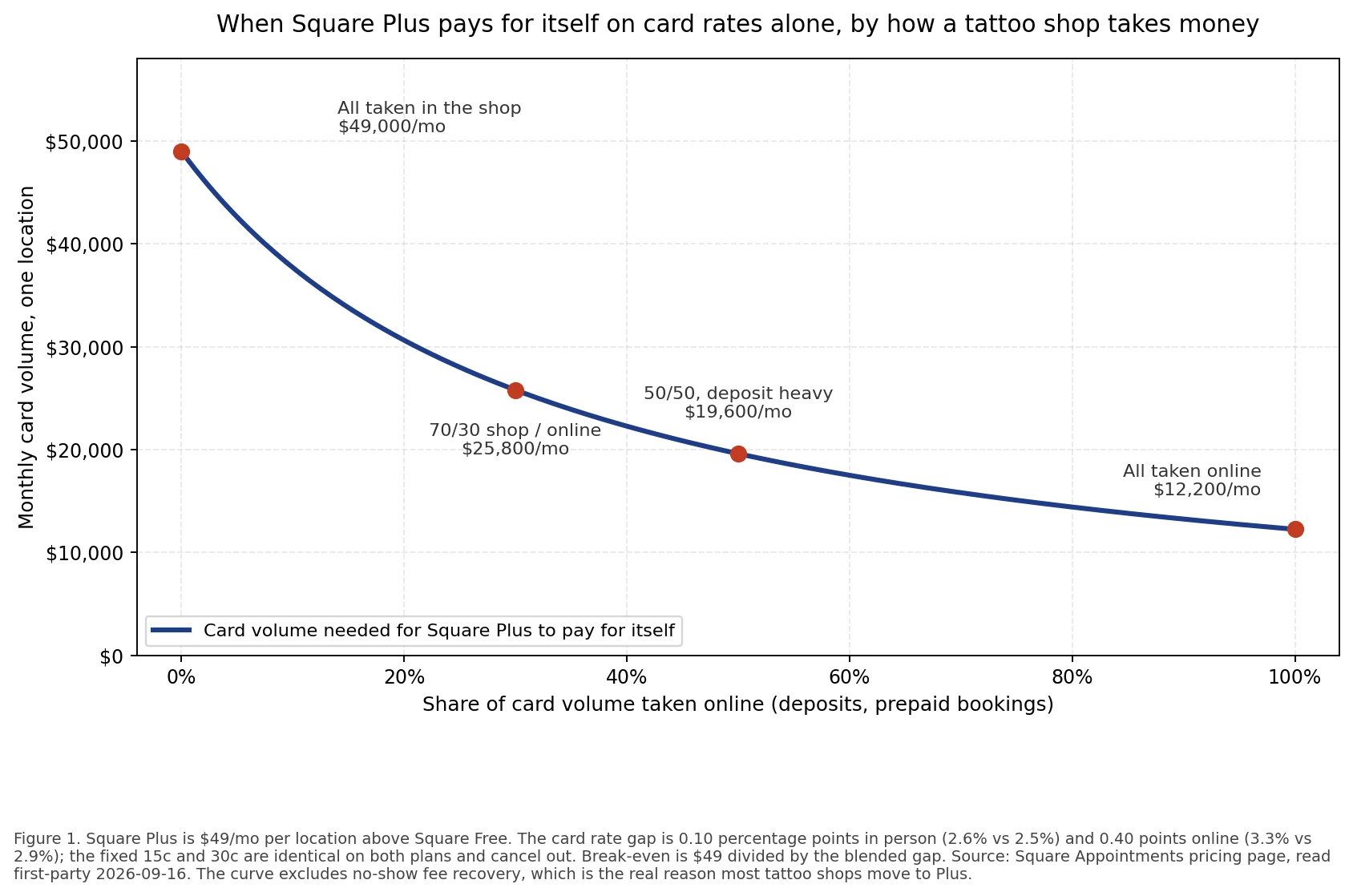
The arithmetic is simple once the fixed cents are removed. The 15 cent and 30 cent components are identical on Free and Plus, so they cancel. The gap that remains is 0.10 percentage points in person and 0.40 points online. Blend those by how you take money and divide $49 by the result. Figure 1 plots it.
At a labelled 70/30 split, seventy per cent taken in the shop and thirty per cent online as deposits, Square Plus starts paying for itself on card rates alone at about $25,800 of monthly card volume at one location. A deposit-heavy shop running closer to 50/50 hits it at $19,600. A shop that takes nothing online needs $49,000.
Here is the part that makes the chart almost beside the point, and it is stated plainly rather than buried. Most tattoo shops do not move to Plus for the card rate. They move for the no-show fee, which Square does not offer on Free at all. One recovered half-day session will usually clear $49 on its own. Read that way, the break-even curve is an argument about a rounding error and the feature gate is the real decision.
Square Premium is a harder sell at a single shop. The online rate does not fall from Plus to Premium, both are 2.9% plus 30 cents, so online volume returns nothing at all, and the in-person gap of 0.10 points means $100,000 of monthly card volume before the extra $100 is covered. Premium has to earn its place on the Future bookings report, Resource management and Service cost tracking instead.
How do the eight tattoo workflow steps compare?
Every cell in Figure 2 was read from the vendor's own pages on 16 September 2026. Where a vendor documents nothing either way, the cell says so rather than guessing, and where Square's own pages disagree the cell says that too.
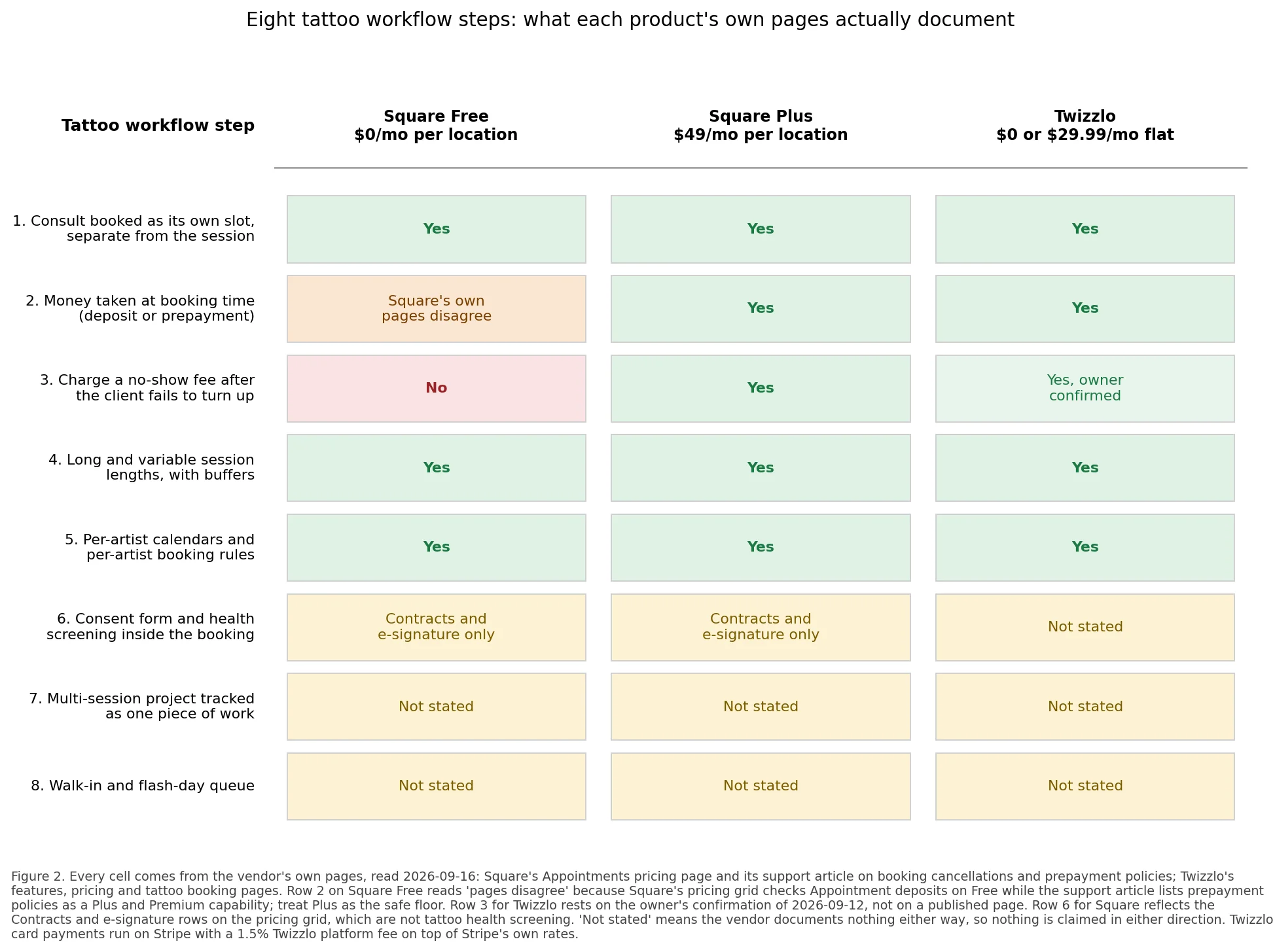
The pattern is clearer than any single row. The first half of a tattoo booking, the consult, the calendar, the session length, the per-artist rules, is solved by all three products and is not where a decision gets made. The second half, the deposit, the no-show fee, the consent form, the multi-session project, is where they separate, and two of those four rows are blank for everybody.
Twizzlo's own gaps belong in that list rather than in a footnote. There are no consent or intake forms in the product, which for a tattoo shop is the same hole Square has. Twizzlo's tattoo consent form template is copy-and-paste text on a web page, not a file you download or a form the software stores. The free plan sends no SMS at all, so text reminders start at $29.99 a month. There is no POS hardware and no retail inventory, which is a genuine reason for a shop selling aftercare off a shelf to stay on Square. And Twizzlo publishes no card processing rate of its own: payments run through Stripe at Stripe's rates with a 1.5% Twizzlo platform fee on top, set out on the Twizzlo payment processing page.
When should a tattoo shop stay on Square, and when should it switch?
Stay on Square if the shop is one address, already has Square hardware at the front desk, sells retail, and wants payroll and commission tracking from the same vendor. At a single location Square Free at $0 genuinely undercuts every paid alternative, and if you do not need to charge for a missed appointment it is hard to argue with. Add a card reader and a retail shelf and the case gets stronger, not weaker.
Look elsewhere when the arithmetic stops being about one shop. The $49 and $149 fees are charged again for every location, so a second address doubles the software bill before a single card is swiped. Three shops on Plus is $147 a month. That per-location model is the most common reason shops leave, and it has nothing to do with the product being bad.
Also look elsewhere if consent and health screening inside the booking flow is what you actually need, because Square does not do it and neither do most general schedulers. That is a job for a tattoo-specific product, and the shortlist of tattoo booking software covers the ones built for it. If the problem is per-artist seat fees rather than compliance, a flat-rate tool with per-artist calendars is the shape to look for, which is what Twizzlo's tattoo booking software is built around and what the wider tattoo studio scheduling software comparison works through.
If you are weighing Square against the other general schedulers rather than against a tattoo product, the head-to-heads with Booksy and with Acuity Scheduling cover the same ground with different opponents.
Frequently asked questions
Is Square Appointments free for tattoo artists?
Square Free is $0 a month per location with no subscription and no trial needed, and Square describes it as being for solo professionals taking payments and managing schedules. For a solo artist it is a real free plan rather than a trial. What Square Free does not carry is cancellation policy and no-show fees, which start on Square Plus at $49 a month per location, and text message marketing, which is not available on Free at all. You still pay card processing on every transaction, at 2.6% plus 15 cents in person and 3.3% plus 30 cents online.
Can Square Appointments collect a tattoo deposit at booking?
It can, but the route matters. Square documents two paid options: require full prepayment, which its own wording limits to fixed price services, and hold card in case of no-show, which works for hourly or quoted work. Because tattoo sessions are rarely fixed price, most shops that make this work create a separate fixed-price deposit service and book that. Square's pricing grid shows appointment deposits on Square Free while its support article lists prepayment policies as a Plus and Premium capability, so confirm it in your own dashboard before committing. Figures read 16 September 2026.
How much notice can I require before a tattoo cancellation?
Square lets you set a cancellation cut-off anywhere from one hour up to two weeks, or none. Two weeks is the ceiling, so a shop that wants a 30-day notice period on a full-day session cannot enforce that automatically and has to handle it manually. Square also states that a cancellation fee can be charged up to 14 days after the appointment, and that refunds for cancellations more than 60 days after the booking date must be issued outside Square. All three read first-party on 16 September 2026.
Does Square Appointments handle tattoo consent forms?
Not in a tattoo-specific way. Square publishes Contracts with reusable templates and e-signature on every Appointments plan, which covers a generic agreement, and that is worth something. What it does not publish is health screening, minor consent handling, multi-language waivers or read-only access for a health inspector. If an inspection is the thing keeping you awake, a tattoo-specific product is the right answer, and this is one of the few areas where the specialist tools have a clear and defensible advantage over the general schedulers.
Is Square Appointments cheaper than a flat-rate booking tool for a tattoo shop?
At one location, Square Free at $0 is cheaper than anything with a subscription, as long as you do not need no-show fees. Square Plus at $49 a month sits above Twizzlo Business Pro at $29.99 a month flat, and the gap widens with every extra address because Square charges per location and flat-rate tools do not. Card processing is separate in both cases: Square publishes its rates on one page, while Twizzlo runs on Stripe with a 1.5% Twizzlo platform fee on top of Stripe's own rates.
Does Square Appointments charge per artist?
No. The Square Appointments plan fee is charged per location and staff count never enters it, so a six-artist shop at one address pays the same $49 a month on Square Plus as a two-artist shop. Unlimited calendars are included on every tier including Free. Costs multiply on addresses rather than on chairs, which is the opposite of the per-seat model used by several salon-first tools and is a genuine advantage for a busy single-site street shop.
Can Square Appointments manage walk-ins and flash days?
Square's tattoo and piercing page names walk-ins in its calendar copy, and Square Plus adds a waitlist that clients can join through the booking site with notifications when a slot opens. What Square does not document anywhere is a walk-in queue with a check-in flow and artist assignment, which is what a busy street shop on a flash day actually runs. Nothing is claimed here in either direction beyond what Square publishes; if flash days are the core of your week, ask for a demo of that specific flow.
Frequently asked questions
Is Square Appointments free for tattoo artists?+
Square Free is $0 a month per location with no subscription and no trial needed, and Square describes it as being for solo professionals taking payments and managing schedules. For a solo artist it is a real free plan rather than a trial. What Square Free does not carry is cancellation policy and no-show fees, which start on Square Plus at $49 a month per location, and text message marketing, which is not available on Free at all. You still pay card processing on every transaction, at 2.6% plus 15 cents in person and 3.3% plus 30 cents online.
Can Square Appointments collect a tattoo deposit at booking?+
It can, but the route matters. Square documents two paid options: require full prepayment, which its own wording limits to fixed price services, and hold card in case of no-show, which works for hourly or quoted work. Because tattoo sessions are rarely fixed price, most shops that make this work create a separate fixed-price deposit service and book that. Square's pricing grid shows appointment deposits on Square Free while its support article lists prepayment policies as a Plus and Premium capability, so confirm it in your own dashboard before committing. Figures read 16 September 2026.
How much notice can I require before a tattoo cancellation?+
Square lets you set a cancellation cut-off anywhere from one hour up to two weeks, or none. Two weeks is the ceiling, so a shop that wants a 30-day notice period on a full-day session cannot enforce that automatically and has to handle it manually. Square also states that a cancellation fee can be charged up to 14 days after the appointment, and that refunds for cancellations more than 60 days after the booking date must be issued outside Square. All three read first-party on 16 September 2026.
Does Square Appointments handle tattoo consent forms?+
Not in a tattoo-specific way. Square publishes Contracts with reusable templates and e-signature on every Appointments plan, which covers a generic agreement, and that is worth something. What it does not publish is health screening, minor consent handling, multi-language waivers or read-only access for a health inspector. If an inspection is the thing keeping you awake, a tattoo-specific product is the right answer, and this is one of the few areas where the specialist tools have a clear and defensible advantage over the general schedulers.
Is Square Appointments cheaper than a flat-rate booking tool for a tattoo shop?+
At one location, Square Free at $0 is cheaper than anything with a subscription, as long as you do not need no-show fees. Square Plus at $49 a month sits above Twizzlo Business Pro at $29.99 a month flat, and the gap widens with every extra address because Square charges per location and flat-rate tools do not. Card processing is separate in both cases: Square publishes its rates on one page, while Twizzlo runs on Stripe with a 1.5% Twizzlo platform fee on top of Stripe's own rates.
Does Square Appointments charge per artist?+
No. The Square Appointments plan fee is charged per location and staff count never enters it, so a six-artist shop at one address pays the same $49 a month on Square Plus as a two-artist shop. Unlimited calendars are included on every tier including Free. Costs multiply on addresses rather than on chairs, which is the opposite of the per-seat model used by several salon-first tools and is a genuine advantage for a busy single-site street shop.
Can Square Appointments manage walk-ins and flash days?+
Square's tattoo and piercing page names walk-ins in its calendar copy, and Square Plus adds a waitlist that clients can join through the booking site with notifications when a slot opens. What Square does not document anywhere is a walk-in queue with a check-in flow and artist assignment, which is what a busy street shop on a flash day actually runs. Nothing is claimed here in either direction beyond what Square publishes; if flash days are the core of your week, ask for a demo of that specific flow.
Try Twizzlo free
Flat-rate booking software. No per-seat, per-chair or per-location fees.