
Best Tattoo Booking Software: A Studio Comparison

In short
The best tattoo booking software depends on how your studio takes work. Studios that review custom requests before confirming a time should shortlist tattoo-focused tools like Venue Ink or Tattoo Studio Pro. Studios that book set appointments directly can compare Square Appointments, Booksy and Twizzlo. Then price each at your artist count, including who pays card and booking fees.
- At five artists and one location, published subscriptions run from $0 (Square Appointments Free) to $250 a month (Porter Studio Pro), read September 25, 2026.
- Venue Ink's free plans add a 10% card fee charged to clients by default (pricing page, read September 25, 2026), so compare who pays fees.
- Check the billing unit first: per business, per location, per calendar, per team member or per included user decides what the next artist costs.
In this article19 sections
Choose tattoo booking software around the way the studio accepts work. A custom tattoo may need artist approval before a time is offered; a standard consultation or service may be directly bookable. Three tattoo-focused tools are compared first, then nine numbered platforms, with a five-artist price comparison at the end. This is a Twizzlo-published research comparison, not a hands-on test or independent ranking. Twizzlo, which publishes this comparison and makes tattoo booking software, is first in the numbered list. Each price links to the vendor's own pricing page or help center, with the date it was read.
How to choose the best tattoo booking software for your workflow
The best tattoo booking software for your studio is the one that handles how you take work: custom requests you approve first, or appointments clients book directly.
Request-led or directly bookable?
For custom work, test how an artist reviews the idea, references, size and placement before offering a calendar slot. For defined consultations or services, test direct selection of a suitable time. In either case, check the deposit and payment step and required paperwork separately.
Studios tightening booking discipline should also think about how tattoo deposits protect studio revenue. Deposit design often matters as much as the calendar itself.
Solo and guest-spot artists looking for the best scheduling app for a tattoo artist working alone should start with our guide to digital scheduling for tattoo artists; this comparison focuses on studios with several artists.
If you want one system to run the whole shop, including artist pay, paperwork and reporting, see our guide to tattoo shop management software; this page compares the booking side.
Tattoo-focused options to include in the shortlist
Tattoo-focused booking tools: workflow, published price and what to check. Sources: each vendor's own pages; prices read September 25, 2026, workflow lines read September 27, 2026.
| Option | First-party workflow description | Published price (read September 25, 2026) | What still needs a plan-specific check |
|---|---|---|---|
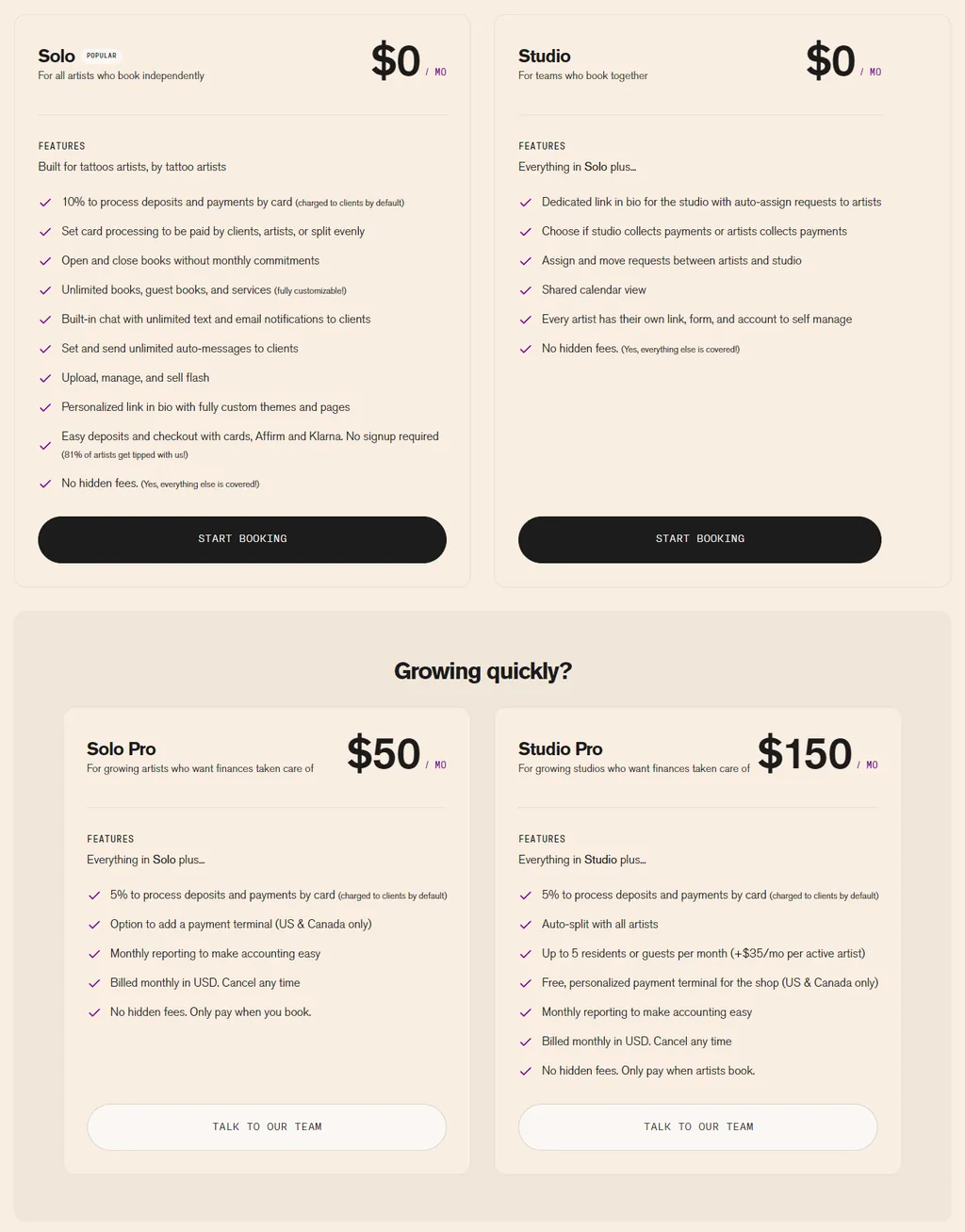
| Venue Ink | Request review, reference uploads, customizable booking forms, flash galleries and deposits | Solo and Studio $0 a month with a 10% card fee charged to clients by default; Solo Pro $50 and Studio Pro $150 a month with a 5% fee (pricing page) | Client-paid fees, terms, artist setup and document requirements |
| Porter | Its pricing page lists unlimited artists and staff, deposits and payments, automated commission splits, 1099s for artists, and liability waivers and consent forms on Studio Pro | Artist plans $35 or $65 a month per artist; Studio Pro $250 a month per location, unlimited artists and staff | Fit for the studio’s required document workflow |
| Bookedin | Its tattoo page describes self-booking, prepayment, reminders and a client list; plans are sold by calendar count | Free (50 bookings a month); Plus $24 to $78 and Pro $48 to $156 a month by calendar count, with no currency code printed (pricing page) | Payment terms; do not infer native e-signatures |
These are vendor-described workflows, not results from tests performed for this article. Compare their full commercial terms before calling any option free or cheaper.
Nine platforms are reviewed below as a second named group. The numbers are list positions, not a ranking, and no candidate here is presented as universally best.
- Twizzlo
- DaySmart Body Art
- TattooGenda
- Vagaro
- Square Appointments
- Fresha
- Booksy
- Squarespace Scheduling (Acuity)
- Tattoo Studio Pro
1. Twizzlo
Twizzlo
Our productBest for: Studios that book set appointments directly and want one price per business as they add artists.
Starting price: Free: $0 a month up to 150 bookings; Business Pro: $29.99 a month per businessRead on the Twizzlo pricing page (opens in a new tab)
Pros
- Unlimited staff and locations on both plans
- Online payments and tips at booking through Stripe
Cons
- Free is capped at 150 bookings a month, with no SMS
- SMS beyond 50 a month costs $0.03 each on Business Pro
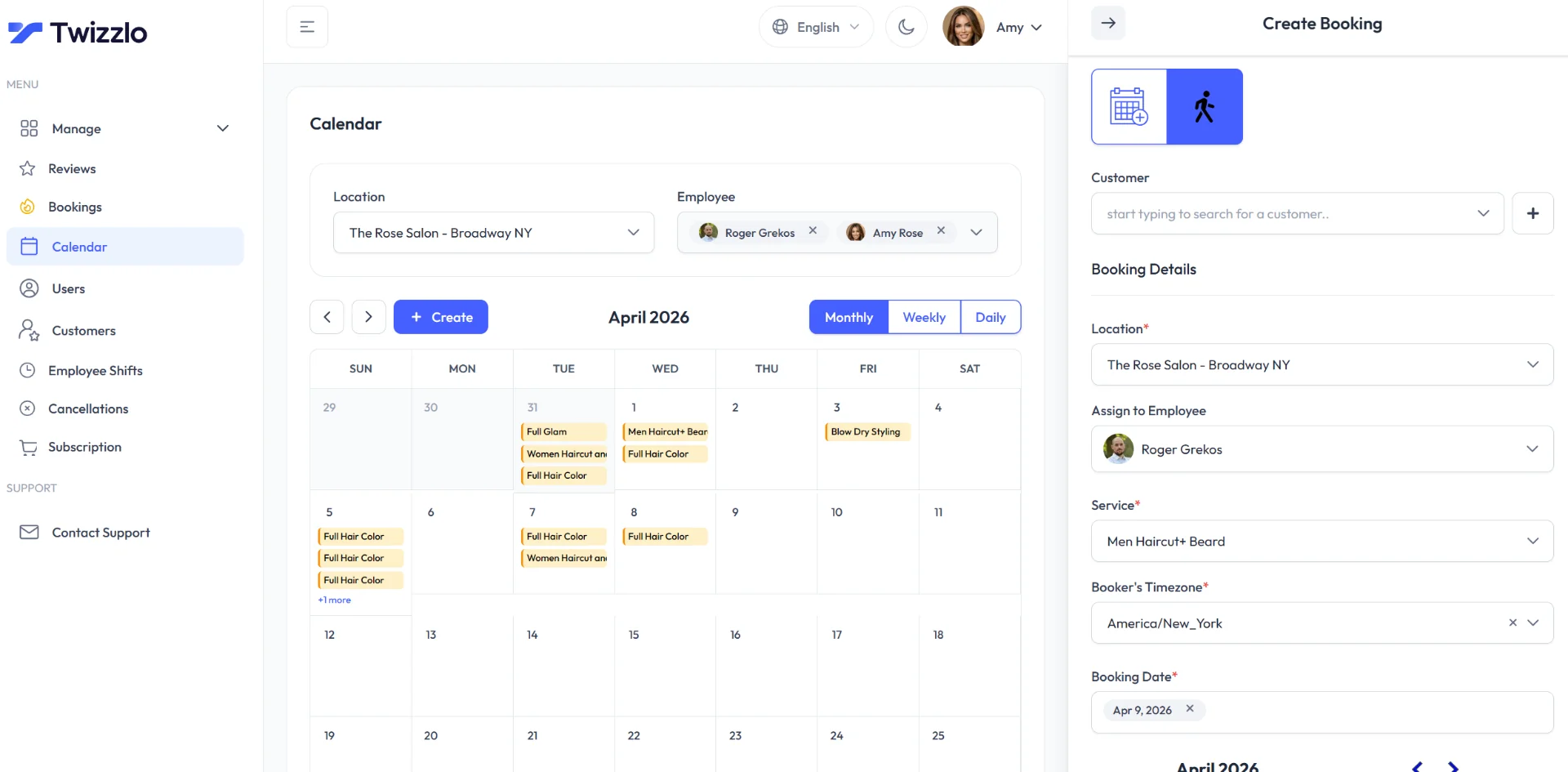
Twizzlo is a candidate for appointment booking, reminders and client management. It is web-based online booking and appointment scheduling software for appointment-based service businesses, with a public booking page, client records, staff schedules and shifts, and Stripe payments and tips.
Twizzlo Free allows 150 bookings per month and has no SMS. Business Pro is $29.99 a month per business and includes 50 SMS messages a month; additional SMS messages cost $0.03 each. Business Pro carries a 30-day money-back guarantee. Online payments carry your Stripe processing rate plus a 1.5% Twizzlo platform fee. The subscription is not the total operating cost.
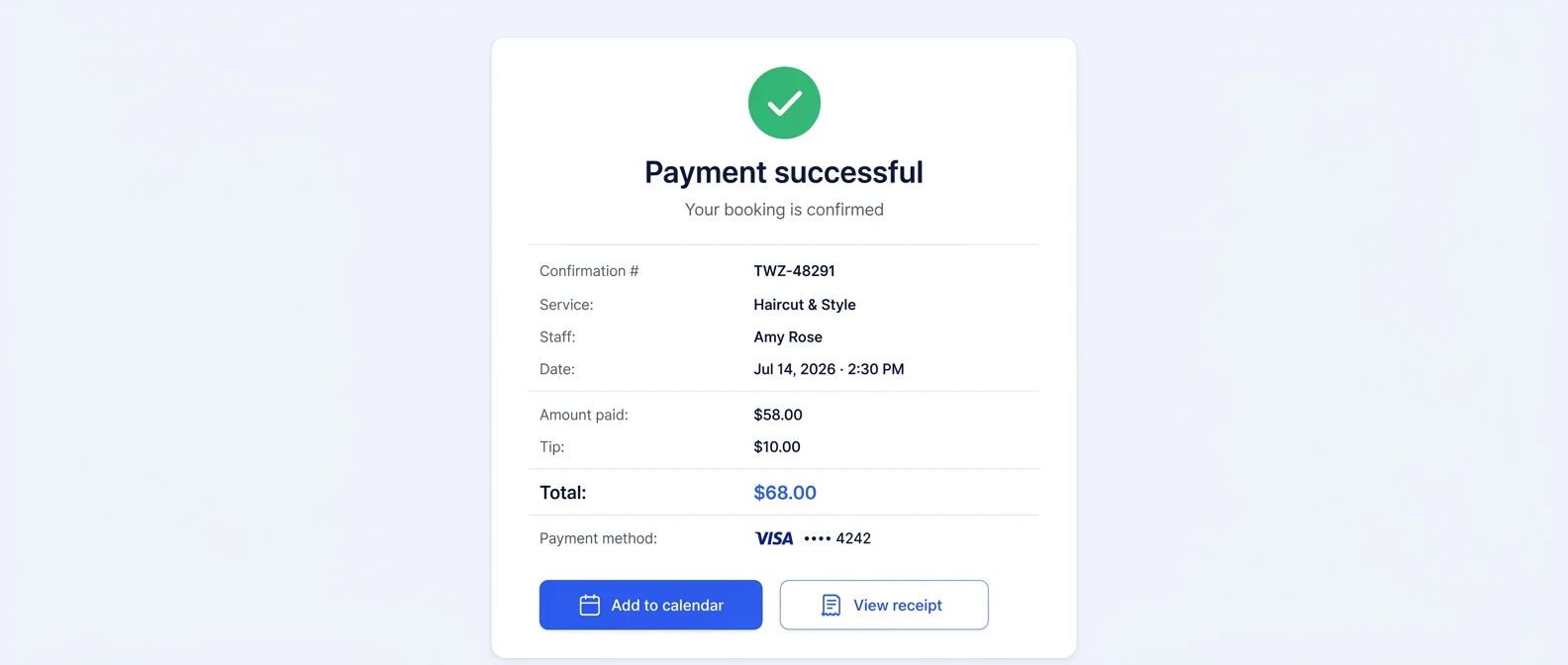
For tattoo studios, booking and consent are separate steps: Twizzlo handles the booking side, and signed consent forms stay in your studio’s own approved form process. Twizzlo supports a business-controlled no-show fee setting; verify the exact payment and paperwork workflow before moving a studio onto it.
Unlimited staff, locations and client records apply on both Free and Business Pro; the 150 limit is a monthly booking count, not a seat cap. You can inspect the current plan terms on the Twizzlo pricing page.
Follow one booking from enquiry to completion
A useful comparison follows one booking from enquiry to completion. Record who approves the request, what happens if payment fails, where any signed paperwork is stored, how reminders are sent and who resolves an artist or location conflict. These are selection checks, not measured performance claims.
2. DaySmart Body Art
DaySmart Body Art
Best for: Tattoo and piercing studios that want booking, payroll and inventory in one system.
Starting price: $29 / Month (Basic, 1 user); Deluxe $69 with 3 users, Premium $199 with 6Read on DaySmart Body Art's pricing page (opens in a new tab)
Pros
- Users included on every plan
- 14-day free trial, no credit card
Cons
- No billing period printed next to $69 and $199
- No price printed for extra users
DaySmart Body Art is a tattoo and piercing studio platform. Its own site, read September 27, 2026, describes booking, client records, digital forms, inventory, payroll, reporting and payment processing in a single operational stack. If you want tattoo-first workflows instead of adapting salon software, it belongs on the shortlist.
Where it fits
Multi-artist shops with retail, front-desk staff and recurring admin processes have more to gain here than a solo artist who only needs calendar automation.
Ask the vendor to demonstrate a consultation-to-session workflow, artist access and storage of any required paperwork. On its pricing page, read September 25, 2026, Basic is $29 a month with one user, Deluxe $69 with three users and Premium $199 with six users; the page prints no billing period next to the Deluxe and Premium prices and no price for extra users. Per DaySmart Body Art’s pricing page, the three plans include 500, 1,000 and 2,500 text messages a month, and the free trial runs 14 days with no credit card required.
Worth checking
- Tattoo and piercing workflow support described on the vendor site
- Management features beyond scheduling, including payroll and inventory
- Whether a “user” counts artists, front desk staff or both before you choose Deluxe or Premium
3. TattooGenda
TattooGenda
Best for: Studios with resident and guest artists that want one price per studio.
Starting price: €45 a month per studio (Expert), unlimited users; no US dollar priceRead on TattooGenda's pricing page (opens in a new tab)
Pros
- Unlimited users on both plans
- Calendars for resident and guest artists
Cons
- Prices published in euros only
- Texts billed at €0.11 per SMS
TattooGenda is tattoo studio software priced per studio with unlimited users. Its site, read September 27, 2026, describes deposit collection, aftercare messages, calendars for resident and guest artists and a waiting list. For shops that regularly juggle guest spots and custom consult intake, that focus is worth testing.
Best use case
TattooGenda is a candidate when your studio workflow is more involved than book a slot and take payment. Ask for a demonstration of artist calendars, multi-session work and the required consent or document process. Its pricing page, read September 25, 2026, lists Expert at €45 a month (€495 a year) and Ultimate at €89 a month (€979 a year) per studio with unlimited users, plus €0.11 per SMS; it publishes no US dollar price and sets up a custom subscription for more than one studio.
Worth checking
- Deposit, reminder and form handling for multi-session projects
- Resident and guest artist operations
- Prices in euros only; confirm billing currency and SMS rates for a US studio
Test reminders and measure attendance
The fair way to compare reminders is by the allowance a plan includes and the price of each extra message. Ask which messages are sent automatically, on which channel, how many are included in the plan and what each additional message costs. Then measure your own attendance before and after the change, because no attendance figure in this comparison has been measured for your studio.
Keep appointment reminders separate from marketing messages when you read a vendor allowance. A large marketing SMS bundle does not describe how many reminders a plan sends.
Studios reviewing cancellation exposure may also want to define a clear tattoo no-show charge policy before they switch systems.
4. Vagaro
Vagaro
Best for: Studios that want a low base price and add paid modules one at a time.
Starting price: $23.99 a month, a limited-time rate (list price not printed), with 1 calendar; $10 a month per extra calendarRead on Vagaro's help center (opens in a new tab)
Pros
- No calendar charge after the seventh license
- Premium features sold as separate add-ons
Cons
- Card rates set by monthly volume; FANF and Mastercard location fees not priced
- No price printed for after the limited-time rate
Vagaro is a broad business management platform used across beauty, wellness and fitness. Its US help center, read September 25, 2026, prices premium features such as Forms, Payroll and an Online Shopping Cart for deposits and cancellation fees as separate add-ons.
How Vagaro is billed
Read from Vagaro’s US help center on September 25, 2026, the US base is $23.99 a month for one calendar, a rate the help center marks “only for a limited time” without printing the price after it. Additional bookable calendars are $10 a month through seven licenses, so five artists at one location come to $63.99 a month before add-ons; the help center prints no subscription price for an added location. Add-ons, payment processing and optional acquisition products are charged separately. Our Vagaro pricing page lists the same base rate and per-calendar charge.
So the number to quote for a studio is not the base price. Count the bookable calendars and locations you actually need, then list the optional modules you would switch on, and distinguish reminders from marketing tools. For a tattoo shop weighing an alternative to Vagaro, compare this per-calendar charge with the per-business, per-location and flat studio plans in the five-artist table.
If you are comparing cost structures in this category, this breakdown of Vagaro vs Acuity for service businesses is a useful secondary reference.
5. Square Appointments
Square Appointments
Best for: Studios that take card payments in person as well as online.
Starting price: $0 a month per location (Square Free); Plus $49, Premium $149Read on Square's pricing page (opens in a new tab)
Pros
- Free plan with unlimited staff calendars
- Lower card rates on Plus and Premium
Cons
- Paid plans bill per location
- Online card rate on Free is 3.3% plus 30 cents
Square Appointments fits studios where payments and hardware matter as much as scheduling. If your studio already runs Square terminals, checkout and retail sales, booking and payment sit in one system.
Where Square fits best
Read from Square’s Appointments pricing page on September 25, 2026, the US plans are Free at $0, Plus at $49 and Premium at $149 per month per location, with unlimited staff calendars. Its published card rates run from 2.6% plus 15 cents in person and 3.3% plus 30 cents online on Free to 2.4% plus 15 cents and 2.9% plus 30 cents on Premium. Payment processing and optional services are charged separately, and a marketing SMS allowance is not the reminder allowance. Our Square Appointments pricing page lists the same three plans.
Test appointment changes alongside the Square checkout and any retail workflow you rely on. Deposits, prepayment rules and cancellation windows are the parts that most often decide the outcome for a tattoo shop, and they are documented in detail in our review of Square Appointments for tattoo artists.
How to compare the total bill
Compare subscription, staff and location charges, required add-ons, messaging, payment processing and marketplace acquisition fees separately. A higher subscription can be worthwhile when it replaces another required system. A fixed subscription can still have variable payment or messaging costs. Our tattoo booking software pricing table prices vendors at 1, 5 and 10 artists.
6. Fresha
Fresha
Best for: Studios that want marketplace exposure for new clients.
Pros
- Lists tattoo and piercing among the businesses it serves
- Client marketplace that can send new bookings
Cons
- One-time fee on new clients from its marketplace
Fresha combines direct booking with a consumer marketplace, client management and payments. Studios may shortlist it for the client-facing experience and the marketplace exposure. Its business page, read September 27, 2026, lists tattoo and piercing among the business types it serves.
Check the regional subscription and acquisition charges
Separate the direct-booking workflow from marketplace acquisition, communication and payment charges, and confirm a dated US-specific subscription, acquisition-fee and messaging quote for your own account. Official localized pages can display another country or currency; do not treat that rate as a US comparison. No Fresha price is stated here, because none has been verified for the US on the check date.
Marketplace distribution can still be worth paying for. If client discovery is your bottleneck, that spend has a job. If your bookings already come from your own channels, compare the acquisition and payment charges against a fixed subscription.
Tattoo shops looking for an alternative to Fresha with a fixed subscription can review these Fresha alternatives for appointment-based businesses.
7. Booksy
Booksy
Best for: Small shops that want every feature in one subscription.
Starting price: Published price $29.99 a month plus tax with one team member; $20 a month per extra memberRead on Booksy's pricing page (opens in a new tab)
Pros
- Confirmations and reminders always free
- 14-day free trial, no credit card
Cons
- $20 a month for each extra team member
- Boost takes 30% of a Boost client's first visit
Booksy publishes self-booking and marketplace discovery. Test the client booking and change process, and distinguish direct bookings from clients acquired through optional Boost.
What operators should watch
Read from Booksy’s own pricing page on September 25, 2026, the published price is $29.99 per month plus $20 per additional team member, before tax; the page prints no country or currency code. Five artists come to $109.99 a month before tax. The optional Boost product charges 30% of the first qualifying new-client visit, not every returning booking, and mobile or keyed-in card payments cost 2.69% plus 30 cents each. Appointment reminders are a different thing from the 2,000 marketing SMS allowance, per Booksy’s pricing page. Our Booksy pricing page lists the same team-member charge.
Frame the decision around where the bookings come from. If Boost reaches clients you could not reach otherwise, the acquisition fee has a job to do. If most clients already book direct, compare the team-member charges against a fixed subscription.
8. Squarespace Scheduling Acuity
Acuity Scheduling
Best for: Studios that want a branded booking page and custom client forms.
Starting price: $20 a month billed monthly (Starter, 1 calendar)Read on Acuity's pricing page (opens in a new tab)
Pros
- Up to six calendars on Standard at $34 a month
- Custom client forms on every plan
Cons
- No free plan; seven-day trial
- Text reminders start on Standard
Acuity Scheduling, a Squarespace company, suits studios that care about a branded booking page and flexible intake forms, especially alongside a Squarespace site.
Best for branded booking flows
Read from the Acuity pricing page on September 25, 2026, monthly plans are Starter $20 for one calendar, Standard $34 for six calendars and Premium $61 for 36 calendars, with annual equivalents of $16, $27 and $49. SMS starts at Standard. There is a seven-day trial and no continuing free plan. Our Acuity pricing page lists the same calendar tiers.
So the comparison question is how many calendars you need and whether SMS, packages or memberships are required. A studio that only needs one calendar and email reminders reads this very differently from a six-artist shop. For a tattoo studio choosing between Square and Acuity, the billing unit decides: Square Appointments bills per location with unlimited staff calendars, while Acuity bills by calendar count, $34 a month for up to six on Standard.
9. Tattoo Studio Pro
Tattoo Studio Pro
Best for: Studios that book or decline each client request and want unlimited reminder texts.
Starting price: $29 a month (Solo, 1 team member); Crew $69 for up to 5Read on Tattoo Studio Pro's pricing page (opens in a new tab)
Pros
- Unlimited SMS reminders, no per-text fee
- Every tier includes every feature
Cons
- Desk staff and apprentices count toward the team limit
- Card rates not printed on the pricing page
Tattoo Studio Pro is tattoo shop software that prices by the number of active team members rather than by location. Its booking app page, read September 27, 2026, says client requests land in an inbox for the studio to book or decline, the confirmation text carries a deposit link, and reminder texts are unlimited on every plan with no per-text fee. The same page lists digital consent forms, a walk-in queue and a built-in tattoo shop point of sale.
How Tattoo Studio Pro bills
On its pricing page, read September 27, 2026, Solo is $29 a month for one team member, Crew $69 for up to five and Tribe $119 for up to 10, with larger bands up to $299 a month for 25; every tier includes every feature, annual billing saves 30% and there is a 30-day free trial. The plan limit counts everyone with a login who is active at the same time, including apprentices, desk staff and assistants; managers do not count. A five-artist studio with one desk person is six people, which moves it from Crew at $69 to Tribe at $119.
Against Square Appointments, which bills $0, $49 or $149 a month per location with unlimited staff calendars, and Booksy, which adds $20 a month per team member (both on pricing pages read September 25, 2026), Tattoo Studio Pro’s Crew band covers up to five active team members for $69 a month. Against Fresha, whose US price was not read for this comparison, the extra check is the one-time fee Fresha charges on new marketplace clients.
Top tattoo scheduling platforms compared: costs and workflow checks
This tattoo scheduling app comparison lists the nine numbered platforms, from tattoo artist scheduling tools to general booking apps, with the check each needs and its published cost. US commercial details checked September 25, 2026 (Tattoo Studio Pro and Twizzlo September 27, 2026); amounts are subscription prices unless stated. Taxes, processing and optional services are separate. Unresolved cells are explicit. This is not a hands-on performance test.
Top tattoo scheduling platforms: the workflow check each needs and its published cost. Sources: the vendor pages linked in each numbered section; Twizzlo from twizzlo.com/pricing/.
| Candidate | Distinct workflow check | Current cost and limit conditions |
|---|---|---|
| Twizzlo plans and pricing | Direct appointments: test service/ | Free: $0 up to 150 bookings a month, no SMS. Business Pro: $29.99 a month per business, 50 SMS then $0.03 each. Online payments carry your Stripe processing rate plus a 1.5% Twizzlo platform fee. |
| DaySmart Body Art | Demonstrate a consultation-to-session workflow, artist access and storage of any required paperwork. | Basic $29 a month with 1 user, Deluxe $69 with 3 users, Premium $199 with 6 users; no billing period printed next to $69 and $199. 14-day free trial. |
| TattooGenda | Demonstrate artist calendars, multi-session work and the required consent/ | Expert €45 a month (€495 a year), Ultimate €89 a month (€979 a year), per studio with unlimited users, plus €0.11 per SMS. No US dollar price. |
| Vagaro | Quote the actual bookable calendars, locations and optional modules; distinguish reminders from marketing. | US base $23.99 a month for one calendar, a limited-time rate; list price not printed. Additional bookable calendars $10 a month through seven licenses; no added-location price printed. Add-ons, processing and optional acquisition products are separate. |
| Square Appointments | Test appointment changes alongside the Square checkout and any required retail workflow. | US Free $0, Plus $49 and Premium $149 per month per location. Unlimited staff calendars. Payment processing and optional services are separate; marketing SMS allowance is not the reminder allowance. |
| Fresha | Separate direct-booking workflow from marketplace acquisition, communication and payment charges. | Confirm a dated US-specific subscription, acquisition-fee and messaging quote. Official localized pages can display another country/ |
| Booksy | Compare direct bookings with clients acquired through optional Boost; test staff and reminder needs. | Published price $29.99 a month plus $20 per additional team member, before tax. Optional Boost: 30% of the first qualifying new-client visit, not every returning booking. Appointment reminders differ from the 2,000 marketing-SMS allowance. |
| Acuity | Compare the required number of calendars and whether SMS, packages or memberships are needed. | Monthly Starter $20/1 calendar, Standard $34/6 calendars, Premium $61/36 calendars; annual equivalents $16/27/49. SMS starts at Standard. Seven-day trial; no continuing free plan. |
| Tattoo Studio Pro | Book or decline one client request, then check the deposit link and the consent form step. | Solo $29 a month for 1 team member, Crew $69 for up to 5, Tribe $119 for up to 10; desk staff and apprentices count. Annual billing saves 30%; 30-day free trial. |
Tattoo scheduling software comparison: one five-artist studio, every billing unit
In this tattoo scheduling software comparison, a five-artist studio at one location pays between $0 and $250 a month in published subscription fees, based on each vendor's pricing page or help center, read September 25, 2026 (Tattoo Studio Pro and Twizzlo on September 27). The $0 options are Square Appointments Free and Venue Ink's Studio plan, which is funded by a 10% card fee charged to clients by default; Twizzlo (150 bookings a month) and Bookedin (50 bookings a month) also have capped free plans. Paid plans that cover five artists run from $29.99 a month per business on Twizzlo Business Pro and $34 on Acuity Standard to $150 on Venue Ink Studio Pro (its page prints “+$35/mo per active artist”), $199 on DaySmart Body Art Premium, whose page prints no billing period next to that price, and $250 per location on Porter Studio Pro. The billing unit decides how the price moves as the studio grows: per business, per location, per calendar, per team member or per included user.
The table applies each vendor's own billing unit to the same studio.
Monthly subscription for five artists at one location, monthly billing, before tax, with card and booking fees as each pricing page prints them. Sources: each vendor's pricing page or help center, read September 25, 2026 (Tattoo Studio Pro read September 27, 2026); Twizzlo from twizzlo.com/pricing/.
| Tool | What it bills by | Five artists, per month | Card and booking fees, as published |
|---|---|---|---|
| Twizzlo Business Pro | Per business | $29.99 (Free: $0 up to 150 bookings a month, no SMS) | Online payments carry your Stripe processing rate plus a 1.5% Twizzlo platform fee |
| Acuity | Calendar tiers | $34 on Standard, which covers up to six calendars | Not printed on the pricing page |
| Square Appointments | Per location | $0 Free, $49 Plus or $149 Premium | Free: 2.6% plus 15 cents in person, 3.3% plus 30 cents online |
| Vagaro | Per location plus calendars | $63.99 on the limited-time base rate ($23.99 plus four calendars at $10); list price not printed | 2.6% + $0.10 per in-person payment under $4,000 a month in card sales; 2.29% + $0.19 above it, with a $10 monthly Large Merchant fee; keyed-in 3.5% + $0.19; FANF and Mastercard location fees apply, amounts not printed (US help center, read September 27, 2026) |
| Booksy | Per business plus team members | $109.99 before tax ($29.99 plus four members at $20) | 2.69% plus 30 cents for mobile and keyed-in payments; Boost takes 30% of a Boost client’s first visit |
| Bookedin | Calendar count | $48 Plus or $96 Pro at five calendars (Free: 50 bookings a month); no currency code printed | Not printed on the pricing page |
| Venue Ink | Per studio | $0 Studio, or $150 Studio Pro, which covers “Up to 5 residents or guests per month (+$35/mo per active artist)” | 10% (Studio) or 5% (Studio Pro) on card deposits and payments, charged to clients by default |
| Porter | Per location | $250 Studio Pro, unlimited artists and staff | Not printed on the pricing page |
| DaySmart Body Art | Plan with included users | $199 Premium, six users included (no billing period printed next to this price) | “Credit Card Processing” listed; rates not printed |
| TattooGenda | Per studio | €45 Expert or €89 Ultimate, unlimited users; no US dollar price | €0.11 per SMS; card rates not printed |
| Tattoo Studio Pro | Active team members | $69 Crew, up to five active team members; a sixth, such as a desk person, moves the studio to Tribe at $119 | Cards through Stripe; rates not printed on the pricing page |
| Fresha | Not read for the US | No verified US price in this comparison | Not read for the US |
Subscription only, before tax. Payment processing, messaging and optional add-ons are billed separately; on Twizzlo, online payments carry your Stripe processing rate plus a 1.5% Twizzlo platform fee.
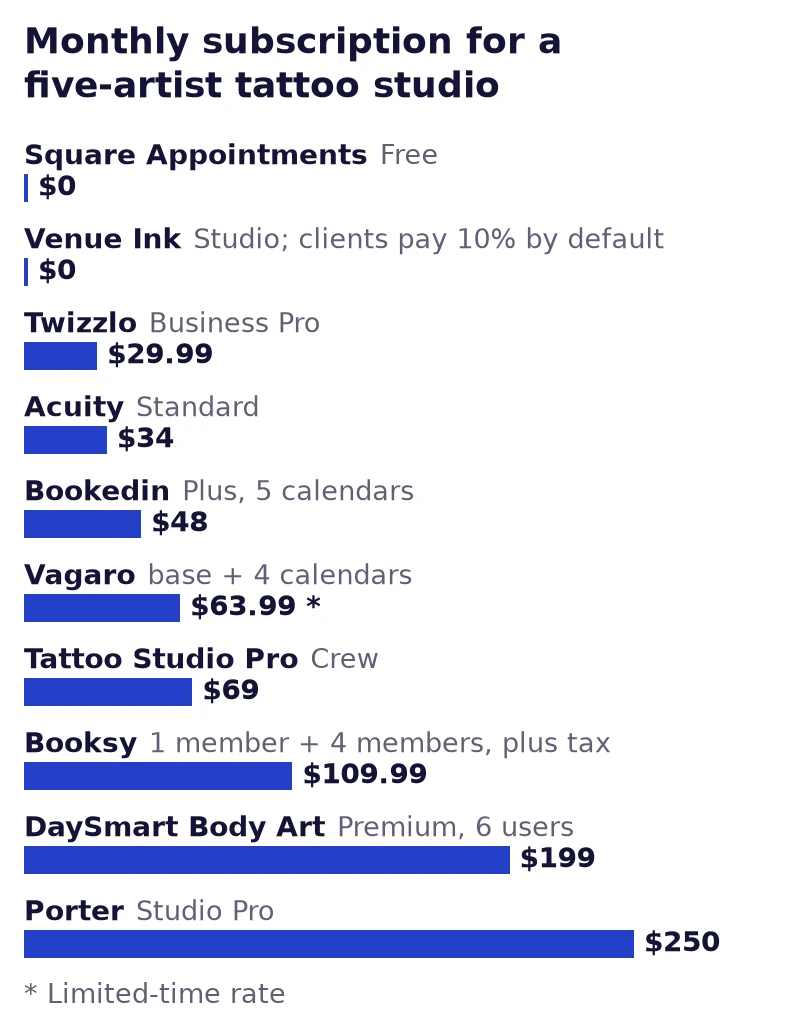
How to choose tattoo booking software from this table: first cross off any tool that fails a must-have step in your workflow (request approval, deposits, paperwork), then price the survivors at the team size you expect in a year. Each extra artist adds $20 on Booksy and $10 on Vagaro through seven licenses, and nothing on Twizzlo Business Pro. Venue Ink Studio Pro prints “+$35/mo per active artist” beside its limit of five residents or guests a month, Tattoo Studio Pro steps from $69 to $119 at the sixth active team member, and Square Appointments, Porter Studio Pro and TattooGenda list unlimited staff calendars, artists or users on the plans above. Tattoo scheduling software reviews help you spot support and billing complaints, but check the date and plan each reviewer was on, because plans and prices change.
What a $100 card payment costs under each fee model
The same $100 card payment at booking costs different amounts, and lands on different people, depending on the tool's fee model.
Fee on one $100 card payment at each tool's published rate. Arithmetic, not a quote, from each vendor's pricing page, read September 25, 2026; Twizzlo from twizzlo.com/pricing/.
| Tool and plan | Published rate | Fee on $100 |
|---|---|---|
| Venue Ink Solo or Studio ($0 a month) | 10% on card deposits and payments, charged to clients by default | $10, so the client pays $110 |
| Venue Ink Solo Pro or Studio Pro | 5% on card deposits and payments, charged to clients by default | $5, so the client pays $105 |
| Square Appointments Free, online | 3.3% plus 30 cents | $3.60 |
| Square Appointments Free, in person | 2.6% plus 15 cents | $2.75 |
| Square Appointments Plus or Premium, online | 2.9% plus 30 cents | $3.20 |
| Booksy, mobile or keyed-in | 2.69% plus 30 cents | $2.99 |
| Twizzlo, online | Online payments carry your Stripe processing rate plus a 1.5% Twizzlo platform fee | $1.50, plus your Stripe processing rate |
Venue Ink’s pricing page says its fee is charged to clients by default and can be set to be paid by clients, artists or split evenly; its own example is a $50 deposit that costs the client $55, and a deposit under $25 still carries a $2.50 fee in US dollars. Venue Ink’s homepage, read September 27, 2026, says the 10% fee also covers Stripe’s card processing, and that on payments, unlike deposits, the fee can only be paid by the client for now. Square Appointments and Booksy publish their rates as card processing fees on their business plans.
Venue Ink Studio Pro is priced at $150 a month (its pricing page also prints “+$35/mo per active artist”) and cuts the fee, charged to clients by default, from 10% to 5%, per the same pricing page. At $3,000 a month in card payments, that 5-point cut equals the $150 subscription (arithmetic, not a quote): below that volume, clients save less than the studio pays, and above it they save more than $150. Tools that do not print card rates on their pricing page are left out; ask for them before you sign.
Frequently Asked Questions
What is the best tattoo booking software for a growing studio
There is no single best tool for every studio. Decide from the workflow you have to support: request approval or direct booking, deposits, paperwork, artist calendars and more than one location. Then compare the full bill for each candidate, including subscription, staff or location charges, messaging and payment processing, at the team size you expect in a year.
Is tattoo-specific software better than generic scheduling tools
Neither category is automatically better. Test the selected plan against the studio’s actual request-approval, calendar, payment and paperwork requirements. A tattoo-specific label does not establish that every required workflow is included, and a general scheduling tool should be judged by a demonstration of those same tasks.
When does free booking software become too expensive
Compare the complete bill and the work the studio still needs to do. Check booking limits, staff and location charges, required add-ons, messaging, payment processing and acquisition fees for both free and paid plans. Paying a fixed subscription does not remove variable fees. Choose a plan whose demonstrated workflow and full costs fit the studio.
Which tattoo booking software is best for multi-location operators
There is no universal best choice for multiple locations. Verify how each quoted plan handles locations, bookable calendars and permissions. Twizzlo Free and Business Pro both support unlimited staff, locations and client records. In Vagaro's US help center, read September 25, 2026, each additional bookable calendar costs $10 per month for up to six additional calendars, or seven licenses total. The help center prints no subscription price for an added location. Compare the full plan and usage conditions in the table before choosing.
Do reminders and deposits really make a financial difference
Test it rather than assume it. Reminders and deposits are intended to reduce late cancellations and protect blocked time, but no attendance figure in this comparison has been measured for your studio. Track your own no-show rate before and after you change the process, and check what each platform charges for the messages it sends and for the payments it takes.
How do you choose tattoo booking software for your studio
Start from your real workflow, not the feature list. Map how a booking actually moves through your shop, from consult request to deposit, consent paperwork, reminders, session and aftercare, then test whether each platform handles that chain without workarounds. Price every candidate at the team size you expect in a year, including staff, location, messaging and payment charges. Our tattoo booking system walkthrough shows what a complete setup looks like.
Does tattoo booking software replace paper consent forms
Only a verified form and signature workflow can replace the paperwork steps your studio needs. Booking software or a copy-and-paste consent template alone does not establish that capability. Check document completion, signature evidence, storage, access and local requirements before changing the process. Related reading: this copy-and-paste tattoo consent template is a starting point for the wording, not evidence that any platform captures or stores a signature for you.
How much does tattoo booking software cost per month
On Twizzlo's pricing page, read September 27, 2026, Free is $0 for up to 150 bookings per month without SMS, and Business Pro is $29.99 a month per business with unlimited bookings and 50 SMS, then $0.03 each. Vagaro’s base is $23.99 a month for one calendar on a limited-time rate, per its US help center, read September 25, 2026; additional bookable calendars are $10 each per month for up to six additional calendars, or seven licenses total. Tattoo-focused tools publish a wider range on their pricing pages, read September 25, 2026: Venue Ink from $0 with a 10% card fee charged to clients by default, DaySmart Body Art from $29 a month for one user and Porter Studio Pro at $250 a month per location. On Twizzlo, online payments carry your Stripe processing rate plus a 1.5% Twizzlo platform fee.
What does tattoo scheduling software cost for a five-artist studio
Among plans with published prices, read on each vendor's pricing page or help center on September 25, 2026 (Twizzlo's on September 27), a five-artist studio at one location pays $29.99 a month on Twizzlo Business Pro, $34 on Acuity Standard, $49 on Square Plus, $63.99 on Vagaro's limited-time base rate, $109.99 before tax on Booksy, $150 on Venue Ink Studio Pro, whose pricing page also prints “+$35/mo per active artist”, and $250 on Porter Studio Pro. Twizzlo Free and Square Free cost $0 within their own limits, and Venue Ink's Studio plan costs $0 with a 10% card fee charged to clients by default. Processing, messaging and add-ons are extra on every tool, so compare the full bill before choosing.
Are tattoo scheduling software reviews reliable
Use them for patterns, not prices. Reviews can show repeated complaints about support, billing or reliability, but a review written on an older plan or at a different team size does not tell you what your studio will pay today. Check the review date and plan, then confirm the current price on the vendor's own pricing page. This article is a research comparison of vendor pages, not a review score.
What is the best tattoo studio software for a studio with several artists
For a tattoo shop with several artists, the best tattoo studio software is the one that fits how your studio takes work and keeps a predictable price as you add artists. On each vendor's pricing page, read September 25, 2026 (Twizzlo's on September 27), Porter Studio Pro is $250 a month per location with unlimited artists and staff, TattooGenda is €45 or €89 a month per studio with unlimited users, and Twizzlo Business Pro is $29.99 a month per business with unlimited staff, while Booksy adds $20 a month per team member.
Do clients or studios pay the booking fees on tattoo booking apps
It depends on the app, so read the fee line on each pricing page. According to Venue Ink's pricing page, read September 25, 2026, its free Studio plan charges a 10% fee on card deposits and payments and Studio Pro charges 5%, both charged to clients by default; its own example is a $50 deposit that costs the client $55. Square Appointments and Booksy publish their card processing rates on their pricing pages, read September 25, 2026. On Twizzlo, online payments carry your Stripe processing rate plus a 1.5% Twizzlo platform fee.
Choose two candidates for a studio test
Choose two candidates that meet your must-have workflow, then run a test consultation, a booking change, a failed payment and a cancellation. Twizzlo is worth evaluating for direct appointment operations; specialist tattoo tools may fit a different paperwork or studio-management requirement. Use the tattoo booking page to inspect Twizzlo’s current workflow before committing.
Evaluate Twizzlo’s tattoo booking workflow
Twizzlo Free allows 150 bookings per month with no SMS, and Business Pro is $29.99 a month per business with 50 SMS messages included and $0.03 for each additional message. Business Pro carries a 30-day money-back guarantee. Unlimited staff, locations and client records apply on both plans. Online payments carry your Stripe processing rate plus a 1.5% Twizzlo platform fee. To check the workflow against your own studio process, see Twizzlo’s tattoo booking workflow.
Sources and methodology
Prices read
- Twizzlo pricing page (opens in a new tab)Read . Supports: Twizzlo plans, booking cap, SMS allowance, money-back guarantee and online payment fee
- Twizzlo features page (opens in a new tab)Read . Supports: Twizzlo online payments and tips at booking; the payment confirmation screenshot (same image)
- Venue Ink pricing page (opens in a new tab)Read . Supports: Venue Ink plans, card fees, who pays them, the $2.50 minimum and the $50 example (page captured again September 27, 2026)
- Venue Ink homepage (opens in a new tab)Read . Supports: Venue Ink request review, reference uploads, booking forms, flash and deposits; the note that its 10% fee covers card processing
- Porter pricing page (opens in a new tab)Read . Supports: Porter artist and Studio Pro prices (Studio Pro feature list re-read September 27, 2026)
- Bookedin pricing page (opens in a new tab)Read . Supports: Bookedin plans by calendar count and the free plan's booking limit
- Bookedin tattoo page (opens in a new tab)Read . Supports: Bookedin online booking, deposits paid online, reminders and client list
- DaySmart Body Art pricing page (opens in a new tab)Read . Supports: DaySmart Body Art plans, included users, texts and trial
- DaySmart Body Art homepage (opens in a new tab)Read . Supports: DaySmart Body Art booking, client records, forms, inventory, payroll, reporting and payment processing
- TattooGenda pricing page (opens in a new tab)Read . Supports: TattooGenda plans in euros, unlimited users, SMS price and multi-studio subscriptions (feature list re-read September 27, 2026)
- Vagaro plans and pricing help article (US) (opens in a new tab)Read . Supports: Vagaro base rate, calendar fees, add-ons and US card rates
- Vagaro business homepage (opens in a new tab)Read . Supports: Vagaro's beauty, wellness and fitness focus
- Square Appointments pricing page (US) (opens in a new tab)Read . Supports: Square plans, unlimited staff calendars and card rates
- Fresha business page (opens in a new tab)Read . Supports: Fresha marketplace, client management, payments and the business types it serves
- Fresha pricing page (read outside the US) (opens in a new tab)Read . Supports: The one-time fee on new marketplace clients (wording only; no Fresha figure is stated)
- Booksy pricing page (opens in a new tab)Read . Supports: Booksy published price, extra team members, Boost fee, card rates, free reminders and trial
- Acuity Scheduling pricing page (opens in a new tab)Read . Supports: Acuity plans by calendar count, client forms, SMS plan and trial
- Tattoo Studio Pro pricing page (opens in a new tab)Read . Supports: Tattoo Studio Pro team bands, who counts, annual saving, trial and card payments through Stripe
- Tattoo Studio Pro booking app page (opens in a new tab)Read . Supports: Tattoo Studio Pro request inbox, deposit links, reminders, forms, walk-in queue and point of sale
From our editorial policy
- Twizzlo sells online booking and appointment scheduling software, the same category we write about. Twizzlo appears in our comparisons and roundups, and we have a commercial interest in you choosing it.
- We do not publish invented quotes, studies, statistics, customer stories or product tests, and we do not imply hands-on use of a product when the research came from the vendor's public documentation.
- To report an error, email support@twizzlo.com with the subject line "Correction: [page URL]". Tell us what is wrong and, if you can, link a source.
Update history
- : Re-read every vendor price on the vendor's own site, priced five tattoo-focused tools, added Tattoo Studio Pro, added a fee comparison on a $100 card payment, and removed a Vagaro list price we could not confirm for the US.
Start free, upgrade when you grow
Flat-rate booking software. No per-seat, per-chair or per-location fees.
- Free plan up to 150 bookings a month, not a trial
- Business Pro is $29.99 a month per business for unlimited bookings, with a 30-day money-back guarantee
- 24/7 support by email