
Cleaning Service Contract Template: Free Agreement to Copy

In short
A cleaning service contract template is a ready-made agreement that a cleaning company and its client fill in and sign to set the scope, schedule, price, payment terms and rules for canceling or ending service. Copy the 17-clause agreement on this page, fill in the bracketed fields and have a local professional review it. There is nothing to download.
- Write the scope as a task list with its own exclusions list, so extra requests need written approval.
- Fill in the rate, billing cycle, due date and cancellation window as numbers your office can apply.
- Keep one master agreement, then adjust the access, billing and scope clauses for homes, offices and rental turnovers.
In this article10 sections

A missed bathroom, a disputed extra task, a late cancellation, an invoice that sits unpaid. Each of these is easier to settle when both sides have signed the same written terms. When the client says, “I thought that was included,” and you can’t point to a signed document, the job often turns into a write-off.
A cleaning service contract template puts those terms in one document: scope, schedule, price, payment, access and cancellation. The contract records what you and the client agreed; the visits themselves run in your cleaning service scheduling software, so both should say the same thing. For client records, see this guide on what CRM software is used for in service businesses.
Cleaning service contract template: the full agreement to copy
Copy the cleaning contract template below, replace every bracketed field with your own terms and keep the clause numbers, so both sides can refer to them. This cleaning service contract agreement template has 17 numbered clauses, from the service address to both signatures.
There is no file to download and nothing to sign up for; treat the text as a working draft.
Copy and paste template
Cleaning Service Agreement
This Cleaning Service Agreement (“Agreement”) is entered into by and between [Cleaning Company Legal Name], located at [Company Address] (“Service Provider”), and [Client Legal Name], located at [Client Address] (“Client”).
1. Property and Service Location
Services will be performed at the following property or properties: [Service Address].
2. Term of Agreement
Services begin on [Start Date] and continue until [End Date or Ongoing Recurring Term], unless terminated under this Agreement.
3. Scope of Services
Service Provider will perform the following cleaning services:
- [List tasks by room, zone, or service category]
- [Example: vacuum floors in offices and common areas]
- [Example: sanitize restrooms and refill agreed supplies]
- [Example: remove trash and replace liners]
- [Example: mop hard floors in designated areas]
Excluded Services
- [List anything not included]
- [Example: exterior windows]
- [Example: biohazard cleanup]
- [Example: heavy post-construction debris removal]
Additional services requested outside the scope above must be approved by the Client and may be billed separately.
4. Service Schedule
Services will be performed on the following schedule: [Days and frequency].
Expected service window or access time: [Time window].
Estimated visit duration: [Duration].
5. Supplies and Equipment
The following items will be provided by the Service Provider: [List supplies/equipment].
The following items will be provided by the Client: [List supplies/equipment or access items].
6. Fees and Payment Terms
Client agrees to pay Service Provider [Rate or flat service fee].
Invoices will be issued [per visit / weekly / monthly / annually].
Payment is due [due date or terms].
Accepted payment methods: [methods].
Late payment terms: [late fee or interest language if applicable].
Rate changes on recurring service: [notice period and how the Client approves a new rate].
7. Deposit
Client will pay a deposit of [deposit amount or percentage], if applicable. The deposit will be applied to [first invoice / final invoice / project balance].
8. Cancellation and Rescheduling
Client must provide [notice period] notice to cancel or reschedule a visit.
If cancellation occurs inside that window, the following fee may apply: [fee terms].
9. Access and Key Handling
Client will provide safe and timely access to the property.
Any alarm codes, keys, entry instructions, or site restrictions are as follows: [details].
Service Provider agrees to use keys, codes, and access credentials only for authorized service purposes.
If the Service Provider cannot access the property at the scheduled time: [lockout fee or rescheduling terms].
10. Insurance and Bonding
Service Provider will maintain the following coverage or protections: [general liability / bonding / workers’ compensation if applicable / other]. Proof may be provided upon request.
11. Damage and Claims
Client must report any property damage or service issue within [reporting window] after service completion.
Service Provider will have a reasonable opportunity to inspect and, if appropriate, correct the issue.
12. Liability Limitations
Service Provider’s liability, if any, will be limited as follows: [insert reviewed language suitable for your business].
13. Independent Contractor Status
Service Provider is acting as an independent contractor and not as an employee of Client, unless otherwise required by law.
14. Termination
Either party may terminate this Agreement by providing [notice period] written notice.
Immediate termination may occur for nonpayment, unsafe conditions, denied access, repeated service refusal, or material breach.
15. Governing Law
This Agreement will be governed by the laws of [State or Jurisdiction].
16. Entire Agreement
This Agreement contains the full understanding between the parties and supersedes prior verbal or written discussions regarding the services described herein.
17. Signatures
Service Provider
Name: [Name]
Title: [Title]
Signature: ____________________
Date: ____________________
Client
Name: [Name]
Title: [Title, if applicable]
Signature: ____________________
Date: ____________________
Table 1 shows how to fill in the clauses that change most between clients.
| Clause | What to fill in | Example |
|---|---|---|
| Parties | Legal names and addresses of both sides | Your registered company name; the client’s legal name |
| 1. Property | Every service address | Two office addresses, one per line |
| 2. Term | Start date; end date or “ongoing” | First visit date; ongoing |
| 3. Scope and exclusions | Tasks by room or area, then exclusions | Kitchen, two bathrooms, floors; no laundry |
| 4. Schedule | Days, arrival window, visit length | Every Tuesday, arrival 9 to 11 a.m., about 3 hours |
| 6. Fees and payment | Rate, billing cycle, due date, late terms | $160 per visit, invoiced monthly, due within 15 days |
| 7. Deposit | Amount and the invoice it reduces | 25% of a one-time project price, applied to the final invoice |
| 8. Cancellation | Notice window and the fee inside it | 24 hours’ notice; half the visit price inside that window |
| 9. Access and keys | Who holds keys or codes; lockout terms | One key, logged at the office; a lockout counts as a late cancellation |
| 10. Insurance and bonding | Cover you carry; how proof is shared | Liability cover; certificate on request |
| 11. Damage and claims | Reporting window and first remedy | Report within 48 hours; re-clean first |
| 14. Termination | Notice to end without cause | 30 days’ written notice |
| 15. Governing law | The state whose law applies | The state where you clean |
Where this template works best
This format works well for recurring residential service, office cleaning, janitorial accounts, and companies that sell both recurring and one-time jobs. It gives you room to attach a checklist, list exclusions, assign supply responsibility, and separate service terms from payment rules so your team is not hunting through one long paragraph for answers.
It also works best when you treat it as an operating document, not a file that gets signed and forgotten. For example, if your agreement says cancellations inside 24 hours incur a fee, your booking system should flag that automatically.
If your company uses several agreement types across services, this service contract template example for another appointment-based business shows the same principle in a different format.
A template has real value only when your dispatcher, account manager, bookkeeper, and field lead all read it the same way and act on it the same way.
What should a cleaning service contract include?
Whether you call it a cleaning company contract template, a service agreement or a cleaning contract, it needs the same core terms: both parties and every service address, the tasks included and excluded, the schedule, price and payment terms, supplies, insurance, access, cancellation and termination rules, governing law and both signatures.
The non-negotiables
-
Party details
Full legal names, service and billing addresses, and each side’s main contact. -
Scope of work
Tasks by room, area or service category, plus a separate exclusions list. -
Service schedule
Frequency, visit windows and access requirements, so staffing is planned, not guessed. -
Fees and payment terms
Pricing, invoicing cycle, due dates and what happens when payment is late. -
Supplies and equipment
Who provides paper goods, chemicals, consumables, specialty tools and restocking items. -
Insurance, bonding, and liability
Required coverage, limits on damage claims and how claims are reported. -
Cancellation and termination rules
Notice windows for skipped visits, early termination and ending recurring service. -
Signatures and governing law
Both signatures, the signing date and the state whose law applies.
What operators often miss
The gap isn’t usually the headline terms. It’s the small clauses that control expensive edge cases.
- Key handling terms protect you when multiple cleaners, supervisors, or after-hours access are involved.
- Damage-reporting windows stop open-ended claims that show up weeks later.
- Exclusions lists are often what save margin on “just one more thing” requests.
- Rate adjustment language matters on recurring work, especially when labor or supply costs change.
Practical rule: If your admin team can’t answer a client question by reading the contract in under a minute, the agreement is still too vague.
Clients often ask for “insured and bonded” as if they were the same. They aren’t; the bonding and insurance FAQ at the end of this guide explains the difference.
For shared-service models with independent professionals, this booth rental contract example for service businesses shows how to document roles and responsibilities instead of assuming them.
How to customize each clause
Customize each clause to match how your company schedules, cleans and bills: if a clause cannot become a checklist item, a billing step or a cancellation rule, it is still too vague.
A client signs for weekly office cleaning at one price. By month two, your crew is restocking paper goods, wiping interior glass, and staying an extra 30 minutes because the manager says, “We thought that was included.” That problem usually starts in the contract.
Scope of work
Scope is where cleaning companies either protect margin or give it away. “General cleaning” creates room for assumptions, and assumptions turn into unpaid labor.
Choose a structure that matches how you dispatch and inspect work:
| Format | Best for | Example |
|---|---|---|
| By room | Homes, small offices | Kitchen, restrooms, lobby, private offices |
| By task category | Multi-site commercial work | Floors, trash, dusting, sanitizing, restocking |
| By service level | Tiered packages | Standard clean, deep clean, add-on services |
Then tighten it. List what is included, what is excluded, who provides consumables, whether teams move furniture, and how add-ons get approved. If you run recurring service, align the wording with your field checklist and inspection form.
Exclusions deserve their own line item. Interior windows, post-construction debris, dishwashing, laundry, heavy buildup, and biohazards should never sit in a gray area.
Payment language
Payment clauses should read like instructions to your admin team. Clear terms reduce debates, speed up collections, and make it easier to send payment reminders.
Write the clause so each part answers one operational question:
- When do you bill? Per visit, weekly, biweekly, or monthly
- When is payment due? On receipt, net terms, or autopay date
- How can the client pay? Card, ACH, bank transfer, check
- What happens if they do not pay? Late fee, service pause, or collections process
- Who approves price changes? Named contact, written approval, or signed change order
Test the clause against a real office scenario: if a bookkeeper can read it once and know when to invoice, when to follow up and when to hold the next visit, it works.
Liability and termination
These clauses should reflect the jobs you perform and the problems you see. A residential maid service, a janitorial company, and a post-construction cleaner should not all use the same wording.
For liability, spell out how clients report damage or service complaints, how quickly they must report them, who investigates, and whether your first remedy is a re-clean, site visit, or documented claim review.
For termination, cover the situations that disrupt revenue or create risk. Nonpayment, repeated lockouts, unsafe conditions, repeated scope creep, and chronic rescheduling all belong here. State the notice period, any fees that survive cancellation, and what happens to scheduled service already on the calendar.
Which clauses change for homes, offices and rental turnovers?
Homes, offices and short-term rental turnovers need different access, schedule, billing and damage-reporting terms, so keep one master agreement and change those clauses for each client type.
Table 2. Which clauses change by client type. Editorial guidance to adapt with a local professional.
| Clause | Home | Office or commercial site | Rental turnover |
|---|---|---|---|
| Scope format | By room | By task and area, per site | Per-turnover checklist: beds, linen, restock, reset |
| Schedule | Day and arrival window | After-hours window and days per week | Between guest checkout and the next check-in |
| Access | Key or door code, pets, who is home | Keys, fobs, alarm codes, sign-in rules | Lockbox or door codes that change between guests |
| Supplies | Whose products are used | Consumables restocking | Linen and toiletry restock, and who pays |
| Billing | Per visit | Monthly invoice per site | Per turnover |
| Insurance and bonding | Proof on request | Certificate naming the client, sometimes a fidelity bond | Proof for the host or manager |
| Damage reporting | Short window after the visit | Through the site contact | Before the next check-in, with photos |
| Ending the agreement | Notice for recurring service | Notice period for the whole contract | Per-booking changes |
The residential and commercial FAQ at the end of this guide covers splitting one master template by service type.
What two public cleaning contracts require
The Town of Purcellville, Virginia, and Siskiyou County, California, publish their cleaning contracts, and both require proof of insurance and treat the cleaner as an independent contractor, according to the documents, read September 27, 2026. Purcellville also sets monthly itemized invoices, a $15,000 blanket fidelity bond for employees and 30 days’ notice for either side to end the contract.
If you are writing a commercial cleaning contract template, the two contracts show what a public buyer may ask for.
| Term | Town of Purcellville, Virginia (2012 custodial and cleaning agreement) | Siskiyou County, California (janitorial contract form) |
|---|---|---|
| Billing | One invoice at month end, itemized by facility | A not-to-exceed monthly amount and term total |
| Payment | Net 30 days; no penalty payable by the Town for late payment | On the last day of the month the work was satisfactorily done |
| Price changes | At renewal, the fee may rise 1.5% at the Town’s discretion if the contractor documents higher costs in writing within 30 days before the term ends | Not stated |
| Ending the contract | Either party, without cause, on 30 calendar days’ written notice; the Town on 10 days’ notice if it relocates, renovates, repairs, modifies or closes a facility | The County, at any time, by written notice, paying pro rata for work done; also for default |
| Insurance | Section XXII: $2 million in public liability cover and workers’ compensation; a certificate naming the Town as additional insured within 7 calendar days of the award | Liability and property damage cover the County accepts; workers’ compensation unless the contractor has no employees and state law does not require it |
| Bonding | Section XX: a $15,000 blanket fidelity bond covering every employee who works under it | Not stated |
| Keys and access | Keys stay Town property; the contractor pays for lost keys and re-keying | No key clause; only the contractor’s employees doing the work may enter |
| Worker status | Independent contractor, not a Town employee | Independent contractor; no employer-employee relationship |
Deposits, cancellations and payment terms
Write deposits, cancellation fees and payment terms as exact amounts and deadlines that your office can quote without interpretation.
Cash flow problems in cleaning rarely show up as dramatic failures. They usually show up as small leaks. A skipped deposit here, a last-minute cancellation there, a monthly client who pays whenever they feel like it. Over time, those habits force your office team to spend more time collecting money than scheduling profitable work.
Deposits that protect the schedule
LawDepot’s cleaning services agreement guide, read September 27, 2026, says a reasonable deposit is usually 10% to 50% of the total contract amount and that the amount depends on the client’s trustworthiness and financial stability.
Use deposits where they solve a real risk:
- Large one-time jobs where labor is blocked off in advance
- First-time commercial clients when payment behavior isn’t proven
- Specialty cleans that require extra prep, supply orders, or equipment
- High-demand time slots you can’t easily refill after a cancellation
Example: a $600 move-out clean with a 25% deposit means $150 at signing and $450 on the final invoice.
Cancellation terms that clients understand
A cancellation clause should be short, specific, and attached to the schedule. If you bury it in fine print, clients won’t respect it and your team won’t quote it confidently.
Neither public contract in Table 3 sets a cancellation window for a single visit, so the number is yours to choose. Example: with a 24-hour window and a fee of half the visit price, a client who cancels a $160 visit inside the window owes $80.
What good financial clauses prevent
Four gaps weaken the money clauses:
- Vague scope wording
- Missing start or end dates
- No notice period
- No damage or re-clean language
These gaps affect whether your team can invoice confidently, whether a client can challenge work after the fact, and whether your calendar gets wrecked by late changes.
Outside cleaning, this deposit policy example for appointment businesses applies the same logic: put the rule in writing before the slot is reserved.
Turn each clause into a booking and billing rule
A contract term protects revenue only when your booking and billing process applies it the same way every time, so write each schedule and money clause as an office rule and set it up where bookings and payments happen.
The test comes on a Tuesday afternoon, when a recurring client tries to reschedule late while your office builds next week’s schedule: if the rule is not written where the booking happens, staff make exceptions that cost margin.
| Clause | Office rule to write down | Where it is applied |
|---|---|---|
| 3. Scope and exclusions | Who can approve extra tasks, and how | Job notes and the written approval |
| 4. Schedule | Days, arrival window and visit length | The booking calendar and each cleaner’s shifts |
| 6. Fees and payment | Rate, billing cycle, due date and late terms | Invoices or payment requests, and the follow-up |
| 7. Deposit | Amount, due date and the invoice it reduces | The quote or confirmation, and the final invoice |
| 8. Cancellation | Notice window and fee | The booking page, confirmations and reminders, and who decides on the fee |
| 9. Access and keys | Who holds keys and codes; lockout terms | Client notes and a key log |
| 11. Damage and claims | Reporting window; re-clean first | A dated record of each report and response |
Software should reduce exceptions, not create more places for exceptions to hide.
The billing side matters too, so review payment processing for appointment-based service businesses with your contract terms in mind. If you are still choosing a tool, our guide to the best scheduling app for cleaning business owners compares the options, and our cleaning service software comparison prices full suites by team size.
Keep the signed agreement in your own document process and use Twizzlo for the booking side: clients book on your booking page, each cleaner has a calendar and shifts, cancellations and reschedules follow your booking rules, and reminders go out before each visit.
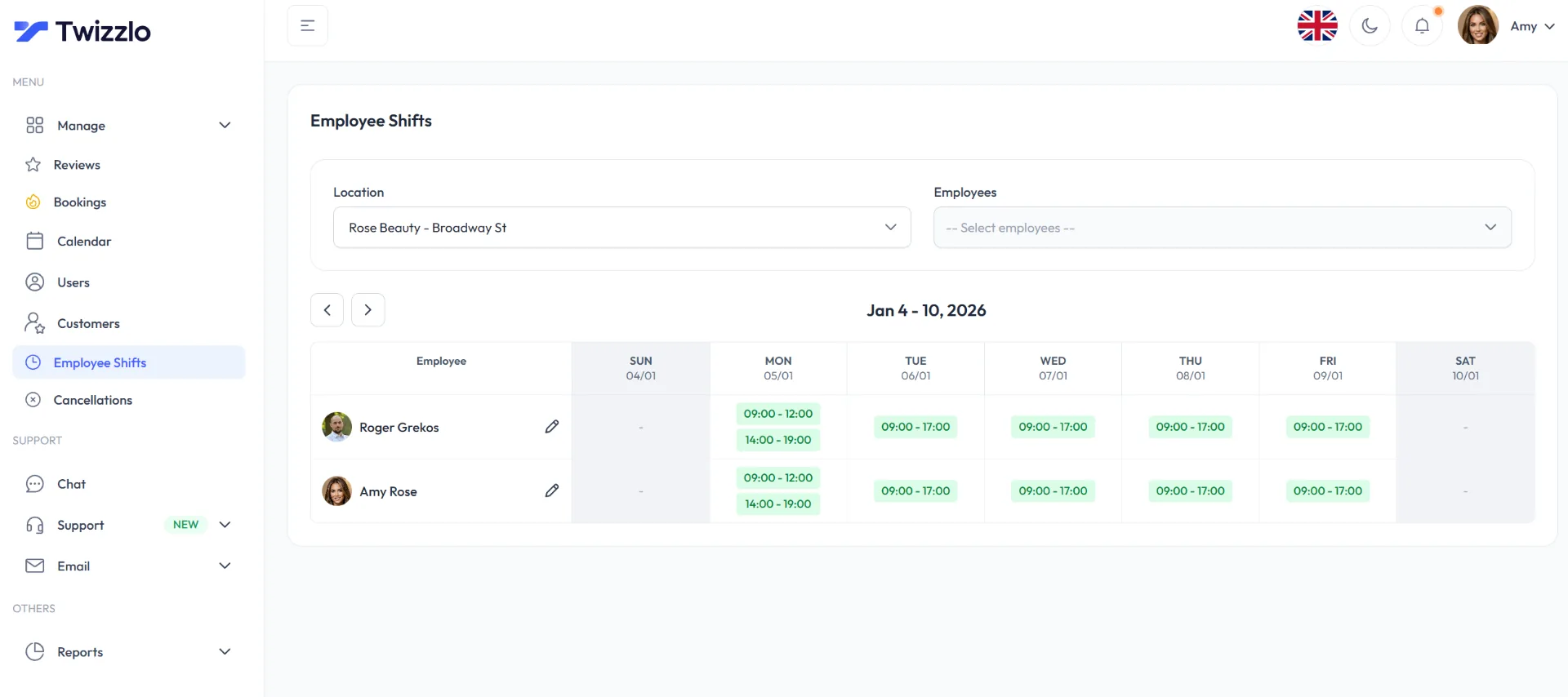
Twizzlo plans for cleaning businesses
Twizzlo is web-based online booking and appointment scheduling software for appointment-based service businesses. For a cleaning company, either plan handles the contract’s booking side: an online booking page, a calendar for each cleaner, client records, email reminders and prepaid bookings, which charge the full service price when the client books.
- Free: $0 a month for up to 150 bookings, free forever rather than a trial. SMS is not included.
- Business Pro: $29.99 a month per business for unlimited bookings. Each month includes 50 SMS, extra messages cost $0.03 each, and the plan comes with a 30-day money-back guarantee.
Staff and locations are unlimited on both plans, so adding cleaners or locations never changes the price. Both plans include 24/7 support by email. Online payments carry your Stripe processing rate plus a 1.5% Twizzlo platform fee. If a client skips a prepaid visit, you decide whether to keep or refund the payment. Compare the two plans on the pricing page.
Frequently Asked Questions
Can I use the same contract for residential and commercial clients
Yes, but don’t use the exact same wording without adjustment. Residential clients usually need simpler access, rescheduling, and property-care language. Commercial clients usually need tighter scope definitions, facility-by-facility billing, site contacts, and after-hours access instructions. Start from one master template, then create separate versions for each service type.
Are digital signatures acceptable
Generally, yes, in the US. The federal E-SIGN Act says a contract in or affecting interstate commerce may not be denied legal effect solely because an electronic signature or record was used to form it (15 U.S.C. 7001, read on govinfo.gov on September 27, 2026). The same law does not require anyone to accept electronic signatures, so have your process reviewed and keep the signed copy where your office can find it.
What’s the difference between bonding and insurance
They cover different risks. Liability insurance covers injury or property damage caused by the work, while a fidelity bond covers losses from employee dishonesty, such as theft. Public buyers can ask for both. The Town of Purcellville, Virginia, requires a certificate of insurance naming the Town and a $15,000 blanket fidelity bond for employees on the job, according to its custodial agreement, read September 27, 2026.
Should cleaners be classified as employees or independent contractors
It depends on how the work is controlled, not on what the contract calls the worker. The IRS says the general rule is that someone is an independent contractor if the payer has the right to control or direct only the result of the work, not what will be done and how. Businesses must weigh behavioral, financial and relationship facts (IRS independent contractor pages, read September 27, 2026). State tests can differ, so confirm locally.
Should the contract include a re-clean policy
Yes. A re-clean clause is one of the simplest ways to avoid refund arguments. State how quickly a client must report a problem, what qualifies for re-service, and whether your company gets the first opportunity to correct the issue before any credit is discussed. That keeps quality control inside a defined process.
How should I store and search signed contracts
Keep every signed agreement in one shared folder or document system your office can search, and name each file with the client, service address and effective date. Record renewal and notice dates where your team plans work, so no contract lapses or renews unnoticed, and keep signed agreements out of email threads.
How much notice should clients give to cancel a cleaning visit
There is no single standard, so the template leaves the window blank. Choose a window long enough to refill the slot or reassign the cleaner, write it in the cancellation clause with the fee that applies inside it, and show the same window on your booking page and in confirmations, so clients see the rule before they book.
How much should a cleaning deposit be
There is no fixed rule. According to LawDepot’s cleaning services agreement guide, read September 27, 2026, a reasonable deposit is usually 10% to 50% of the total contract amount, depending on the client’s trustworthiness and financial stability. Use deposits where they solve a real risk: large one-time jobs that block labor, first-time commercial clients, specialty cleans that need extra supplies, and slots that are hard to refill.
What should a cleaning contract exclude
Anything that invites scope creep if left in a gray area. Common exclusion candidates include window work, post-construction debris, dishwashing, laundry, heavy buildup, and biohazard cleanup. Give exclusions their own line items instead of burying them in prose, and pair the list with an approval rule: any request outside scope needs client approval and may be billed separately.
Is a cleaning service agreement the same as a cleaning service contract
In everyday use, yes: both names describe the same signed document, and this cleaning service contract template is titled Cleaning Service Agreement. What matters is the content: parties, service address, scope and exclusions, schedule, fees, payment, cancellation and termination terms, and signatures. Whether an agreement is enforceable depends on its terms and your state’s law, so have it reviewed locally.
Can I use this cleaning contract template for Airbnb or vacation rental turnovers
Yes, with changes to four clauses. Set the service window between guest checkout and the next check-in, state how you receive door or lockbox codes, list linen, laundry and restocking tasks in the scope, and set a short reporting window for damage or missing items before the next guest arrives. You can also price per turnover.
Sources and methodology
- Town of Purcellville, Virginia: Custodial and Cleaning Services Agreement (opens in a new tab)Read . Supports: the Purcellville column of Table 3, the public-contracts summary and the bonding and insurance FAQ
- Siskiyou County, California: Contract for Janitorial Services (county form) (opens in a new tab)Read . Supports: the Siskiyou County column of Table 3 and the public-contracts summary
- LawDepot: Cleaning Services Agreement (opens in a new tab)Read . Supports: the 10% to 50% deposit guidance (deposits section and the deposit FAQ)
- IRS: Independent contractor defined (opens in a new tab)Read . Supports: the general rule for independent contractors (worker classification FAQ)
- IRS: Independent contractor (self-employed) or employee? (opens in a new tab)Read . Supports: the behavioral, financial and relationship categories (worker classification FAQ)
- 15 U.S.C. 7001, E-SIGN Act (govinfo.gov, United States Code 2023 edition) (opens in a new tab)Read . Supports: the legal effect of electronic signatures and records (digital signatures FAQ)
- Twizzlo pricing page (opens in a new tab)Read . Supports: Twizzlo plan prices, SMS allowance, support and online payment fees
- Twizzlo features page (opens in a new tab)Read . Supports: Twizzlo booking-side features and the Employee Shifts screenshot (same image)
From our editorial policy
- Our templates, such as consent forms, contracts and confirmation messages, are text to copy and adapt to your business. They are not legal advice. Have a qualified local professional review anything you rely on.
- To report an error, email support@twizzlo.com with the subject line "Correction: [page URL]". Tell us what is wrong and, if you can, link a source.
Update history
- : Moved the agreement to the top, added a fill-in guide, clause changes by client type, two public contracts with official sources and two FAQs; corrected the deposit and cancellation figures and the Twizzlo plans section.
Start free, upgrade when you grow
Flat-rate booking software. No per-seat, per-chair or per-location fees.
- Free plan up to 150 bookings a month, not a trial
- Business Pro is $29.99 a month per business for unlimited bookings, with a 30-day money-back guarantee
- 24/7 support by email