
Cleaning Service Software: What Seven Tools Cost at 1, 3 and 8 Cleaners

By Roger Grekos, founder and editor, Twizzlo. Prices were read first-hand from each vendor's own website on September 15, 2026.
Twizzlo publishes this page and competes with the products priced on it. Every competitor price stated here as current is read from that vendor's own website, its pricing page or help center, with the qualifier printed there, or recorded as not published.
Quick answer: Cleaning service software splits into two kinds. Field service tools price per cleaner and add quotes, dispatch and GPS, so an eight person crew runs from $252 to $329 a month. Booking led tools charge a flat fee or per location, from $0 to about $49. Pick by job type, not by feature count.
What counts as cleaning service software?
Cleaning service software is any tool that holds your jobs, your clients and your money in one place instead of across a phone, a paper diary and a bank app. That definition is broad enough to be useless on its own, which is why buying is hard. Two products can both call themselves cleaning service software and be built for completely different businesses.
The split that matters is this. Field service platforms assume you send crews to addresses. They are built around quotes, dispatch, routing, timesheets and job costing, and they almost all price per person on the team. Booking platforms assume clients choose a slot and pay for it. They are built around a public booking page, reminders, prepayment and a client record, and they tend to price per business or per location.
A residential maid service running forty recurring weekly cleans with four staff is a field service business. A solo operator selling one off deep cleans and move out cleans from an Instagram link is a booking business. They need different software, and the roundups that rank for this term mostly sell one shape and review the other.
Worth saying plainly before the prices: every vendor in this piece was read on its own pricing page on 15 September 2026. Where a vendor does not publish a number, this article says so rather than borrowing one from a third party.
What does cleaning service software cost at 1, 3 and 8 cleaners?
Here is the part the comparison tables skip. The headline price of a cleaning tool tells you almost nothing until you attach it to a team size, because the pricing models are not the same shape. Some charge a flat fee no matter how many cleaners you add. Some charge per location. Some charge per seat from the first seat. Some bundle thirty seats into the base price.
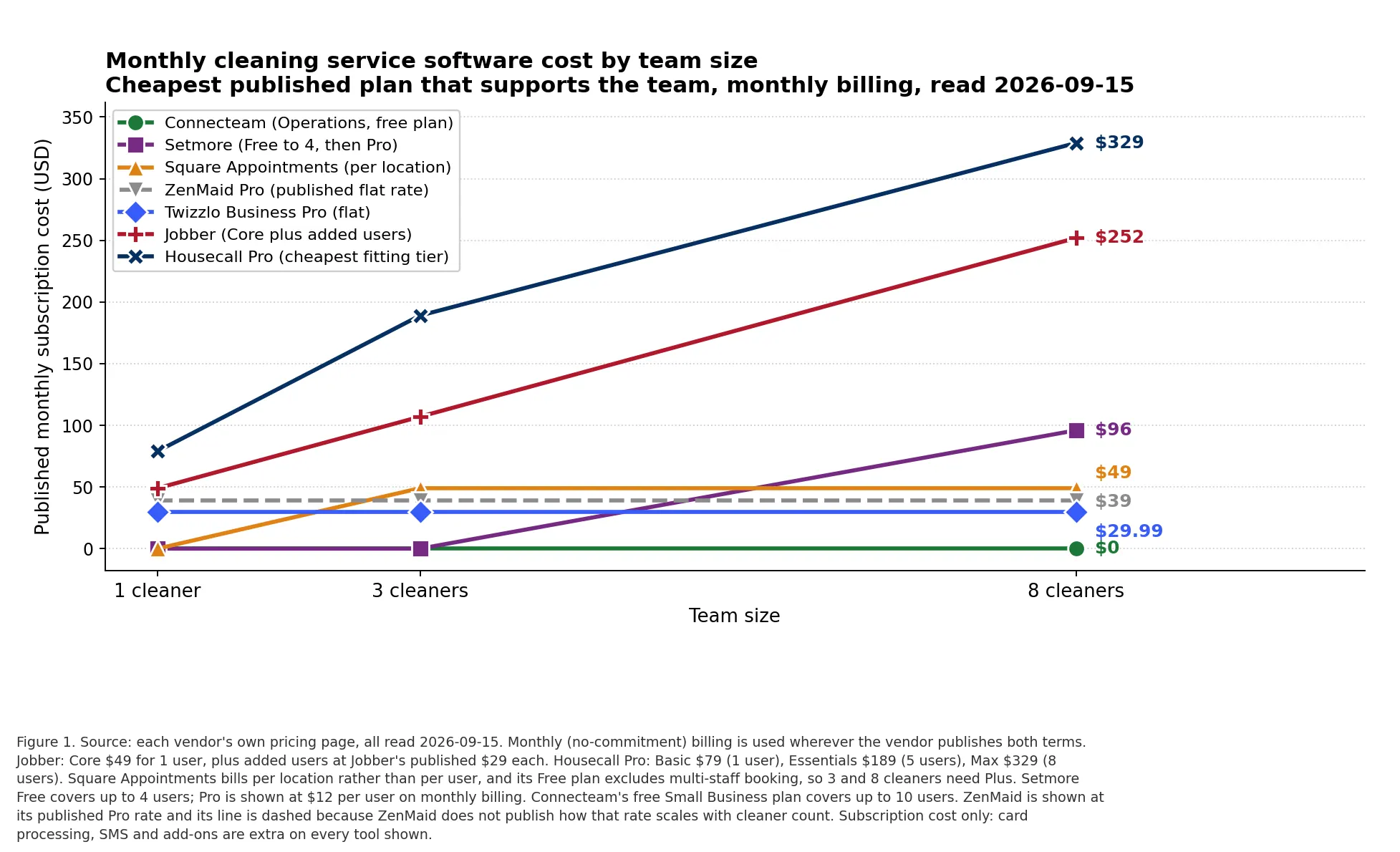
The spread at eight cleaners is the story. Housecall Pro Max is $329 a month and Jobber reaches $252 on Core plus seven added users at the published $29 each. Square Appointments is still $49 because it bills per location and puts no limit on staff calendars. Setmore is $96 at $12 per user on monthly billing, or $40 on annual. Connecteam's free Small Business plan covers up to ten users at $0. Twizzlo is $29.99 flat whether you have one cleaner or eight.
None of those is the right answer by itself. The $329 buys route optimisation, recurring service plans, job costing and GPS enabled timesheets. The $29.99 does not buy any of those things. What Figure 1 shows is the cost of a decision, not a ranking.
Three caveats belong with that chart rather than under it. ZenMaid publishes Starter at $19, Pro at $39 and Pro Max at $49, but its pricing page runs a calculator that asks how many cleaners and office managers you have, and the rates that calculator produces are not in the page source. So ZenMaid's line is dashed: the tier prices are published, the scaling is not. Housecall Pro publishes $35 per extra user on Max but does not publish an extra user price on Basic or Essentials, which is why the three cleaner figure jumps to the $189 Essentials tier. Workyard publishes only a floor, "plans start at $6 per user per month, billed annually", and no per tier price at all, so it is absent from the chart rather than estimated into it.
Add the money side before you commit. Jobber publishes 2.9% plus 30 cents for cards and 1% for bank payments. Housecall Pro publishes card rates starting at 2.59% and a 1% bank fee. Square's rate depends on the plan you are on, from 2.6% plus 15 cents in person on Free down to 2.4% plus 15 cents on Premium. Setmore charges nothing itself and passes you to Stripe or Square at their rates. Twizzlo runs payments through Stripe and adds a 1.5% platform fee on top of Stripe's own rates, which its own payment processing page states directly. On $12,000 of monthly card volume that 1.5% is $180, which dwarfs the $29.99 subscription. Read the processing line before the subscription line.
Why do the prices in roundups not match the vendors' own pages?
Because the roundups are mostly written by vendors about their own competitors, and because seat counts get dropped.
Every one of the three pages ranking highest for this term on 15 September 2026 is published by a company selling into the same market: Workyard, Connecteam and ZenMaid. All three rank themselves first in their own comparison. That is not dishonest by itself, and two of the three disclose their methodology. It does mean the ordering is not independent.
The pricing is where it gets concrete. Workyard's table lists Jobber as Core $49, Connect $199, Grow $399 and Plus $699. Jobber's own pricing page, read the same day, publishes Connect at $139 for one user, Grow at $199 for one user, and Plus starting at $499 for five users. The roundup's numbers are real prices, but they are the multi seat bundle prices printed without the seat counts those bundles include, sitting in a column next to Core, which is a single user price.
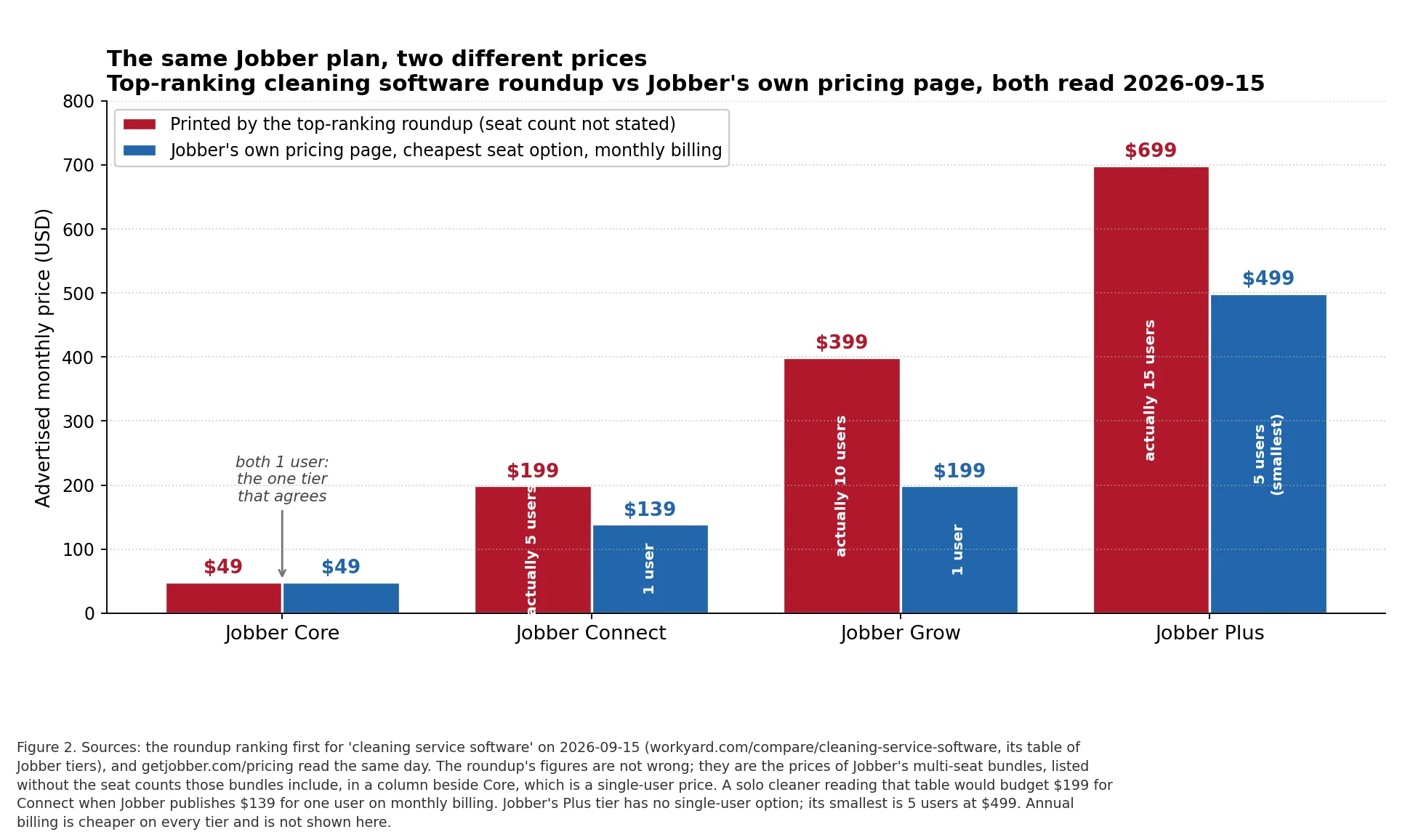
A solo cleaner reading that table budgets $199 for Connect. Jobber will sell it to them for $139 on monthly billing, or $99 on annual. That is a 30% error on the number that decides the purchase.
There are others worth checking yourself. Both Workyard and Connecteam print ZenMaid as roughly $19 base plus $4 per user, and ZenMaid's own pricing page publishes no per user figure at all today. Connecteam quotes Housecall Pro at $59 while Workyard quotes $79; both are correct, because $59 is the annual rate and $79 is the monthly rate, and neither table says which. Workyard's own page lists Kickserv at $60 in its summary table and $75 in its detail table. And the ZenMaid article is headed 2026 while its own top entry is still subtitled 2025.
The practical rule: use roundups to build a shortlist, then price every shortlisted tool on the vendor's own page on the day you buy. That includes this article.
Which tools fit recurring residential cleans?
This is the largest slice of the market and the least forgiving. A maid service lives on repeat visits: the same client, same day, same crew, every week or fortnight, billed on a cycle. If your software cannot create a recurring job and roll it forward automatically, you will rebuild your schedule by hand every month.
ZenMaid is built for exactly this and prices accordingly, with Pro at $39 a month adding digital checklists, payroll, GPS tracking in the mobile app and a Spotfinder tool for slotting new recurring customers into gaps. Jobber and Housecall Pro both handle recurring work, though Housecall Pro puts recurring service plans on its Max tier at $329. Connecteam's free plan covers scheduling and time tracking for up to ten users, which is unusually generous, but it is a workforce tool rather than a client booking tool, so client facing booking and invoicing are weaker.
Twizzlo's own pages do not document recurring appointment scheduling in either direction, so this article does not claim it either way. If you run mostly recurring cleans, confirm that directly with the vendor before you commit. It is the single question that decides the fit.
Which tools fit one off and deep cleans?
One off work is a booking problem, not a dispatch problem. Somebody finds you, picks a slot, and you want their money before they cancel on the morning of a four hour deep clean. Quotes, routing and job costing matter much less here, and a clean public booking page matters much more.
This is where the cheap end of Figure 1 stops being a compromise. Square Appointments at $0 on Free or $49 per location on Plus gives you a booking site, a cancellation policy and no show fees, and puts no limit on staff calendars. Setmore's free plan covers up to four users with unlimited appointments and a branded booking page, moving to Pro for deposits, SMS reminders and removing Setmore branding. Twizzlo is $29.99 flat with unlimited staff and locations, prepaid bookings to protect long slots, and no show fees the business controls.
Deposits are the feature that pays for itself here. A four hour deep clean that no shows costs you the whole slot. Whichever tool you pick, check that prepayment or deposits are on the tier you are actually buying, because on Setmore deposits sit behind Pro and on Square no show fees are not available on Free. Our wider appointment scheduling software comparison covers the booking led tools in more depth, and a signed cleaning service contract does the part software cannot.
Which tools fit commercial contract cleaning?
Commercial work changes the problem again. You are servicing offices on fixed contracts, often at night, often with staff you are not standing next to, and the client wants evidence the work happened. Proof of service, inspections and accurate timesheets stop being nice to have and start being how you keep the contract.
This is the end of the market where the expensive tools earn their price. WorkWave sells specifically into commercial cleaning and quotes by consultation rather than publishing a price. Workyard is built around GPS verified time tracking and publishes a $6 per user per month starting point on annual billing, though no per tier price. Housecall Pro Max at $329 adds route optimisation and an open API. Connecteam's paid Operations tiers, at $35 a month monthly for the first thirty users, are genuinely cheap for large headcounts because extra users cost cents rather than dollars.
None of the booking led tools, Twizzlo included, is the right answer for commercial contract cleaning. They do not do dispatch, geofenced clock in, inspections or job costing, and pretending otherwise would cost you a contract.
Where does Twizzlo fit, and where does it not?
Twizzlo is booking led, not field service. On its own published pages it gives you a 24/7 booking page with real time availability, per crew calendars with drag to reschedule, prepaid bookings, automatic SMS and email confirmations and reminders, a client CRM holding notes, preferences and address, staff and shift management, and multi location support with central insights. It is $0 up to 150 bookings a month and $29.99 a month flat above that, with unlimited staff and locations on both plans. No show fees are supported and are a setting the business controls.
The gaps are real and worth naming. Twizzlo does not document route optimisation, dispatch, GPS timesheets, quotes and estimates, or job costing. It does not document recurring appointment scheduling, which matters enormously for a maid service. Card payments carry a 1.5% Twizzlo platform fee on top of Stripe's own rates. There is no published card processing rate of its own. If your business is crews, routes and contracts, several tools above serve you better and this article is not going to pretend otherwise.
Where the flat fee genuinely wins is a growing booking led cleaning business. At one cleaner, $29.99 is more than Setmore's free plan and more than Square Free. At eight cleaners it is still $29.99, while Jobber is $252 and Housecall Pro is $329. The line in Figure 1 that does not slope is the whole proposition. If you want the detail, the cleaning service scheduling software page sets out what is included, and there are direct comparisons against Square Appointments and Setmore.
How do you choose without paying for a crew you do not have?
Work in this order. It takes about an hour and it is cheaper than a year on the wrong tool.
- Write down your job mix in numbers, not adjectives. How many recurring cleans a week, how many one offs a month, how many commercial contracts. The largest number picks your category.
- Count the people who need to log in, not the people you employ. Most tools bill per login, and an office admin who never touches a mop is usually a billable seat.
- Price your actual team size on the vendor's own pricing page, on the day. Not the roundup, not this article. Figure 2 exists because the roundups and the vendors disagree.
- Add processing. Multiply your monthly card volume by the vendor's rate and add any platform fee on top. On real volumes this is usually larger than the subscription.
- Test the one feature that would break you. Recurring jobs for a maid service. Deposits for deep cleans. Proof of service for commercial. Build it in the trial before you pay.
- Check what the trial actually trials. Housecall Pro's fourteen day trial runs on Max, the top tier, so the product you test is not the product you buy on Basic.
One more thing that costs nothing. Before you migrate, export your client list and your recurring schedule from wherever it lives now. Every tool here will import a contact list. Not every one will import a recurring schedule, and rebuilding forty repeat bookings by hand is a weekend you will not get back. If you want a shorter, booking first shortlist, our best scheduling app for cleaning businesses guide covers that end specifically.
Frequently asked questions
What is the best software for a cleaning business?+
There is no single best software for a cleaning business, because the category holds two different products. If you run recurring residential cleans with a crew, a field service tool such as ZenMaid, Jobber or Housecall Pro fits, and you should expect to pay per cleaner. If you sell one off and deep cleans and mostly need a booking page, deposits and reminders, a booking led tool such as Square Appointments, Setmore or Twizzlo will do the job for a fraction of the price. Decide the category first from your job mix, then compare inside it. Comparing across the two categories on price alone is how businesses end up paying for dispatch they never use.
How much does cleaning service software cost per month?+
On prices read from each vendor's own page on 15 September 2026, a single operator pays between $0 and $79 a month, and an eight person team pays between $0 and $329. The spread comes from the pricing model rather than the feature list. Housecall Pro Max is $329 for eight users and Jobber reaches $252 on Core plus added users. Square Appointments stays at $49 because it bills per location, Connecteam's free plan covers ten users, and Twizzlo is $29.99 flat at any team size. Card processing is extra on all of them and on real volumes usually costs more than the subscription.
Do I need cleaning specific software, or will general scheduling software work?+
General scheduling software works well if your business is booking led: clients pick slots, pay, and you turn up. It stops working when you need crew routing, geofenced clock in, quotes, job costing or proof of service, because general tools do not build those. The practical test is whether your daily bottleneck is filling the calendar or running the day. If it is filling the calendar, general booking software is usually cheaper and simpler. If it is running the day across several addresses and several cleaners, buy the cleaning or field service specific tool and accept the per seat cost.
Why do comparison articles list different prices for the same tool?+
Three reasons, all visible in Figure 2. First, annual and monthly rates get quoted interchangeably without a label, which is why Housecall Pro appears as both $59 and $79 across two roundups on the same day. Second, multi seat bundle prices get printed as if they were the plan price, so Jobber Connect shows as $199 when the single user price is $139. Third, some tables are simply stale, and at least one contradicts itself between its summary and detail tables. Price your shortlist on the vendor's own page on the day you buy, and treat every third party table, this one included, as a starting point.
Does cleaning software handle recurring weekly and fortnightly jobs?+
Most field service tools do, and it is usually the reason to buy one. ZenMaid is built around recurring maid service scheduling, and Jobber and Housecall Pro both support recurring work, though Housecall Pro places recurring service plans on its top Max tier. Booking led tools vary a great deal and several place recurring bookings behind a paid tier, as Setmore does on Pro. Twizzlo's published pages do not document recurring appointment scheduling in either direction, so confirm it directly before committing if repeat visits are most of your revenue. Never assume recurring scheduling is included because a tool handles bookings.
What does card processing actually cost on top of the subscription?+
Enough to change which tool is cheapest. Jobber publishes 2.9% plus 30 cents for cards and 1% for bank payments. Housecall Pro publishes card rates starting at 2.59% and 1% on bank payments. Square runs from 2.6% plus 15 cents in person on its Free plan down to 2.4% plus 15 cents on Premium, with online rates higher. Setmore adds nothing of its own and passes you to Stripe at 2.9% plus 30 cents or Square at its published rates. Twizzlo runs payments through Stripe and adds a 1.5% platform fee on top of Stripe's rates. On $12,000 of monthly card volume, a one percentage point difference is $120 a month, which is more than most of these subscriptions.
Is there genuinely free cleaning service software?+
Yes, with real limits that you should read before relying on them. Connecteam's Small Business plan is free for life for up to ten users and includes its hubs, which makes it the most generous free tier here for a small crew. Setmore's free plan covers up to four users with unlimited appointments and a branded booking page, but holds back deposits, SMS reminders and recurring appointments for Pro. Square's Free plan has no monthly fee but excludes multi staff appointment booking, cancellation policies and no show fees, and carries its highest processing rates. Twizzlo's free plan caps at 150 bookings a month. Free tiers are genuinely usable for solo operators and tend to break at the point you hire.
Try Twizzlo free
Flat-rate booking software. No per-seat, per-chair or per-location fees.