
Cleaning Business Plan: A Template to Copy, With Jobs per Cleaner and Break-Even Math

In short
A cleaning business plan covers eight parts: a summary, services and pricing, the service area, team and pay, operations, licenses and insurance, marketing, and the financial plan. Its money section rests on capacity: how many homes one cleaner can finish in a paid day once drive time is counted. Copy the template below and fill in your own figures.
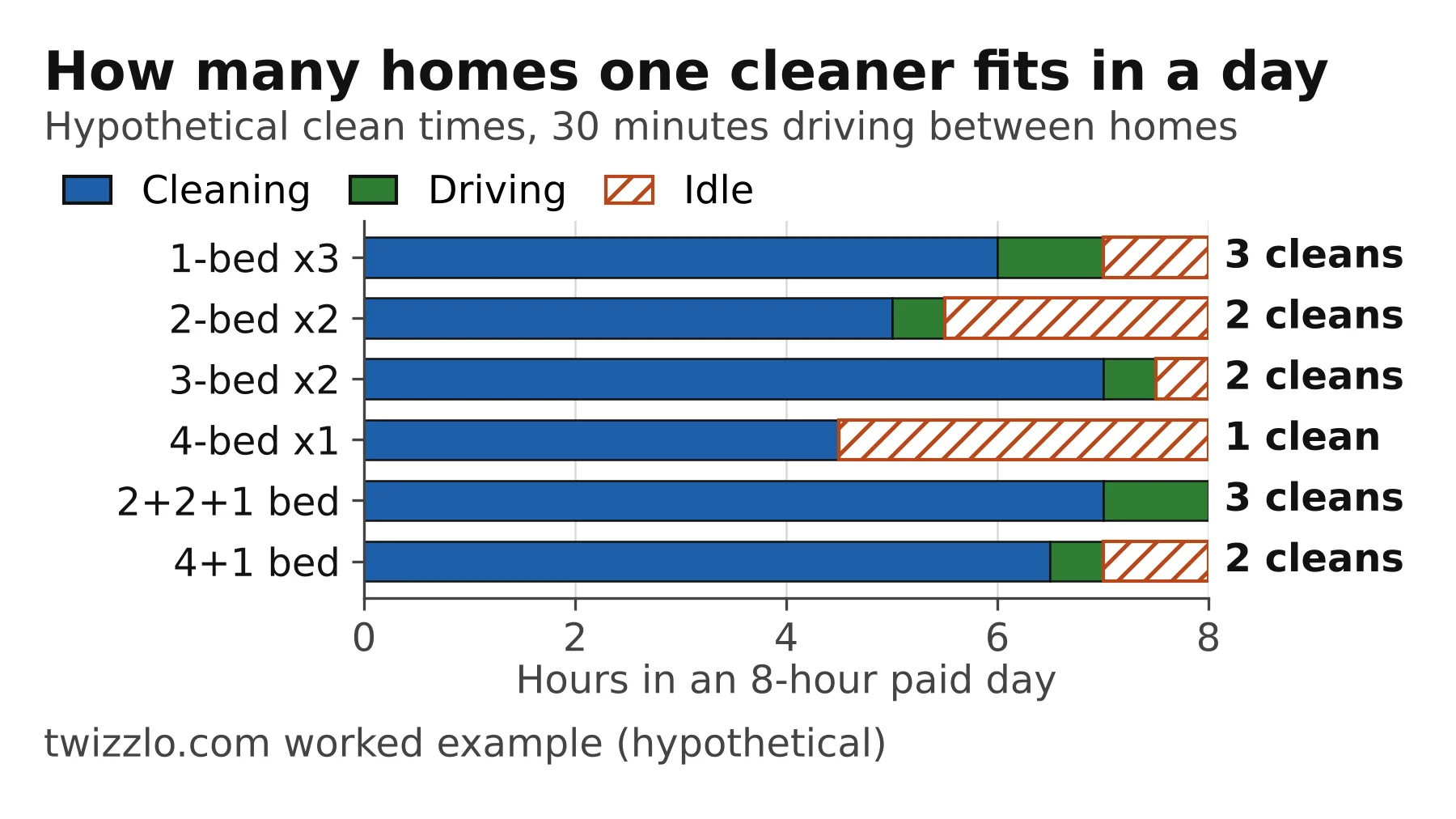
- Mixing home sizes fills a cleaner's day: two two-bedroom homes plus a one-bedroom use all eight hours in our example.
- Idle hours still cost wages: in our example, a two-bedroom clean costs $78.97 on a half-empty day, not $60.48.
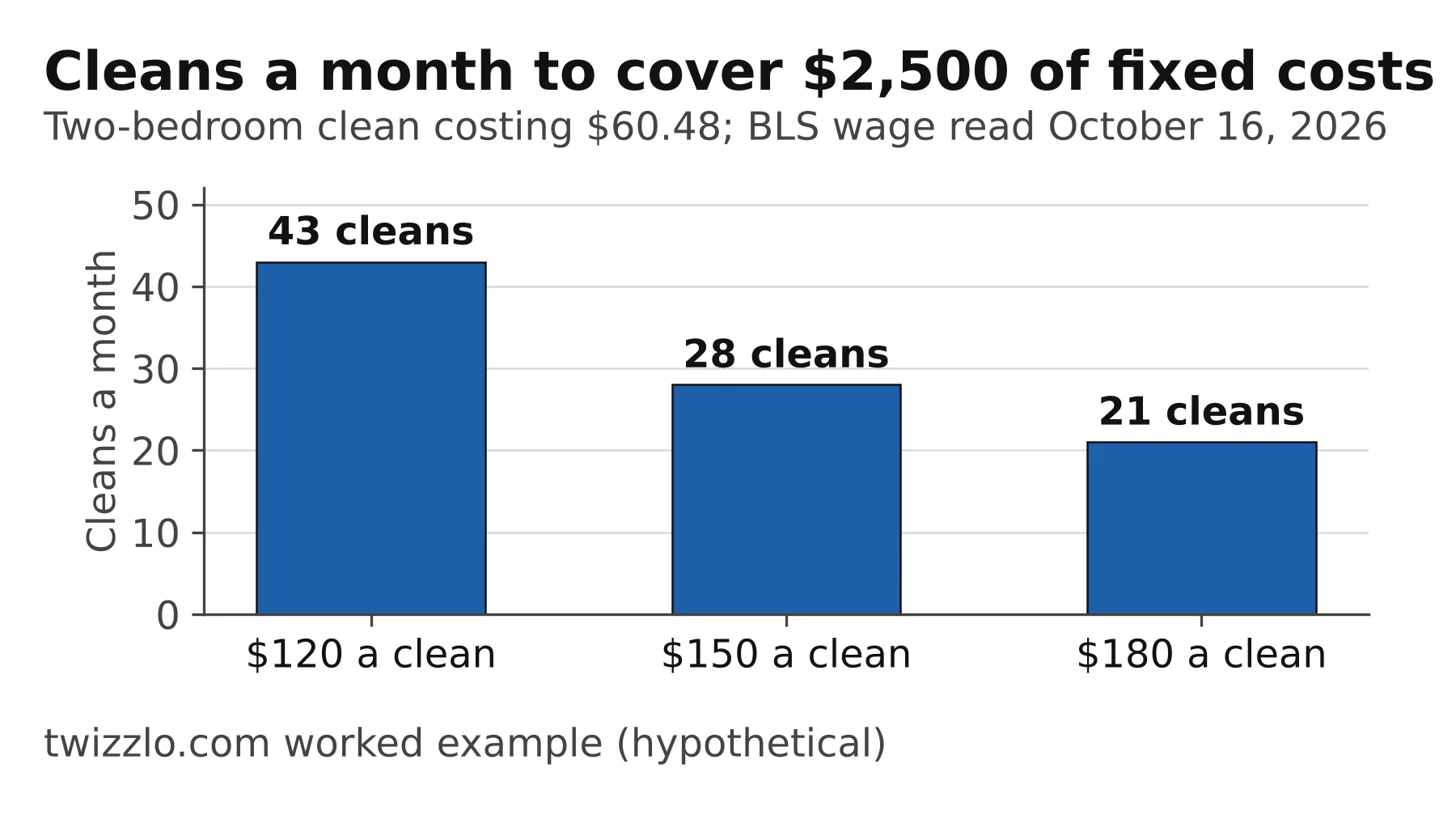
- In our example, raising a two-bedroom clean from $120 to $150 cuts break-even from 43 cleans a month to 28.
In this article9 sections
If your cleaning business is one person, a car and a few clients from friends, a plan still matters the day you want a loan, a van or your first hire. Each of those depends on one number: how much work one cleaner can do in a paid day. This guide gives you a template to copy and the arithmetic that turns home sizes into that number.
We read the plan guides that ranked for this search on October 16, 2026, from a U.S. connection. They came from Shopify, the Merry Maids franchise blog, a LivePlan sample plan, the cleaning trade association ISSA and Lovable, plus templates from Jobber and Housecall Pro. They agree on the sections. Few show how many jobs fit in a day, and the pay and price ranges some quote carry no source. Our wage figure comes from the U.S. Bureau of Labor Statistics (BLS), software prices come from each vendor's own pricing page, and every other number is a labelled hypothetical. Twizzlo, which publishes this guide, sells booking software, so product details and prices stay in the section about Twizzlo near the end, apart from the next paragraph.
For the booking and scheduling line of the plan, our cleaning service scheduling software page shows how a residential team takes standard and deep cleans online. It also shows a calendar for each cleaner with shifts and buffer time for the drive, and access notes on each client profile.
What a cleaning business plan has to answer
A cleaning business plan has to show what you clean, for whom, at what price, with which people, and how many cleans a month cover your costs.
| Section | What it answers | The cleaning question to settle |
|---|---|---|
| 1. Company summary | What the business is and what it needs to start | Residential, commercial or both, and your first service area |
| 2. Services and pricing | What you sell and how you price it | Standard, deep and move-out cleans priced by the hour, by home size or by job |
| 3. Service area and competition | Where you work and who else cleans there | ZIP codes you cover and how long the drive is between homes |
| 4. Team and pay | Who cleans and how they are paid | Employees or contractors, and the hourly wage you will offer |
| 5. Operations | How a day runs | Jobs per cleaner per day, supplies, checklists and keys or access codes |
| 6. Licenses, insurance and bonding | What you need before the first job | Local business license, liability insurance and a bond if clients ask for one |
| 7. Marketing and first clients | How clients find you | Google Business Profile, referrals and reviews from every client |
| 8. Financial plan | Startup cost, monthly cost and break-even | Labor cost per clean and the cleans a month that cover fixed costs |
Table 1. Every section appears in at least three of the five top-ranked guides we read on October 16, 2026. The third column is this guide's cleaning question for each.
A salon plan uses a similar frame with chair hours in place of home sizes, as our salon business plan template shows.
A cleaning business plan template to copy
Copy the cleaning business plan template below into your own document; there is nothing to download, just text to paste and edit. Replace each bracket with your details and write the company summary last, once the financial plan has numbers in it.
1. Company summary
[Business name] offers [residential, commercial or both] cleaning in [city or area], starting in [month, year].
We will be known for [standard cleans, deep cleans, move-out cleans or a niche such as vacation rentals].
To start we need $[amount] for [vehicle, equipment, supplies and insurance], funded by [savings, a loan or a partner].
Monthly costs covered from month [number], at [number] cleans a week.
2. Services and pricing
Services: [standard clean], [deep clean], [move-out clean], [add-ons such as oven or inside windows].
Pricing basis: [hourly per cleaner, a flat price by bedrooms and bathrooms, or a quote per job].
Price list: one-bedroom $[ ], two-bedroom $[ ], three-bedroom $[ ], four-bedroom $[ ].
Supplies: [we bring all products and equipment, or the client supplies them].
3. Service area and competition
ZIP codes or neighborhoods we cover: [list], with a typical drive of [minutes] between homes.
Competitors: [number] cleaning businesses in that area, with the prices they publish.
Our clients: [busy households, landlords, offices or rental hosts], and how they find cleaners.
4. Team and pay
At launch: [owner cleaning alone, or owner plus (number) cleaners].
Pay: $[ ] an hour for [employees or contractors], paid for [cleaning time only, or cleaning plus drive time].
Payroll costs on top of wages: [the figure from your payroll provider or accountant].
Next hire: when bookings pass [number] cleans a week.
5. Operations
Clean time by home size: one-bedroom [hours], two-bedroom [hours], three-bedroom [hours], four-bedroom [hours].
Jobs per cleaner per day: [number] (use the capacity math in the next section).
Checklists for each service, supply restocking day and how keys or access codes are stored.
Booking, reminders and payment: [the tool you will use] (see the cost table below).
6. Licenses, insurance and bonding
Business registration and local business license from [city or county office]: $[ ].
General liability insurance quoted at $[ ] a year; workers' compensation if you hire employees.
Bonding: [yes or no], quoted at $[ ], if commercial or residential clients ask for it.
7. Marketing and first clients
Launch plan: first [number] clients from [referrals, neighborhood groups, a local landlord or a realtor].
Google Business Profile with your service area, prices and a booking link.
A review request to every client after each clean, with nothing offered in return.
8. Financial plan
Startup costs: vehicle $[ ], vacuum and equipment $[ ], first supplies $[ ], insurance $[ ], license $[ ], opening reserve $[ ].
Monthly fixed costs: insurance $[ ], vehicle and fuel $[ ], phone $[ ], software $[ ], marketing $[ ].
Cost per clean: labor $[ ] plus supplies $[ ] (see the labor section).
Cleans needed each month: fixed costs $[ ] divided by what each clean leaves ($[ ] price minus $[ ] cost) = [number].
How many homes can one cleaner clean in a day?
In our hypothetical example, one cleaner fits three one-bedroom cleans or two two-bedroom cleans into an eight-hour paid day, counting 30 minutes of driving between homes. Only one four-bedroom clean fits.
| Day of cleans | Clean time each | Cleans in the day | Hours cleaning plus driving | Idle paid hours |
|---|---|---|---|---|
| One-bedroom homes | 2 hours | 3 | 7.0 | 1.0 |
| Two-bedroom homes | 2.5 hours | 2 | 5.5 | 2.5 |
| Three-bedroom homes | 3.5 hours | 2 | 7.5 | 0.5 |
| Four-bedroom homes | 4.5 hours | 1 | 4.5 | 3.5 |
| Mixed: 2 two-bedroom plus 1 one-bedroom | 2.5 and 2 hours | 3 | 8.0 | 0.0 |
| Mixed: 1 four-bedroom plus 1 one-bedroom | 4.5 and 2 hours | 2 | 7.0 | 1.0 |
Table 2. One cleaner, eight paid hours, 30 minutes of driving between cleans and none before the first. Clean times are hypothetical examples; time your own first 20 jobs and replace them.
The arithmetic: a day fits as many cleans as the eight hours allow once each drive is added. Three two-bedroom cleans would take 7.5 hours of cleaning plus one hour of driving, or 8.5 hours, so only two fit. Booking a one-bedroom home beside two two-bedroom homes uses the hours a single-size day would waste. Put your own clean times into the operations section, and plan each cleaner's week as a mix of home sizes rather than taking jobs in the order they arrive.
Commercial contracts change the math, because offices are often cleaned at night on a fixed schedule. Measure those jobs by hours a week per site, not by cleans a day. For carpet work priced by room, see our guide to carpet cleaning scheduling software.
What a clean costs you in labor
In our hypothetical example at the BLS median wage of $16.08 an hour (May 2023 estimates, read October 16, 2026), a two-bedroom clean costs $60.48 in labor and supplies when the day is full. That figure adds a hypothetical 15% to the wage for payroll costs.
The same BLS wage page for maids and housekeeping cleaners showed a mean of $16.66 an hour, $13.75 at the 25th percentile and $18.09 at the 75th. Wages in your area may sit well above or below those national figures, so use the rate you will actually offer. The 15% for payroll taxes and workers' compensation is a placeholder; ask your payroll provider for your real figure.
| Home size | Paid hours per clean (clean plus drive) | Labor at $18.49 an hour | Supplies (hypothetical) | Cost per clean |
|---|---|---|---|---|
| One-bedroom | 2.5 | $46.23 | $5.00 | $51.23 |
| Two-bedroom | 3.0 | $55.48 | $5.00 | $60.48 |
| Three-bedroom | 4.0 | $73.97 | $5.00 | $78.97 |
| Four-bedroom | 5.0 | $92.46 | $5.00 | $97.46 |
Table 3. $18.49 is the BLS median of $16.08 (read October 16, 2026) plus a hypothetical 15% for payroll costs. Clean times and supplies are the hypothetical examples from Table 2. Each clean carries one 30-minute drive, a slight overcount on the day's first job.
Those costs hold only when every paid hour is booked. A cleaner paid for eight hours who finishes two two-bedroom homes costs $147.94 for the day, or $78.97 a clean once supplies are added, not $60.48. That is why the capacity table comes first: idle hours raise the cost of every clean in the day. Whether your cleaners are employees or contractors changes payroll costs and who supplies equipment, so settle it with an accountant before the pay model goes into the plan.
How many cleans a month cover your fixed costs?
In our hypothetical example, $2,500 a month of fixed costs takes 43 two-bedroom cleans at $120 to cover, 28 at $150 or 21 at $180.
| Price of a two-bedroom clean | Cost per clean | Left over per clean | Cleans a month to break even |
|---|---|---|---|
| $120 | $60.48 | $59.52 | 43 |
| $150 | $60.48 | $89.52 | 28 |
| $180 | $60.48 | $119.52 | 21 |
Table 4. Fixed costs of $2,500 a month (insurance, vehicle, phone, software and marketing) are a hypothetical example. Break-even cleans are rounded up to whole cleans.
The arithmetic: break-even is fixed costs divided by what each clean leaves after labor and supplies. At $150, $2,500 divided by $89.52 is 27.9, so 28 cleans. At two two-bedroom cleans a day, that is 14 working days for one cleaner. Every clean after that adds $89.52 to profit before tax. Weekly and every-two-weeks clients make this line steadier than one-off deep cleans, so show how many of each you expect. If the owner also cleans, decide whether the owner's own pay sits in fixed costs or comes out of what is left over, and say which in the plan.
Which startup and monthly costs belong in the plan?
The plan needs startup lines for a vehicle, equipment, a license, insurance, marketing and an opening reserve, plus monthly lines for supplies, software and fuel, each with the quote or published price behind it.
| Cost line | When it is paid | Where the number comes from |
|---|---|---|
| Vehicle, or mileage on your own car | Startup, then monthly | Loan quote or your mileage log |
| Vacuum, mops, caddies and equipment | Startup | Supplier price lists |
| Cleaning products and consumables | Monthly | Supplier prices times cleans a month |
| Business license and registration | Startup, then at renewal | Your city or county office |
| General liability insurance and a bond | Yearly | Broker quotes |
| Booking, scheduling and payment software | Monthly | The vendor's pricing page; see the note below and our booking software comparisons |
| Marketing: website, profile and print | Startup, then monthly | Quotes and your own budget |
| Opening reserve | Startup | The months of fixed costs you want covered |
Table 5. Cost lines to price for section 8 of the template.
Price the software line at the team size and bookings you expect, not the ones you have today. A cleaner averaging three cleans a day, five days a week, books about 65 a month (three times five times 52, divided by 12). On October 16, 2026, the calculator on ZenMaid's pricing page showed Starter at $23 a month for one cleaner, capped at 40 appointments a month. Pro, with unlimited appointments, was $53 a month for one cleaner and $95 for four, and SMS charges were not included. Our guide to cleaning service software prices more tools at one, three and eight cleaners. Before the first client signs, put your prices and cancellation terms into writing with our cleaning service contract template.
Where Twizzlo fits
Twizzlo is web-based online booking and appointment scheduling software for appointment-based service businesses, and in a cleaning business plan it covers the booking, scheduling and payment line.
Each clean is a service with its own price and length, so a two-bedroom and a four-bedroom clean can be separate services. Each cleaner has a calendar, and Employee Shifts set working hours by location and week. Buffer times leave a gap after each visit for the drive to the next home, and access notes sit on the client profile. Prepaid bookings take the full price of a deep or move-out clean through Stripe. Twizzlo's features page does not list route planning, recurring bookings, quotes or dispatch, so a business built on weekly routes should compare the field service suites in the cleaning software guide above.
Free is $0 a month for up to 150 bookings a month, free forever and not a trial, with no SMS. Business Pro is $29.99 a month per business for unlimited bookings, with 50 SMS a month included, then $0.03 each, and a 30-day money-back guarantee. Both plans include unlimited staff and locations. Online payments carry your Stripe processing rate plus a 1.5% Twizzlo platform fee. Details are on the Twizzlo pricing page.
The solo cleaner's 65 bookings a month from the costs section fit within Free's 150 bookings, with email reminders. A team of four cleaners at that pace books about 260 a month and needs Business Pro. Sending each client one text reminder uses the 50 included texts plus 210 more at $0.03, or $6.30, for $36.29 a month. If clients prepay 20 deep cleans a month online at a hypothetical $250, the $5,000 carries $75 in platform fees before Stripe's rate.
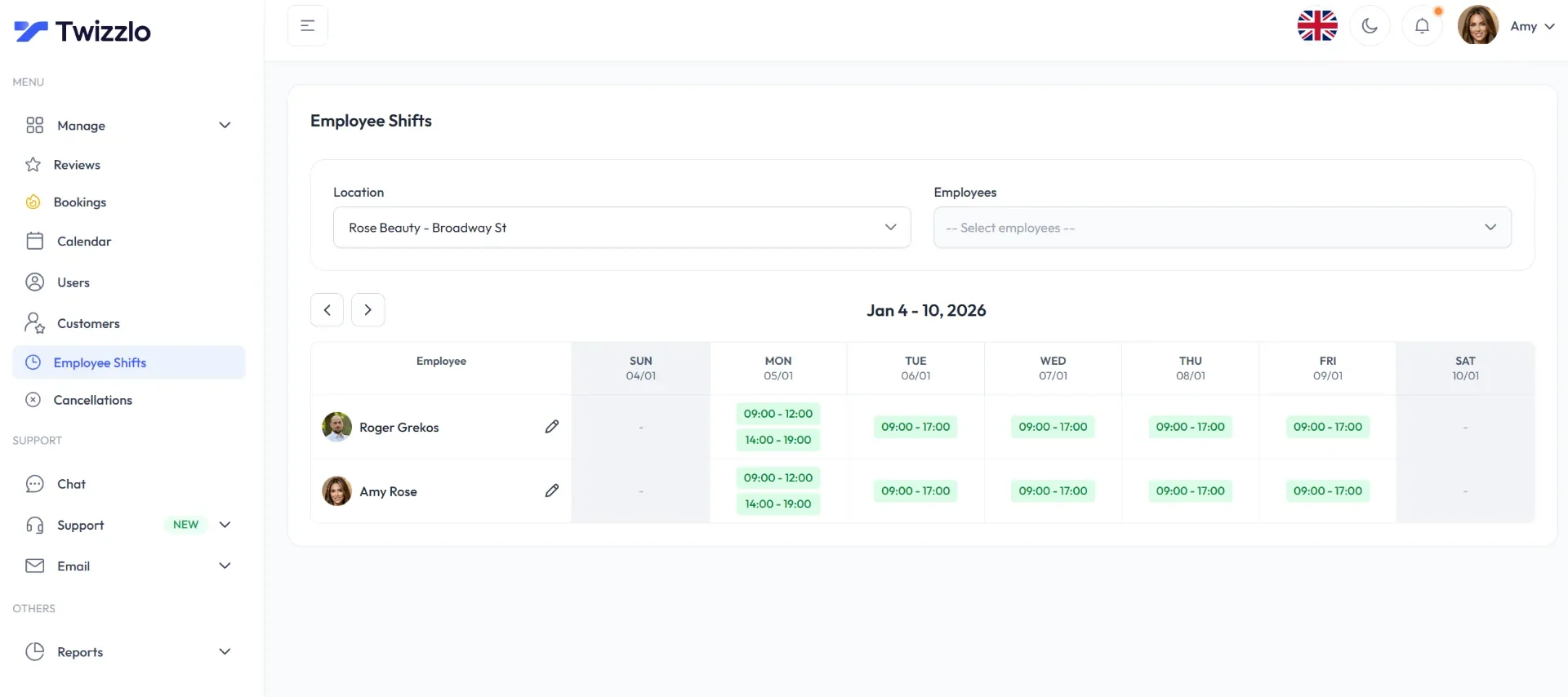
To set up services and cleaner shifts before your first booking, you can start on the Free plan, then upgrade to Business Pro past 150 bookings a month or when you want text reminders.
Frequently asked questions
Do I need a business plan to start a cleaning business?
You need one when a lender, a partner or a vehicle finance company asks for it. Even a solo cleaner gains from the financial plan, because it shows how many cleans a month cover insurance, fuel and supplies before you set prices.
What should a cleaning business plan template include?
Eight parts: a company summary, services and pricing, service area and competition, team and pay, operations, licenses and insurance, marketing and a financial plan. The operations part should record clean times by home size, because the financial plan depends on them.
How many houses can a cleaner clean in a day?
It depends on home size and drive time. In our hypothetical example with an eight-hour paid day and 30 minutes between homes, one cleaner fits three one-bedroom cleans, two two-bedroom or three-bedroom cleans, or one four-bedroom clean. Mixing sizes fills more of the day.
How do I price cleaning jobs in a business plan?
Start from the paid hours each clean takes, including the drive, times your loaded hourly wage, plus supplies. The BLS median for maids and housekeeping cleaners was $16.08 an hour (May 2023 estimates, read October 16, 2026). Then set a price that leaves enough per clean to cover fixed costs at a number of cleans you can book.
Should a new cleaning business hire employees or contractors?
It is a legal and tax question that turns on how much control you have over the work. The answer changes payroll costs, insurance and who supplies equipment, so ask an accountant before you write the team and pay section.
Sources and methodology
Prices read
- U.S. Bureau of Labor Statistics: Occupational Employment and Wages, May 2023, 37-2012 Maids and Housekeeping Cleaners (opens in a new tab)Read . Supports: Median $16.08, mean $16.66, 25th percentile $13.75, 75th percentile $18.09 an hour (labor section, Table 3, Figure 2, FAQ 4)
- ZenMaid pricing page (opens in a new tab)Read . Supports: Calculator read October 16, 2026: Starter $23 a month for one cleaner, up to 40 appointments a month; Pro $53 for one cleaner and $95 for four, unlimited appointments; SMS charges not included (costs section)
- Twizzlo pricing page (opens in a new tab)Read . Supports: Free and Business Pro plans, SMS, guarantee, 1.5% platform fee
- Twizzlo features page (opens in a new tab)Read . Supports: Calendar per staff member, services with price and duration, buffer times, Employee Shifts, prepaid bookings through Stripe; screenshot source
From our editorial policy
- Our templates, such as consent forms, contracts and confirmation messages, are text to copy and adapt to your business. They are not legal advice. Have a qualified local professional review anything you rely on.
- We do not publish invented quotes, studies, statistics, customer stories or product tests, and we do not imply hands-on use of a product when the research came from the vendor's public documentation.
- To report an error, email support@twizzlo.com with the subject line "Correction: [page URL]". Tell us what is wrong and, if you can, link a source.
Start free, upgrade when you grow
Flat-rate booking software. No per-seat, per-chair or per-location fees.
- Free plan up to 150 bookings a month, not a trial
- Business Pro is $29.99 a month per business for unlimited bookings, with a 30-day money-back guarantee
- 24/7 support by email