
Booth Rental Contract: A Guide for Salon and Spa Owners

In short
A booth rental contract, also called a booth rental agreement, is the signed deal between a salon owner and an independent stylist, barber or esthetician who rents a station to run their own business. It names the parties and the exact booth and sets rent, due dates, shared expenses, house rules, insurance, client ownership and exit terms.
- Name the parties and the exact booth, then write rent, due date, late fees and deposit as numbers, not intentions.
- List what rent includes and what is billed separately, with the formula, so shared costs never turn into monthly arguments.
- Keep salon rules to the premises and leave prices, schedule and clients to the renter, because control decides contractor status.
In this article9 sections
Without a written contract, a salon owner and a renter end up arguing about late rent, utilities, client ownership, keys, product storage and whether the renter is really an employee.
Twizzlo publishes this guide and sells salon scheduling software. We are not a law firm, and nothing here is legal advice: have a local attorney review your final agreement.
What is a booth rental contract for a salon, and why do you need one?
A booth rental contract is the written deal that lets an independent stylist, barber or esthetician run their own business from a station in your salon. You need one because every term left in texts or verbal promises, from utilities to notice, is a term both sides can later remember differently.
A strong booth rental contract should answer five basic questions fast:
- Who is renting. Full legal name, business name if they use one, and current contact details (clause 1).
- What space they get. The exact station, suite, or room, plus any included furniture or storage (clause 2).
- What comes with the rent. Utilities, Wi-Fi, laundry, dispensary access, break room use, parking, front desk access, and shared equipment (clauses 2 and 7).
- How money works. Rent amount, due date, accepted payment methods, late fees, deposits, and bounced payment rules (clauses 4, 5 and 6).
- How the relationship ends. Required notice, move-out condition, key return, final balances, and what happens if someone leaves abruptly (clause 14).
If two reasonable adults can read the contract and reach different conclusions, the contract is weak.
This matters for more than rent collection. Your agreement also supports the business model itself. Booth rental only works when the renter is running an independent business. The contract must reflect that reality. If your daily practices say one thing and your paperwork says another, you are creating legal and tax trouble for yourself.
If your salon lease has restrictions on subletting, room use, or shared commercial space, review them before you draft renter terms.
The contract sets expectations. Its main value is what it prevents.
Salon booth rental agreement template to copy
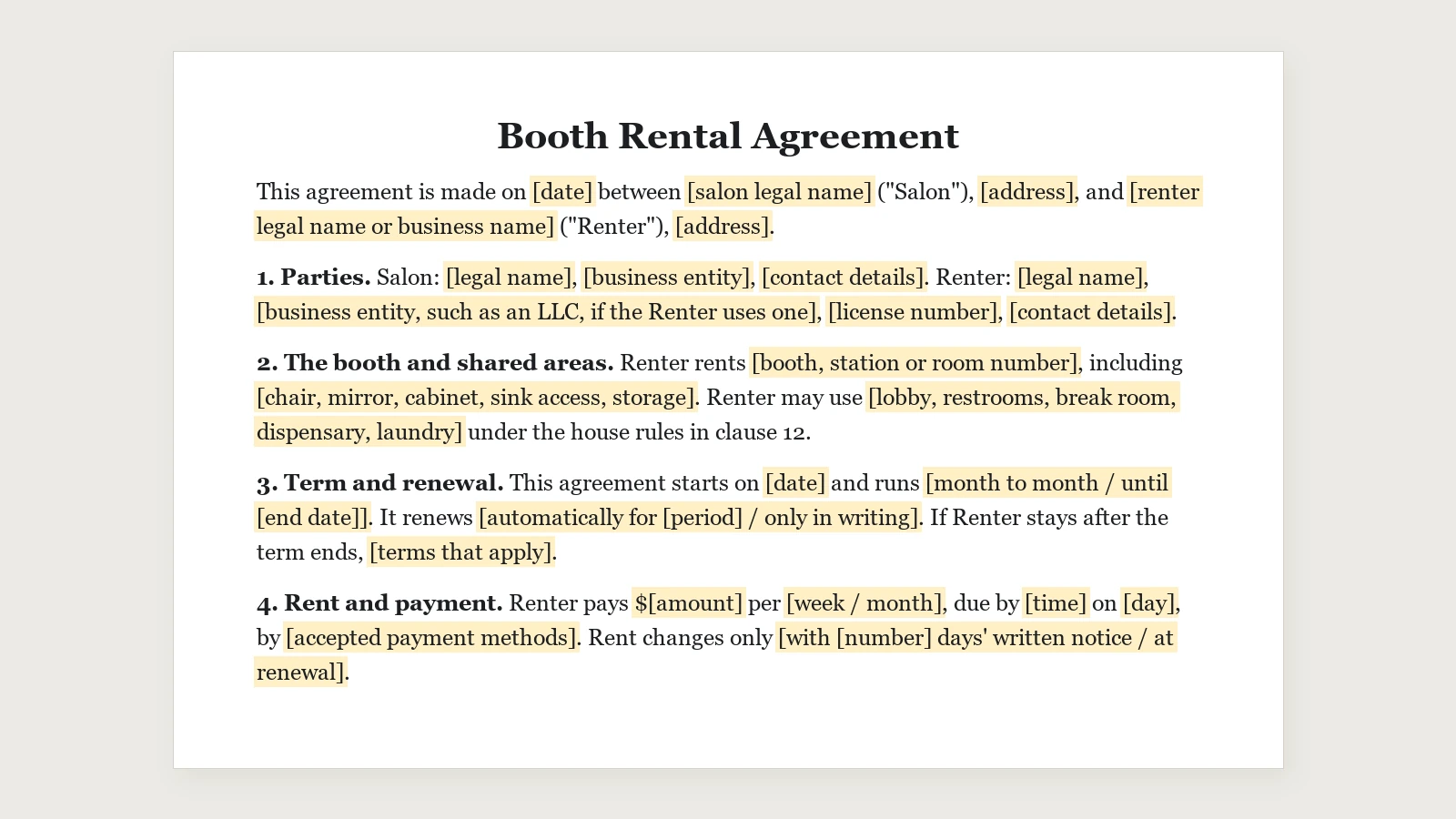
Copy the agreement below, replace every bracketed field with your own terms and keep the clause numbers so both sides can refer to them. It has 15 numbered clauses and a signature block, running from the parties and the booth to move-out and changes in writing. Have a local attorney review the final version before anyone signs.
It works for a station, suite or room in a salon, spa or barbershop. There is no file to download and nothing to sign up for.
Booth Rental Agreement
This agreement is made on [date] between [salon legal name] ("Salon"), [address], and [renter legal name or business name] ("Renter"), [address].
1. Parties. Salon: [legal name], [business entity], [contact details]. Renter: [legal name], [business entity, such as an LLC, if the Renter uses one], [license number], [contact details].
2. The booth and shared areas. Renter rents [booth, station or room number], including [chair, mirror, cabinet, sink access, storage]. Renter may use [lobby, restrooms, break room, dispensary, laundry] under the house rules in clause 12.
3. Term and renewal. This agreement starts on [date] and runs [month to month / until [end date]]. It renews [automatically for [period] / only in writing]. If Renter stays after the term ends, [terms that apply].
4. Rent and payment. Renter pays $[amount] per [week / month], due by [time] on [day], by [accepted payment methods]. Rent changes only [with [number] days' written notice / at renewal].
5. Deposit. Renter pays a deposit of $[amount] on signing. Salon returns it within [number] days after move-out, less [items], each listed in writing.
6. Late payment. Rent not received by [time] on [day] is late. The late fee is $[amount] [once / per day, up to $[cap]]. [Number] late payments in [period] count as a default under clause 14.
7. Included services and shared expenses. Rent includes [items, such as electricity, water, Wi-Fi, trash, laundry or front desk use]. Billed separately: [item], calculated as [formula], due [date], with [documentation]. Optional add-ons: [item and price], each accepted or declined in writing. If the Salon requires booking software, [Salon / Renter] pays for it.
8. Permitted services. Renter may provide [services]. New services need the Salon's written approval. Not allowed on the premises: [services and the reason, such as odor, noise, cleanup or building restrictions].
9. Independent business. Renter runs an independent business. Renter sets their own prices, schedule, services, methods and promotions, keeps their own client relationships and pays their own taxes. Salon rules cover only the premises, the shared areas and legal compliance.
10. Licenses and insurance. Renter keeps [licenses] current and carries [insurance type and minimum coverage], with proof before move-in and at each renewal. Salon keeps [premises license and insurance] current.
11. Equipment, damage and repairs. Salon provides [salon-owned items]. Renter brings and maintains their own tools and products. Renter reports damage within [number] hours and pays for damage beyond normal wear, measured against the condition recorded at the move-in walkthrough.
12. House rules. Renter follows the house rules on access hours [hours]; keys and alarm codes, with a lost-key charge of $[amount]; cleaning and sanitation [standards]; music and noise [limits]; guests and children [policy]; retail display [rules]; and use of the lobby, break room and reception [rules].
13. Clients, booking pages and business identity. [Clients the Renter brings or builds belong to the Renter.] Leads from the Salon's website, walk-ins, front desk or social media are assigned [as follows]. Phone numbers, online booking pages, social handles and listing profiles tied to the Salon's name belong to [the Salon].
14. Default, notice and move-out. Default includes [nonpayment, an expired license, missing insurance, repeated rule violations, unlawful conduct, property damage]. After written notice, Renter has [number] days to fix [late payment / a rule violation]. [Working without a required license] ends this agreement [immediately]. Either side may end this agreement with [number] days' written notice by [delivery method]. At move-out, Renter [cleans the booth, returns all keys, removes their property within [number] days and pays any final balance].
15. Changes in writing. This document is the whole agreement. A change counts only if it is written and signed by both sides.
Signatures
Salon
Name: [name]
Title: [title]
Signature: ____________________
Date: ____________________
Renter
Name: [name]
Signature: ____________________
Date: ____________________
This template is a starting point, not legal advice. Booth rental, licensing and worker-classification rules differ by state, so have a local attorney review the final agreement.
How to fill in the agreement
- Write numbers and dates, not words like "reasonable" or "promptly."
- Delete every bracketed option you do not use, so only one term remains.
- Sign a separate agreement for each renter and keep dated copies.
What should a booth rental contract include?
A booth rental contract should include 15 terms: the parties, the booth, the term, rent, the deposit, late payment, included and shared expenses, permitted services, the independent-business clause, licenses and insurance, equipment and damage, house rules, client ownership, default and move-out, and a rule that every change is made in writing.
A renter spills color on your cabinetry, starts offering a new service your plumbing cannot support, stops paying on time, then argues that none of it was covered. That is what a weak contract looks like in real life. The point of this agreement is not to sound legal. The point is to stop expensive arguments before they start.
| Clause | What it settles | The dispute it prevents |
|---|---|---|
| 1. Parties | Legal names, business entities, license number and contact details | A dispute over a nickname instead of a legal name or LLC |
| 2. Booth and shared areas | The exact station or room, its furniture and storage, and which shared areas the renter may use | One renter spreading into another's storage or assuming a color bar is shared |
| 3. Term and renewal | Start date, any end date, renewal and what happens if the renter stays on | Vacant stations after a sudden exit, or a renter paying for time they no longer use |
| 4. Rent and payment | Amount, weekly or monthly cycle, due date, payment methods and how rent can rise | Rent arguments that start with vague terms, and surprise increases |
| 5. Deposit | The amount paid on signing, when it comes back and what can be kept | Arguments at move-out over what is returned |
| 6. Late payment | When rent is late, the fee and when repeated lateness becomes a default | An owner negotiating every late payment as a one-off exception |
| 7. Included and shared expenses | What rent includes, what is billed separately and by what formula, and who pays for required booking software | "Utilities included" turning into monthly arguments |
| 8. Permitted services | The services allowed, how new ones get approved and what is prohibited | A renter investing in a service the salon will not allow |
| 9. Independent business | The renter's control of prices, schedule, methods, clients and taxes; salon rules stop at the premises | Paperwork that says renter while daily practice says employee |
| 10. Licenses and insurance | Required licenses and coverage, with proof at move-in and at renewal | One uninsured problem spilling across the whole business |
| 11. Equipment, damage and repairs | Who supplies which items, how damage is reported and who pays for it | Wear-or-damage fights over cabinets, handles and sinks |
| 12. House rules | Access hours, keys and codes, sanitation, noise, guests, retail display and shared rooms | Rules enforced by mood instead of in writing |
| 13. Clients and business identity | Who owns clients, salon-generated leads, phone numbers, booking pages and profiles | An ugly breakup over the client book |
| 14. Default, notice and move-out | What counts as default, time to fix it, how notice is given and move-out duties | A bad month turning into an abrupt, costly exit |
| 15. Changes in writing | The signed document is the whole deal, and every change is written and signed | Side promises in texts that each side remembers differently |
A strong booth rental contract does two jobs at once. It keeps rent predictable, and it keeps the working relationship workable. The best contracts also explain the why behind each clause, because people follow rules faster when they understand the risk those rules are there to control.
Identify the parties and the exact space
Start with the names that matter in a dispute (clauses 1 and 2). Use full legal names, business entities, and current contact information for both sides. If the renter operates through an LLC, list the LLC, not just the stylist’s nickname.
Then describe the rented area with enough detail that a stranger could walk in and identify it. Booth number. Room number. Sink access. Storage cabinet. Waiting area use. Included furniture.
This is not paperwork for paperwork’s sake. Space disputes create daily friction. One renter spreads into another person’s storage. Someone assumes a color bar is shared. Another person claims a private room includes extra hallway shelving. Write it down now or referee it later.
Set the term so nobody gets trapped or surprised
Choose a term that fits how you run the business (clause 3). Month to month works well if you want flexibility and faster course correction. A fixed term works if you invested in buildout, furniture, or marketing support and need a predictable commitment in return.
State these points clearly:
- Start date
- End date, if there is one
- How renewal happens
- How much notice each side must give
- What happens if the renter stays after the term expires
Owners often focus only on the notice period. The smarter move is to tie notice to your operating reality. If your salon usually needs a few weeks to fill a chair, say so and set a notice period that gives you a fair shot at replacing that income. Renters should push for equal clarity so they do not get stuck paying for time they are not using.
Put the exit rules in writing before the relationship is tested.
Write the money clause like it will be read in court
Rent fights are rarely about the amount. They are about vagueness. If payment terms are loose, renters fill in the blanks with whatever suits them, and owners get dragged into endless exceptions.
Your contract should state (clauses 4 to 6):
- The rent amount
- Whether rent is weekly, biweekly, or monthly
- The exact due date
- Accepted payment methods
- Deposit amount and conditions
- Late fee terms
- What happens after missed payments
- How and when rent increases can happen
Be direct about consequences. If rent is due Friday by 6 p.m., say that. If a payment is late on Saturday morning, say what fee applies. If two late payments in a quarter trigger default, say that too.
Precise terms serve both sides. Owners get predictable cash flow. Renters get fewer surprise fee changes and random policy shifts. Fair terms keep good people. Fuzzy terms chase them out.
Separate included expenses from shared expenses
Owners lose money in small amounts, and these accumulate until it becomes a real problem. “Utilities included” sounds friendly. It also creates arguments unless you define what utilities means.
List each item (clause 7):
- Included in rent, such as electricity, water, Wi-Fi, trash, laundry, or front desk use
- Billed separately, with the formula, due date, and backup documentation
- Optional add-ons, with the renter’s right to accept or decline
If booking software is required, say who pays. If laundry use has limits, write the limits. If reception support only covers greeting clients and not managing a renter’s calendar, make that plain.
The why matters here. Unclear shared costs create resentment fast because renters feel nickeled and dimed, while owners feel taken advantage of. A clean expense clause keeps routine overhead from turning into a trust problem.
Define allowed services before someone tests the limits
Do not assume a license answers this question. It does not. Your lease, insurance, plumbing, ventilation, local code, and floor plan all affect what can happen inside your space.
Spell out what services the renter may provide (clause 8). If a new service requires your written approval, say that. If certain treatments are prohibited because of odor, noise, cleanup demands, or building restrictions, list them.
This keeps your business model clear. It also gives renters a fair boundary line. Nobody wants to invest in new equipment or market a service only to hear later that the salon will not allow it.
Assign responsibility for equipment, tools, and damage
Clause 11 prevents the petty fights that sour a salon. The owner says a broken cabinet handle is damage. The renter says it was old already. The owner says a clogged sink came from misuse. The renter says it is normal wear.
Stop relying on common sense. Common sense disappears when money is involved.
Use a clear split like this:
| Responsibility Area | Typically Salon Owner's Duty | Typically Booth Renter's Duty |
|---|---|---|
| Workspace | Provide the booth, room, or station as described | Keep assigned area orderly and usable |
| Furniture and fixtures | Supply agreed salon-owned items like chair, mirror, cabinetry | Avoid damage and report issues promptly |
| Tools and service products | Provide only what the contract specifically includes | Bring and maintain personal tools and products |
| Utilities and Wi-Fi | Provide included services listed in the contract | Pay any separate or allocated shared charges |
| Common areas | Maintain lobby, restrooms, and shared zones | Use shared areas properly and clean up after use |
| Licensing and insurance | Maintain business-level requirements for the premises | Maintain personal licenses and required coverage |
| Booking and marketing | Provide only agreed shared support | Handle personal clients, promotions, and schedule if independent |
| Taxes | Handle the salon’s own business taxes | Handle personal income and contractor tax obligations |
Require proof of licensing and insurance
Do not treat this as a handshake issue. Make it a document issue. The contract should require the renter to keep all required professional licenses current and maintain any insurance you require, with proof provided before move-in and again at renewal (clause 10).
The proof matters beyond compliance. One uninsured problem can spill across the whole business and reach your reputation and your other renters.
Put operational rules in writing without acting like an employer
Owners get this wrong in both directions. Some write nothing and end up enforcing rules by mood. Others write rules that sound like an employee handbook and create classification risk.
The fix is simple. Write rules about the space and shared operations, not the renter’s professional judgment (clause 12).
Good contract rules often cover:
- Access hours
- Alarm, key, or code procedures
- Cleaning standards
- Trash, towels, and sanitation duties
- Music and noise limits
- Guest and child policies
- Retail display rules
- Use of lobby, break room, and reception areas
- Building safety requirements
These clauses should answer one question. What does this renter need to do to use the premises without creating headaches for everyone else?
Clarify client ownership and business identity
Clause 13 saves ugly breakups. If the renter brings their own clients, say that those clients belong to the renter. If leads come through the salon website, walk-in traffic, front desk, or salon social media, say who controls those leads and how they are assigned.
Do the same for phone numbers, online booking pages, retail accounts, social handles, and listing profiles tied to the salon name.
This is also a negotiation point, not just an owner dictate. If you expect the renter to benefit from your brand and marketing machine, you may have a fair argument for tighter rules around salon-generated leads. If the renter is building and funding their own client book, they need language that says that book is theirs.
Define default, cure periods, and exit duties
No owner likes writing the breakup section. Write it anyway. This is the part that keeps a bad month from becoming a legal mess.
State (clause 14):
- What counts as default, such as nonpayment, expired license, missing insurance, repeated rule violations, unlawful conduct, or property damage
- Whether the renter gets time to fix the problem
- How notice must be delivered
- What happens at move-out, including cleaning, repairs, abandoned property, key return, and final balances
Do not give every breach the same treatment. Late payment may deserve a short cure period. Working without a required license may justify immediate termination. Match the consequence to the risk.
If you want another example of clean business language around scope, payment, and termination, review this coaching contract template for service businesses. The format is different, but the lesson is the same. Clear terms prevent emotional arguments.
Is a booth renter an independent contractor or an employee?
Whether a booth renter is an independent contractor or an employee turns on control: the renter should control the work, and the salon only the premises. The IRS sorts the evidence into behavioral control, financial control and the type of relationship, and says no single factor decides (IRS independent contractor pages, read September 27, 2026). State tests can differ.
| Factor (IRS wording, shortened) | What the IRS asks | Clauses in this template that speak to it |
|---|---|---|
| Behavioral | Does the company control, or have the right to control, what the worker does and how the worker does the job? | 9 (independent business), 12 (house rules), 13 (clients) |
| Financial | Are the business aspects of the job controlled by the payer, such as how the worker is paid, whether expenses are reimbursed and who provides tools and supplies? | 4 (rent), 7 (expenses), 11 (equipment) |
| Type of relationship | Are there written contracts or employee-type benefits, will the relationship continue, and is the work a key aspect of the business? | 3 (term), 14 (default and move-out) |
A clause helps only when daily practice matches it.
A renter pays weekly booth rent, sets up their own station, and calls themselves independent. Then the owner tells them which days to work, what to charge, which products to use, and how to handle time off. That setup falls apart fast. If a state board, tax agency, or labor investigator looks past the title and sees employee-level control, the contract will not save you.
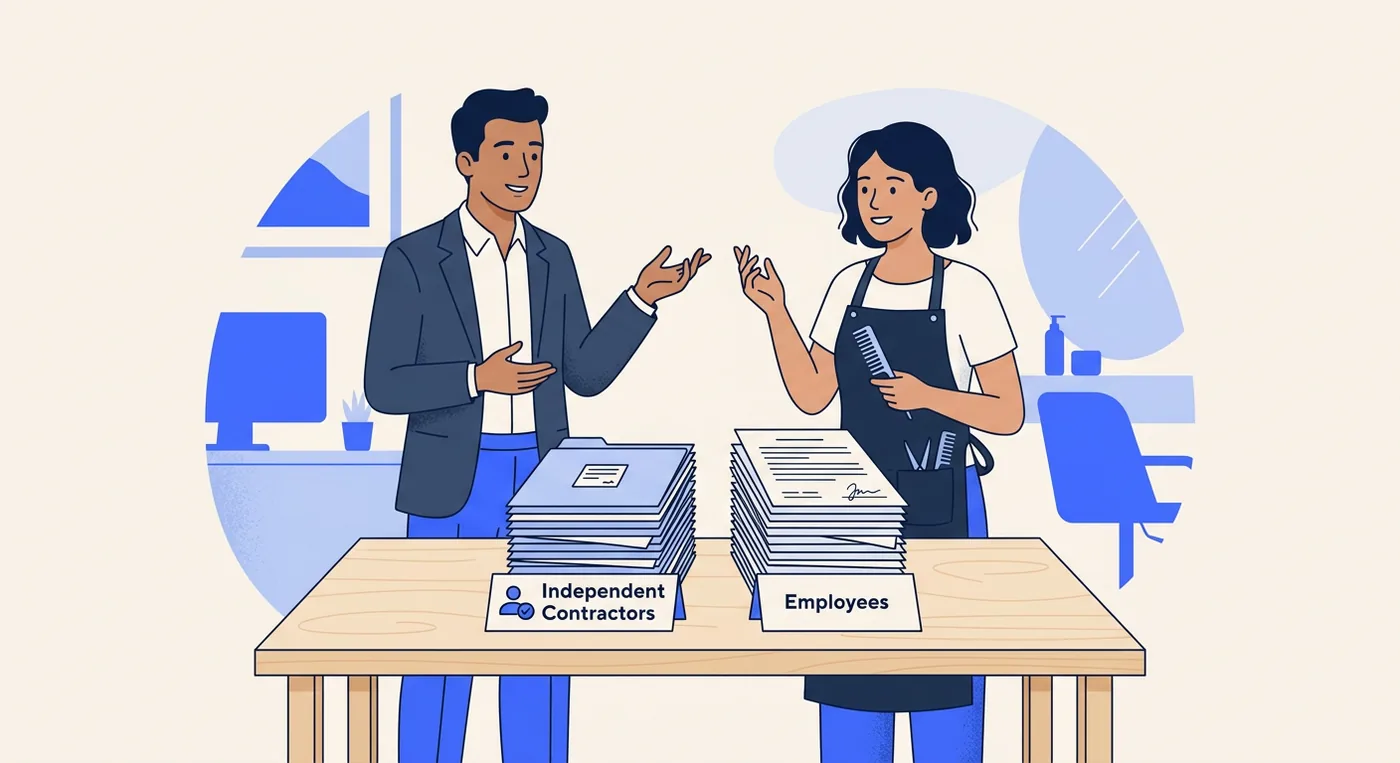
Owners create expensive problems for themselves when the paperwork and the daily practice disagree. If an employer-employee relationship exists, the IRS says the worker is not an independent contractor, whatever the relationship is called (IRS, "Independent contractor defined", read September 27, 2026).
The test is control
Forget labels for a minute. Focus on who controls the work.
A real booth renter runs an independent business inside your space. They usually control their pricing, schedule, service methods, client relationships, and business decisions, as long as they follow health rules, licensing rules, and reasonable property rules.
You control the premises. That includes rent, access, sanitation standards for the facility, shared-space expectations, security, and maintenance. Keep your hands there.
Owners get into trouble when they keep the renter model on paper and run an employee model in practice. Common examples include:
- setting fixed shifts
- requiring approval for time off
- dictating service prices
- requiring specific service methods, not just safety standards
- routing all bookings through the salon as if the renter were staff
- assigning clients the renter must take
- disciplining renters for performance issues the way a manager would handle employees
That behavior creates the financial risk behind this clause. The core question is why the line matters. Control creates liability.
Write the clause to match real operations
Your contract should say the renter is responsible for their own taxes, licensing, insurance, supplies if that is your model, pricing, schedule, and client book. Then your daily operations need to match those words.
Use language that draws a clean line:
- Owner controls: the rented space, common areas, building access, sanitation requirements, noise, safety, utilities, and house rules tied to the property
- Renter controls: appointments, rates, services offered, work methods, rebooking, client communication, and business promotion
That split serves both sides. The owner lowers the odds of a classification dispute. The renter gets the freedom that makes booth rent worth paying for in the first place.
Smart negotiation points for both sides
This part gets overlooked, and it should not.
Owners should push for rules about the salon itself. Require proof of license and insurance. Require compliance with sanitation laws. Set boundaries for shared spaces, key access, guest policies, and damage to equipment. Those rules deal with property risk and regulatory risk, not worker control.
Renters should push back on anything that turns them into managed staff. If the contract controls their hours, pricing, discounts, client communications, or service process, the deal is drifting away from true booth rent. Fix it before signing.
A good contract does not scare away talented professionals. It shows them you know the difference between protecting the business and micromanaging their business.
If you are still choosing between an employee model and booth rental, the salon business plan template compares the two models.
A classification checklist for booth rental
Do this
- state that the renter runs an independent business
- require the renter to handle their own taxes and insurance
- keep copies of licenses, insurance certificates, and signed agreements
- limit salon rules to the premises, legal compliance, and shared operations
- let the renter control their own book of business
Do not do this
- assign set shifts like employee scheduling
- set or approve the renter’s prices
- require manager approval for time off
- evaluate performance like payroll staff
- fold renters into employee policies that control how they perform services
What state rules and red flags should you check?
Check three things before you rely on any template: your state board's rules for booth renters, your state's worker-classification test and your own commercial lease. Salon, barber and classification rules vary by state, and a lease can restrict subletting or shared use of the space.
A booth rental contract can be solid on paper and still fail in practice if it ignores state rules. Salon, barber, and cosmetology laws vary. Worker classification rules vary. Licensing rules vary.
That means you should never pull a random template online, change the names, and assume you’re covered. Use this article to get smart before you talk to a local attorney, not instead of talking to one.
Red flags of a weak booth rental contract
Some problems jump off the page immediately.
- The space isn’t clearly described. If the contract doesn’t identify the exact booth, room, or storage rights, expect arguments later (clause 2).
- Payment terms are fuzzy. If there’s no precise due date or no written consequence for nonpayment, the owner will end up negotiating every month (clauses 4 and 6).
- No clause on shared expenses. Utilities, laundry, software, and cleaning create tension when nobody defines responsibility (clause 7).
- No exit language. If the agreement doesn’t explain notice, breach, and move-out duties, the breakup will be expensive and personal (clause 14).
Red flags that create misclassification trouble
These are more serious because they can undermine the whole business model.
A bad contract may require attendance at mandatory staff meetings, force the renter to work fixed shifts, require use of specific product lines in a way that controls the service method, or dictate exact service pricing. Those terms don’t just feel heavy-handed. They start to look like an employee arrangement.
What to bring to a lawyer
Don’t walk into a legal review with vague questions. Bring the actual operating details.
Take these with you:
- Your intended rental structure. Weekly or monthly rent, any deposit, and whether costs are shared (clauses 4, 5 and 7).
- Your house rules. Hours, keys, sanitation, reception use, retail, and common-area expectations (clause 12).
- Your classification plan. What the renter controls versus what the salon controls (clause 9).
- Your local licensing details. State board requirements, landlord rules, and any building restrictions (clause 10).
A lawyer can fix wording. They can’t fix a confused business model you haven’t thought through.
The best contracts are boring. They don’t try to sound intimidating. They remove ambiguity before it becomes a point of contention.
How do you negotiate and finalize the agreement?
Negotiate the rent, start date, term length and what the rent includes. Keep payment timing, late fees, insurance and license proof, access rules, sanitation standards and the exit steps fixed. Then walk the booth together, write every agreed change into the contract and sign dated copies.
A strong renter wants to move in by next week. The energy is good, the chair will stop sitting empty, and everyone wants to keep the process easy. That is exactly when owners make expensive mistakes. They agree to side promises, skip hard questions, and sign a contract that looks fine until the first late payment, client complaint, or ugly exit.
Good negotiation starts with one rule. If a term will cost you money, time, or legal trouble later, put it in writing now.
Negotiate from operating reality, not optimism
Do not price a booth based on what you hope this renter will become. Price it based on what the space must earn, what the market supports, and how much friction your setup removes for the renter.
A booth with reception support, laundry, online booking access, prime foot traffic, and strong walk-in volume can justify more than a bare station and a key. Owners who ignore that either undercharge and resent the renter later, or overcharge and watch good candidates walk.
The same logic applies to concessions. A short intro rate can make sense if it has a firm end date in the contract. Open-ended discounts create arguments.
Know what can move and what should stay fixed
Everything does not deserve equal flexibility. Treating every clause like a bargaining chip makes you look disorganized.
Terms that are usually fair to discuss:
- Rent amount within a realistic range (clause 4)
- Start date (clause 3)
- Initial term length (clause 3)
- What is included in rent (clause 7)
- A limited move-in concession or ramp-up period (clause 4)
Terms that should stay fixed:
- How and when rent is paid (clause 4)
- Late fees (clause 6)
- Insurance and license requirements (clause 10)
- Access rules for keys, guests, and common areas (clauses 2 and 12)
- Cleanliness and sanitation standards (clause 12)
- Default, notice, and termination steps (clause 14)
- The renter’s control over their own business, which supports independent contractor status (clause 9)
Here is the why behind that split. Rent and timing affect deal fit. Insurance, sanitation, payment rules, and exit procedures affect business survival.
If a renter fights you on the fixed terms, pay attention. You are not negotiating style. You are getting an early preview of how they will behave once they have the keys.
Give both sides clear tradeoffs
Strong renters do not need a softer contract. They need a clear one.
Say this plainly: your agreement covers their independence, your income, and the working environment everyone depends on. Then walk through the terms that usually cause tension. Explain what the renter gets in exchange for the rent. Explain what happens if payment is late. Explain who pays for damage, lost keys, extra cleaning, or unpaid client disputes tied to their business.
This is also the time to discuss negotiation points that good renters care about. Storage. Guest policies. Retail commissions. Reception support. Cancellation expectations. If the renter manages their own appointments, they also need a written client policy. A simple guide on charging a no-show fee can help them protect their chair income without creating front-desk drama for you, and a booking confirmation email template keeps expectations clear before the first visit.
Finalize the deal like a professional
Do a live walkthrough before anyone signs. Confirm the exact booth, storage areas, shared equipment, break room use, cleaning expectations, hours, alarm access, and parking details. Verbal assumptions die hard. Fix them before move-in.
Then clean up the paperwork. Put every negotiated change into the contract itself. Do not rely on texts, handwritten side notes, or “we’ll remember.” You will not remember, and neither will they six months from now.
Last, sign dated copies and store them where you can find them fast. The best contract in the world is useless if the final version is scattered across email threads and screenshots.
A booth rental contract should keep your income predictable and your space in order without turning your salon into a courtroom. Keep it direct. Keep it specific. And make sure your daily behavior matches the agreement you're asking someone to sign.
The owners who avoid problems are rarely the nicest or toughest. They're the clearest.
If you're running multiple renters, multiple rooms, or multiple locations, clarity becomes even more important because small misunderstandings multiply fast. Write the contract like you plan to scale, not like you plan to improvise.
Where does Twizzlo fit when you rent out booths?
Twizzlo is web-based online booking and appointment scheduling software for appointment-based service businesses, and it fits a salon with booth renters in two ways: a renter who runs their own book can open a separate Twizzlo account with their own booking link, and the salon runs its own account for its employees and front desk. Free is $0 a month for up to 150 bookings, with no SMS.
Whatever tool you use, clause 13 should say who owns each booking page and client list. When a renter books clients through their own account, that clause is simpler to write.
Twizzlo Business Pro is $29.99 a month per business, with unlimited bookings, 50 SMS a month included then $0.03 per message, and a 30-day money-back guarantee. Free is free forever rather than a trial. Both plans include unlimited staff and locations, so adding employees or a second location never raises the Business Pro price. Online payments carry your Stripe processing rate plus a 1.5% Twizzlo platform fee. Support is available 24/7 by email. The pricing page lists both plans.
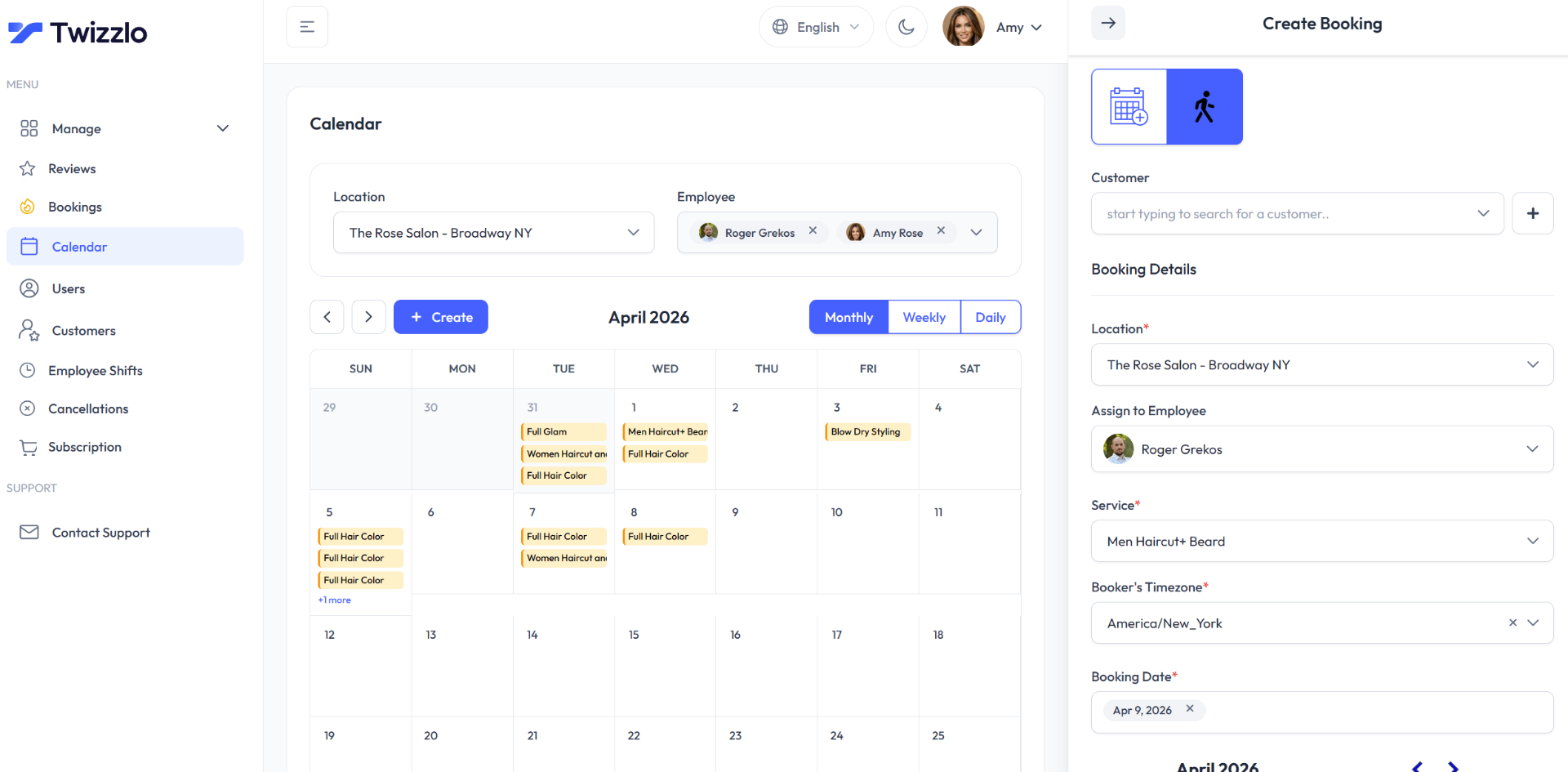
Barbershops that rent chairs work the same way; see Twizzlo's barbershop booking software.
Choosing an app rather than a contract? Renters can compare the best scheduling app for hair stylists, and salon teams can start with the best salon software.
If you want your employees on one calendar while each renter keeps their own book, start with Twizzlo's salon appointment software on the free plan.
Frequently Asked Questions About Booth Rental Contracts
Can I use a free booth rental contract template I found online
You can start there, but don’t stop there. Generic templates miss local rules, your actual salon setup, and the operational details that cause real disputes.
What should I do if a booth renter breaches the contract
Follow the written notice and default process in the agreement. Document the issue, give notice the way the contract requires, and avoid emotional side deals.
What’s a reasonable notice period to end the agreement
Many owners use a written notice period, but the right answer depends on your market, your operating model, and local law. Put it in writing and make sure both sides sign it.
Can a salon owner fire a booth renter
Not in the employee sense. You terminate the rental agreement based on the contract terms if the renter breaches the deal.
Should each booth renter have a separate contract
Yes. Use a separate signed agreement for each renter, even if the terms are mostly the same. Shared assumptions create messy disputes.
How much does it cost to rent a booth in a salon
There is no single market rate, and this guide deliberately avoids quoting one. Price the booth on what the space must earn, what your local market supports, and how much friction the setup removes for the renter. A station with reception support, laundry, online booking access, and strong walk-in traffic justifies more than a bare chair and a key. Structure it weekly or monthly, and put any increase rules in writing. A salon business plan template helps you work out what each chair needs to bring in.
How does booth rental work in a salon
The renter runs an independent business inside your space. They pay rent for a defined booth, suite, or room, and they control their own pricing, schedule, service methods, and client relationships. The owner controls the premises: access, sanitation standards, shared areas, and house rules. The contract holds the arrangement together by defining the space, the money, the rules, and how either side exits.
Who owns the clients when a booth renter leaves
Whatever the contract says, so say it clearly before anyone signs. The common split: clients the renter brought and built belong to the renter, while leads generated by the salon’s website, walk-in traffic, front desk, or social media are assigned however the agreement defines. Apply the same logic to phone numbers, online booking pages, and listing profiles tied to the salon name. Silence on this clause is how ugly breakups happen.
Is a booth renter an employee or an independent contractor?
It depends on who controls the work, not on what the contract calls the renter. Under the IRS general rule, a worker is an independent contractor when the person or business they work for has the right to control or direct only the result of the work, not what is done or how. The IRS groups the evidence into behavioral, financial and relationship facts, and no single fact decides (IRS independent contractor pages, read September 27, 2026). A renter who sets their own prices, hours and methods fits the contractor side better than one working salon shifts. State rules can differ, so confirm locally.
Should a booth rental contract be month to month or a fixed term?
Month to month suits a salon that wants flexibility and a faster way to correct a poor fit. A fixed term suits a salon that invested in buildout, furniture or marketing support and needs a predictable commitment. Either way, write the start date, any end date, how renewal happens, the notice each side must give and what happens if the renter stays on.
Sources and methodology
- IRS: Independent contractor (self-employed) or employee? (opens in a new tab)Read . Supports: The three categories of control evidence (behavioral, financial and type of relationship) and that no one factor decides
- IRS: Independent contractor defined (opens in a new tab)Read . Supports: The general rule on control of the result, and that an employer-employee relationship counts whatever it is called
- Twizzlo pricing page (opens in a new tab)Read . Supports: Twizzlo plan prices, booking cap, SMS allowance, money-back guarantee, 24/7 email support and the online payment fee
- Twizzlo features page (opens in a new tab)Read . Supports: The calendar screenshot in Figure 1 (same image)
From our editorial policy
- Our templates, such as consent forms, contracts and confirmation messages, are text to copy and adapt to your business. They are not legal advice. Have a qualified local professional review anything you rely on.
- To report an error, email support@twizzlo.com with the subject line "Correction: [page URL]". Tell us what is wrong and, if you can, link a source.
Update history
- : Added a 15-clause booth rental agreement template, a clause table and the IRS control factors; moved Twizzlo facts into their own section; fixed the FAQ schema.
Start free, upgrade when you grow
Flat-rate booking software. No per-seat, per-chair or per-location fees.
- Free plan up to 150 bookings a month, not a trial
- Business Pro is $29.99 a month per business for unlimited bookings, with a 30-day money-back guarantee
- 24/7 support by email