
Zenoti Pricing in 2026: What the Vendor Publishes and What Everyone Else Guesses

In short
Zenoti pricing is not published: every plan on Zenoti's pricing page ends at Get a Quote, with no price shown (read September 25, 2026). Five third-party estimates, read September 8, 2026, run from $225 to $600 a month before add-ons and setup fees. Treat them as a planning range and get Zenoti's quote in writing, line by line.
- Zenoti's pricing page prints no price; every plan ends at Get a Quote (read September 25, 2026).
- Five third-party estimates, read September 8, 2026, run $225 to $600 a month and count different units.
- Zenoti's FAQ bills voice, SMS and messaging by consumption, so ask for usage rates with any quote (read September 25, 2026).
In this article13 sections
If you have been hunting for Zenoti pricing and keep landing on pages that give you a different number every time, the reason is simple. Zenoti publishes no price at all. Its pricing page, read on September 25, 2026, ends every plan at Get a Quote and shows no currency figure. Every number you have read about Zenoti came from somewhere else, and those sources do not agree with each other. Twizzlo, which publishes this guide, sells spa booking software.
How much does Zenoti pricing actually cost per month?
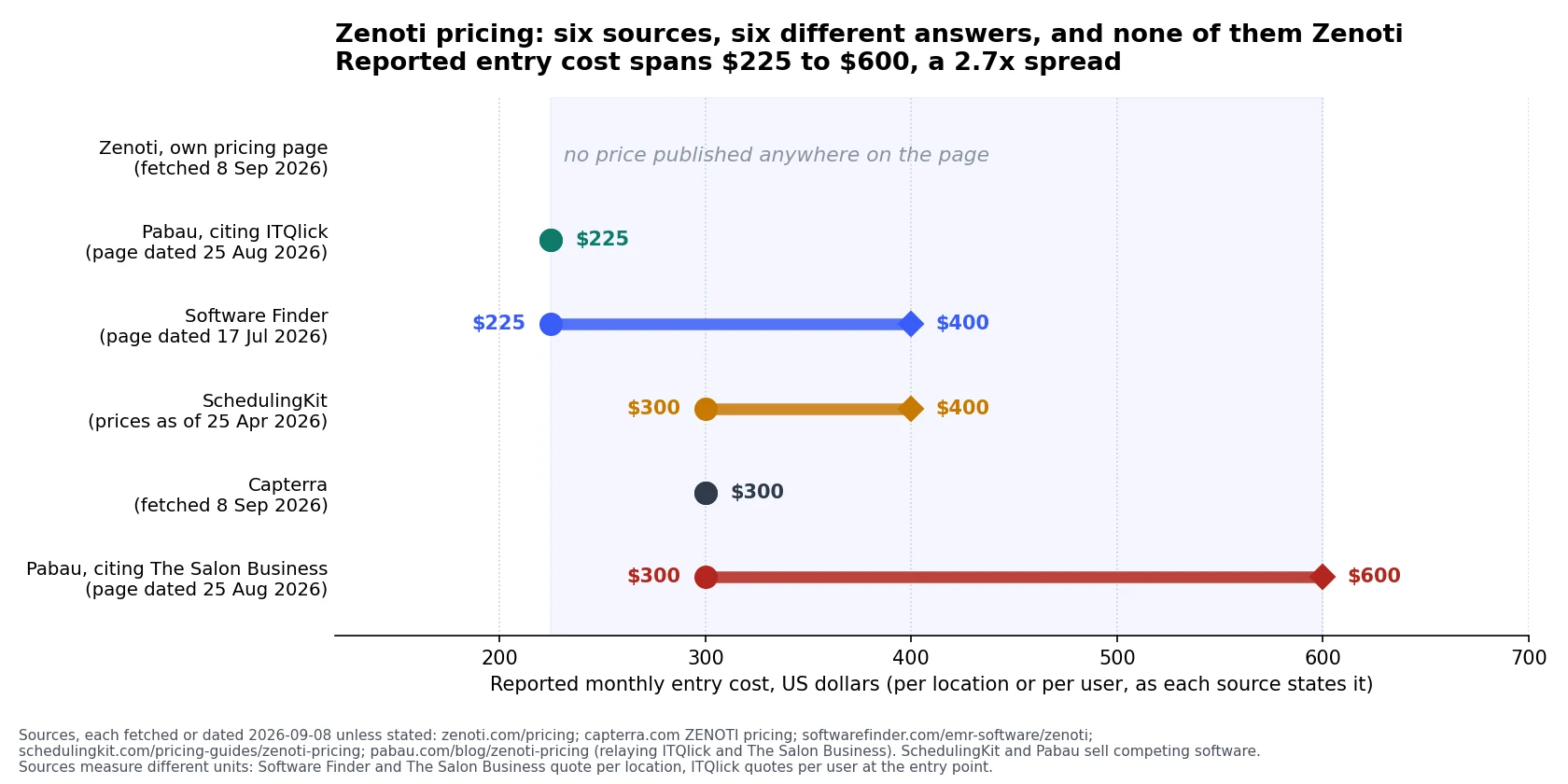
Nobody outside Zenoti's sales team knows, and the published estimates are far apart. Here is every figure found on the first page of results for the phrase on September 8, 2026, with the source and the date each source states.
| Source | Entry figure quoted | Date on the source |
|---|---|---|
| Zenoti, own pricing page | No figure published | Read September 25, 2026 |
| Capterra | $300.00 per month, one plan named Basic | Read September 8, 2026 |
| Software Finder | $225 to $400 per month per location | Page states last updated July 17, 2026 |
| SchedulingKit | Roughly $300 to $400 per month, single location | Page states prices as of April 25, 2026 |
| Pabau, citing ITQlick | Around $225 per month for a single user | Page states last updated August 25, 2026 |
| Pabau, citing The Salon Business | $300 to $600 per month, with options at $350, $450 and $500 per location | Page states last updated August 25, 2026 |
The low end is $225 and the high end is $600. A buyer reading two of these pages back to back could reasonably budget either $2,700 or $7,200 for a single location's first year, before a single add-on. That is a $4,500 difference on the subscription alone.
Two of those sources sell software that competes with Zenoti. SchedulingKit's guide ends with a pitch for SchedulingKit, and Pabau's ends with a pitch for Pabau. That does not make their numbers wrong, and both attribute their figures rather than inventing them. It does mean the numbers arrive with an interest attached, and a buyer should read them that way.
What does Zenoti publish on its own pricing page?
Structure, not price. Read on September 25, 2026, the page asks for a business type (Salon & Spa, Medspa, Fitness, Barbershop or Zenoti OS) and shows two blocks that each end at Get a Quote.
Zenoti OS is the foundation. The page, read September 27, 2026, groups its capability into Operations (appointment book, employee management, payroll and commissions, staff performance and goals, inventory, resource and room management, with eight further items collapsed), Transactions (point of sale, payment processing, Text2Pay, memberships and packages, gift cards, loyalty, plus six more) and Interactions (online booking webstore, social booking, Reserve with Google, marketing automation, reputation management, AI phone line, plus five more).
The second block, Your AI Workforce, listed ten AI agents on September 27, 2026, from an AI Receptionist that answers calls to an AI Dispute Manager for chargebacks and an AI Inventory Manager. The FAQ states plainly that you must be on the AI Plus package to use the AI agents.
Read on September 25, 2026, the FAQ confirms three cost facts that matter more than they first appear. Multi-location pricing is customized to your footprint. Communication usage is billed by consumption on top of the subscription, with optional base packs. And the page lists no free plan and no free trial.
One more detail worth recording: Zenoti has two pricing addresses in search. Semrush's US results for "zenoti pricing" on September 25, 2026, listed zenoti.com/
Why do the third-party Zenoti pricing estimates disagree so much?
Because they are reconstructions, and each one was reconstructed at a different moment from different fragments. The plan names make this visible.
Zenoti's own page, read on September 25, 2026, names Zenoti OS, the AI Plus package and an AI Workforce. Software Finder, whose page states July 17, 2026 (read September 8, 2026), names the same three. Pabau, whose page states August 25, 2026 (read September 8, 2026) and is therefore the more recently updated of the two, names a different set entirely: Growth, Hypergrowth and Complete. Capterra, read on September 8, 2026, lists one plan called Basic at $300.
So the freshest third-party page carries plan names the vendor's own site does not use, and the aggregator describes a plan structure that does not match either. A recent update date on a pricing article tells you when someone touched the file. It does not tell you whether the numbers were checked against the vendor.
There is a second reason the numbers scatter. The sources are not measuring the same thing. Software Finder quotes per location. ITQlick, as relayed by Pabau (read September 8, 2026), quotes per user at the low end and then per team size as it climbs, reaching roughly $1,800 a month for about ten users, $10,000 to $15,000 for around a hundred, and above $50,000 for large enterprise deployments. The Salon Business quotes per location per month. Comparing $225 to $500 is not comparing two prices for the same thing.
What are the add-on and one-time costs?
Third parties report add-ons of $29 to $400 a month per location and one-time costs from $2,000 to $30,000 and above (Pabau and Software Finder, read September 8, 2026); Zenoti's pricing page prints none of these figures.
This is where the total moves, and it is the part of Zenoti pricing that the entry-figure debate obscures. The figures below are third-party, and they are reproduced with the attribution each source gives, because none of them appears on Zenoti's own site.
Pabau, citing The Salon Business (read September 8, 2026), lists recurring add-ons per location: two-way messaging through ezConnect at $29 for WhatsApp only, $139 for SMS only and $169 for SMS with MMS or SMS with WhatsApp; reputation management through ezRepute Pro at $189; an AI chat and booking bot at $150 to $400; and employee performance tracking through ezPulse at $49. The same source prices marketing credits by volume, with email running from $200 for 10,000 messages to $1,500 for 300,000, and SMS from $180 for 5,000 texts to $1,000 for 50,000.
Take a single location that wants two-way SMS, reputation management and performance tracking. That is $139 plus $189 plus $49, or $377 a month in add-ons, sitting on top of a base subscription that might be $225 or might be $600. The add-ons alone can exceed the disputed base price.
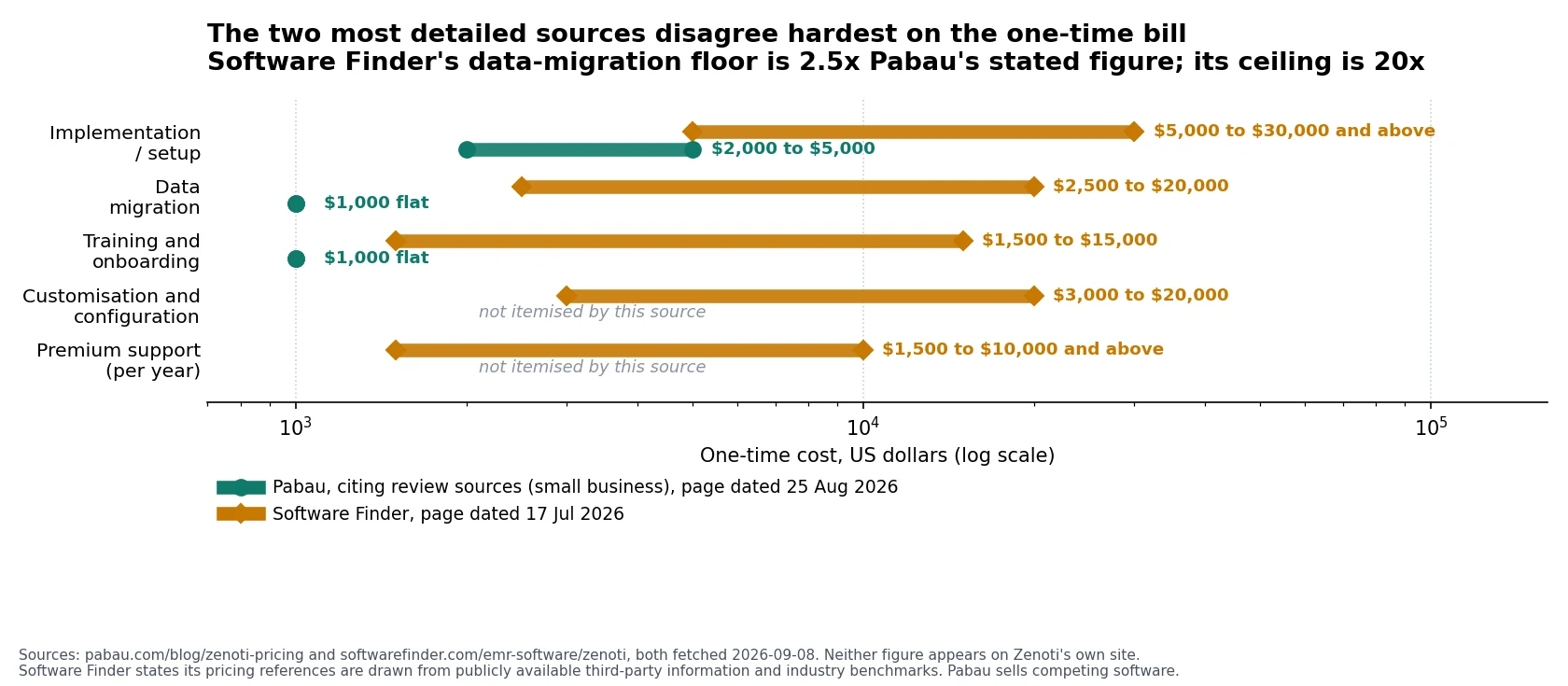
One-time costs are where the two most detailed sources, Pabau and Software Finder (both read September 8, 2026), disagree hardest.
| One-time item | Pabau, citing review sources | Software Finder |
|---|---|---|
| Implementation or setup | $2,000 to $5,000 for small businesses | $5,000 to $30,000 and above |
| Data migration | $1,000, covering up to two years of history | $2,500 to $20,000 |
| Training and onboarding | Included in the professional services fee of $1,000 | $1,500 to $15,000 |
| Customization and configuration | Not itemized | $3,000 to $20,000 |
| Premium support and success services | Not itemized | $1,500 to $10,000 or more per year |
Software Finder's floor for data migration is two and a half times Pabau's stated figure, and its ceiling is twenty times. Software Finder attaches its own disclaimer, stating the references are drawn from publicly available third-party information and industry benchmarks.
Pabau also reports that data migration covers up to two years of history with a white-glove import taking four to six weeks, and that onboarding runs on a similar timescale. Zenoti's own FAQ says most customers are live within days to weeks, with larger deployments phased (read September 27, 2026). Those two statements are not flatly contradictory, but a buyer planning a switch should ask which one applies to a business their size.
What does Zenoti's own FAQ say about the costs third parties estimate?
Zenoti's FAQ names the cost lines but prints no amounts. It says messaging usage is billed by consumption with optional base packs, every subscription includes onboarding support and training resources, and migration comes with white-glove support (read September 25 and 27, 2026). The table sets each line beside what third parties report and the question to put in writing.
| Cost line | What Zenoti's page says | What third parties report (read September 8, 2026) | Ask for in writing |
|---|---|---|---|
| Subscription | "Multi-location pricing is customized based on your footprint and needs." No price printed | $225 to $600 a month across five estimates that count per location, per user or one plan | The unit and the monthly figure per location |
| Messaging and calls | The subscription includes access to voice, SMS and messaging tools; "Usage is billed based on consumption with optional base packs." | Two-way messaging $29 to $169 a month per location; SMS credits from $180 for 5,000 to $1,000 for 50,000 (Pabau, citing The Salon Business) | The per-message and per-minute rates and what a base pack holds |
| Onboarding and training | "Every subscription includes onboarding support, training resources, and access to Zenoti University." | Inside a $1,000 professional services fee (Pabau); $1,500 to $15,000 (Software Finder) | Whether onboarding carries any one-time fee |
| Data migration | "Zenoti offers white-glove migration support." | $1,000 for up to two years of history (Pabau); $2,500 to $20,000 (Software Finder) | The years of history covered and the fee |
| Time to go live | "Most customers can be up and running in days to weeks." Larger deployments get phased rollouts | Four to six weeks for a white-glove import (Pabau) | A dated go-live plan |
| Support | 24/7 global support for every customer; AI Plus customers get a dedicated Customer Success Manager and priority assistance backed by SLAs | Premium support and success services $1,500 to $10,000 or more a year (Software Finder) | Which support tier the quote includes |
| AI agents | "You must be on our AI Plus package to leverage our AI Agents." | AI chat and booking bot $150 to $400 a month per location (Pabau, citing The Salon Business) | The AI Plus price |
Zenoti pricing page: subscription, messaging, AI Plus and Customer Success Manager lines read September 25, 2026; onboarding, migration, timing and 24/7 support lines read September 27, 2026. Third-party figures as printed on the pages named, read September 8, 2026.
Zenoti's page makes its own total-cost case, "Cancel the rest. Zenoti replaces them all," and its FAQ says most customers eliminate 8 to 12 separate subscriptions (read September 27, 2026); neither line prints a price a buyer can check before a quote.
What does Zenoti cost across three locations compared with Twizzlo's flat rate?
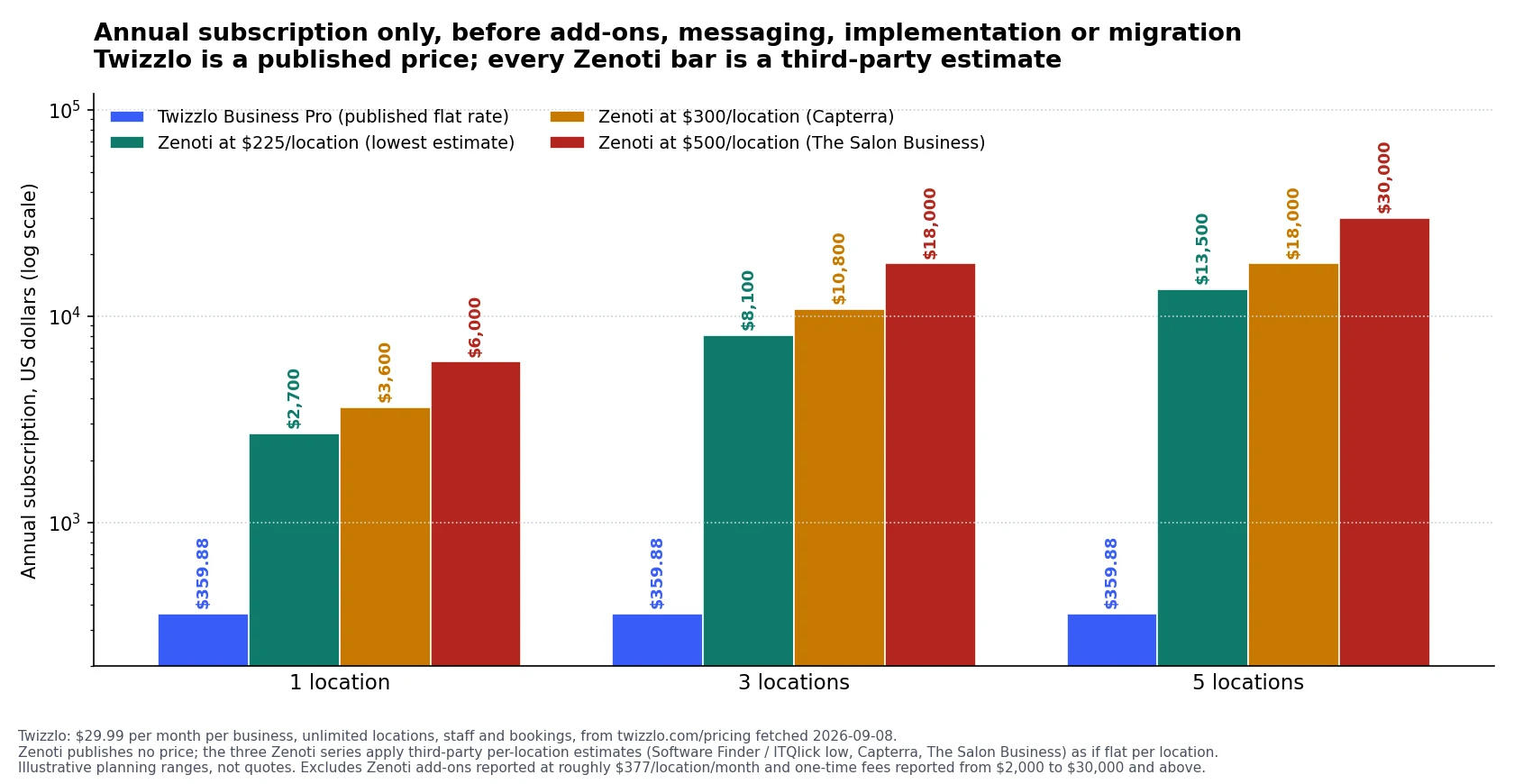
Over twelve months, a three-location group pays $359.88 on Twizzlo Business Pro and $8,100 to $18,000 at the $225 and $500 per-location estimates the table below uses (read September 8, 2026), before add-ons.
Worked arithmetic, using each party's own published position, makes the shape of the decision clearer than any single number.
Twizzlo publishes $29.99 a month per business on Business Pro, with unlimited bookings, employees, locations and customers, and a Free plan capped at 150 bookings a month, with no SMS (Twizzlo's pricing page, read September 27, 2026). That is a published figure on a public page, not an estimate. Business Pro includes 50 SMS a month, then $0.03 each.
For a three-location salon group over twelve months:
- Twizzlo Business Pro: $29.99 a month for the business, or $359.88 a year total, locations included.
- Zenoti at the lowest third-party estimate of $225 per location: $675 a month, or $8,100 a year.
- Zenoti at Capterra's $300: $900 a month, or $10,800 a year.
- Zenoti at The Salon Business's $500 per location: $1,500 a month, or $18,000 a year.
None of the Zenoti figures includes add-ons, messaging consumption, implementation or migration. Add the $377 monthly add-on stack from the section above across three locations and the annual figure rises by $13,572 on its own.
The Zenoti pricing column is estimate-based and should be read as a planning range, not a quote. The point of the comparison is not the precise gap. It is that the gap is roughly one to two orders of magnitude, and that only one side of it can be verified before you speak to a salesperson.
| Locations | Twizzlo Business Pro (published flat rate) | Zenoti at $225/location (lowest estimate) | Zenoti at $300/location (Capterra) | Zenoti at $500/location (The Salon Business) |
|---|---|---|---|---|
| 1 location | $359.88 | $2,700 | $3,600 | $6,000 |
| 3 locations | $359.88 | $8,100 | $10,800 | $18,000 |
| 5 locations | $359.88 | $13,500 | $18,000 | $30,000 |
Twizzlo: $29.99 a month per business, unlimited locations, staff and bookings, from twizzlo.com/pricing read September 27, 2026. Zenoti publishes no price; the three Zenoti series apply third-party per-location estimates (Software Finder / ITQlick low, Capterra, The Salon Business; read September 8, 2026) as if flat per location. Illustrative planning ranges, not quotes. Excludes Zenoti add-ons reported at roughly $377 a month per location and one-time fees reported from $2,000 to $30,000 and above.
What does Zenoti pricing add up to for one location in year one?
On the published estimates (third-party figures read September 8, 2026), one Zenoti location could cost about $5,700 to $16,200 in its first year before add-ons, and about $10,224 to $20,724 with the three add-ons priced above. The table combines figures already quoted in this article, so every line carries the same caveat: these are third-party estimates, not a Zenoti quote.
| Year-one line, one location | Low reading | High reading |
|---|---|---|
| Subscription, 12 months | $2,700 ($225 a month, lowest estimate) | $7,200 ($600 a month, highest estimate) |
| Implementation or setup | $2,000 (Pabau's floor) | $5,000 (Software Finder's floor) |
| Data migration | $1,000 (Pabau) | $2,500 (Software Finder's floor) |
| Training and onboarding | Inside Pabau's $1,000 professional services fee | $1,500 (Software Finder's floor) |
| Year one before add-ons | $5,700 | $16,200 |
| Two-way SMS, reputation and performance add-ons ($377 a month) | $4,524 | $4,524 |
| Year one with those add-ons | $10,224 | $20,724 |
The high reading uses Software Finder's lowest figures; its own ranges run to $30,000 and above for implementation alone. Message consumption sits on top of both columns, because Zenoti's FAQ says communication usage is billed by consumption. Take this table to the quote call and ask Zenoti to fill in its own number on each line.
Where does Zenoti beat a flat-rate tool like Twizzlo?
Zenoti beats a flat-rate booking tool in several places, all listed on Zenoti's own pricing page.
Zenoti's own page lists built-in payroll and commissions, inventory with resource and room management, a franchise product (Zenoti for Franchise), business intelligence dashboards, ten AI agents, and a dedicated Customer Success Manager with SLA-backed support for AI Plus customers (read September 25 and 27, 2026). It states 30,000+ businesses across more than 50 countries.
Twizzlo does not run payroll, commission tracking or memberships. Twizzlo is web-based online booking and appointment scheduling software for appointment-based service businesses, with a public booking page, reminders, client records, staff schedules and online payments, and a business that needs payroll run out of the same system it books appointments in should not shortlist it.
The criticism the third-party sources converge on is not capability. It is complexity and cost predictability. Capterra's own review excerpts include an owner writing that changing a product's price required going into several different places, and another noting that add-ons raise the cost especially across multiple centers. Pabau's summary of user complaints cites a steep learning curve and slow migration. Software Finder's own cons list leads with the learning curve for new users (all read September 8, 2026).
Who should shortlist Zenoti, and who should not?
Shortlist it if you run several locations, need payroll and inventory inside the booking system, carry clinical records, operate a franchise, or have someone whose job includes owning a platform rollout for four to six weeks. The sources agree on this profile even while disagreeing on Zenoti pricing.
Skip it if you are a single location or a small team booking appointments and taking payments. At the lowest third-party estimate (read September 8, 2026), one Zenoti location costs $2,700 a year before add-ons, you cannot see the price before a sales call, and the capability you would be paying for is payroll, inventory and franchise tooling you would not switch on. A flat-rate booking platform that scales without per-seat fees is a better shape for that business, and our note on appointment software with no seat fees sets out why per-user pricing punishes growing teams. If you decide to skip it, our Zenoti alternatives guide compares eight platforms priced from their own pricing pages.
If you are between the two, running two or three locations and wondering whether you have outgrown simple booking, the honest test is whether you need centralized payroll and inventory or just centralized calendars. Our guide to multi-location scheduling software works through that distinction, and Mangomint versus Boulevard covers the mid-market tier that sits between a flat rate and a Zenoti quote.
What should you ask on the Zenoti quote call?
Since Zenoti pricing arrives verbally rather than on a page, write the questions down first. Every one of these maps to a cost that the published estimates disagree about.
- Is the quoted subscription per location, per user, or per business, and what happens to it when I open a fourth location?
- Which of Zenoti OS, AI Plus and AI Workforce does this quote include, and what does each additional layer cost?
- Are two-way messaging, reputation management and employee performance tracking included, or are they separately billed add-ons?
- What is the consumption rate for SMS, WhatsApp and voice once the base pack is used, and what does the base pack include?
- What is the one-time total for implementation, configuration, training and data migration, quoted as a single number?
- How many years of historical data does the migration fee cover, and what is the fee beyond that?
- What is the contract term, what is the notice period, and what is the early termination charge?
- Will this quote be honored at renewal, and what is the cap on the annual uplift?
Ask for the answers in writing. A platform that does not publish a price should at least be willing to put one in an email.
Where Twizzlo sits
Twizzlo publishes its price because the price is the argument. One flat paid plan at $29.99 a month per business covers unlimited bookings, employees, locations and customers, with no per-seat charge and no modules held back behind a higher tier. There is a Free plan capped at 150 bookings a month, and it is a plan rather than a trial. Free has no SMS. Business Pro includes 50 SMS a month, then $0.03 each, and carries a 30-day money-back guarantee. Both plans include unlimited staff and locations (Twizzlo's pricing page, read September 27, 2026). Online payments carry your Stripe processing rate plus a 1.5% Twizzlo platform fee. You can read all of that on the Twizzlo pricing page without booking a call.
That approach fits salons, spas and studios that want a calendar, payments, reminders and a client record without a procurement process. It does not fit an enterprise chain that needs payroll and franchise tooling in one system. If you are shopping for the former, start with salon scheduling software, online booking for day spas, or the equivalent for med spas. If you want to see how the published-price platforms compare against an enterprise system with a sales-led model, our Mindbody comparison covers the closest analogue, and the best spa management software roundup puts the tiers side by side.
Frequently asked questions
How much does Zenoti cost per month?
Zenoti does not publish a monthly price: its pricing page, read September 25, 2026, shows none. Third-party sources checked on September 8, 2026, place the entry figure between $225 and $600 per month, with Software Finder quoting $225 to $400 per location, Capterra listing $300, and Pabau relaying reports of $300 to $600. Larger deployments are reported far higher, reaching $10,000 to $15,000 monthly at around a hundred users (ITQlick, via Pabau). Every one of those numbers is an estimate produced by someone other than Zenoti.
What does Zenoti cost in the first year?
Zenoti publishes no price, so any first-year figure is an estimate. Using the third-party figures quoted in this article (read September 8, 2026), one location lands between about $5,700 and $16,200 before add-ons (subscription plus implementation, migration and training), and about $10,224 to $20,724 with two-way SMS, reputation management and performance tracking at $377 a month. Twizzlo Business Pro is $359.88 for the same year ($29.99 a month on Twizzlo's pricing page, read September 27, 2026).
Does Zenoti offer a free plan or a free trial?
Zenoti's pricing page lists neither (read September 25, 2026), and every call to action on it leads to a quote request or a demo booking. Capterra (read September 8, 2026) records free trial as not available and free version as not available, while noting that no credit card is required to request pricing. If a free evaluation matters to you, that is a structural difference rather than a negotiating point, and platforms with published free tiers are a different category of purchase.
Why is Zenoti pricing so hard to find?
Because Zenoti quotes every deal individually, based on business type, your footprint and the add-ons and AI Plus package you take, its FAQ indicates (read September 25, 2026). That is a legitimate model for enterprise software, and it is also why review sites, competitors and forum posts have filled the gap with reconstructions that disagree by a factor of nearly three. The vendor's silence is the direct cause of the noise.
What are Zenoti's hidden costs?
The recurring extras reported by third parties (read September 8, 2026) are messaging, reputation management, AI chat and employee performance tracking, each billed per location, together with metered email and SMS credits. Zenoti's own FAQ confirms the metering (read September 25, 2026), stating that communication usage is billed by consumption with optional base packs. One-time implementation, configuration, training and data migration are reported separately by Pabau and Software Finder, at figures ranging from $2,000 for a small business to $30,000 or more for a complex multi-location rollout.
What plans does Zenoti offer in 2026?
Read on September 25 and 27, 2026, Zenoti's pricing page asks for a business type (Salon & Spa, Medspa, Fitness, Barbershop or Zenoti OS) and shows two quote-only blocks: Zenoti OS, described as every workflow from booking to payroll, and Your AI Workforce, ten named AI agents. Its FAQ says the AI agents need the AI Plus package. Older plan names still circulate on third-party pages, including Growth, Hypergrowth and Complete (Pabau) and a single plan called Basic (Capterra), both read September 8, 2026; none appears on Zenoti's page.
Is Zenoti worth it for a single-location salon?
On the published evidence, rarely. A single location would pay $2,700 a year before add-ons at the lowest reported entry figure ($225 a month, Software Finder, read September 8, 2026), without being able to see the price in advance, and the capability driving that cost is payroll, inventory, franchise management and business intelligence. A single salon that needs a calendar, deposits, reminders and a client list is buying an enterprise system to use a fraction of it.
How does Zenoti pricing compare with Twizzlo?
They are opposite models. Twizzlo publishes Business Pro at $29.99 a month per business with unlimited bookings, staff and locations, plus a Free plan for up to 150 bookings a month (Twizzlo's pricing page, read September 27, 2026). Online payments carry your Stripe processing rate plus a 1.5% Twizzlo platform fee. Zenoti publishes no price and quotes after a call (its pricing page, read September 25, 2026). For a three-location group the published Twizzlo figure is $359.88 a year in total, while the lowest third-party Zenoti estimate works out at $8,100 a year before add-ons ($225 a month per location, Software Finder, read September 8, 2026). Zenoti offers payroll, inventory and franchise tooling, while Twizzlo covers booking, payments, reminders and client records, so the comparison is a question of what you need rather than which number is smaller.
Does Zenoti charge for onboarding and data migration?
Zenoti's FAQ says every subscription includes onboarding support, training resources and access to Zenoti University, and that it offers white-glove migration support; it prints no fee for either (read September 27, 2026). Third-party pages report one-time costs from $2,000 for implementation at a small business (Pabau) to $30,000 and above (Software Finder), read September 8, 2026, so ask Zenoti to state any one-time fee in writing.
Is Zenoti priced per location or per user?
Zenoti's pricing page does not say; its FAQ says multi-location pricing is customized based on your footprint and needs (read September 25, 2026). The third-party estimates count different units: Software Finder quotes $225 to $400 a month per location, ITQlick (via Pabau) about $225 a month for a single user, and The Salon Business (via Pabau) $300 to $600 a month, all read September 8, 2026. Ask which unit your quote uses.
Sources and methodology
Prices read
- Zenoti pricing page (opens in a new tab)Read . Supports: quote-only plans, business types, Zenoti OS modules, AI agents and AI Plus, FAQ lines on multi-location pricing, messaging, onboarding, migration, timing and support; quote-only status also read September 25, 2026
- Capterra Zenoti profile (opens in a new tab)Read . Supports: the $300 Basic plan figure, free trial and free version not available, review excerpts
- Software Finder Zenoti page (opens in a new tab)Read . Supports: $225 to $400 a month per location, plan names, one-time and support cost ranges, disclaimer and cons list
- SchedulingKit Zenoti pricing guide (opens in a new tab)Read . Supports: roughly $300 to $400 a month for a single location, prices stated as of April 25, 2026
- Pabau Zenoti pricing post (opens in a new tab)Read . Supports: ITQlick and The Salon Business estimates, add-on and credit prices, one-time costs, migration timing and plan names
- Twizzlo pricing page (opens in a new tab)Read . Supports: Twizzlo plans, booking cap, SMS allowance, money-back guarantee and online payment fee
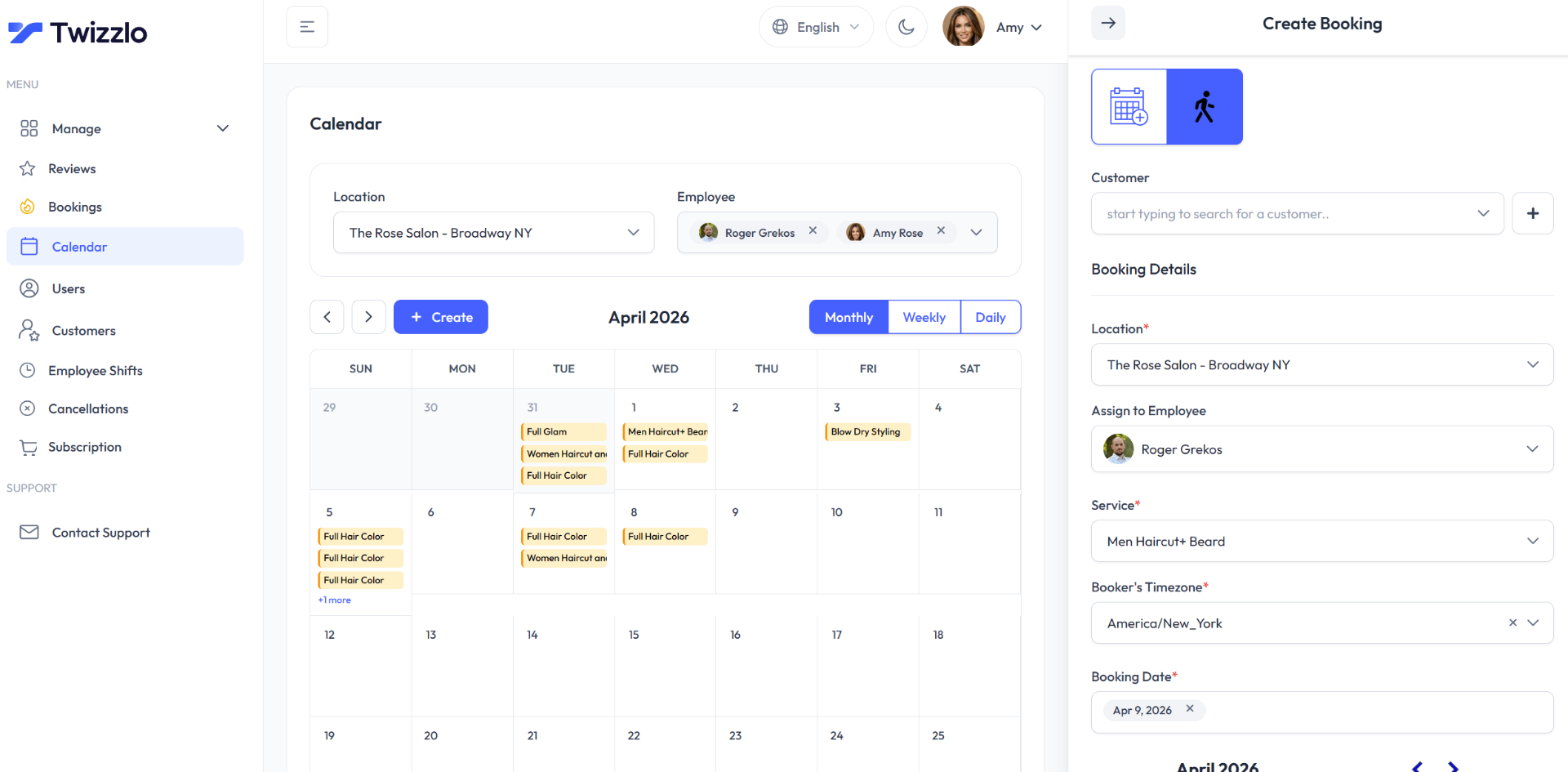
- Twizzlo features page (opens in a new tab)Read . Supports: the calendar screenshot (same image) and the booking, client record, staff schedule and payment features
From our editorial policy
- Twizzlo sells online booking and appointment scheduling software, the same category we write about. Twizzlo appears in our comparisons and roundups, and we have a commercial interest in you choosing it.
- We do not publish invented quotes, studies, statistics, customer stories or product tests, and we do not imply hands-on use of a product when the research came from the vendor's public documentation.
- To report an error, email support@twizzlo.com with the subject line "Correction: [page URL]". Tell us what is wrong and, if you can, link a source.
Update history
- : Zenoti's pricing page re-read September 25 and 27, 2026 (plan structure and FAQ lines updated); answer box, a Zenoti FAQ-versus-estimates table and two FAQs added.
Start free, upgrade when you grow
Flat-rate booking software. No per-seat, per-chair or per-location fees.
- Free plan up to 150 bookings a month, not a trial
- Business Pro is $29.99 a month per business for unlimited bookings, with a 30-day money-back guarantee
- 24/7 support by email