
How to Start a Nail Salon Business: A Checklist With License Fees and Break-Even Math

In short
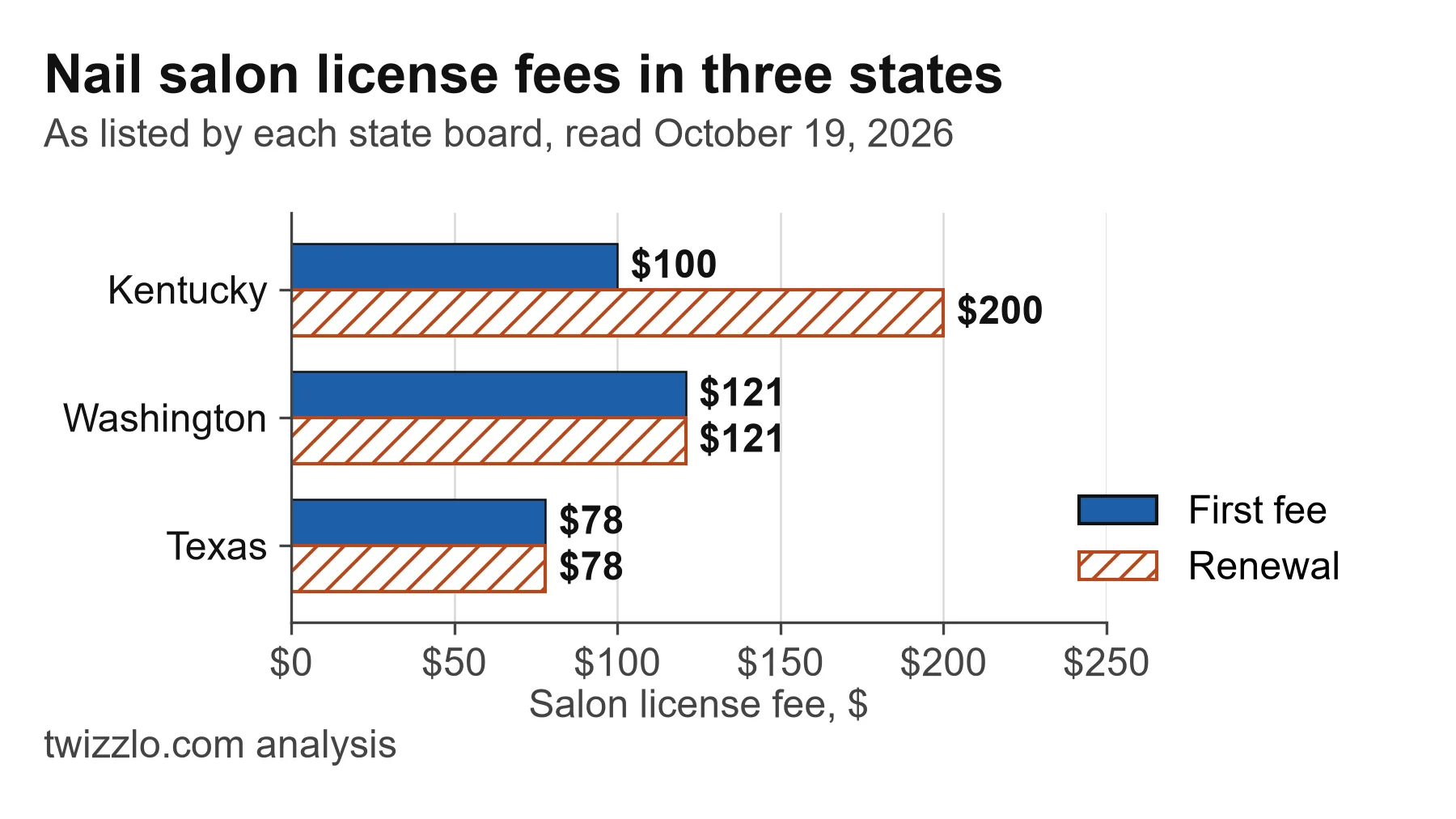
To start a nail salon business, check your state's salon and nail tech licenses, choose how techs get paid, and price the station count, ventilation and plumbing before you sign a lease. Then register the business, license the salon and open bookings. First salon license fees we read ran from $78 (Texas) to $121 (Washington State).
- Kentucky lists $100 for a new nail salon license but $200 to renew it, so budget the renewal as well (read October 19, 2026).
- In our hypothetical salon, $7,500 a month of fixed costs needs 89 services a week at a $50 ticket on a 55% tech commission.
- In the same example, one owner-tech booked 70% of a 48-hour week covers those costs only at a $65 average ticket.
In this article11 sections
Most new nail salon owners are already licensed techs with a client list. What they have not done before is the business side: two kinds of license, a station count the rent can carry, and a space with the ventilation and plumbing nail work needs. This checklist covers those in the order they depend on each other.
Our method: on October 19, 2026, we read the step guides that ranked for this search, from ZenBusiness, Yellowbrick, Skynova, Consumer Queen, Zenind and TRUiC, from a Canadian connection. U.S. results may rank differently. Most cover a plan, licenses, a location and marketing, and none names a fee taken from a licensing board. Our fee figures come from the Texas and Washington State board pages and Kentucky's fee regulation, read the same day. Break-even and menu figures are worked examples marked hypothetical; swap in your own quotes and timings. Twizzlo, the publisher, sells booking software; its product details and plan prices stay in the final section before the FAQ.
Once the menu and techs are set, our nail salon booking software page shows how a nail salon takes bookings at any hour from a single link. It also shows a calendar for each tech, with walk-ins kept on that calendar.
How to start a nail salon business: the checklist in order
Work through the checklist by deadline: decide before you sign a lease, build and license before opening day, then fill the stations in the first weeks.
| Stage | Check this | Done when |
|---|---|---|
| Before the lease | 1. Concept and local prices: who the salon serves and what nearby salons charge | You can name your client and your average ticket |
| Before the lease | 2. License rules: your own nail tech license and the state's salon license | You know both fees and what the board inspects |
| Before the lease | 3. Pay model: commission, hourly pay or booth rent | You know what the salon keeps from each ticket |
| Before the lease | 4. Plan and budget: startup costs, monthly costs and the services a week that cover them | The break-even count fits your station count (Table 3) |
| Before the lease | 5. Funding: savings, a loan, a partner or a mix | The budget's total is covered with a reserve |
| Before opening | 6. Registration: name, structure, employer identification number (EIN), bank account, sales tax | The salon license application can name the owner |
| Before opening | 7. Space: zoning, pedicure plumbing, ventilation and a signed lease | The landlord has agreed the build-out in writing |
| Before opening | 8. Build-out and equipment: tables, pedicure chairs, lamps, cleaning and storage | Every station works and the board's cleaning rules are met |
| Before opening | 9. Salon license and insurance | Both are issued for the salon's address |
| First weeks | 10. Techs: licenses checked and pay terms in writing | Every tech's license is current |
| First weeks | 11. Service menu and booking link: prices and durations per service | Clients can book a named tech online |
| First weeks | 12. First clients: Google Business Profile, Instagram and window sign | The first two weeks have bookings |
Table 1. The checklist order we drew from the nail salon guides read on October 19, 2026, grouped by the deadline for each item.
For the written plan in the plan and budget step, our salon business plan template gives the sections lenders expect and a revenue line built from bookable hours.
What do nail salon and nail tech licenses cost? Three state examples
On the state board pages we read on October 19, 2026, a first salon license cost $78 in Texas, $121 in Washington State and $100 in Kentucky, plus a separate license for each nail tech.
| State and board | First salon license | Salon renewal | Nail tech license | Notes from the board page |
|---|---|---|---|---|
| Texas, Department of Licensing and Regulation | $78 (establishment or specialty establishment) | $78 | Not on the pages read | Licenses valid two years; mini-establishment $70 |
| Washington, Department of Licensing | $121 (salon or shop) | $121 ($181 late) | $35 (manicurist); renewal $66 | Same fee page lists cosmetologist, barber and manicurist licenses; renewal period not stated |
| Kentucky, Board of Cosmetology (201 KAR 12:260) | $100 (nail salon) | $200 | $50 (nail technician); renewal $100 | Regulation effective December 2, 2025; renewal period not stated |
Table 2. Fees from each board's page or regulation, read October 19, 2026. Exam and school costs for the individual license are left out. Check your own board's current page before you apply.
Renewals are not always cheaper than the first fee: in Kentucky the nail salon renewal is twice the first fee. The salon license is separate from each tech's own license, so a tech who opens a salon pays for both. Ask your county and city about a business license and a certificate of occupancy too, and put every renewal date in your calendar.
How many services a week does a nail salon need to break even?
In our hypothetical salon, $7,500 a month of fixed costs needs 89 services a week at a $50 average ticket when a tech earns 55% commission, or 37 when the owner does the service. Both counts allow 6% of each ticket for supplies.
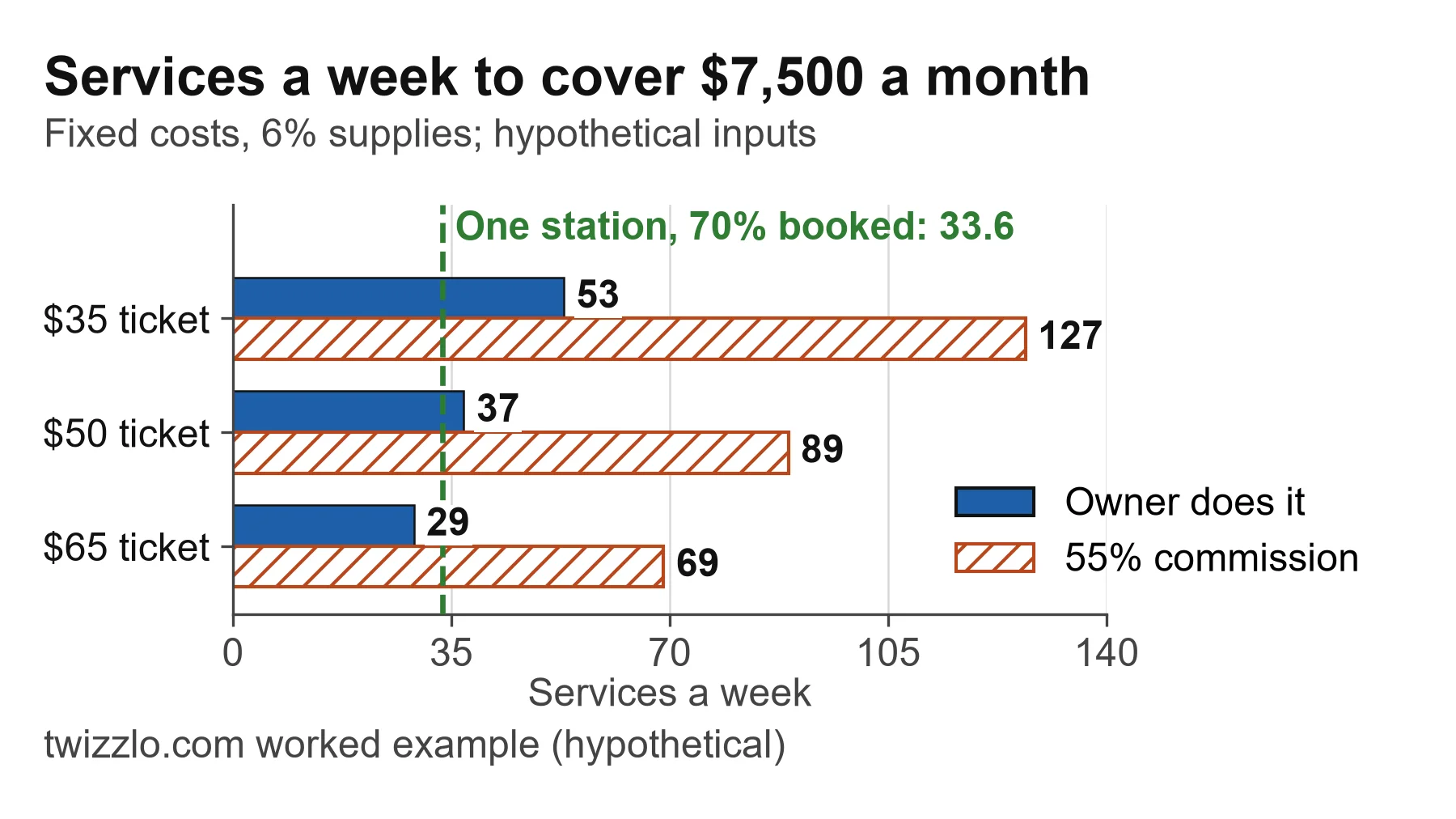
The arithmetic: $7,500 a month is $1,730.77 a week (12 months of $7,500 spread over 52 weeks). From a $50 ticket, 6% goes on supplies, so the owner who does the service keeps $47. On a 55% commission the salon keeps 45% of the ticket, or $22.50, less $3 of supplies: $19.50. Divide the weekly costs by what the salon keeps and round up: 37 services or 89.
| Average ticket | Services a week, owner does it | Services a week, 55% commission | Stations at 70% booked, commission |
|---|---|---|---|
| $35 | 53 | 127 | 4 |
| $50 | 37 | 89 | 3 |
| $65 | 29 | 69 | 3 |
Table 3. Services a week needed to cover $7,500 a month of fixed costs after 6% supplies, before card fees. A station open 48 hours a week with 60-minute bookings holds 48 slots, so at 70% booked it sells 33.6. Hypothetical inputs.
The station column is the useful one before you sign. At a $50 ticket on commission, the salon needs three busy stations, so at 70% booked a two-station unit cannot carry $7,500 a month. An owner working alone fills one station: at 70% booked that covers the costs at a $65 ticket but not at $35 or $50. TRUiC's guide puts supplies at 2% to 8% of sales and tech commission at 35% to 60%, so test your own numbers inside those ranges.
Booth rent works differently. If every station rents for $175 a week, the same $1,730.77 a week needs 10 rented stations, more than three times the stations the commission case needs at a $50 ticket.
Build the service menu around station time
A nail menu is a list of station hours, so price each service and give it a duration that includes cleanup before you publish it.
| Service | Example service time | With 10 minutes of cleanup | Station type |
|---|---|---|---|
| Classic manicure | 30 minutes | 40 minutes | Manicure table |
| Gel manicure | 45 minutes | 55 minutes | Manicure table and lamp |
| Acrylic full set | 90 minutes | 100 minutes | Manicure table |
| Fill | 60 minutes | 70 minutes | Manicure table |
| Pedicure | 50 minutes | 60 minutes | Pedicure chair |
Table 4. Example durations to replace with your own techs' timings. Hypothetical inputs.
Pedicure chairs and manicure tables are separate stations, so count them separately when you size the shop. A menu heavy in full sets fills fewer slots a day, so each service has to earn more to cover the same fixed costs. Long sets are also where a no-show costs most; our guide to ways to reduce no-shows in a salon covers reminders and prepaid bookings for those slots.
Commission, hourly pay or booth rent for nail techs
Choose the pay model before you size the salon, because it decides what the salon keeps from each ticket. Commission ties the salon's income to each ticket, hourly pay fixes the wage and leaves the salon the service revenue, and booth rent gives the salon a fixed weekly rent per station.
Commission: the tech earns a share of each service and the salon keeps the rest; the agreement says who supplies products. Salon income rises and falls with the techs' books.
Hourly pay: techs are employees on a wage. The Bureau of Labor Statistics (BLS) lists a 2025 median of $17.19 an hour for manicurists and pedicurists. The salon also pays payroll taxes and keeps the service revenue.
Booth rent: each tech pays a fixed weekly rent, sets their own prices and keeps their own book. In Texas, an establishment that leases space files an independent contractor list with its application. A renter needs their own Texas license or a $70 mini-establishment license, which must sit inside a licensed establishment. Renting techs who run their own book can compare tools in our best booking app for nail techs roundup.
Employee or independent contractor status for a nail tech is set by law, not by the pay label. Have an accountant or employment attorney confirm it before you build the pay model into your plan.
Ventilation, chemicals and cleaning belong in the build-out
Nail products may contain chemicals that, without precautions, can cause breathing problems, so plan the ventilation, the pedicure plumbing and the cleaning area before the build-out quote, not after.
The Occupational Safety and Health Administration (OSHA) lists toluene, formaldehyde, dibutyl phthalate and methacrylate compounds among the chemicals nail products may contain. Without precautions, it says, they can cause breathing problems, irritated eyes and skin problems. It also names aches from bending over a work table and infections from contact with infected skin, nails or blood.
Ask a contractor to price ventilation sized for the number of stations you plan.
Check that the unit's water lines and drains can serve the pedicure chairs, or price the plumbing work.
Get your state board's cleaning and disinfection rules before you buy pedicure chairs and tools, then plan a cleaning area that meets them.
Choose tables and chairs that let techs work without leaning on hard edges.
Startup cost lines to quote before signing a lease
Published startup totals are too wide to plan with: ZenBusiness gives $10,000 to $500,000, and TRUiC puts a 1,000-square-foot build-out at $75,000 to $125,000. Price each line below from quotes for your own unit instead.
| Cost line | When you pay it | How to get the number |
|---|---|---|
| Build-out, ventilation, plumbing for pedicure chairs, electrical and signage | Before opening | Two or three contractor quotes for the unit |
| Manicure tables, pedicure chairs, lamps, stools and storage | Before opening | Supplier quotes per station times your station count |
| Polish, gels, acrylics, files and disposables | Before opening, then monthly | Supplier price lists; supplies as a share of each ticket (Table 3 uses 6%) |
| Cleaning and disinfection supplies your board requires | Before opening, then monthly | Your state board's rules and supplier quotes |
| Salon, tech and city license fees | Before opening, then at each renewal | Your state board and city pages (Table 2) |
| General and professional liability insurance | Yearly or monthly | Broker quotes |
| Rent, lease deposit and utilities | At signing, then monthly | The lease offer and the utility providers |
| Booking and payment software | Monthly | Plan price plus card processing; see our booking software comparisons |
| Card payments at the front desk | Monthly, plus any hardware | Our nail salon POS guide prices two vendors' plans and rates |
| Opening reserve | Before opening | The months of fixed costs you want covered |
Table 5. Cost lines to price for a new nail salon.
Registration, insurance and the first clients
Register the business before you apply for the salon license, because the license application, the lease and the bank account each need the registered business name and owner.
Name and structure: check the name in your state's business registry, then choose between a sole proprietorship and a limited liability company (LLC) with an accountant.
EIN: the Internal Revenue Service (IRS) issues one online for free, and you need it to hire employees.
Bank and sales tax: open a business account, and ask your state's revenue department whether the products or services you sell need a sales tax permit.
Insurance: get general and professional liability quotes before opening day, and ask whether your lease sets a minimum.
First clients: share the booking link from a Google Business Profile, your Instagram bio and a window poster during the fit-out.
Where Twizzlo fits
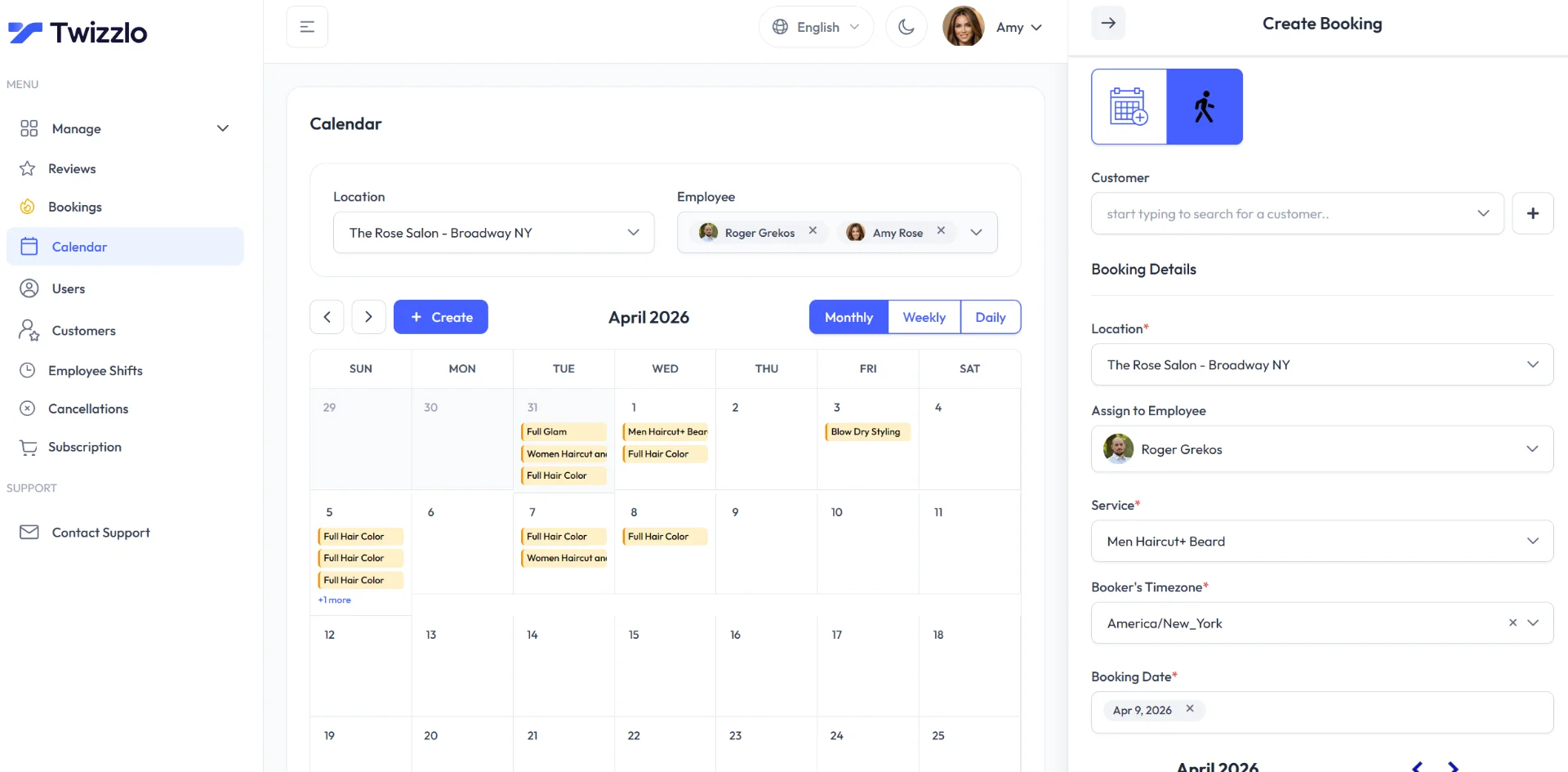
Twizzlo is web-based online booking and appointment scheduling software for appointment-based service businesses. For a salon about to open, it handles the service menu and booking link step: the booking page, tech calendars and online payments.
Each tech gets a calendar, every service has its own price and duration, and buffer times hold the cleanup minutes from Table 4. The booking page stays open around the clock with real-time openings, and walk-ins are added to that same calendar. For long sets, prepaid bookings collect the full service price through Stripe when the client books. Client profiles keep notes, preferences and allergies.
Free is $0 a month for up to 150 bookings a month, free forever and not a trial, with no SMS. Business Pro is $29.99 a month per business for unlimited bookings, with 50 SMS a month included, then $0.03 each, and a 30-day money-back guarantee. Both plans include unlimited staff and locations. Online payments carry your Stripe processing rate plus a 1.5% Twizzlo platform fee. Details are on the Twizzlo pricing page.
A solo tech doing 25 services a week makes about 108 bookings a month (25 a week over 52 weeks, spread across 12 months), within Free's 150. Four stations at Table 3's 33.6 services a week make 134.4 a week, about 582 a month, over Free's cap, so that salon belongs on Business Pro. Sending one text reminder per booking, it would use the 50 bundled texts plus 532 more at $0.03, or $15.96, for $45.95 a month. If clients prepay 80 full sets at $60 online, the $4,800 carries $72 in platform fees before Stripe's rate.
Twizzlo's /features/ page does not list commission calculation or payroll. If you want either in the same system as your bookings, the salon suites compared in our nail salon management software guide list commission tools or paid payroll add-ons on some plans.
You can start on the Free plan and load your menu and techs while the fit-out finishes. Switch to Business Pro when bookings pass 150 a month or you want text reminders.
Frequently asked questions
How much does it cost to start a nail salon business?
The total depends on the unit, how many stations you fit and the fit-out work, so get quotes for your own space. Published totals range widely, from $10,000 to $500,000 in ZenBusiness's guide. License fees you can know in advance: on October 19, 2026, three state boards listed $78 to $121 for a first salon license, plus each tech's license.
How to open a nail salon: what comes first?
Before the lease, settle your concept and budget, your state's license rules and your pay model. Together they tell you what each service earns the salon, and so how much rent and how many stations you can afford before you sign a lease.
Do I need a salon license if I already hold a nail tech license?
Yes in the three states we checked: the salon or establishment license has its own fee, on top of the individual license. In Texas, a salon can lease space to a mini-establishment licensee or to an individual license holder, and lists them on an independent contractor list. Check your own board before you apply.
How many nail stations should a new salon start with?
Size it from the weekly services your fixed costs require. With our hypothetical numbers, $7,500 a month needs 89 services a week at a $50 ticket on a 55% commission, which three stations cover at 70% booked.
Should a new nail salon rent booths or pay commission?
Booth rent gives the salon a fixed income but needs every station rented: in our example, 10 stations at $175 a week. Commission lets fewer stations cover the costs when techs are busy, but the salon's income falls in a slow week.
Sources and methodology
Prices read
- Texas Department of Licensing and Regulation: apply for a barbering or cosmetology establishment license (opens in a new tab)Read . Supports: Establishment and specialty establishment $78, mini-establishment $70; licenses valid two years; independent contractor list when leasing space (Table 2, Figure 1, pay model section)
- Texas Department of Licensing and Regulation: renew an establishment license (opens in a new tab)Read . Supports: Renewal $78 full-service and specialty establishment, $70 mini-establishment (Table 2, Figure 1)
- Washington State Department of Licensing: fees for cosmetologists (opens in a new tab)Read . Supports: Salon/shop $121, renewal $121, late $181; manicurist $35, renewal $66 (Table 2, Figure 1)
- Kentucky Legislative Research Commission: 201 KAR 12:260, Board of Cosmetology fees (opens in a new tab)Read . Supports: Nail salon $100 initial, $200 renewal; nail technician $50 initial, $100 renewal; effective December 2, 2025 (Table 2, Figure 1)
- U.S. Bureau of Labor Statistics, Occupational Outlook Handbook: manicurists and pedicurists (opens in a new tab)Read . Supports: 2025 median pay $17.19 an hour (pay model section)
- Occupational Safety and Health Administration: health hazards in nail salons (opens in a new tab)Read . Supports: Chemicals in nail products and their effects; ergonomic and biological hazards (ventilation section)
- Internal Revenue Service: get an employer identification number (opens in a new tab)Read . Supports: EIN issued online for free
- Twizzlo pricing page (opens in a new tab)Read . Supports: Free and Business Pro plans, SMS, guarantee, 1.5% platform fee
- Twizzlo features page (opens in a new tab)Read . Supports: Calendar per staff member, services with durations, buffer times, walk-ins, prepaid bookings through Stripe, client notes and allergies; screenshot source
From our editorial policy
- We do not publish invented quotes, studies, statistics, customer stories or product tests, and we do not imply hands-on use of a product when the research came from the vendor's public documentation.
- To report an error, email support@twizzlo.com with the subject line "Correction: [page URL]". Tell us what is wrong and, if you can, link a source.
Start free, upgrade when you grow
Flat-rate booking software. No per-seat, per-chair or per-location fees.
- Free plan up to 150 bookings a month, not a trial
- Business Pro is $29.99 a month per business for unlimited bookings, with a 30-day money-back guarantee
- 24/7 support by email