
Salon Business Plan Template: Free Growth Guide 2026

In short
A salon business plan template gives you seven sections to fill in: executive summary, company description, market analysis, services and pricing, operations and staffing, marketing, and financial projections. For a hair or beauty salon, build the financial section on schedule capacity and price every cost, software included, at the headcount the plan reaches.
- Fill in seven sections, attach a startup budget, a profit and loss projection and a cash flow forecast, and write the executive summary last.
- Build revenue from providers, bookable hours, the share of hours booked and revenue per booked hour, lower in the opening months.
- Price software at the headcount your plan reaches: per-member billing rises with each hire, per-location and per-business billing do not.
In this article10 sections

This salon business plan template gives you the seven sections a lender reads, ready to copy, plus a worksheet that turns schedule capacity into a revenue line and a way to price software at the headcount you plan to reach. Twizzlo publishes it and sells salon scheduling software, one of the costs the template asks you to price.
Your Free Salon Business Plan Template to Copy
Copy the template below and fill in each bracket. It holds the seven sections a lender or partner reads, the questions each section must answer and the three financial documents to attach. Write the one-page executive summary last, once the other sections are done.
A salon business plan template isn’t a decorative document. It’s the lender-ready structure that turns your idea into an operating model. The seven sections follow the traditional business plan format the U.S. Small Business Administration describes, renamed for a salon, with its funding request folded into the executive summary (read September 28, 2026).
The seven sections at a glance:
-
Executive Summary
Your concept, positioning, funding need, and growth case. -
Company Description
Ownership structure, location, legal setup, and business model. -
Market Analysis
Target clientele, local competition, demand, and differentiation. -
Services and Pricing
Core services, add-ons, retail, packages, and membership logic. -
Operations and Staffing
Staffing model, front desk workflow, scheduling, software, and roles. -
Marketing and Sales
Launch plan, retention strategy, referral engine, and local visibility. -
Financial Projections
Startup budget, cash flow, break-even, P&L, and working capital.
The full template follows, with fill-in prompts in brackets. There is nothing to download and no signup: copy the text into your own document.
[Salon name] Business Plan
Prepared by: [owner names], [date]
Funding request: [amount] for [uses]
1. Executive summary (one page; write it last)
Concept: [one sentence: what you are opening and for whom]
Business model: [employee, booth rental, suite rental or hybrid]
Market gap: [the gap in your trade area and your evidence for it]
Funding need and use: [buildout, equipment, opening inventory, launch marketing and reserve, each with an amount]
Break-even month: [from section 7]
2. Company description
Legal structure and owners: [structure; owners and their shares]
Location: [address, square footage, lease length, monthly rent]
Licenses and insurance: [held or needed, with dates]
3. Market analysis
Target clients: [who they are, where they live or work, how often they visit]
Competitors in your trade area: [name, price of your anchor service, what they do not offer]
Demand evidence: [pre-bookings, waitlist, survey results]
4. Services and pricing
Anchor services: [service, duration, price, product cost, rebooking interval]
Add-ons and retail: [items and prices]
Provider levels: [levels and the price for each]
Policies: [cancellation window, no-show fee, prepayment rule]
5. Operations and staffing
Staffing plan by month: [role, start month, pay basis]
Control: [who sets the calendar, prices and client records]
Systems: [booking software, payments, payroll], each with its billing unit and its cost at opening and at the year-two headcount
6. Marketing and sales
First-visit channels: [three or four channels, one owner each]
Second-visit engine: [rebooking at checkout, reminders, follow-up]
Launch offer: [offer, end date, audience]
7. Financial projections
Startup budget: [line items, each with a quote]
Revenue capacity: [providers × bookable hours × share booked × revenue per booked hour]
Profit and loss: [monthly for year one, then yearly]
Cash flow: [monthly for year one; name the lowest cash month]
Reserve: [the months of rent, payroll and product cost it covers]
Have an accountant check the financial section before a lender sees it.
Practical rule: If a lender can’t see how appointments turn into revenue, labor cost, and cash flow, your plan isn’t finished.
Crafting Your Executive Summary and Company Vision
The executive summary is one page that answers four questions: what you are opening, who it serves, why it will win and how much money you need and for what. Write it last, from the finished sections, so every claim in it has a page behind it.
What is the most important part of a salon business plan?
The executive summary is the most important part because it tells a lender or operator whether the business is coherent. In one page, it should show the model, the market, the operational logic, and the financial ask. If that page feels fuzzy, the full plan feels risky.
Write it like this:
-
Business concept
“A modern hair and beauty salon focused on repeatable, premium service delivery for busy professionals in a defined local trade area.” -
Business model
Explain whether you’re employee-based, booth rental, suite rental, or hybrid. -
Gap in the market
State the unmet need clearly. Faster service. Better retention. Membership-led predictability. Premium color specialization. Multi-service convenience. -
Funding use
Spell out where capital goes. Buildout, equipment, launch marketing, insurance, and cash reserve.
Your company vision needs operating logic
A weak vision statement says you want to “deliver exceptional service.” Every salon says that. A useful company vision says what kind of business you are building and how it scales without operational chaos.
For example, if you’re building around recurring visits, your vision should mention retention and continuity of care. If you’re planning a multi-location brand, your vision should mention standardized service delivery and centralized scheduling. If you’re a booth-rental model, your company description should explain how tenant independence still fits brand standards.
A lender funds clarity. They don’t fund taste, enthusiasm, or Pinterest boards.
Your company description should also include your legal structure, ownership, leadership responsibilities, and location logic. If your site choice depends on walk-in traffic, say that. If it depends on pre-booked demand and parking convenience, say that instead.
For owners planning expansion, document your systems mindset early. A useful reference is this guide to scaling a service business without breaking operations. It’s the right lens for writing a company vision that survives growth.
Defining Your Service Menu and Profit-Driven Pricing
Price the menu from time and cost. Each service needs a realistic duration, a provider level, a product cost and a rebooking interval, whether it is a cut, a color or a treatment, because those four inputs decide how many hours your chairs can sell and what each hour earns.
Most salon service menus are built like a brochure. That’s a mistake. Your plan needs a revenue architecture, not a nice-looking list of treatments.
Start with the services you can deliver consistently, profitably, and on schedule. Then build pricing tiers around skill level, time intensity, product usage, and rebooking potential. Don’t overload the menu with low-demand complexity during launch.
Build the menu around margin and repeatability
A strong service section usually includes:
-
Anchor services
The core bookings that define your brand and fill the calendar. -
Upgrade paths
Add-ons, treatment boosters, finish upgrades, or retail attachments. -
Tiered delivery
Junior, senior, and master provider pricing if your staffing model supports it. -
Time discipline
Each service should have a realistic duration, not a fantasy slot that wrecks the day.
That last point matters more than most owners realize. If your plan shows one thing and your booking setup allows another, your revenue forecast is fiction.
Model memberships and prepaid bundles if you sell them
If your model depends on memberships or prepaid bundles, such as maintenance color or blowout programs, model them as recurring revenue with renewal and usage assumptions, not as a footnote.
Use this checklist:
| Service menu element | What to include in the plan |
|---|---|
| Core services | Highest-demand appointments and target positioning |
| Add-ons | Upsells that increase ticket value without crushing schedule flow |
| Memberships | Included services, renewal logic, and usage assumptions |
| Retail | Products tied to service outcomes, not random shelf filler |
| Deposits and policies | No-show, late-cancel, and prepayment rules |
A clean no-show policy protects the pricing logic you’re projecting. If you need a model, review this guide to a salon no-show charge policy and setup.
If your menu rewards complexity but your schedule can’t absorb it, you’ll book revenue on paper and lose profit in reality.
Structuring Your Operations and Staffing Model
Choose the staffing model first (employee, booth rental, suite rental or hybrid), then write who controls the calendar, pay, inventory and client records under it. Price every system at the headcount the plan reaches, not at opening, because some bill per team member and some do not.
A lender reads your staffing plan one way. You read it another. The lender sees execution risk. If your plan says you will add stylists in month six, extend hours in month nine, and improve retention with better booking flow, your operating system has to support that growth.
Choose the staffing model first, then build operations around it
Employee, booth rental, suite rental, and hybrid salons run differently. Treating them as interchangeable is one of the fastest ways to write a weak plan.
An employee model gives you tighter control over schedule flow, service standards, and upsells. It also requires stronger management, cleaner payroll assumptions, and better front-desk execution. Booth rental gives providers more independence, but it raises the stakes on policy clarity, shared resource rules, and platform permissions. Hybrid setups create the most confusion because owners often mix compensation structures without defining who controls booking, client communication, inventory, and dispute handling.
Spell out the operating model in practical terms:
-
Ownership and supervision
Who is accountable for reception, daily floor management, inventory, retail displays, and client recovery. -
Scheduling control
Who can adjust hours, block time, approve time off, handle late arrivals, and assign chairs or rooms. -
Compensation structure
Hourly, salary, commission, rent, or a mixed setup, with a clear reason for each role. -
Capacity plan
What changes operationally when you add a colorist, esthetician, assistant, or second location.
If you plan to rent chairs, document it properly. A weak agreement creates operational messes that bleed into scheduling, compliance, and collections. Use a booth rental contract template for salon operators that matches how your business operates.
Your software pricing model belongs in the staffing section
A staffing plan that adds two stylists in month six also changes every cost billed per person: payroll, some insurance and some software. Booking platforms bill per team member, by plan tier with staff limits, per location or per business, so the same hire can raise one system’s price and leave another’s unchanged. Write each system’s billing unit into the operations section and carry its cost at each headcount into the financial section, where the software table prices it.
Build staffing assumptions that reflect retention, not just hiring
A serious operations model does more than count chairs and payroll. It shows how clients return, how providers stay productive, and how team structure supports repeat revenue.
That is where loyalty design belongs in the operating plan, not just the marketing plan. If you intend to use points, referral rewards, or visit-based incentives, note who manages them, how they appear at checkout, and how they affect rebooking behavior.
Write this section so a lender can answer four questions fast:
- Who does what each day?
- How does scheduling capacity expand?
- Which costs stay stable as the team grows?
- Which systems change price as the team grows?
Building a Marketing Plan That Attracts High-Value Clients
The marketing section of a salon plan names the client you want, three or four channels you can run every week, the offer that brings the first visit and the step that books the second, with one person responsible for each channel.
A salon with weak demand generation doesn’t have a marketing problem. It has a forecasting problem. If client acquisition is vague, revenue projections are inflated by default.
Your marketing section should identify who you want, where they already spend attention, and what will move them to book the first appointment and the next one. Skip generic lines about “posting on Instagram regularly.” That’s not a strategy.
Define the client you actually want to retain
High-value clients are not just high spenders. They rebook, arrive on time, buy within your service philosophy, and fit your team’s strengths. That means your plan should describe a target segment with operational relevance.
Use prompts like these:
-
Lifestyle fit
Busy professionals, parents, event-driven clients, wellness-focused regulars. -
Booking behavior
Advance planners, same-week bookers, package buyers, or membership candidates. -
Service pattern
Maintenance color, short-interval grooming, seasonal skin services, or high-ticket transformations.
Build a launch plan with channels you can manage
Your opening strategy should combine a few channels you can execute well, not every tactic you’ve ever heard of.
A practical startup mix includes:
-
Local search visibility
Optimized business listings, consistent contact details, and review generation. -
Referral activation
Founding client offers, stylist-driven invites, and partner outreach. -
Retention mechanics
Rebooking prompts, post-visit follow-up, and loyalty incentives. -
Grand opening promotion
A controlled offer with a clear expiration and target audience.
Loyalty needs structure, not random discounts.
Marketing also needs operational support. If reception can’t manage campaigns, reminders, and rebooking consistently, acquisition spend leaks value. This guide to marketing systems for beauty salon growth is useful for turning promotions into repeatable workflows.
How do you make a salon marketing plan credible?
Make it specific. Name the channels, define the offer, assign ownership, and connect each tactic to either first bookings or repeat bookings. A credible plan doesn’t promise “brand awareness.” It shows how appointments will be generated, confirmed, and retained.
Mastering Your Financial Projections for Funding Success
Lenders expect at least three documents: a startup budget, a profit and loss projection and a cash flow forecast. Build revenue from schedule capacity, meaning providers, bookable hours, the share of hours booked and revenue per booked hour, and price every cost line, software included, at the headcount the plan reaches.
Your projections need to prove four things. You know your startup costs. You know how revenue builds month by month. You know when cash gets tight. You know whether your software model supports expansion or punishes it.
For the first year, the U.S. Small Business Administration suggests quarterly or even monthly projections, inside a five-year outlook of forecasted income statements, balance sheets, cash flow statements and capital expenditure budgets (read September 28, 2026).
Start with the visual below, then build the actual model in a spreadsheet lenders can inspect.
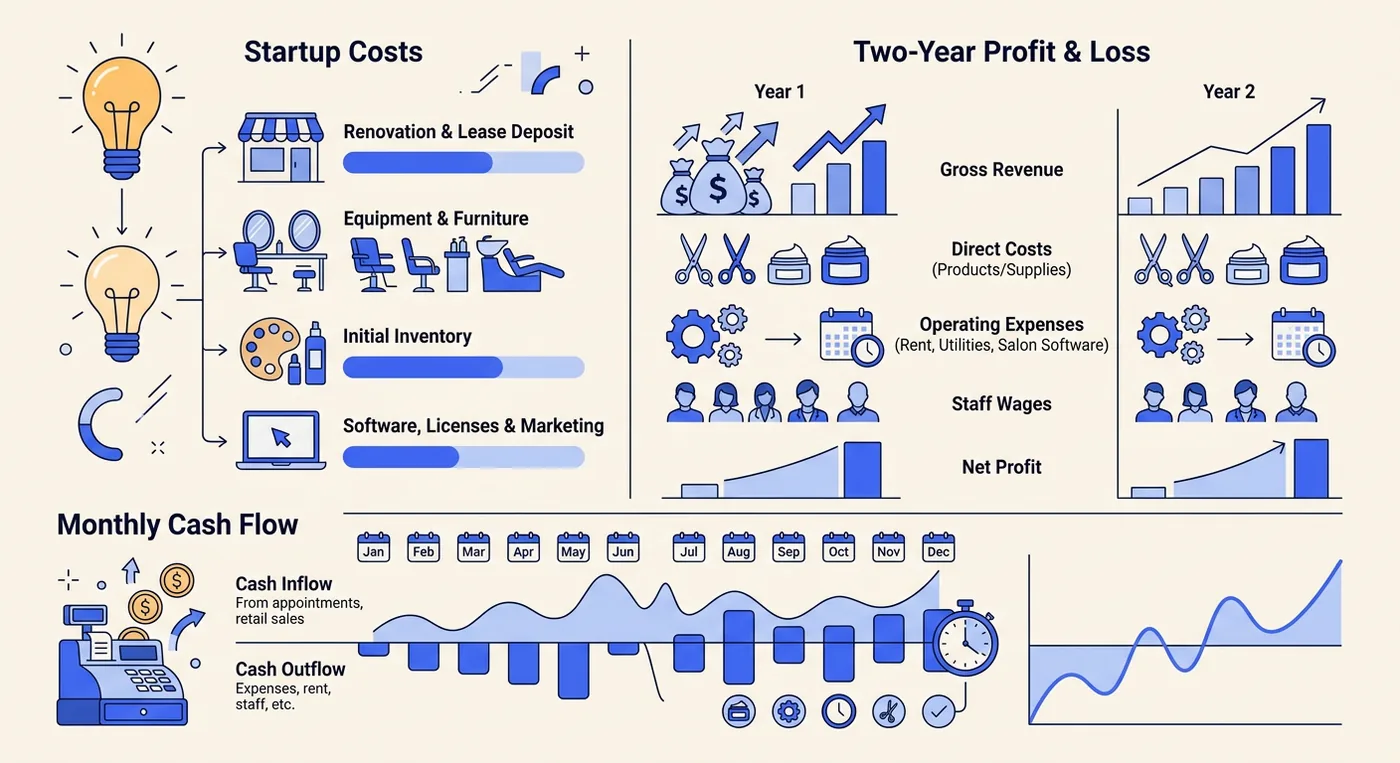
Detailed numbers get funded
Serious plans use line items, timing, and assumptions that can be challenged. Round numbers signal guesswork.
Build your startup budget with specific costs for:
- Buildout and leasehold improvements
- Stations, backbar equipment, and furniture
- Initial inventory and retail stock
- Insurance, licenses, and compliance costs
- Grand-opening marketing
- Software and payments infrastructure
- Working capital reserve
For payroll in the profit and loss projection, the U.S. Bureau of Labor Statistics puts the median wage for hairdressers, hairstylists and cosmetologists at $17.21 an hour in May 2025 (read September 28, 2026); price your own local offer, not the national median.
Turn schedule capacity into a revenue line
Revenue in a salon plan cannot exceed the hours your providers can sell, so build the revenue line from the schedule, one line at a time.
| Line | How to calculate | Example |
|---|---|---|
| Providers taking bookings | Stylists on the floor | 4 |
| Bookable hours per provider per week | Open hours minus breaks, admin and training | 32 |
| Bookable hours per week | Providers × bookable hours | 128 |
| Share of bookable hours booked | Your estimate; lower in the opening months | 60% |
| Booked hours per week | Bookable hours × share booked | 76.8 |
| Revenue per booked hour | Average ticket divided by average service hours | $70 |
| Weekly service revenue | Booked hours × revenue per booked hour | $5,376 |
| Monthly service revenue | Weekly × 52 ÷ 12 | $23,296 |
The example inputs only show the arithmetic; they are not averages or benchmarks, so replace each with your own schedule and prices, and step the share booked up month by month through the ramp.
How does salon software impact my financial projections?
It changes capacity, labor efficiency, no-show control, reporting quality, and overhead. Those are not side issues. They drive the credibility of your model.
A weak system distorts the entire forecast. Schedules stay underfilled because booking friction hurts conversion. Front desk labor rises because staff handle work the software should automate. Reporting gets patchy, so owners make staffing and marketing decisions from incomplete numbers. That is why software belongs in the core operating model, not in a miscellaneous expense row.
Price the software line at the headcount you plan to reach
Booking platforms bill by different units, so the same staffing plan produces a different software line with each vendor. The table prices four vendors’ plans at one, four and 10 stylists at one location.
| Plan and billing unit | 1 stylist | 4 stylists | 10 stylists | Year at 10 |
|---|---|---|---|---|
| Booksy, per team member | $29.99 | $89.99 | $209.99 | $2,519.88 |
| GlossGenius, by staff tier | $28 Standard | $56 Gold | $168 Platinum | $2,016 |
| Square, per location | $0 Free | $49 Plus | $49 Plus | $588 |
| Twizzlo Business Pro | $29.99 | $29.99 | $29.99 | $359.88 |
How each plan bills: Booksy is $29.99 a month plus tax with one team member and $20 a month per added member; GlossGenius Standard is $28 with no staff management, Gold $56 for up to 9 staff and Platinum $168 for teams of 10 or more; Square Appointments prices per location, with Free at $0, described for solo professionals, and Plus at $49, described for growing teams, which adds no-show fees and multi-staff booking; Twizzlo Business Pro is priced per business.
At one stylist, Square Appointments Free costs $0 and the other plans cost $28 to $29.99 a month; at 10 stylists the four rows cost $29.99 (Twizzlo Business Pro) to $209.99 (Booksy) a month, before card processing. Square Free also lists unlimited staff calendars, so a team that can work without the Plus features can stay at $0.
Prices come from each vendor’s own pricing page: Booksy’s and Square Appointments’ read September 25, 2026 (Square’s feature grid captured September 27, 2026), GlossGenius’s read September 27, 2026, and Twizzlo’s. Our Booksy pricing, Square Appointments pricing and GlossGenius pricing pages break each bill down further. The Twizzlo row shows Business Pro; Twizzlo’s Free plan is $0 a month for up to 150 bookings, with no SMS.
Price alone does not pick a system; our guide to the best salon software weighs features as well.
Build the three documents lenders expect
Use this structure:
| Financial document | What it must prove |
|---|---|
| Startup budget | You know every major launch cost and reserve need |
| Profit and loss projection | Your revenue model can support payroll and overhead |
| Cash flow forecast | Timing gaps won’t crush the business during ramp-up |
ProjectionHub’s video walks through salon financial projections for an employee-model salon, for planning or a loan application.
Don’t skip liquidity planning
A salon can be fully booked on paper and still run short of cash. Opening month can look fine on paper while the next eight weeks expose the gap between booked revenue and actual cash in the account.
Build a working capital buffer for the slow ramp period, not just opening week. Payroll and rent arrive on schedule whether your chairs are full or not. Retail sells unevenly. Color costs move with service mix. Chargebacks, refunds, and no-shows create drag. A lender wants to see that you planned for those realities.
After opening, track the same numbers you projected. That is how you catch margin drift before it turns into a cash problem. Use sales reporting software for appointment-based businesses that shows provider productivity, service mix, rebooking performance, and revenue trends clearly enough to compare plan versus actual every month.
Common Mistakes That Get Salon Business Plans Rejected
Salon plans fail review on credibility: rounded startup budgets, reserves sized for opening week, revenue above what the schedule can hold, hiring with no dates, pricing with no rebooking engine and a software line priced at one seat for a plan that hires five.
In a rejected plan, the owner describes a vision, but not a business that can be run, measured, and scaled.
The mistakes show up in the same places again and again:
-
Soft startup budgets
Rounded numbers make you look unprepared. Build real line items for build-out, equipment, opening inventory, licenses, deposits, payroll float, and reserve cash. -
Working capital built for launch day instead of ramp-up
Opening is not the hard part. Weeks two through twelve are. If your plan cannot carry rent, payroll, product costs, and owner draws through a slower booking ramp, the forecast will not survive review. -
Revenue projections that outrun schedule capacity
A plan gets rejected fast when booked hours, provider availability, service duration, and expected demand do not line up. If one stylist needs to produce a packed calendar from month one to make the numbers work, the model is broken. -
No staffing logic
Hiring “as demand grows” is not an operating plan. State when you hire, what each role produces, how payroll changes by phase, and who owns client retention. -
Pricing with no retention engine
High ticket prices alone do not create a stable salon. Repeat visits do. Your plan should show why clients come back, how often they rebook, and which services create predictable revenue. -
Software treated like a minor admin expense
If your scheduling platform charges by seat, provider, or location, overhead rises every time the business grows. That directly weakens margins, hiring plans, and multi-location projections. A lender notices when the software line is priced at one seat and the staffing plan hires five.
Read the finished document like an operator with cash on the line. Can a manager use it to decide who to hire, what to charge, when to market harder, and how to protect cash? If the answer is no, revise it before a lender rejects it for you.
Frequently Asked Questions
Do I need a salon business plan if I’m opening a small solo studio?
Yes. A smaller salon needs a plan just as much as a larger one because tight margins leave less room for mistakes. Your plan doesn’t need to be bloated, but it does need clear assumptions on services, schedule capacity, marketing, and cash flow.
What’s the difference between an employee model and a booth rental model in a business plan?
An employee model centers on payroll control, schedule management, and service consistency. A booth rental model centers on rent income, space utilization, and policy enforcement. Your plan should reflect how revenue is earned, who controls the calendar, and which operating costs sit with the business.
How much working capital should a salon include in its plan?
Use a buffer for the ramp-up period rather than assuming quick stability. Size the reserve to carry rent, payroll, and product costs through the slower ramp months described in the financial section, not just opening week. That reserve gives you room to absorb slower booking growth and seasonal dips.
Should I include memberships in a salon business plan?
Yes, if they fit your service model. Memberships and prepaid programs can improve predictability and support retention. They’re especially useful when your business depends on maintenance services or repeat visit cycles rather than occasional big-ticket bookings.
What financial documents matter most to lenders?
Three documents matter most. A detailed startup budget, a profit and loss forecast, and a cash flow projection. Together they show whether the salon can launch cleanly, operate sustainably, and survive the early months without running short on cash.
How long should a salon business plan be?
Long enough to cover the seven core sections with assumptions a lender can challenge, and no longer. The executive summary should hold to a single page, and the financial documents matter more than page count. A lean plan with specific line items, realistic schedule capacity, and a clear staffing ramp beats a long one padded with vision language.
Can I use the same template for a booth rental salon?
Yes, the seven-section structure stays the same, but the content changes. Revenue comes from rent income and space utilization instead of service tickets, so your financial projections, scheduling control, and policy enforcement sections need to reflect that. Document who controls booking, client communication, and inventory, and attach a proper rental agreement to the operations plan.
What startup costs should a salon business plan include?
Build specific line items for buildout and leasehold improvements, stations and backbar equipment, initial inventory and retail stock, insurance and licenses, grand-opening marketing, software and payments infrastructure, and a working capital reserve. Round numbers signal guesswork, so price each item for your actual space and market. The software line should reflect what it costs at your planned headcount, not just at launch.
How often should I update the plan after opening?
Compare plan versus actual every month. Track provider productivity, service mix, rebooking performance, and revenue trends against your projections so margin drift shows up early. Revisit the full document when something structural changes, such as a new hire, a pricing change, or a second location.
What should a hair salon business plan include?
The same seven sections as any salon plan, with hair-specific inputs: service durations by provider level, color and product cost per service, the number of chairs and whether each is employed or rented, and a rebooking interval for cuts and color. Those inputs feed the revenue capacity line in the financial section.
How do I estimate salon revenue for a business plan?
Multiply the providers taking bookings by their bookable hours, the share of those hours you expect to book and your revenue per booked hour, then convert the weekly figure to months. Use a lower share in the opening months and show the month the salon covers rent, payroll and product costs.
How should a salon business plan budget for booking software?
Price it at the headcount and location count the plan reaches, not at opening. Billing units differ: Booksy adds $20 a month per added team member, GlossGenius prices plan tiers by staff count and Square Appointments charges per location (vendor pricing pages read September 25 and 27, 2026). Keep card processing as its own line.
Where Twizzlo fits in a salon business plan
Twizzlo is web-based online booking and appointment scheduling software for appointment-based service businesses, with a public booking page, email and SMS reminders, client records, staff schedules and shifts, and Stripe payments and tips. Neither plan charges more for staff or locations, so the software line in your plan stays the same when you hire.
Free is $0 a month for up to 150 bookings, with no SMS, and it is free forever rather than a trial. Business Pro is $29.99 a month per business, with unlimited bookings, 50 SMS a month included then $0.03 per message, and a 30-day money-back guarantee. Both plans include unlimited staff and locations. Support is by email, 24/7. Online payments carry your Stripe processing rate plus a 1.5% Twizzlo platform fee.
For the monthly plan-versus-actual review, Twizzlo’s insights show booking volume, revenue, new customers, staff availability and utilization, and forecasts, by day, week or month.
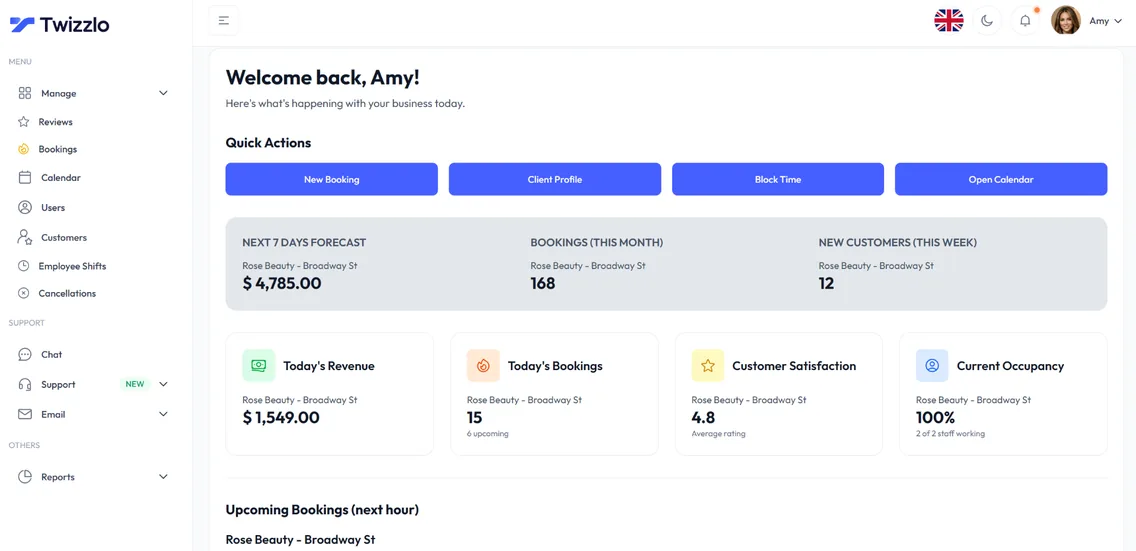
Twizzlo does not run payroll, commission tracking or memberships.
If a software line that stays the same as you hire fits your plan, start with Twizzlo’s online booking for hair salons on the Free plan and compare Business Pro on the pricing page.
Sources and methodology
Prices read
- U.S. Small Business Administration: Write your business plan (opens in a new tab)Read . Supports: the traditional business plan sections the template follows and the five-year outlook with quarterly or monthly first-year projections
- U.S. Bureau of Labor Statistics, Occupational Outlook Handbook: Barbers, Hairstylists, and Cosmetologists (opens in a new tab)Read . Supports: the median hourly wage for hairdressers, hairstylists and cosmetologists, May 2025 (payroll line)
- Booksy pricing page (opens in a new tab)Read . Supports: subscription price and the fee per additional team member (software cost table, FAQ 12)
- GlossGenius pricing page (opens in a new tab)Read . Supports: Standard, Gold and Platinum monthly prices and staff limits (software cost table, FAQ 12)
- Square Appointments pricing page (opens in a new tab)Read . Supports: Free and Plus prices per location and plan descriptions; feature grid lines (unlimited staff calendars, no-show fees and multi-staff booking from Plus) captured September 27, 2026
- Twizzlo pricing page (opens in a new tab)Read . Supports: Twizzlo plans, booking cap, SMS allowance, money-back guarantee and online payment fee
- Twizzlo features page (opens in a new tab)Read . Supports: the insights list and the insights screenshot (same image)
From our editorial policy
- Our templates, such as consent forms, contracts and confirmation messages, are text to copy and adapt to your business. They are not legal advice. Have a qualified local professional review anything you rely on.
- To report an error, email support@twizzlo.com with the subject line "Correction: [page URL]". Tell us what is wrong and, if you can, link a source.
Update history
- : Added a copy-and-paste template, a revenue capacity worksheet and a software cost table by team size; replaced unsourced claims and three images; corrected the Twizzlo plan facts; synced the FAQ schema.
Start free, upgrade when you grow
Flat-rate booking software. No per-seat, per-chair or per-location fees.
- Free plan up to 150 bookings a month, not a trial
- Business Pro is $29.99 a month per business for unlimited bookings, with a 30-day money-back guarantee
- 24/7 support by email