
Barbershop Marketing Ideas: 14 Ways to Fill Your Chairs and What Each Costs

In short
The barbershop marketing ideas that pay back fastest cost no cash: a booking link on your Google Business Profile, review requests at the chair, Instagram posts that point to booking, and rebooking clients before they leave. A paid idea must win at least its break-even in new clients: monthly cash cost divided by your average first-visit ticket, rounded up.
- A $20 referral reward ($10 to each side) costs more than Booksy Boost's 30% fee below a $66.67 first-visit service price, and less above it.
- Ask every new client how they found you and count new clients per source each month; without that count, no break-even check works.
- Never trade a discount for a review: Google's help center calls review incentives fake content and prohibits them.
In this article12 sections
Most lists of barbershop marketing ideas, and most advice on how to promote a barbershop, stop at the idea. This one adds the numbers a shop owner needs before trying any of them: the cash each idea costs and the time it takes, plus the break-even arithmetic for ideas you pay for up front. Some ideas cost nothing but time. Some cost money only when a client sits in the chair. A few cost money up front, and those are the ones worth checking against a break-even number first.
Each idea below should end with a booked appointment. If you are still choosing the tool that takes those bookings, our barbershop booking software page shows how Twizzlo handles barber calendars and walk-ins. Our guide to setting up a barber booking website compares the other routes. If you run a salon rather than a barbershop, our guide to marketing for beauty salon owners is written for salon services.
How we built it: on October 4, 2026, we read each cost and rule on the provider's own page, from Google, Instagram, Nextdoor, the U.S. Postal Service (USPS) and Booksy. Each source is linked where it is used and listed with its read date at the end of this guide. The figures come from desk research and arithmetic, not from campaigns we ran.
The ticket prices in the examples are round numbers for the arithmetic, not market averages, so swap in your own. The time figures are our planning estimates for a one- or two-chair shop, not measurements; log your own time for the first four weeks and replace them. Postage, fees and platform rules change, so open the linked page again before you spend.
How to read the numbers
Each idea carries a cost type, because "cheap" means different things for different ideas:
No cash cost: the idea costs only time. Its price is the chair time you give up to do it.
Per client: you pay each time a client books or shows up, such as a referral reward, a punch-card reward or a marketplace fee. Any subscription or printing the idea also needs is listed under it.
Up front: you pay before you know whether it worked, such as postcards, printed cards or an ad budget.
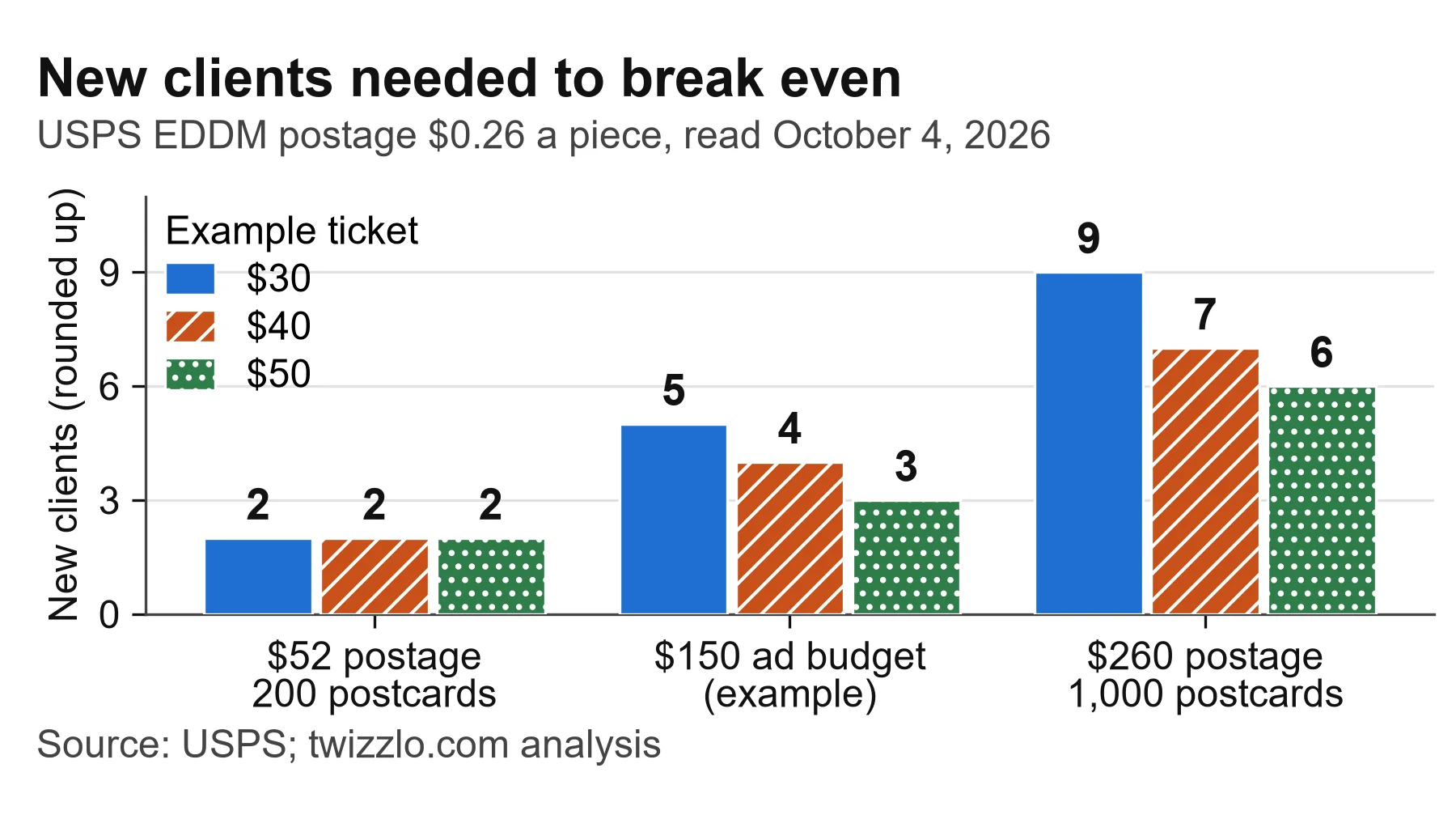
For the up-front ideas, the break-even is simple arithmetic: divide the month's cash cost by your average first-visit ticket, then round up. At a $40 average ticket, a $150 spend needs four new clients (3.75, rounded up). That count assumes you keep the whole ticket, as a solo barber or a chair renter does. If your barbers are paid a commission, divide by the shop's share instead. With a 50% commission the shop keeps $20 of a $40 cut, so the same $150 needs eight new clients (7.5, rounded up).
The count uses first visits only, which makes it strict. A new client who returns every four weeks at $40 brings in $520 over a year (13 visits), so an idea that breaks even on first visits alone can still be a good one. The strict number is the one to judge a test by, because it does not depend on guessing who comes back.
All 14 ideas at a glance
Six of the 14 ideas cost no cash, four cost money each time a client comes in, and four cost money up front.
| Idea | Cost type | Cash cost | Time to plan for (our estimate) |
|---|---|---|---|
| 1. Google booking link | No cash cost | $0 | 1 hour, then 15 to 20 min a week |
| 2. Reviews at the chair | No cash cost | $0 | Under 1 min per client, 15 min a week |
| 3. Instagram with booking link | No cash cost | $0 | 1 to 2 hours a week |
| 4. Nextdoor business page | No cash cost | $0 | 30 min, then 10 min a week |
| 5. Rebook at the chair | No cash cost | $0 | About 1 min per client |
| 6. Messages to overdue regulars | No cash cost | $0 | About 20 min a week |
| 7. Referral reward | Per client | Your rewards ($20 in the example) | 1 hour, then seconds per booking |
| 8. Slow-hours first-visit offer | Per client | Your discount ($5 in the example) | 30 min |
| 9. Booksy Boost | Per client | 30% of the first-visit base service price, add-ons excluded, $10 min, $100 max, plus a Booksy subscription | A few minutes |
| 10. Paper punch card | Per client | One free cut in 10 ($4 a visit at a $40 ticket) | Seconds per visit to stamp |
| 11. QR-code cards | Up front | Your printer's quote | 1 hour |
| 12. Card swap or pop-up with a partner | Up front | Cards from idea 11; pop-up supplies you buy | 1 hour, then monthly |
| 13. EDDM postcards | Up front | $0.26 each in postage, 200 minimum | 2 to 3 hours per mailing |
| 14. Paid local ads | Up front | Your budget ($150 in the example) | 2 to 3 hours, then 30 min a week |
Costs read October 4, 2026, on Google's, Nextdoor's, USPS's and Booksy's own pages, before tax. Examples in parentheses are amounts you set, not prices. Time figures are our planning estimates, not measurements.
Some ideas on other lists are left off this one because no published price exists to check. Gift cards and bulk email or text campaigns depend on the software that sells or sends them, so their cost varies by tool; idea 6 covers personal messages instead. Influencer posts cost whatever the influencer asks, and a new logo is a design fee with no new client to count. Good service is not on the list either: every idea here assumes it.
No cash cost: ideas that take only time
1. Add a booking link to your Google Business Profile
Listing the shop on Google costs nothing: Google's own page, read October 4, 2026, says creating a Business Profile and listing your business "is free" (Google Business Profile). If your profile has no booking link, a client who finds you on Maps still has to call. To add one from Google Search, choose Booking, then Add link, and paste your booking page; from Google Maps, start with Edit profile. Google accepts up to 10 links of each type, and you can mark one as "Business preferred" (Google Business Profile Help). Paste the same booking link you share everywhere else, so every booking lands on one calendar.
Cash cost: $0.
Time to plan for: about an hour to set up, then 15 to 20 minutes a week to add fresh photos of cuts and reply to reviews.
What to count: new clients who say they found you on Google or Maps.
2. Ask for a Google review at the chair
Reviews show next to your profile on Maps and Search, and Google's help center suggests asking clients to open a Google review link or scan a QR code (Google Business Profile Help). Ask while the client is still looking at the cut in the mirror, and keep the QR code on the station so nobody has to search for you. Our guide to getting Google reviews walks through the link, the wording and replies.
One review rule is absolute. Google says that offering incentives, "like free or discounted goods or services," in exchange for posting reviews, changing them or removing negative ones "is considered fake & misleading content and is strictly prohibited" (Google Business Profile Help, read October 4, 2026). So no $5 off for a review, five-star or otherwise. Ask, make it easy, and reply to what comes in.
Cash cost: $0.
Time to plan for: under a minute per client, plus about 15 minutes a week for replies.
What to count: reviews per month, and new clients who mention your reviews when they book.
3. Post your cuts on Instagram and put the booking link first
Fades, line-ups and beard work photograph well, which makes Instagram a portfolio clients scroll before they choose a barber. A post pays off only if the next tap leads to a booking. Instagram lets a profile carry up to five links. In the app, open Edit profile and then Links to add the booking page, and use Reorder links so it sits first (Instagram Help Center, read October 4, 2026). End captions with a plain line such as "Book through the link in my profile." A clean, well-lit station shows up in every photo; our barber station ideas guide covers layout and costs.
Cash cost: $0.
Time to plan for: one to two hours a week, most of it taking clean photos as you finish each cut.
What to count: new clients who say they found you on Instagram.
4. Claim a free Nextdoor business page
Nextdoor shows local posts to neighbors in a newsfeed, which suits a shop that draws from a few blocks around it. On October 4, 2026, Nextdoor offered a free Business Page and free posts; it also sells ads, with no price listed on that page (Nextdoor for small business). Use the page for what a neighbor cares about: your hours, your booking link, and a short post when you add a barber or start opening on a new day of the week.
Cash cost: $0 for the page and posts.
Time to plan for: about 30 minutes to set up, then 10 minutes a week.
What to count: new clients who mention Nextdoor or a neighbor's recommendation.
5. Book the next visit before the client leaves the chair
Keeping a client already in your chair costs nothing. Before you take payment, ask when they want to come back and book that visit on the spot. Booking software then sends the confirmation and the reminder, which our guide to appointment reminders covers in detail.
Cash cost: $0; the visit goes into the calendar you already use.
Time to plan for: about a minute per client.
What to count: the share of clients who leave with their next visit booked, week by week.
6. Email or call regulars who are overdue
A regular who usually comes every three weeks and has not booked in six may simply have forgotten to. Once a week, look through your client records for regulars past twice their usual gap and send each one a short personal email, or call, with your booking link. One message, not a series.
Cash cost: $0.
Time to plan for: about 20 minutes a week.
What to count: overdue regulars contacted, and how many book within two weeks.
Per client: ideas you pay for each time a client shows up
7. Reward referrals on both sides
A referral reward gives your regulars a reason to say your name to friends. Keep it simple and give something to both people: for example, $10 off the friend's first cut and $10 off the regular's next one. You pay only when the friend comes in, so the cost per new client is the two rewards together. Print the offer on a card the client can hand over, and write the referrer's name in your records when the friend books.
Cash cost: the rewards you choose, paid only for clients who show up ($20 per new client in the example), plus the printed cards.
Time to plan for: an hour to set up the card and the rule, then a few seconds per booking to note the referrer.
What to count: referral cards redeemed per month.
8. Offer a first-visit discount in your slow hours
If some of your hours sell themselves and others sit empty, a small first-visit offer limited to the empty hours can fill them without discounting your busy ones. Name the exact window, such as weekdays from 10 a.m. to 2 p.m., and limit it to new clients so regulars do not move their visits into the cheaper slot. A small discount, such as $5 off, costs nothing when nobody uses it.
Cash cost: the discount, paid only per new client who redeems it.
Time to plan for: 30 minutes to set the rule and the wording.
What to count: first-visit bookings inside the offer window, and how many of those clients come back at full price.
9. Pay Booksy Boost only for new marketplace clients
Booksy's pricing page describes Boost as a marketing feature for better visibility on the Booksy Marketplace, and its help center says Boost has no monthly fee of its own (Booksy pricing page; Booksy Help Center). When Boost brings in a client who has never booked you, Booksy takes a one-time commission of 30% of that first visit's base service price, never less than $10 and never more than $100. Booksy's help center listed these terms on October 4, 2026; add-ons are not counted, and the tip stays yours (Booksy Help Center). Every later visit from that client is yours in full.
On its pricing page, Booksy says clients from your own marketing carry no commission. It also tells you to send them your Booksy profile link, so they are not charged as Boost clients while Boost is on. Boost is charged only for visits that took place, so mark a no-show the same day to avoid the fee. Boost also needs a paid Booksy subscription; the plan prices and per-user costs are on our Booksy pricing page.
At a $40 first-visit service price, Boost costs $12 for that client. At $30 it costs $10, because 30% of $30 is $9 and the $10 minimum applies.
Cash cost: the Boost fee above, per Boost client, on top of a paid Booksy plan.
Time to plan for: a few minutes to switch it on; the profile itself is the work.
What to count: Boost clients per month and how many book a second visit.
10. Stamp a paper punch card for regulars
A printed card that gives the 10th cut free rewards the clients who already pay your bills. It costs one cut in 10: at a $40 ticket, that is $40 for every 10 visits, or $4 a visit. Print it with your QR cards and stamp it at checkout.
Cash cost: one free cut for every 10 visits, plus printing.
Time to plan for: seconds per visit to stamp the card.
What to count: cards completed per month, and how often card holders come back.
Up front: ideas you pay for before you know they work
11. Put QR-code cards at the stations and the front desk
A small card with a QR code that opens your booking page turns "I'll call you" into a booking made on the spot. Put one at each station, one at the desk and a few by the door for people walking past. Printing prices vary by printer and quantity, so price this idea with your own quote. Whatever the quote, the same rule applies: a $40 order of cards breaks even on one first visit at a $40 ticket. Our guide to business cards with QR codes covers what to print on them.
Cash cost: your printer's quote, paid once.
Time to plan for: an hour to design and order.
What to count: bookings that arrive through the link printed on the card.
12. Swap cards or run a pop-up with a nearby business
A gym, a sneaker shop or a tattoo studio down the street sees the same people you want in your chair. Offer to keep their cards at your desk if they keep yours at theirs. Give their customers the same first-visit offer you use for slow hours, so you can tell where those clients came from.
A step further is a pop-up: an hour of quick line-ups at the partner's shop on its busiest day, with your booking QR code on the table. Check your state barber board's rules on cutting hair outside a licensed shop before you plan one. Its cash cost is the supplies and cards you bring; judge it with the same break-even rule.
Cash cost: the cards from idea 11, any pop-up supplies you buy, plus the offer per new client if you use one.
Time to plan for: an hour of visits to set it up, then a check-in each month.
What to count: new clients who name the partner when they book.
13. Mail Every Door Direct Mail (EDDM) postcards
Every Door Direct Mail (EDDM), a USPS service, lets you mail a postcard to every address on the postal routes you choose, without buying a mailing list. The pieces are addressed to "Postal Customer" (USPS Every Door Direct Mail). On October 4, 2026, USPS listed EDDM Retail postage at $0.26 per piece for flat-size mail pieces up to 3.3 ounces (USPS; USPS business prices). Each mailing needs at least 200 pieces, and you can send up to 5,000 a day per ZIP code. Postage for the minimum 200 pieces is $52, and for 1,000 pieces it is $260. Printing is extra.
Before you print, run the design through the Mailpiece Size Checker in the EDDM Online Tool, which USPS provides to check that a flyer or postcard meets the requirements for marketing mail.
The break-even section below shows what each mailing size must bring in. Mail the routes closest to the shop, put the booking link and a QR code on the card, and add a first-visit offer so the card is easy to count.
Cash cost: the postage above, plus your printing quote.
Time to plan for: two to three hours to choose routes, design and drop off the mailing.
What to count: first visits that bring the card or use its offer.
14. Run paid local ads on social media or Google
Paid ads put your work in front of people nearby who do not follow you yet. Set a fixed budget and a fixed test period before you start, and send every click straight to your booking page rather than your profile. As an example, $5 a day for 30 days is $150. The break-even table below shows how many first visits that $150 must bring in at three tickets. Judge the test on booked first visits, not on likes or clicks.
Cash cost: the budget you set, paid whether or not anyone books.
Time to plan for: two to three hours to set up the first campaign, then about 30 minutes a week to check it.
What to count: first visits booked through the ad's link during the test.
Break-even: how many new clients each spend needs
Postage for the 200-postcard minimum, $52, needs two new clients to break even at any ticket from $30 to $50, while $260 for 1,000 postcards needs seven at a $40 ticket. That postage is USPS EDDM Retail at $0.26 a piece, read October 4, 2026, before printing. Figure 1 and the table under it add an example $150 ad budget and show the unrounded results at $30, $40 and $50 tickets.
| Spend in one month | At a $30 ticket | At a $40 ticket | At a $50 ticket |
|---|---|---|---|
| $52: postage for 200 postcards | 2 (1.73) | 2 (1.3) | 2 (1.04) |
| $150: ad budget of $5 a day for 30 days | 5 (5.0) | 4 (3.75) | 3 (3.0) |
| $260: postage for 1,000 postcards | 9 (8.67) | 7 (6.5) | 6 (5.2) |
| $150 ad budget, shop keeps 50% of the ticket | 10 (10.0) | 8 (7.5) | 6 (6.0) |
New clients needed, rounded up, with the exact quotient in parentheses. The first three rows assume the shop keeps the whole first-visit ticket; the last row divides by the shop's 50% share. Postage from USPS, read October 4, 2026, before printing. The ad budget, the tickets and the 50% commission are examples.
Add your printing quote to the $52 before you count the real break-even for the smallest mailing. A higher ticket shortens every break-even, which is why a shop that sells cut-and-beard combinations can afford more paid reach than one that sells only quick cuts.
Payback adds the return visits, counted at the full ticket. Say a $260 mailing brings five new clients at a $40 ticket: $200 on first visits, short of the seven clients it needs. If three of the five come back four weeks later, they add $120. By that second visit cycle, about four weeks after the first visits, the mailing has brought in $320 against its $260 cost. The five and the three are example numbers; use your own counts from the next section.
Per-client cost: what one new client costs at each first-visit service price
Below a $66.67 first-visit service price, a $20 referral reward ($10 to each side) costs more than Booksy Boost's 30% fee (as listed on October 4, 2026); above it, Boost costs more. A $5 first-visit discount stays at $5. Apart from the paid Booksy plan that Boost runs on, these three cost nothing in a month that brings no new client, but each takes a slice of every new client. Figure 2 shows that slice at first-visit service prices from $20 to $120.
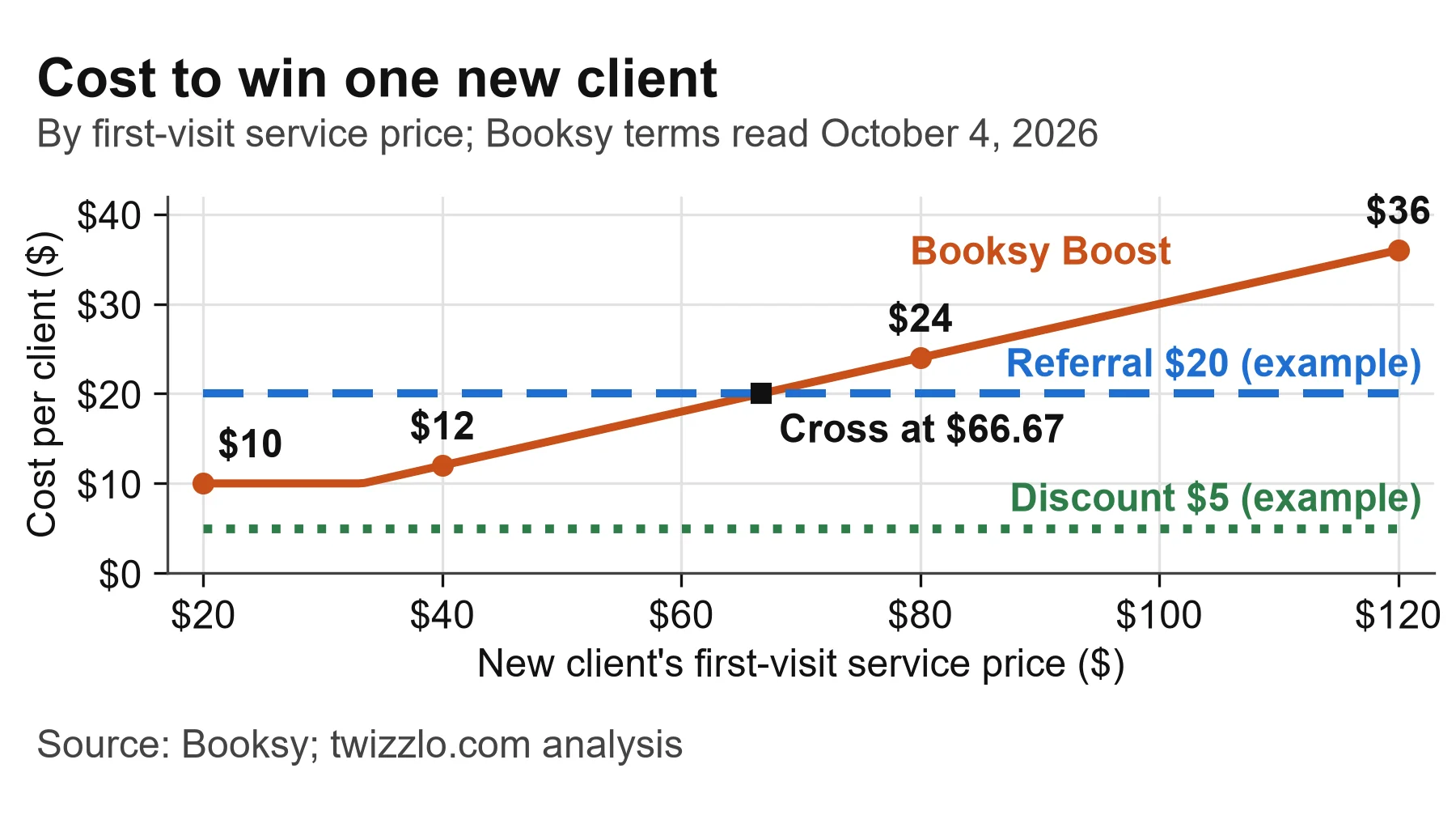
| First-visit service price (before add-ons and tip) | Booksy Boost fee | Referral reward ($10 plus $10) | First-visit discount ($5) |
|---|---|---|---|
| $20 | $10 (minimum) | $20 | $5 |
| $30 | $10 (minimum) | $20 | $5 |
| $40 | $12 | $20 | $5 |
| $50 | $15 | $20 | $5 |
| $80 | $24 | $20 | $5 |
| $120 | $36 | $20 | $5 |
Booksy Boost: 30% of the first-visit base service price, add-ons excluded, with a $10 minimum and a $100 maximum (Booksy help center and pricing page, read October 4, 2026). The referral reward and discount are example amounts you set.
Whichever you use, the cost is worth paying only if a good share of those clients come back at full price.
Count where every new client came from
None of these numbers helps unless you know which idea brought each new client in, so build the count into every first visit:
Ask every new client one question when they book or arrive: "How did you hear about us?"
Write the answer in the same place every time, with the client's record, using a short fixed list: Google, Instagram, Nextdoor, referral, offer, postcard, ad, partner, marketplace, walk-by.
At the end of each month, count new clients per source and set the count next to that idea's cash cost.
Give each paid idea a fixed test of four to eight weeks. If it misses break-even on first visits and the clients it brought are not rebooking, stop it and move the money to the idea that is working. If a no-cash idea is bringing in most of your new clients, give it more of your time before you spend money anywhere else.
Which marketing ideas should a barbershop try first?
Start where your chairs sit empty, and add paid reach only after the no-cash ideas are running:
A new shop with empty chairs: ideas 1 to 6 in the first week, then a 200-piece postcard mailing to the routes around the shop with a first-visit offer.
A busy shop with full weekends and empty weekday mornings: idea 8 for the empty window and idea 5 for every client, before any paid reach.
A solo barber renting a chair: ideas 2, 3 and 7, which cost little; reviews and referrals build on regulars you already have. If you also need a booking tool, compare the free barber booking apps first.
A shop that wants marketplace discovery: price idea 9 at your real first-visit service price, and count how many of those clients book a second visit.
Where Twizzlo fits
Twizzlo is web-based online booking and appointment scheduling software for appointment-based service businesses such as barbershops, and for these ideas it is the booking side: the page every link points to. The booking page is open around the clock and shows only the times your barbers are free. Each location has its own booking link, so one link can go on your Google profile, your Instagram and your QR cards. Twizzlo's features page also lists walk-in bookings, buffer times and client self-rescheduling. Twizzlo's barbershop page, linked in the introduction, carries a short note from a barbershop owner who uses Twizzlo.
For the counting habit above, every client has a profile that holds visit history, notes and preferences, and total spend. You can also check there when a regular last came in before you get in touch (idea 6). Note the source there on the first visit, and repeat client tracking then shows whether those clients come back. The insights view reports new customers by day, week or month. Clients get booking confirmations and reminders by email on either plan, with text messages (SMS) on Business Pro, and they can pay through Stripe at booking and tip at checkout.
Free is $0 a month for up to 150 bookings a month, with no SMS, and it is free forever, not a trial. Business Pro is $29.99 a month per business for unlimited bookings, with 50 SMS a month included and $0.03 for each one after that, and it comes with a 30-day money-back guarantee. Both plans include unlimited staff and locations. Online payments carry your Stripe processing rate plus a 1.5% Twizzlo platform fee. Support is available 24/7 at support@twizzlo.com. Plan details are on the Twizzlo pricing page.
Twizzlo does not run a consumer marketplace, so it fits businesses that already bring in their own clients. The ideas above are how those clients find you. A shop whose barbers book eight cuts a day in total, five days a week, books about 173 a month (8 x 5 x 52 / 12). That is past Free's 150, so plan on Business Pro; a shop that books 30 a week, about 130 a month, stays inside Free. Business Pro is also the step up once the shop needs text reminders. To try it with your own booking link, start on the Free plan.
Frequently asked questions
What is the best marketing for a barbershop on no budget?
Start with the six ideas that cost only time: add a booking link to your Google Business Profile, ask every happy client for a Google review, post your cuts on Instagram with the booking link first on your profile, claim a free Nextdoor business page, book each client's next visit before they leave, and contact regulars who are overdue. All six cost $0 in cash.
How do I work out whether a paid marketing idea is worth it?
Divide the month's cash cost by your average first-visit ticket, or by the shop's share of it if your barbers earn a commission, and round up. That is the number of new clients the idea must bring in to pay for itself. At a $40 ticket, a $150 spend needs four new clients. Count first visits only, then check whether those clients rebook.
Can I give clients a discount for leaving a Google review?
No. Google's help center says offering incentives such as free or discounted goods or services in exchange for posting, changing or removing negative reviews is fake and misleading content and is strictly prohibited. Ask for the review, make the link or QR code easy to reach and reply to reviews instead.
How much do Every Door Direct Mail postcards cost a barbershop?
The U.S. Postal Service listed EDDM Retail postage at $0.26 a piece on October 4, 2026, for flat-size mail pieces up to 3.3 ounces, and each mailing needs at least 200 pieces. Postage is $52 for 200 postcards and $260 for 1,000; printing costs extra.
How much does Booksy charge for new clients from Boost?
Booksy's help center, read October 4, 2026, sets the Boost commission at 30% of the base service price on a new client's first visit, charged once, with a $10 minimum and a $100 maximum. Add-ons and tips are not counted. Boost has no monthly fee of its own, and Booksy charges no commission on that client's later visits.
How should a barbershop track where new clients come from?
Ask every new client how they heard about the shop, record the answer from a short fixed list with the client's record, and count new clients per source at the end of each month. Set each count next to that idea's cash cost to see which ideas pay back.
Sources and methodology
Prices read
- Google Business Profile (opens in a new tab)Read . Supports: creating a Business Profile and listing your business is free
- Google Business Profile Help: Manage your local business links (opens in a new tab)Read . Supports: booking link steps, up to 10 links per category, Business preferred link
- Google Business Profile Help: Tips to get more reviews (opens in a new tab)Read . Supports: review link or QR code; incentives for reviews prohibited
- Instagram Help Center: Add a website to your Instagram profile (opens in a new tab)Read . Supports: up to five profile links, Edit profile and Links steps, Reorder links
- Nextdoor for small business (opens in a new tab)Read . Supports: free Business Page and free posts; ads offered, no price listed
- USPS Every Door Direct Mail (opens in a new tab)Read . Supports: EDDM Retail $0.26 per piece, 200 minimum, 5,000 a day per ZIP code, Postal Customer addressing, Mailpiece Size Checker
- USPS business prices (opens in a new tab)Read . Supports: EDDM Retail $0.26 for flats up to 3.3 oz
- Booksy pricing page (opens in a new tab)Read . Supports: Boost marketing feature on Booksy Marketplace; no commission on clients from your own marketing; share your profile link
- Booksy Biz Help Center (United States): How does Boost pricing work? (opens in a new tab)Read . Supports: no monthly fee; $10 minimum, $100 maximum; later visits and tips 100% yours; no-show rule
- Booksy Biz Help Center (United States): Are Add-ons included when calculating Boost commissions? (opens in a new tab)Read . Supports: Boost commission on the base service price, add-ons excluded
- Twizzlo pricing page (opens in a new tab)Read . Supports: Free and Business Pro plans, SMS, guarantee, 1.5% platform fee, support
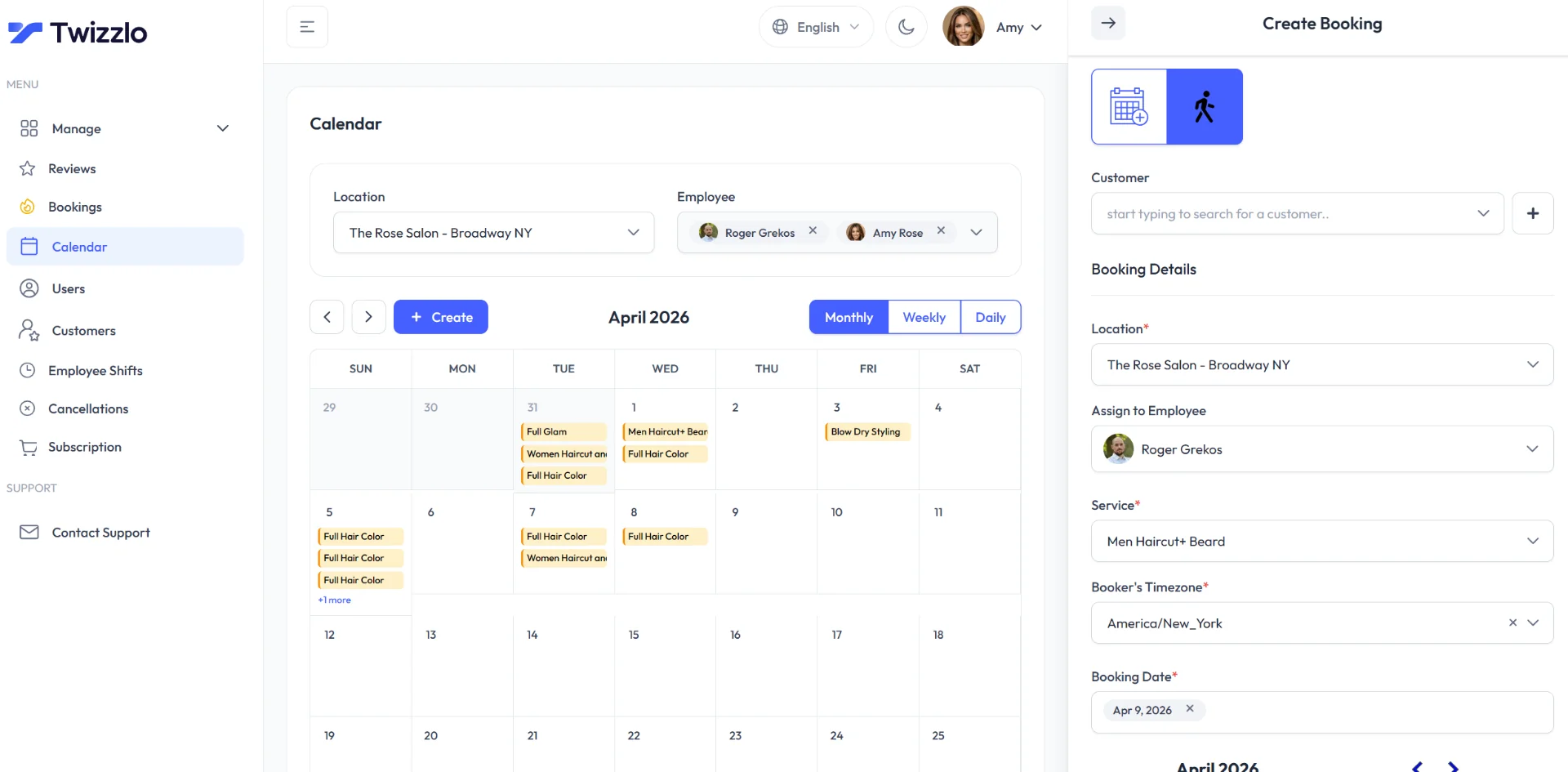
- Twizzlo features page (opens in a new tab)Read . Supports: booking page, per-location link, walk-ins, buffer times, self-rescheduling, client profiles, repeat client tracking, new-customer insights, calendar screenshot
From our editorial policy
- We do not publish invented quotes, studies, statistics, customer stories or product tests, and we do not imply hands-on use of a product when the research came from the vendor's public documentation.
- To report an error, email support@twizzlo.com with the subject line "Correction: [page URL]". Tell us what is wrong and, if you can, link a source.
Start free, upgrade when you grow
Flat-rate booking software. No per-seat, per-chair or per-location fees.
- Free plan up to 150 bookings a month, not a trial
- Business Pro is $29.99 a month per business for unlimited bookings, with a 30-day money-back guarantee
- 24/7 support by email