
Barber Station Ideas: Real Dimensions, Clearances and Costs

By Roger Grekos, founder and editor, Twizzlo. Prices were read first-hand from each vendor's own website between September 8 and September 11, 2026.
Twizzlo publishes this page and competes with the products priced on it. Every competitor price stated here as current is read from that vendor's own website, its pricing page or help center, with the qualifier printed there, or recorded as not published.
Good barber station ideas start with three numbers: wall width per station, room depth behind the chair, and counter height. Budget 47 to 72 inches of wall per surveyed station, about 11 feet 10 inches of depth for two facing rows, and check work surfaces against the 34 inch ADA maximum and the front desk against 36 inches.
Barber station ideas sold as photographs give you a mood, a finish and a wall color, and nothing you can put on a tape measure or a purchase order. This piece runs the other way. Its sample frame is one retailer's catalog, Buy-Rite Beauty, first read on 2026-09-08, covering eleven stations and three barber chairs whose own spec panels publish a width and a depth. The Bali Tower Styling Station w/ Retail & Mirror is priced too, but its dimensions are not used here. Every clearance is taken from the 2010 ADA Standards for Accessible Design as published by the U.S. Access Board. Every software plan price comes from the vendor's own pricing page, fetched the same day, with later reads dated where they appear.
Twizzlo is our own product and it is charted here against three competitors, so the method is on the page for you to check. No accessibility professional and no shopfitter reviewed this piece. Where a number could not be sourced first-party, the article says so.
What separates barber station ideas that work from ones that only photograph well?
A barber station ideas gallery gives you a finish, a mood board and a retailer link. It does not give you a width, a depth or a counter height, so you cannot check whether the station fits the wall you actually have.
A station is three things at once. It is storage for clippers, guards, blades and bottles. It is a work surface at a height your shoulders can tolerate for eight hours. It is also a footprint that takes floor away from the chair in front of it and the aisle behind it.
Get the footprint wrong and no finish saves you. A shop that squeezes in a fifth chair loses the walking route between chairs three and four. The barber at chair four then spends the day sidestepping a client's knees. So this piece treats every idea as a measurement, in one order: station width, then room depth, then counter height.
How much wall does each barber station actually need?
Start with the station itself, then add the chair, because the chair takes up wall width too. Read on 2026-09-08 from its Buy-Rite Beauty product page, the Bali Professional Barber Station lists a Total Width of 47 inches and a Cabinet Width of 42 inches.
The Collins E1071 Finley Barber Station lists a Width of 58 inches plus 6 inches. Add those together and the Finley occupies 64 inches of wall. Two more Collins units list a wider Width than the Finley's 58 inches. The Collins E1073 Nico Barber Station lists Width 60 inches, Depth 15.5 inches and Height 42 inches. The Collins 68A LaCarte Barber Station lists Width 72 inches, Depth 22 inches and Height 39 inches. So, with the Bali's 47 inches, the dedicated barber stations in this survey span 47 to 72 inches wide, and the station at the top of that range is one this article also prices.
Wall mounted stations with a full width work surface run 36 to 48 inches wide in this survey. The Manhattan Wall Styling Station lists Width 36 inches, Depth 15 inches and Height 8 inches. The Econo Wall Styling Station lists Width 36 inches, Depth 15 inches and Height 7 inches. The Jazz Wall Styling Station lists Width 40 inches, Depth 15 inches and Height 7 inches, with a Drawer Width of 24 inches. The Boston Styling Station lists Width 48 inches, and its own page reads Ranked #3 Best Wall-Mounted Station. The Brooklyn Styling Station, listed on the same retailer category page as the Boston, publishes a Width of Work Surface of 16 inches and a Width w/ Tool Panel of 21 inches.
Now the chair. The K.O. Professional Barber Chair lists Outside Arms 26.5 inches and an Extra Large 28 inch Chrome Base. The Lenox Professional Barber Chair lists Outside Arms 24.75 inches. The Takara Belmont BB-225 Elegance Barber Chair lists Width 25 inches and Depth 37 inches. Here is the arithmetic behind these barber station ideas. Put chairs on a 36 inch pitch, which is what a 36 inch wide Manhattan wall station invites, and the clear gap between chair arms is 36 minus 26.5, or 9.5 inches. That is not a route. That is a shoulder. Put them on the Bali's 47 inch pitch and the gap between arms is 47 minus 26.5, or 20.5 inches. Better, and still not walkable.
The 2010 ADA Standards set the clear width of walking surfaces at 36 inches minimum in section 403.5.1. That section also carries an exception, and the exception matters here. The clear width may be reduced to 32 inches minimum for a length of 24 inches maximum, provided the reduced segments are separated by segments 48 inches long minimum and 36 inches wide minimum. A gap between two chairs can be a short segment, but the 32 inch figure may apply only if the narrow part of the gap is 24 inches long or less. The 36 inch figure still governs the aisle it feeds. Carry both numbers into your plan, not one.
Now count gaps, not chairs. Four chairs in a row have three gaps between them, not four. Size each gap at the floor, where the K.O.'s 28 inch base is wider than its 26.5 inch Outside Arms. With a 36 inch route in each gap, the run is four times 28 plus three times 36, or 220 inches. That is 18 feet 4 inches of uninterrupted wall. Take the 32 inch exception in each gap instead and the run is 112 plus 96, or 208 inches, which is 17 feet 4 inches.
Four Bali stations at a 47 inch pitch take 188 inches, or 15 feet 8 inches, with no walking routes. The gaps between those chairs, 20.5 inches between arms, then meet neither the 36 inch nor the 32 inch ADA width. Only the 220 and 208 inch layouts keep walking routes, the 208 only where each narrow gap is 24 inches long or less. The three layouts are different shops, and you should know which one you are buying before the freight truck arrives. If you rent chairs rather than employ barbers, the wall you assign per chair is also a contract term, and our booth rental contract template covers how to describe it.
How deep does the room have to be for two rows of chairs?
Width gets all the attention. Depth is what kills a floor plan, and it is the number the Minerva Beauty list of barber station ideas, checked below, never prints. The Bali Professional Barber Station lists Depth 16 inches, and Depth w/ Lift Lid 33 inches. The Collins E1073 Nico lists Depth 15.5 inches. The Collins 68A LaCarte lists Depth 22 inches, the deepest listed Depth of any station in this survey, lift lids aside. The Takara Belmont BB-225 Elegance lists Depth 37 inches.
Set the chair directly in front of a 16 inch station such as the Bali, and with the Takara Belmont's 37 inch depth the wall to the chair's front edge is 16 plus 37, or 53 inches. That is before anyone moves. Add the ADA section 403.5.1 minimum clear width of 36 inches for a walking surface and a single row against one wall needs 53 plus 36, or 89 inches. That is 7 feet 5 inches of depth for one row of chairs and one walking route.
Two rows facing each other across one shared aisle is the layout sized here. That comes to 53 plus 36 plus 53, or 142 inches. Call it 11 feet 10 inches of interior width, wall to wall, with nothing else in the room. The 32 inch exception in section 403.5.1 does not rescue that aisle. It is capped at a length of 24 inches maximum, and a main aisle runs the length of the room.
If you want a wheelchair to turn in the aisle rather than reverse out of it, section 304.3.1 requires a circular turning space of 60 inches diameter minimum. Swap the 36 for 60 and the room becomes 53 plus 60 plus 53, or 166 inches. That is 13 feet 10 inches. Two feet of extra building width is what a turning circle adds to this layout, so settle it before you sign the lease.
The Bali's lift lid is a separate depth trap. It takes the station from 16 inches to 33 inches deep when it is open. With the lid up, wall to chair front becomes 33 plus 37, or 70 inches. It is momentary, but if your aisle is exactly 36 inches, a barber with an open bottle well has just closed the route behind them.
Swap the 16 inch deep Bali for the 22 inch deep LaCarte and each row's station plus chair depth grows from 53 to 59 inches. None of these figures are recommendations from us. They are published product depths added to published ADA minimums. Your local code may demand more, and a licensed designer should sign off before you build. Check whether your state barbering board sets a minimum floor area per chair. No state board rule was fetched for this piece.
What counter height should you build your barber stations to?
Counter height is where one ranking barber station ideas article, checked below, gives advice with no accessibility caveat. Here are the published heights, read on 2026-09-08. The Bali Professional Barber Station lists Work Surface Height 40 inches and Total Height 43 inches, with a Backsplash Height of 3 inches. The Collins E1071 Finley Barber Station lists Height 39 inches, and the Collins 68A LaCarte lists Height 39 inches. The Collins E1073 Nico lists Height 42 inches, the tallest of the three Collins units. So the dedicated barber stations publish a Work Surface Height or a bare Height of 39 to 42 inches.
On the salon side, the Boston Styling Station lists Height to Work Space 36 inches, and the Brooklyn Styling Station lists Height to Work Surface 36 inches. The Omega 36 and Denali both list Height to work surface 36.25 inches. Now the standard. Section 902.3 of the 2010 ADA Standards states that the tops of dining surfaces and work surfaces shall be 28 inches minimum and 34 inches maximum above the finish floor or ground.
Compare each published work surface height with the 34 inch ADA maximum. The Bali's Work Surface Height of 40 inches is 6 inches over. The Omega and Denali at 36.25 inches are 2.25 inches over, and the Boston and Brooklyn at 36 inches are 2 inches over. That is five stations with a published work surface height, and not one lands at or under 34 inches. The Collins Finley, Nico and LaCarte are left out: their published Height is 39 to 42 inches, and their pages, read in full on 2026-09-11, give no work surface height. The Manhattan, Econo and Jazz publish a unit Height of 8, 7 and 7 inches, which is the cabinet body rather than a height above the floor, so they are not in that count.
The practical point is that you cannot buy your way to a compliant work surface from this survey's specs alone: none of its stations publishes a work surface height at or under 34 inches. That is not a scandal. Barber stations are working equipment, and section 902 governs accessible dining and work surfaces rather than every counter in a building. You specify that surface, or you build it. The front desk plays by a different rule again. Section 904.4.1 requires a portion of the counter surface 36 inches long minimum and 36 inches high maximum for a parallel approach. Section 904.4.2 allows 30 inches long minimum at 36 inches high maximum for a forward approach, with knee and toe space underneath. So your building has two different ceilings in it.
An accessible work surface caps at 34 inches high. The accessible portion of a sales and service counter caps at 36 inches high. They sit 2 inches apart and they are not interchangeable. A single 36 inch number for both fails the work surface rule. Have a local accessibility consultant confirm which surfaces in your specific shop are scoped as work surfaces.
What do barber stations cost, wall mounted through full cabinet?
Here is the price ladder for these barber station ideas, read from buyritebeauty.com product pages on 2026-09-08. Most products show a struck list price and a lower sale price. Every list and sale price below was rechecked on 2026-09-10 and none had changed. Budget on the list price anyway, because a sale price is the retailer's to withdraw and a build budget should not depend on it.
Units the retailer files under Wall Mounted Stations, list then sale: Manhattan Wall Styling Station $199 then $169. Econo Wall Styling Station $229 then $199. Jazz Wall Styling Station $299 then $249. Brooklyn Styling Station $549 then $499. Boston Styling Station $799 then $699. Vanity units with a mirror, filed there too in breadcrumbs read on 2026-09-11: Omega 36 inch Black Vanity Station and Mirror $899 then $799. Denali Vanity Styling Station and Mirror $999 then $899.
Dedicated barber stations, list then sale: Bali Professional Barber Station $1,195 then $1,095. Collins E1071 Finley Barber Station $1,302, with no sale price shown. Collins E1073 Nico Barber Station $1,756. Collins 68A LaCarte Barber Station $3,738. Chairs from the same page set: K.O. Professional Barber Chair $779 then $679. Lenox Professional Barber Chair $899 then $799. Takara Belmont BB-225 Elegance Barber Chair $3,962 then $3,862.
Price each position as one station plus one chair. A Manhattan wall station and a K.O. chair is $199 plus $779, or $978 per position at list. A Bali station and a Takara Belmont is $1,195 plus $3,962, or $5,157 per position at list. That is a 5.3 times range for the same job, and the cheaper one takes 11 inches less wall, 36 inches against 47. Those are two different floor plans, not two finishes, and the width difference compounds across four positions.
Shipping terms change the total. On its product pages, Buy-Rite states "Free shipping on all orders over $5,000". The Bali and LaCarte product pages state that larger items ship by Freight Delivery and that "All Freight Deliveries are curbside deliveries", meaning the driver leaves the pallet at the curb. Buy-Rite's shipping policy, read on 2026-09-10, limits that free shipping to "continental US-based shipping destinations", excludes Alaska, Hawaii and split shipments, and warns that lift gate or residential delivery "may incur shipping fees". The same policy says free shipping promotions "cannot be combined with any other offers or discounts". Get a written freight quote for four stations to your actual ZIP. The same shipping page says delivery inside your business is not included, and this piece did not price freight.
What does each extra chair add to your barbershop booking software subscription?
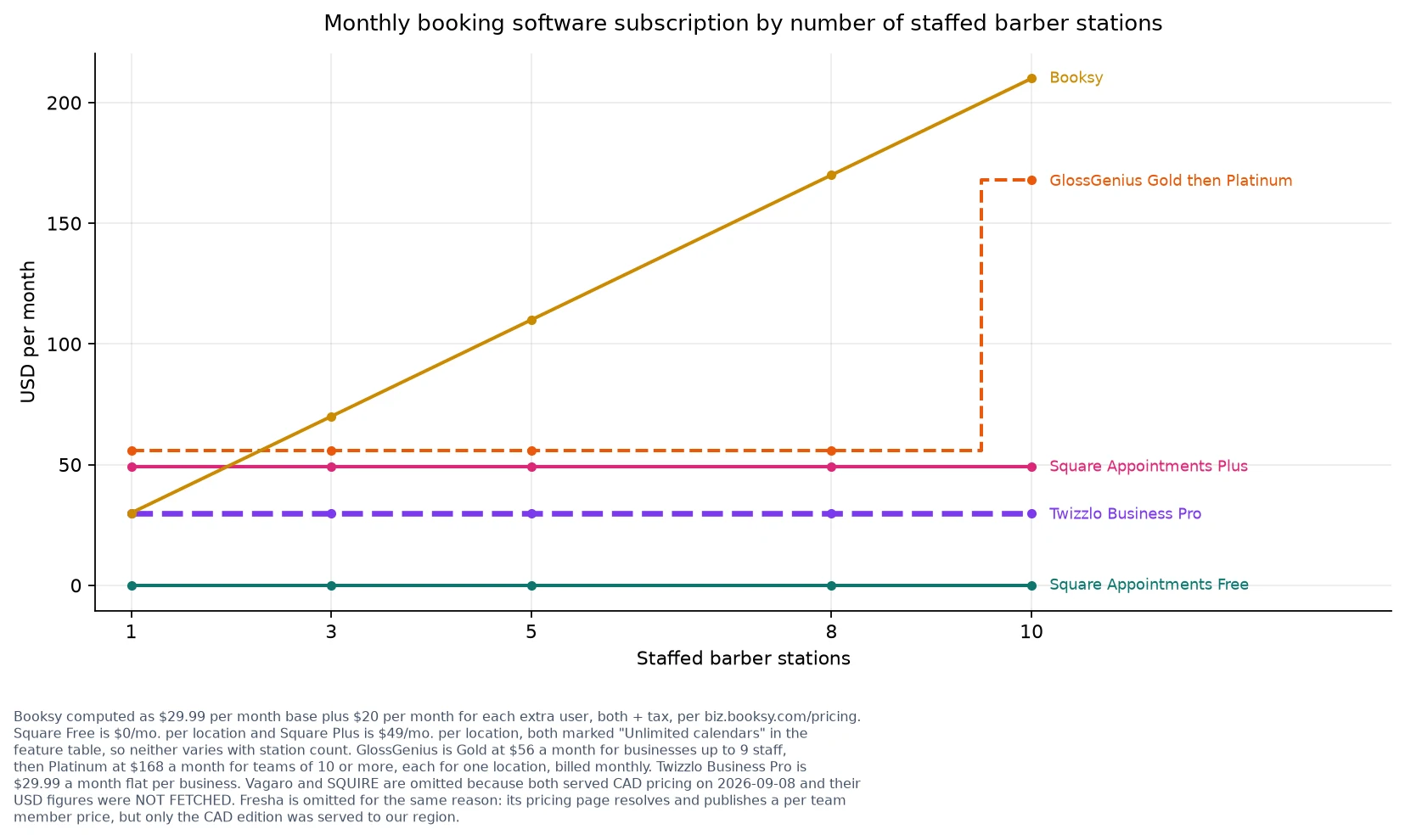
Furniture is a one time number. Software is a number every month, and on some platforms it scales with the count of staffed chairs. Every plan price below was read from the vendor's own pricing page on 2026-09-08, and later reads are dated where they appear. The station count assumption is ours and it is stated plainly: one booking user per staffed station.
Booksy publishes "Get everything for $29.99" with "per month + tax" underneath, and beside it "Add extra users for $20/month each". Its own FAQ reads "Booksy costs $29.99 per month, plus $20 per month for each additional team member (+ tax)". Note the qualifiers. It is per extra user, not per user.
Square Appointments publishes $0/mo. per location, $49/mo. per location and $149/mo. per location for Free, Plus and Premium. A fourth tier, Square Pro, reads "Get custom pricing". A line on that card, read on 2026-09-10, asks businesses that process over $250,000 per year to talk to Square's team about eligibility. The phrase "Unlimited staff calendars" sits in the top features summary on the Free card only. The feature table carries a row reading "Unlimited calendars" with the note "Add and view as many staff calendars as your business needs. There is no employee limit." The page states that with Plus and Premium "the monthly fee applies to each location you run".
Square scopes Free "For solo professionals taking payments and managing schedules" and puts "Multi-staff appointment booking" on the Plus card, alongside a cancellation policy with no-show fees and a waitlist. Free is still charted above at $0 a month per location, because on a pure calendar count no published subscription for ten chairs is lower. Leaving it out would flatter every paid plan in the chart, including our own.
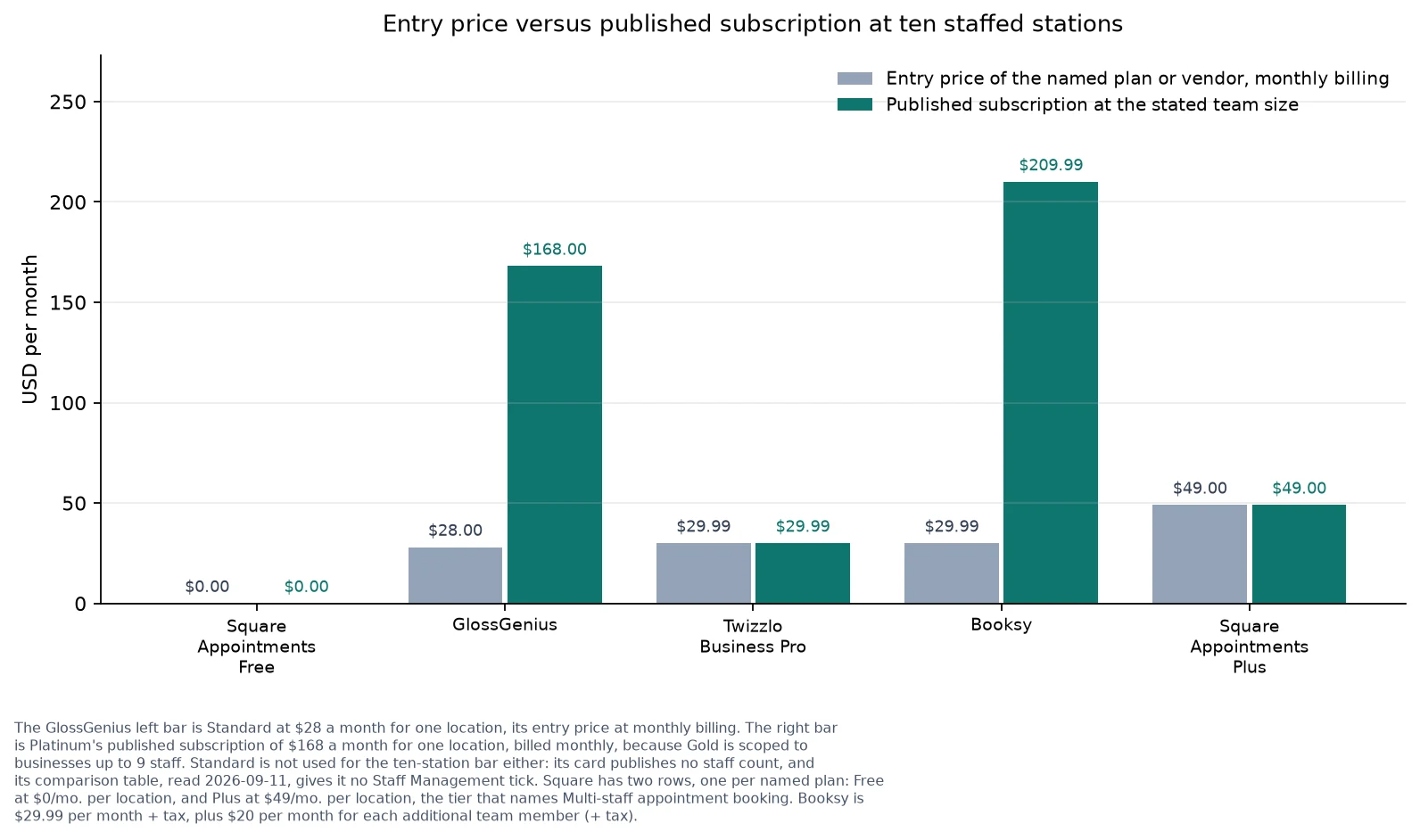
GlossGenius publishes Standard at $28 a month, Gold at $56 a month and Platinum at $168 a month, each billed monthly, with a lower figure billed annually. Those prices are per location: a footnote to the page's Compare plans table, read on 2026-09-11, says "Each additional location is charged the plan price, at a 15% discount." Standard is "Essential tools for businesses just starting out". Gold is "Revenue-boosting features for businesses up to 9 staff". Platinum is "Full power for established businesses and teams 10+". Standard publishes no staff count at all, and the page's comparison table, read on 2026-09-11, ticks Staff Management for Gold and Platinum but not for Standard. That is why the line chart above plots Gold and Platinum rather than Standard.
Twizzlo Business Pro is $29.99 per month flat per business, with unlimited bookings, employees, locations and customers, and 50 SMS included then $0.03 per message. There is also a free plan at $0 per month, permanent rather than a trial, capped at 150 bookings per month with no SMS. Twizzlo runs card payments through Stripe with a 1.5% Twizzlo platform fee on top of Stripe's own fees, which is set out in our payment processing article rather than on the pricing page.
Now the crossover, at monthly billing. One location, one chair, monthly billing: Square Free $0.00, GlossGenius Standard $28.00, Booksy $29.99 + tax, Twizzlo $29.99, Square Plus $49.00 and GlossGenius Gold $56.00. A single chair shop pays a lower subscription on GlossGenius Standard than on Twizzlo, and pays no subscription on Square Appointments Free. From two chairs, GlossGenius is listed on Gold or Platinum. One location, two chairs, monthly billing: Square Free $0.00, Twizzlo $29.99, Square Plus $49.00, Booksy $49.99 + tax and GlossGenius Gold $56.00. One location, five chairs, monthly billing: Square Free $0.00, Twizzlo $29.99, Square Plus $49.00, GlossGenius Gold $56.00 and Booksy $109.99 + tax. One location, ten chairs, monthly billing: Square Free $0.00, Twizzlo $29.99, Square Plus $49.00, GlossGenius Platinum $168.00 and Booksy $209.99 + tax.
Booksy passes Twizzlo at chair two, and passes Square Appointments Plus by 99 cents a month, both before Booksy's tax. Two Booksy users come to $49.99 per month + tax, against Twizzlo's $29.99 a month flat per business and Square Plus at $49.00 a month per location. The GlossGenius subscription triples at chair ten, from Gold at $56 a month to Platinum at $168 a month, each for one location billed monthly, because Gold is scoped to businesses up to 9 staff. If you plan to hire past nine, that step is a budget event rather than a footnote.
Every monthly plan price in this section is a subscription price only, and it excludes card processing. Twizzlo adds a 1.5% Twizzlo platform fee on top of Stripe's own fees. GlossGenius publishes a "Flat 2.6% rate", which its pricing FAQ, read on 2026-09-11, applies "on all transactions". Square publishes 2.6% + 15 cents down to 2.4% + 15 cents on each in-person payment when a card is present, by plan tier. The processing line can outweigh the subscription line, so Twizzlo's $29.99 a month flat per business is not a total cost of ownership and this article does not present it as one. Plan detail sits on our flat rate barbershop booking software page, and the per-seat comparison is broken out in booking software with no seat fees.
What do the top ranking barber station guides get wrong?
Three pages ranking for this query were fetched on 2026-09-08 and checked against primary sources. A fourth, from Salon Equipment Center, returned HTTP 403 to a plain fetcher and was NOT FETCHED. The Minerva Beauty article "8 Barber Station Ideas That Are Cool and Functional" carries the date January 19, 2022 on the page. Across all eight of its ideas it publishes no width, no depth, no counter height, no clearance and no price. A Mentioned Products module appended below the article lists three product prices, but none of the eight ideas carries a number. It is a styling guide filed under a purchasing query, and more than four and a half years is a long run for ideas with no measurement in them.
The Keller International article "8 Barber Station Ideas That Boost Style And Efficiency", dated May 20, 2026, gives one real figure. It advises "finding a fixed counter near your standing elbow height", which it puts at "roughly 36 to 40 inches for most barbers". That is sound ergonomics for a standing barber, honestly stated as a range. What it does not say is that section 902.3 of the 2010 ADA Standards caps an accessible work surface at "34 inches (865 mm) maximum above the finish floor or ground". Build every counter in the shop to 36 to 40 inches and you have no compliant work surface anywhere in the building. Their range sits 2 to 6 inches above the federal ceiling, and the article carries no accessibility note at all.
The DIR Store article "Top Barber Station Ideas for a Modern and Efficient Barbershop Setup", dated August 11, 2025, states: "According to industry stats, shops with integrated sinks report up to 20% faster service turnaround". It names no study, publisher, year or link. We could not locate the source it credits. Treat that 20% as unattributed until somebody produces the study behind it. One more, on a page we otherwise relied on. The Buy-Rite Beauty listing titled Denali 42" Vanity Styling Station and Mirror shows Width: 36" in its own spec panel, with a Wood Framed Mirror at 40"W x 36"H. Ask Buy-Rite which figure the 42 in that product name refers to before you plan a wall run around it. We have not confirmed it.
A barber station ideas checklist for a four chair shop
This is a barber station ideas checklist in numbers. If you are still choosing a platform rather than a cabinet, start with the best booking app for barbers and the Booksy comparison. Then work this list in order. Each step names the number it depends on and where that number came from.
Step one. Measure the shortest clear wall in the room, in inches, with the baseboard in place. Not the lease plan. The wall. Step two. Decide whether chair gaps are routes, then count gaps rather than chairs. Four chairs have three gaps. At the K.O. chair's 28 inch base plus the 36 inch ADA section 403.5.1 clear width in each gap, four chairs need 220 inches, or 18 feet 4 inches. At the section 403.5.1 exception of 32 inches, which is allowed for a length of 24 inches maximum, four chairs need 208 inches, or 17 feet 4 inches. If the gaps are not routes, a 47 inch Bali pitch gives four chairs in 188 inches, or 15 feet 8 inches.
Step three. Check depth before you buy anything. Station depth plus chair depth plus aisle. With a 16 inch station and a 37 inch chair that is 53 inches per row. Two facing rows across a 36 inch aisle is 142 inches, or 11 feet 10 inches. Across a 60 inch turning circle it is 166 inches, or 13 feet 10 inches. A 22 inch deep LaCarte adds 6 inches to each row.
Step four. Set two counter heights, not one. Work surfaces that must be accessible cap at 34 inches under section 902.3. The accessible portion of your front desk must be 36 inches long minimum and 36 inches high maximum under section 904.4.1. Off the shelf barber stations in this survey publish a Work Surface Height or a bare Height of 39 to 42 inches, so the compliant surface is something you specify.
Step five. Confirm power before the station goes on the wall. The Collins E1071 Finley lists Two Front-Facing Duplex Outlets. Read on 2026-09-11, the Collins E1073 Nico lists Two Front-Facing Duplex Outlets and a Six-Outlet Power Strip, and the Collins 68A LaCarte lists (3) Duplex Electrical Outlets. The Bali does not list outlets in its spec panel. Confirm outlet count and placement per station with your electrician before drywall closes.
Step six. Price the position, not the item. A Manhattan wall station plus a K.O. chair at list is $978. Bali plus Takara Belmont at list is $5,157. Multiply by four before you commit to a look.
Step seven. Budget freight separately. Buy-Rite's free shipping applies to orders over $5,000; its shipping policy, read on 2026-09-10, limits it to continental US destinations, excluding Alaska and Hawaii, and lift gate or residential delivery may add fees. The same policy says free shipping cannot be combined with any other offers or discounts, and split shipments are ineligible. Freight is curbside only.
Step eight. Price the software per chair, not per shop, and read the free tiers first. The subscription for four staffed chairs is $0.00 per month per location on Square Appointments Free, which Square scopes for solo professionals. It is $29.99 a month flat per business on Twizzlo Business Pro, $49.00 a month per location on Square Appointments Plus and $56.00 a month for one location on GlossGenius Gold, billed monthly. It is $89.99 per month + tax on Booksy, at $29.99 per month plus three extra users at $20 a month each. None of those figures include card processing.
Step nine. Name what your software will not do. Twizzlo has no retail inventory, so the four adjustable retail compartments in a Brooklyn station, or the Bali Tower w/ Retail at $1,795 list, are display space you will count by hand. Twizzlo also has no POS hardware, no payroll or commissions, no membership autopay or package builder, and no published card processing rate. If your build includes a retail wall, price that honestly against a platform whose pricing page, read on 2026-09-11, lists inventory tools, such as our Square Appointments comparison or our GlossGenius comparison.
Prices in this article were read from each vendor's own website between September 8 and September 11, 2026, and they will drift, so check the vendor's page before you buy. If a flat rate fits how you are growing, start with Twizzlo's barbershop booking software and test it on the free plan.
Frequently asked questions
How wide should a barber station be?+
Dedicated barber stations in this one retailer survey run 47 to 72 inches wide. The Bali lists a Total Width of 47 inches, the Collins E1071 Finley lists 58 inches plus 6 inches, and the Collins 68A LaCarte lists 72 inches. Surveyed wall mounted units with a full width work surface run 36 to 48 inches. Read 2026-09-08.
How much space do you need between barber chairs?+
That depends on whether the gap is a walking route. The K.O. chair lists Outside Arms of 26.5 inches and an Extra Large 28 inch Chrome Base, and the wider base sets the clear width at the floor. ADA section 403.5.1 sets 36 inches minimum clear width for walking surfaces, with an exception of 32 inches for a length of 24 inches maximum. Four chairs have three gaps, so a 36 inch route in each needs 220 inches of wall, or 18 feet 4 inches.
What is the correct height for a barber station counter?+
There is no single correct height. Off the shelf barber stations in this survey publish a Work Surface Height or a bare Height of 39 to 42 inches: 40 on the Bali, and 39 to 42 on the three Collins units. ADA section 902.3 caps an accessible work surface at 34 inches maximum, while section 904.4.1 caps the accessible portion of a service counter at 36 inches. Those are three different numbers.
How much does a barber station cost?+
In this one retailer survey of Buy-Rite Beauty, read on 2026-09-08 and rechecked on 2026-09-10, the surveyed units the retailer files under Wall Mounted Stations start at $199 list for the Manhattan Wall Styling Station. At the top is the Bali Tower Styling Station w/ Retail & Mirror at $1,795 list, unchanged on 2026-09-11. In between sit the Brooklyn at $549, the Boston at $799, and the Omega and Denali vanities (breadcrumbs read 2026-09-11) at $899 and $999. The dedicated barber stations surveyed run $1,195 list for the Bali Professional to $3,738 for the Collins 68A LaCarte, with the Collins E1071 Finley at $1,302 and the Collins E1073 Nico at $1,756. Every station named here except the Finley, Nico and LaCarte showed a lower sale price beside its list price.
Are wall mounted barber stations better than freestanding ones?+
The Manhattan, Econo and Jazz wall units are cheaper and shallower than every dedicated barber station surveyed, not better. They list $199 to $299 at 15 inches deep, against $1,195 to $3,738 and 15.5 to 22 inches for the Bali Professional and the three Collins units. That does not hold for every unit the retailer files as wall mounted, a filing read on 2026-09-11 for the Omega and Denali. The Brooklyn and Boston are 16 inches deep and the Omega and Denali 19, all deeper than the 15.5 inch Finley and Nico, and the Bali Tower lists $1,795. The tradeoff is chair pitch: a 36 inch station leaves 9.5 inches between the arms of two 26.5 inch chairs, which is a shoulder, not a route under any ADA figure.
How deep does a barbershop need to be for two rows of chairs?+
About 11 feet 10 inches on the figures below. A 16 inch station plus a 37 inch deep chair is 53 inches per row, and two rows across a 36 inch aisle is 142 inches. If you want the 60 inch turning circle from ADA section 304.3.1 in that aisle, the figure becomes 166 inches, or 13 feet 10 inches.
Does booking software cost more as you add chairs?+
On some platforms, yes. Booksy publishes $29.99 per month + tax, plus $20 per month + tax for each extra user. GlossGenius Gold covers businesses up to 9 staff at $56 a month for one location, billed monthly, then Platinum is $168 a month for one location, billed monthly, for teams of 10 or more. Square Appointments Free stays $0 per month per location and Twizzlo Business Pro stays $29.99 a month, flat per business. Those are subscription prices, before card processing.
What should you buy first when building out a barbershop?+
Measure first, buy second. Fix your wall length, room depth and two counter heights before you price a single cabinet. A Manhattan wall station plus a K.O. chair is $978 per position at list, and a Bali plus a Takara Belmont is $5,157, so the layout decision sets the budget, not the finish.
Try Twizzlo free
Flat-rate booking software. No per-seat, per-chair or per-location fees.