
Apps Like Vagaro: 10 Vagaro Alternatives With 2026 Prices

In short
Apps like Vagaro include Square Appointments, GlossGenius, Booksy, StyleSeat, Fresha, Mangomint, Boulevard, Mindbody, Zenoti and Twizzlo. At five bookable staff, Vagaro costs $63.99 a month on its limited-time base rate, against $0 on Square Free, $56 on GlossGenius Gold and $109.99 plus tax on Booksy, according to each vendor's pricing page or help center, read September 25, 2026.
- Per-calendar and per-member bills grow with each hire (Vagaro's until the seventh license); per-location, per-account and per-business prices do not.
- At five staff, published prices run from $0 (Square Free) to $170 (Mangomint), with Vagaro at $63.99 on a limited-time rate, read September 25, 2026.
- Vagaro add-ons such as Forms and the Online Shopping Cart cost $10 a month each (help center, read September 25, 2026).
Source: Vagaro plans and pricing help article (US) (opens in a new tab), read
In this article18 sections
Salon and spa owners look for apps like Vagaro when the monthly bill grows with every bookable calendar. This guide compares 10 Vagaro alternatives the same way: what each one bills by, and what one, five and 10 staff cost a month. Each Vagaro alternative is checked against its own pricing page or help center, read September 25, 2026 (Twizzlo’s on September 27).
Twizzlo publishes this guide and is one of the 10 tools; every other price comes from that vendor’s own page. Vagaro’s full price ladder and add-on list are on our Vagaro pricing page.
What are apps like Vagaro?
Apps like Vagaro are booking and business software for salons, spas and other appointment businesses: online booking, staff calendars, payments, client records and reminders. They differ most in what they bill by. Vagaro charges per bookable calendar; the alternatives here bill per team member, per user and location, per location, by staff band, per account or per business.
Vagaro alternatives by monthly cost at 1, 5 and 10 staff
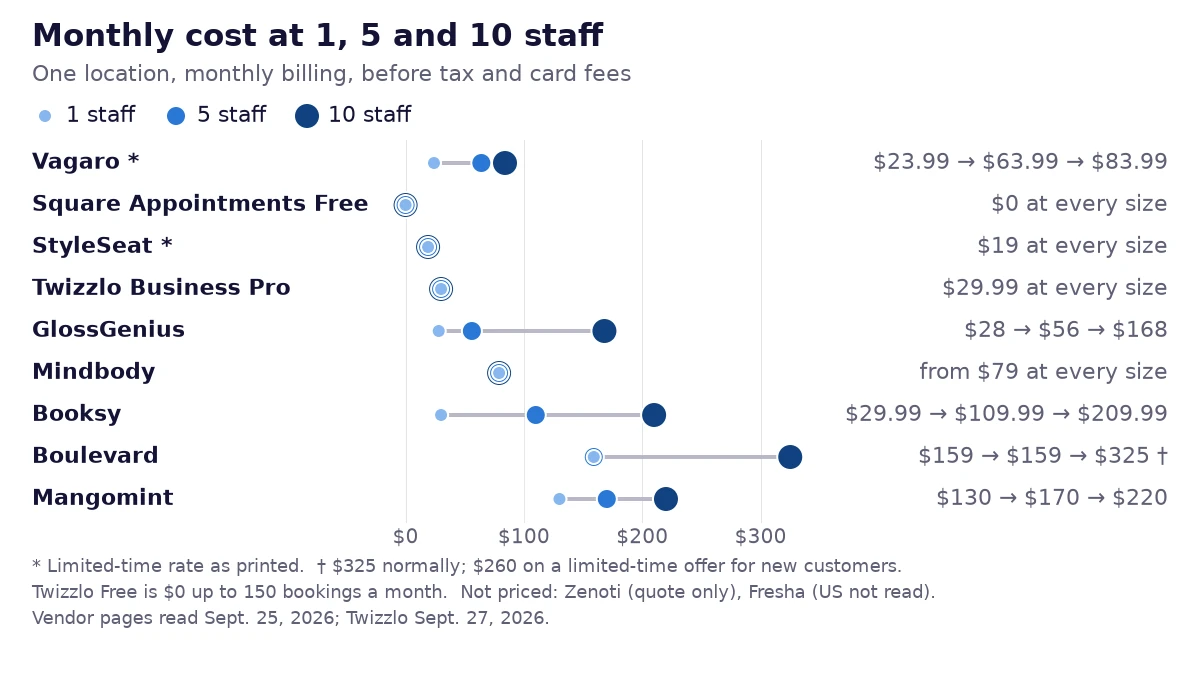
For five bookable staff at one location, Vagaro’s limited-time base rate plus four added calendars comes to $63.99 a month. Square Appointments Free costs $0, StyleSeat $19 on a limited-time rate, GlossGenius Gold $56 and Booksy $109.99 plus tax, according to each vendor’s page read September 25, 2026.
Table 1. Monthly cost of Vagaro and each Vagaro alternative at 1, 5 and 10 bookable staff: one location, monthly billing, before tax and card processing, cheapest published plan that covers the team. Sources: Vagaro’s US help center and each vendor’s pricing page, read September 25, 2026, linked in each tool’s section below; Twizzlo’s pricing page, read September 27, 2026.
| Tool | Bills by (as published) | 1 staff | 5 staff | 10 staff |
|---|---|---|---|---|
| Vagaro | Base subscription with 1 calendar, $10 per added calendar up to seven licenses | $23.99* | $63.99* | $83.99* |
| Square Appointments | Per location: Free $0, Plus $49, Premium $149 | $0 | $0 | $0 |
| StyleSeat | Per account, up to 15 chairs | $19* | $19* | $19* |
| Twizzlo | Per business: Free up to 150 bookings a month, no SMS; Business Pro unlimited | $0 or $29.99 | $0 or $29.99 | $0 or $29.99 |
| GlossGenius | Per business, by plan and staff band | $28 (Standard) | $56 (Gold) | $168 (Platinum) |
| Mindbody | Per location, unlimited users; plans by quote | from $79 | from $79 | from $79 |
| Booksy | 1 team member included, $20 per added member, plus tax | $29.99 | $109.99 | $209.99 |
| Boulevard | Essentials up to 5 providers; Premier per location | $159 | $159 | $325 normally ($260* offer for new customers) |
| Mangomint | $120 per location plus $10 per user | $130 | $170 | $220 |
| Zenoti | Quote only | Quote | Quote | Quote |
| Fresha | Paid plans; one-time fee on new marketplace clients | Not shown | Not shown | Not shown |
* Limited-time rate as the vendor prints it: Vagaro’s US help center marks $23.99 “Only for a limited time” and prints no list price; StyleSeat’s pricing page calls $19 “a limited-time offer for new pros,” and its help center lists a $35 Premium Plan; Boulevard’s $260 Premier rate is a fall offer. Card processing is extra on every tool. GlossGenius Standard has no staff management, so five staff start on Gold (“businesses up to 9 staff”). Mangomint counts front desk profiles as users. Booksy’s page prints no country or currency.
Bills that count people grow with each hire: Vagaro charges per calendar until the seventh license, Booksy per team member and Mangomint per user. Bills set per location, per account, per business or by staff band stay flat until the team crosses a plan limit, as happens on GlossGenius at 10 staff and on Boulevard Essentials above five providers.
What Vagaro costs today, and the add-ons it sells
Vagaro’s US base subscription is $23.99 a month, marked “Only for a limited time,” and covers one calendar; each extra calendar adds $10 until seven licenses are paid (help center, read September 25, 2026).
That puts one calendar at $23.99, five at $63.99 and seven or more at $83.99, since new employees are added “at no additional charge” once seven licenses are paid for. The help center prints no subscription price for an added location: its “Additional locations” line, $10 a month per location, is part of the Branded App add-on. The help center also prints no list price, no price for after the limited-time rate and no rule for how calendar licenses count across locations, so this guide prints no multi-location total.
Premium features are monthly add-ons: Forms $10; the Online Shopping Cart, which sets up deposits and cancellation fees for online appointments, $10; the Check-In App $10; MySite $20; Payroll $34 plus $5 per employee; and text marketing from $20 a month for 1,000 credits. If per-calendar billing is why you are leaving, start with flat-rate booking software that scales.
Worked example: five calendars and two add-ons
Example: a salon with five bookable calendars at one location that adds Forms and the Online Shopping Cart pays $63.99 + $10 + $10 = $83.99 a month on Vagaro before card processing, on the limited-time base rate (US help center, read September 25, 2026). Vagaro’s US card rates are 2.6% + $0.10 per in-person payment under $4,000 a month in card sales; 2.29% + $0.19 above it, with a $10 monthly Large Merchant fee; keyed-in 3.5% + $0.19; FANF and Mastercard location fees apply, amounts not printed (US help center, read September 27, 2026). Table 1 prices the same five-person team on each alternative.
1. Twizzlo
Twizzlo fits salons and spas that want one price per business while they add staff or locations. It is web-based online booking and appointment scheduling software for appointment-based service businesses, with a public booking page, email and SMS reminders, client records, staff schedules and shifts, and Stripe payments and tips.
Free is $0 a month for up to 150 bookings, with no SMS, and it is free forever, not a trial. Business Pro is $29.99 a month per business for unlimited bookings and 50 SMS a month, then $0.03 each, with a 30-day money-back guarantee. Both plans include unlimited staff and locations, so hiring or adding a location never changes the price (Twizzlo pricing page, read September 27, 2026). Online payments carry your Stripe processing rate plus a 1.5% Twizzlo platform fee.
- Prepaid bookings: clients can pay the full service price when they book; after a no-show, the business decides whether to keep or refund it, and no-show fees apply at its discretion.
- Reminders: by email on both plans, and by SMS on Business Pro.
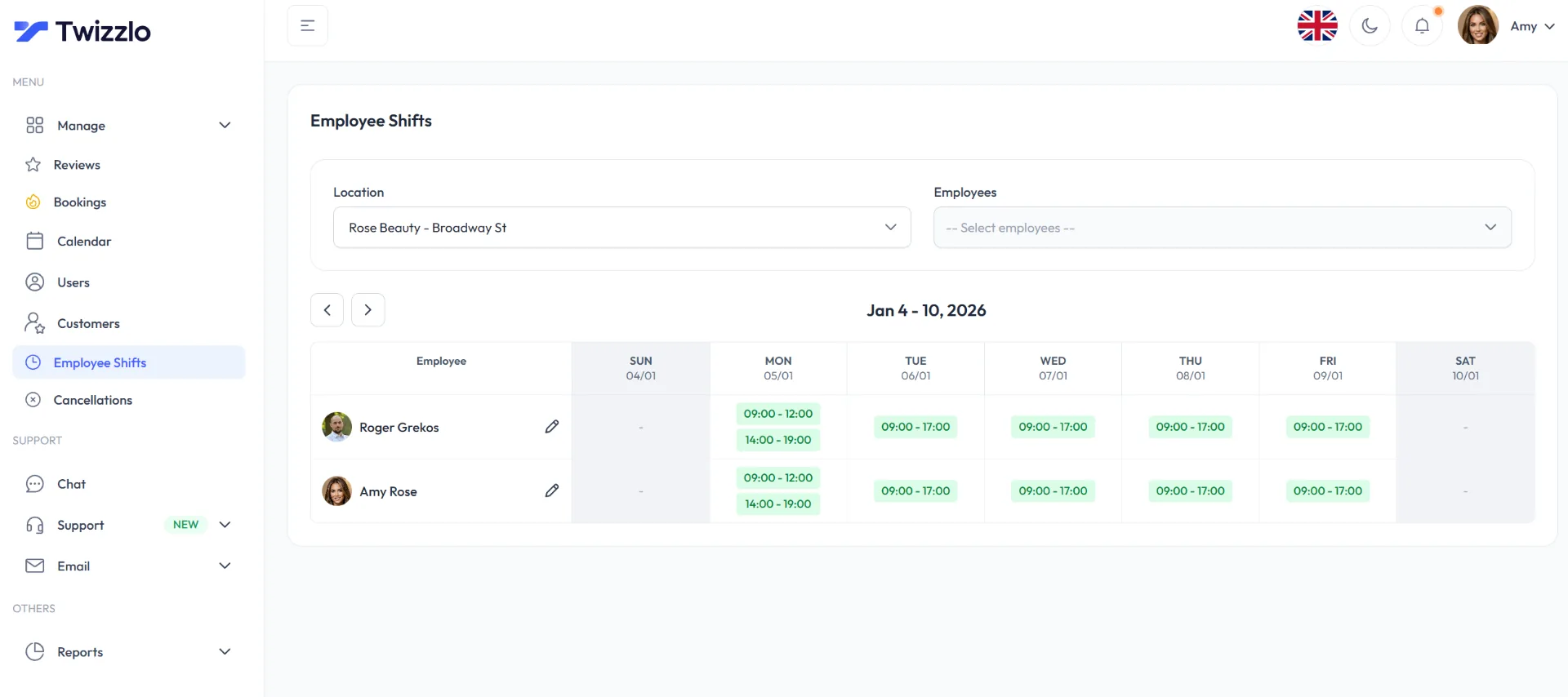
- Schedules across locations: Employee Shifts sets each person’s weekly shifts by location.
- Insights and support: unlimited real-time insights on both plans, and 24/7 support by email.
- Best for: salons and spas that plan to hire or open another location.
- Bills by: the business, at any team size.
- Watch for: a salon that wants payroll run, commissions tracked or memberships sold inside its booking software fits better with a tool that lists them; Twizzlo does not include them.
2. Fresha
Fresha fits independents and small single-location teams that want a consumer marketplace to send them new clients. Fresha sells paid plans and charges a one-time fee on new marketplace clients (pricing page, read September 25, 2026). Its US prices were not readable from our reading location that day, so this guide prints no Fresha figure.
Because the fee applies to new clients who find the salon on the marketplace, the total depends on how many arrive that way. Our guide to the best salon booking software compares more tools for single-location salons.
- Best for: independents who want marketplace discovery.
- Bills by: paid plan, plus a one-time fee per new marketplace client.
- Watch for: the fee grows with the share of clients who arrive through Fresha.
3. Mindbody
Mindbody fits studios and multi-service businesses that want a per-location price with no per-user charge. It lists plans from $79 a month per location with unlimited users; its Starter, Accelerate and Ultimate plans are priced by quote (pricing page, read September 25, 2026). More detail is on our Mindbody pricing page.
The $79 figure is a starting point, not a quote: the plan and its price come from a sales call, and the page prints no card processing rate. Owners leaving Mindbody itself can start with our Mindbody alternative guide.
- Best for: businesses with several service types under one roof.
- Bills by: each location, with unlimited users.
- Watch for: the plan price needs a sales call.
4. Booksy
Booksy fits barbers and beauty pros who want a consumer marketplace to bring in new clients. It costs $29.99 a month plus tax with one team member and $20 a month for each added member, so five staff pay $109.99 plus tax (pricing page, read September 25, 2026; the page prints no country or currency). More detail is on our Booksy pricing page.
Per the same pricing page, Boost, Booksy’s optional marketplace promotion, is free to turn on and takes a one-time fee of 30% of the total cost of a Boost client’s first visit. According to Booksy, plans include 2,000 free SMS marketing messages a month, confirmations and reminders are free, and a 14-day trial needs no credit card. If Booksy is on your shortlist, read our Vagaro vs Booksy comparison.
- Best for: shops that win new clients through a marketplace.
- Bills by: each team member after the first.
- Watch for: each hire adds $20 a month.
5. Square Appointments
Square Appointments fits salons that want to start at $0 or already take payments through Square. Square Free costs $0, Plus $49 and Premium $149 a month per location, and Free lists “Unlimited staff calendars” (pricing page, read September 25, 2026). Plus and Premium have 30-day free trials. More detail is on our Square Appointments pricing page.
The trade-off on Free is the card rate: online payments cost 3.3% plus 30 cents on Free against 2.9% plus 30 cents on Plus and Premium. Square hardware has “options starting at $59.” Square’s plan grid lists features that differ by plan, so test the ones your salon uses first.
- Best for: small teams that want $0 software, and salons already on Square.
- Bills by: each location.
- Watch for: a higher online card rate on Free.
6. GlossGenius
GlossGenius fits solo pros and teams under 10 that want a published price and one card rate. Its pricing page, read September 25, 2026, lists three plans on monthly billing: Standard at $28 with no staff management, Gold at $56 for businesses up to 9 staff and Platinum at $168 for teams of 10 or more ($24, $48 and $148 billed annually). Per GlossGenius, Gold includes 500 text credits and Platinum 2,500. More detail is on our GlossGenius pricing page.
Card processing is a flat 2.6%, with no extra fee for tap to pay, card on file or manual entry. Each added location costs the plan price less 15%, and payroll is an add-on at $40 a month plus $6 per seat. Owners leaving GlossGenius itself can start with our GlossGenius alternative guide.
- Best for: solo stylists and teams of up to nine.
- Bills by: plan and staff band, per business.
- Watch for: the 10th staff member moves a salon from $56 to $168 a month.
7. Boulevard
Boulevard fits premium salons and spas, from small teams on Essentials to larger ones that pay per location. Essentials costs $159 a month ($143 billed annually) for up to five providers. Premier is $325 a month per location normally, or $260 on a limited-time fall offer for new customers; Prestige is $455 normally, or $364 on the same offer (pricing page, read September 25, 2026).
Card processing starts at 2.65%, automated campaigns cost $2 per completed appointment, and forms and charts are an add-on on Essentials and Premier.
- Best for: premium salons and spas that want per-location plans with unlimited professionals.
- Bills by: one flat price for up to five providers on Essentials; each location on Premier and Prestige.
- Watch for: a sixth provider moves a salon to Premier, and the $260 and $364 rates are for new customers only.
8. Mangomint
Mangomint fits salons and spas that want one formula for locations and staff: $120 a month per location plus $10 per user, so one location with five users costs $170 a month (pricing page, read September 25, 2026). The page says: “Anyone with a profile in Mangomint counts as a user.”
Add-ons are Phone at $70 a month per line, Marketing from $30 a month and Payroll at $50 a month plus $8 per worker. Its pricing FAQ asks whether Mangomint takes a fee for appointments booked in the platform and answers: “Nope. Never.”
- Best for: salons and spas that price software by headcount.
- Bills by: each location and each user.
- Watch for: front desk profiles count as users.
9. Zenoti
Zenoti fits chains and franchise groups that want pricing built around many locations. Every plan is priced by quote, its page says “Multi-location pricing is customized,” and communications are billed by consumption with optional base packs (pricing page, read September 25, 2026).
With no public price, Zenoti cannot be compared line by line in Table 1. Salons with two or three locations can compare simpler multi-location scheduling software first.
- Best for: chains and franchise groups.
- Bills by: quote only.
- Watch for: no price to compare before a sales call.
10. StyleSeat
StyleSeat fits solo stylists and suite renters who want a marketplace and one account price. Its pricing page lists $19 a month after the free trial, which it calls “a limited-time offer for new pros,” for stylists and salons with up to 15 chairs, with “Staff calendars at no extra seat cost” (read September 25, 2026). Payments are free in the trial, then 1.9% for six months.
Its help center, read the same day, lists a $35 Premium Plan, an optional New Client Connection fee of 30% of a new client’s first appointment ($50 maximum) and a $2.35 booking fee paid by the client. Neither page calls $35 the price after the offer ends.
- Best for: solo stylists and suite renters.
- Bills by: the account, up to 15 chairs.
- Watch for: the $19 rate is limited-time.
Which Vagaro alternative fits which business
The right Vagaro alternative depends on who books your clients and how your team is counted. Table 2 matches each tool to the business it fits and the one thing to check first; prices and read dates are in Table 1.
| Tool | Best fit | Bills by | Watch for |
|---|---|---|---|
| Twizzlo | Salons and spas adding staff or locations | Per business: Free up to 150 bookings a month, no SMS; Business Pro $29.99 a month | Payroll, commissions and memberships not included |
| Fresha | Independents who want marketplace clients | Paid plans plus a one-time fee on new marketplace clients | No US figure shown |
| Mindbody | Businesses with several service types | Per location, from $79 a month | Plan prices by quote |
| Booksy | Barbers and beauty pros who want marketplace discovery | $29.99 a month plus tax, plus $20 per added member | Boost takes 30% of a Boost client’s first visit |
| Square Appointments | Teams that want $0 software or already use Square | Per location: $0, $49 or $149 a month | Higher online card rate on Free |
| GlossGenius | Solo pros and teams of up to nine | By plan: $28, $56 or $168 a month | No staff management on Standard |
| Boulevard | Premium salons and spas | Essentials $159 up to 5 providers; Premier $325 per location normally | $260 Premier rate is for new customers, limited time |
| Mangomint | Salons and spas pricing by headcount | $120 per location plus $10 per user | Front desk profiles count as users |
| Zenoti | Chains and franchise groups | Quote only | No public price |
| StyleSeat | Solo stylists and suite renters | $19 a month on a limited-time new-pro rate, up to 15 chairs | New Client Connection fee, up to $50 per new client |
Four checks before you leave Vagaro
Four checks decide whether a switch saves money: your team size, the Vagaro add-ons you use, what client messages cost and whether you want a marketplace.
- Count bookable calendars and locations. Then read your row in Table 1. Vagaro stops charging for calendars after the seventh license, so seven or more staff pay $83.99 a month on the limited-time rate, while per-member and per-user bills keep growing.
- List the Vagaro add-ons you pay for. Forms, the Online Shopping Cart, text marketing and Payroll are separate monthly charges on Vagaro. Check on the new tool’s own pricing page whether it includes each one, sells it or does not offer it.
- Price client messages and retention tools. These costs differ most: Vagaro text marketing from $20 a month for 1,000 credits, Booksy 2,000 free SMS marketing messages a month, GlossGenius 500 or 2,500 text credits by plan, Mangomint Marketing from $30 a month and Boulevard $2 per completed appointment for automated campaigns (all read September 25, 2026).
- Decide whether you want a marketplace. Booksy Boost, StyleSeat New Client Connection and the Fresha marketplace can send new clients, and each charges a one-time fee on new clients who book through it. If most clients already book you directly, the monthly price matters more.
Apps Like Vagaro: FAQ
What is the best app like Vagaro?
The best alternative to Vagaro depends on team size and where clients come from. At five staff, Square Appointments Free costs $0, GlossGenius Gold $56 and Vagaro $63.99 on its limited-time rate, according to each vendor’s pricing page or help center, read September 25, 2026. Booksy and StyleSeat suit salons that want marketplace discovery, Boulevard and Mangomint have the highest published prices here, and Zenoti is priced by quote. Twizzlo Business Pro is $29.99 a month per business at any team size (pricing page, read September 27, 2026).
How much is Vagaro per month?
Vagaro’s US help center, read September 25, 2026, lists the base subscription at $23.99 a month, marked “Only for a limited time,” with one bookable calendar included. Each added calendar costs $10 a month up to seven licenses, so five calendars cost $63.99 and seven or more cost $83.99. Add-ons are extra, for example Forms and the Online Shopping Cart at $10 a month each. The help center prints no price for after the limited-time rate.
Are there free apps like Vagaro?
Yes, two tools in this guide have a $0 plan. Square Appointments Free costs $0 a month per location and lists unlimited staff calendars (pricing page, read September 25, 2026). Twizzlo Free costs $0 a month for up to 150 bookings, with no SMS, and is free forever, not a trial (pricing page, read September 27, 2026). Fresha sells paid plans and charges a one-time fee on new marketplace clients (pricing page, read September 25, 2026).
Which Vagaro alternative is best for a solo stylist?
For a solo stylist, three tools have low published prices, all read September 25, 2026. StyleSeat’s pricing page lists $19 a month as a limited-time rate for new pros, and its help center lists an optional New Client Connection fee of 30% of a new client’s first appointment, up to $50. GlossGenius Standard costs $28 a month with flat 2.6% card processing, and Square Appointments Free costs $0 per location. Fresha’s US prices were not readable that day.
Which app like Vagaro is best for multiple locations?
For several locations, compare how each tool bills per location, all read September 25, 2026. Zenoti prices every plan by quote and says “Multi-location pricing is customized.” Mindbody starts at $79 a month per location with unlimited users. Square Appointments costs $0, $49 or $149 a month per location. Vagaro’s help center prints no subscription price for an added location. Both Twizzlo plans include unlimited locations (pricing page, read September 27, 2026).
What is the best alternative to Vagaro for premium salons?
For premium salons, Boulevard and Mangomint have the highest published prices in this guide at five and 10 staff, per their pricing pages read September 25, 2026. Boulevard Essentials costs $159 a month for up to five providers, and Premier is $325 a month per location normally, or $260 on a limited-time offer for new customers. Mangomint costs $120 a month per location plus $10 per user. The choice turns on headcount: Boulevard Essentials stops at five providers, while Mangomint adds $10 for each person with a profile.
Who are Vagaro’s competitors?
Vagaro’s competitors include the 10 tools in this guide, grouped here by what they bill by on their pricing pages, read September 25, 2026 (Twizzlo’s on September 27). Booksy bills per team member; Mangomint per location and per user; Square Appointments and Mindbody per location; GlossGenius and Boulevard Essentials by staff band; StyleSeat one price per account; and Twizzlo Business Pro one price per business. Zenoti prices by quote, and Fresha’s US prices were not readable that day.
Try Twizzlo’s Free plan before you switch
You can run your real bookings on Twizzlo before you cancel another tool. Free is $0 a month for up to 150 bookings, with no SMS, and it is free forever, not a trial. Business Pro is $29.99 a month per business with unlimited bookings, 50 SMS a month then $0.03 each, and a 30-day money-back guarantee. Both plans include unlimited staff and locations, so the Twizzlo row in Table 1 holds at any team size. Online payments carry your Stripe processing rate plus a 1.5% Twizzlo platform fee. Compare the two plans to see what each includes.
Sources and methodology
Prices read
- Vagaro plans and pricing help article (US) (opens in a new tab)Read . Supports: Vagaro base rate, calendar fees, add-on prices and US card rates
- Square Appointments pricing page (US) (opens in a new tab)Read . Supports: Square plans per location, unlimited staff calendars, card rates, trials and hardware
- StyleSeat pricing page (opens in a new tab)Read . Supports: StyleSeat's limited-time rate for new pros, chair limit, staff calendars and payments rate
- StyleSeat help center: How much does StyleSeat cost (opens in a new tab)Read . Supports: StyleSeat Premium Plan, New Client Connection fee and client booking fee
- GlossGenius pricing page (opens in a new tab)Read . Supports: GlossGenius plans, staff bands, text credits, card rate, location discount and payroll add-on
- Mindbody pricing page (opens in a new tab)Read . Supports: Mindbody starting price per location, unlimited users and quote-only plans
- Booksy pricing page (opens in a new tab)Read . Supports: Booksy price, added team members, Boost fee, SMS allowance, reminders and trial
- Boulevard pricing page (opens in a new tab)Read . Supports: Boulevard plans, the fall offer for new customers, card rate, campaign fee and forms add-on
- Mangomint pricing page (opens in a new tab)Read . Supports: Mangomint location and user prices, who counts as a user, add-ons and its booking-fee answer
- Zenoti pricing page (opens in a new tab)Read . Supports: Zenoti quote-only plans, multi-location pricing and communications billing
- Fresha pricing page (read outside the US) (opens in a new tab)Read . Supports: Fresha paid plans and the one-time fee on new marketplace clients (wording only; no Fresha figure is stated)
- Twizzlo pricing page (opens in a new tab)Read . Supports: Twizzlo plans, booking cap, SMS allowance, money-back guarantee, support and online payment fee
- Twizzlo features page (opens in a new tab)Read . Supports: Twizzlo reminders, prepaid bookings, no-show fees, Employee Shifts and insights; the Employee Shifts screenshot (same image)
From our editorial policy
- Twizzlo sells online booking and appointment scheduling software, the same category we write about. Twizzlo appears in our comparisons and roundups, and we have a commercial interest in you choosing it.
- We do not publish invented quotes, studies, statistics, customer stories or product tests, and we do not imply hands-on use of a product when the research came from the vendor's public documentation.
- To report an error, email support@twizzlo.com with the subject line "Correction: [page URL]". Tell us what is wrong and, if you can, link a source.
Update history
- : Re-read every price on the vendor's own page, added a cost table and chart at 1, 5 and 10 staff, removed Mindbody, Boulevard and Mangomint figures their pricing pages do not show and Fresha figures we could not confirm for the US, and corrected the Square Free plan description.
Start free, upgrade when you grow
Flat-rate booking software. No per-seat, per-chair or per-location fees.
- Free plan up to 150 bookings a month, not a trial
- Business Pro is $29.99 a month per business for unlimited bookings, with a 30-day money-back guarantee
- 24/7 support by email