
Guest Spot Tattoo Guide: How Guest Spots Work, What Hosts Charge and Four State Licenses

In short
A guest spot tattoo stay puts a visiting artist in a studio that is not their home shop, usually for a few days to several weeks. The host takes a flat day fee or a share of the work: 20% to 50% in Painful Pleasures and Artfolio guides read November 20, 2026. Some states require a short-term license first.
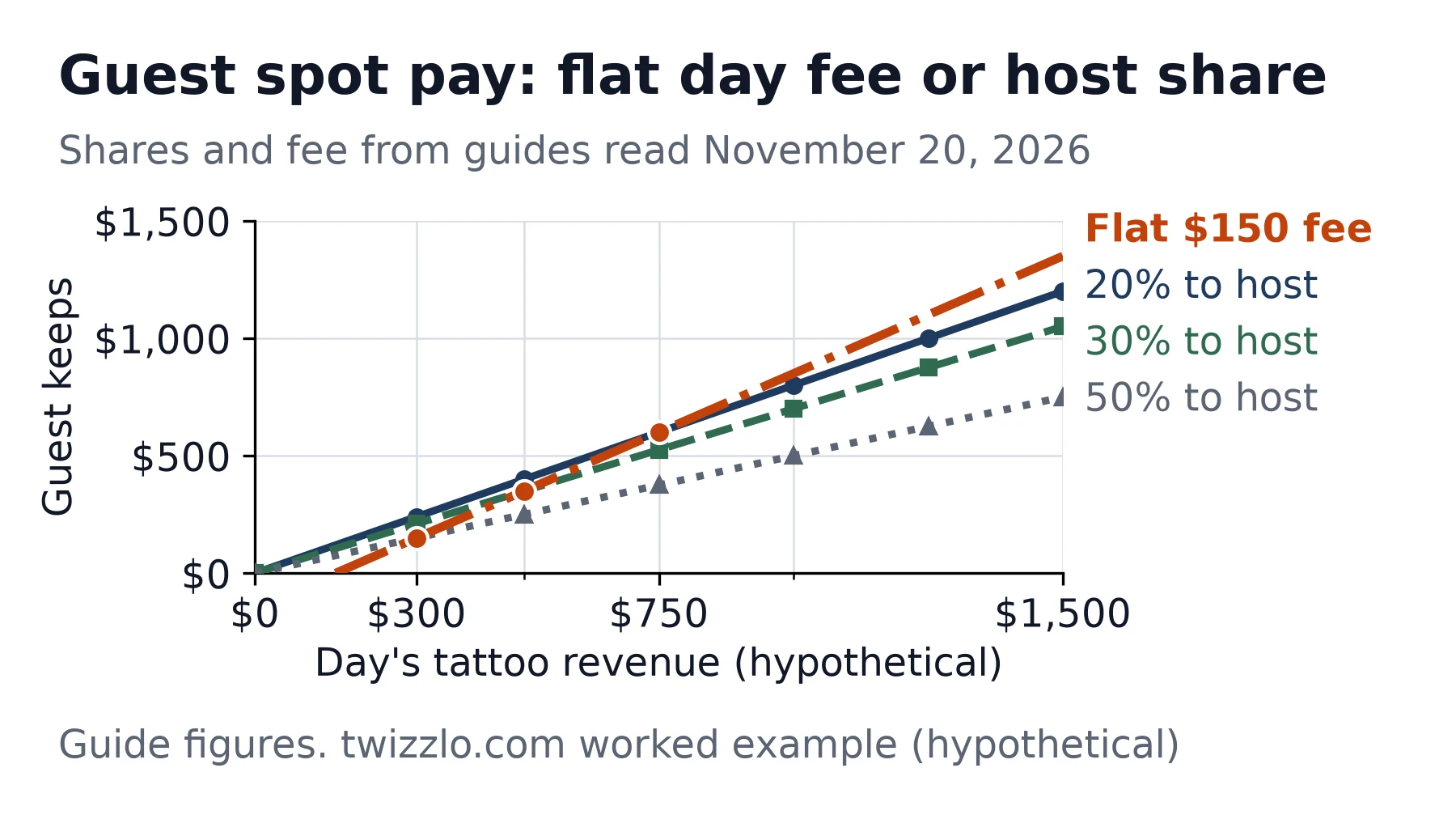
- By our arithmetic on guide figures read November 20, 2026, a flat $150 day fee beats a 30% host share above $500 of daily revenue.
- Virginia, on rules read November 20, 2026, holds the sponsoring parlor responsible for a guest tattooer's acts and wants its form 21 days ahead.
- Minnesota statutes read November 20, 2026, cap a guest artist at 30 days of body art work per calendar year; the application costs $140.
In this article10 sections
A guest spot is simple to describe and easy to get wrong on money and paperwork. We read pages from nine sites and the guest license rules of four U.S. states on November 20, 2026.
The nine sites ranked that day in searches for guest spots, how they work and what hosts charge. Seven publish guides: InkSearch, Artfolio, Painful Pleasures, Melbourne Tattoo Supplies, Tattooed.co, InkFreakz and Dojo Business. Two are studios that host guests, Alchemy Tattoo Collective in St. Louis and Chronic Ink. All nine are company or studio sites and are named without links.
This is desk research: we surveyed no artists or studios, so every fee and share below is another publisher's figure, shown with its source and date. The state rules come from official pages, which are linked. Nothing here is legal or tax advice. Rules change, so check the state and county where the guest will work. Stays outside the United States, with their visas and work permits, are not covered.
Studios that host visiting artists can see on our tattoo booking software page how a guest artist gets a profile and a shift for the dates they are in the chair.
What is a guest spot in tattooing?
A guest spot is a temporary stay in which a tattoo artist works at a studio that is not their home shop, usually for a few days to several weeks.
The guides differ on length. InkFreakz says a guest spot typically lasts a few days to a week, and Melbourne Tattoo Supplies says a few days or several weeks. Alchemy Tattoo Collective tells visiting artists it hosts stays of a weekend, a month or longer.
Both sides gain, InkSearch and Melbourne Tattoo Supplies say. The guest reaches clients in another city and learns from the host's artists, and the host gets a new style to offer and the guest's own clients through the door.
A resident artist who pays a commission split or chair rent month after month has a different deal. Our tattoo artist salary guide compares those two models for residents.
How do tattoo guest spots work?
Tattoo guest spots work in six steps: pick a city and studio, ask with a portfolio and dates, agree money and supplies, clear the license, announce the dates and be a good guest.
- Pick the city, then the studio. InkSearch suggests an Instagram poll that asks followers which city to visit. Painful Pleasures says to check that the area has tattoo activity and to read the shop's reviews on Google and Yelp.
- Ask properly, with a portfolio and dates. Tattooed.co says to send an email with portfolio links, a few date ranges and references from earlier guest spots. InkFreakz calls the portfolio the most important part of an application, and Artfolio suggests making contact four to six months ahead.
- Agree the money and the supplies before you book travel. Tattooed.co lists payment splits, deposits and the booking process among the shop policies to learn. Melbourne Tattoo Supplies says most studios supply basic consumables, but to check, and to bring your own inks, machines and needles.
- Clear the license. Some states make a visiting artist hold a short-term license before tattooing. Virginia's form, read November 20, 2026, is due 21 days ahead, and the license section below has four examples.
- Announce the dates and fill the book before you fly. Painful Pleasures suggests announcing at least two weeks to a month ahead and leaving room for walk-ins. Artfolio's calendar has the city and the booking link going out 14 days before.
- Be a good guest. Tattooed.co says to respect the staff, clients and studio space and to leave your station spotless, and Artfolio says to respect the house rules. Artfolio also says to send repeat inquiries back to the host studio after you leave. For touch-ups it suggests a voucher for the client's next visit, or paying a resident artist to do them.
What tattoo guest spot percentage do studios take?
Studios take 20% to 50% of a guest's tattoo revenue in guides we read on November 20, 2026, and one of them, Painful Pleasures, names a flat fee of $100 to $150 a day. The low end is Painful Pleasures' 20%, Dojo Business gives 20% to 40%, and the high end is Artfolio's 50/50 split.
None of the six pages in Table 1 ties its fee figures to a named trade standard or published survey. Dojo Business lists eight general sources at the foot of its page and links none of them to its guest spot figure.
| Source | Page date | What the page says the host takes |
|---|---|---|
| Painful Pleasures (supply store) | November 21, 2024 | A flat rate of $100 to $150, or 20% of the day's earnings, whichever is cheaper; it adds that some shops charge more |
| Artfolio (portfolio site) | October 6, 2025 | Three models: a flat chair rental with 0% to the host, where the artist brings all supplies; a 50/50 split with shared supplies; a 70/30 split with 30% to the host, where the host supplies basics |
| Dojo Business (business-plan publisher) | October 22, 2025 | The shop keeps 20% to 40% on guest spot clients, and visiting artists with strong reputations often keep 70% to 80% |
| Melbourne Tattoo Supplies (supply store, Australia) | August 28, 2025 | The artist it interviewed thinks a guest should pay 5% to 10% less than resident artists, and that walk-ins carry the shop's usual cut |
| InkSearch (tattoo software company) | Not stated | Some studios let the artist 'buy out' the spot, and some settle on a percentage of the tattoo fees |
| InkFreakz (guest spot marketplace) | Not stated | A shop's listing states a percentage of earnings or a fixed rate |
Table 1. What six guides say a host studio takes from a guest artist, read November 20, 2026. The figures are as each publisher states them, and Artfolio gives no rent amount for its flat chair rental.
Who supplies what moves with the share in Artfolio's table: the host that takes rent alone supplies nothing, and the host that takes 30% supplies the basics.
Walk-ins can be priced apart. The artist interviewed by Melbourne Tattoo Supplies says the shop deserves its usual cut on them, because those clients came to the shop and not to the guest.
Flat day fee or percentage: which leaves a guest more?
A flat $150 day fee leaves a guest more than a 20% host share once daily tattoo revenue passes $750, a 30% share above $500 and a 50% share above $300. The fee and the shares come from guides read November 20, 2026, and the crossovers are our arithmetic.
Table 2 works three day totals through the shares and the fee that the guides in Table 1 name. The day totals are hypothetical, and every figure is before supplies, travel, tips and tax.
| Day's tattoo revenue (hypothetical) | Guest keeps at 20% to the host | Guest keeps at 30% to the host | Guest keeps at 50% to the host | Guest keeps after a flat $150 day fee |
|---|---|---|---|---|
| $600 | $480 | $420 | $300 | $450 |
| $900 | $720 | $630 | $450 | $750 |
| $1,200 | $960 | $840 | $600 | $1,050 |
Table 2. Worked example: what a guest keeps from one day's tattoo revenue under four fee models. The revenue is hypothetical; the 20%, 30% and 50% shares and the $150 fee are figures from the guides in Table 1, read November 20, 2026.
The crossovers follow from the arithmetic: a flat fee beats a share once revenue passes the fee divided by the share. A $150 fee divided by 20% is $750, by 30% is $500 and by 50% is $300. With a $100 fee the same points fall to $500, $333.33 and $200.
Painful Pleasures' 'whichever is cheaper' wording means the guest pays the lower of the two. On a $600 day, 20% is $120, so against a $150 flat rate the guest pays $120. A busy guest gains most from a flat fee. A guest with a thin book is safer on a share, because a share of a slow day is small and a flat fee is not.
Does a guest spot pay for the trip?
A five-day guest spot that takes $900 a day leaves $885 to $2,385 after trip costs in our hypothetical worked example, depending on the fee model, before tax.
The example assumes five tattoo days at $900 a day, which is $4,500. The costs are a $400 flight, six nights of lodging at $130 ($780) and $150 for supplies and shipping. The last cost is Florida's $35 guest registration, read November 20, 2026, a fee the state says may vary by location. Together the trip costs come to $1,365.
| Fee model | Host takes | Guest's share of $4,500 | Left after $1,365 of trip costs | Day revenue needed to break even |
|---|---|---|---|---|
| 20% to the host | $900 | $3,600 | $2,235 | $341.25 |
| 30% to the host | $1,350 | $3,150 | $1,785 | $390 |
| 50% to the host | $2,250 | $2,250 | $885 | $546 |
| Flat $150 day fee | $750 | $3,750 | $2,385 | $423 |
Table 3. Worked example: a five-day guest spot at $900 of tattoo revenue a day, less trip costs of $1,365. The day revenue, flight, lodging and supplies are hypothetical, and the shares and the $150 fee are the guides' figures in Table 1. Florida's $35 guest registration fee is from its official page, read November 20, 2026, and the state says fees may vary by location. Break-even is the day revenue at which the guest's share over five days equals the trip costs.
Break-even shows the risk. On a 50/50 split the guest needs $546 of tattoos a day to cover the trip, against $341.25 at 20%. Below those figures the trip loses money before the artist's own time is counted.
Two guides flag a thin book as the risk. Painful Pleasures warns that arriving with no clients can cost the guest and the host money. The artist interviewed by Melbourne Tattoo Supplies says breaking even is sometimes worth it for the experience and the connections.
Cover is one more cost to check. Artfolio tells guests to ask whether their liability policy covers out-of-state work, and our tattoo shop insurance guide sets out six policy types.
Do you need a license for a guest spot?
In Florida, Minnesota, Oregon and Virginia, yes: each requires a registration or license before a visiting artist tattoos there and offers a short-term one, on official pages read November 20, 2026. The four are examples, not a national rule: licensing is set state by state, and some counties and cities add their own.
This is not legal advice. Fees and forms change, so confirm with the agency before you book travel.
| State | Short-term license | Fee | How long it lasts | Who stands behind the guest | Paperwork due |
|---|---|---|---|---|---|
| Florida | Guest tattoo artist registration | $35; the Florida Department of Health says fees may vary by location | Up to 14 consecutive days; the statute lets a guest register again | The application names the licensed tattoo establishment, and the guest holds an active license, registration or certification from outside Florida | Not stated on the page read |
| Minnesota | Temporary license for a guest artist | $140 application fee | No more than 30 days of body art work per calendar year | A licensed technician sponsors the guest | Not stated in the section read |
| Oregon | Temporary 30-day tattoo license | $70: a $50 application fee plus a $20 license fee, on the form revised June 1, 2024 | Up to 30 consecutive calendar days; renewable up to two times in 12 months | The guest must work in a licensed facility | Received at least 20 days before tattooing starts |
| Virginia | Guest tattooer license | $127.25 on the application form dated August 7, 2026; its footnote cites a $7.25 technology fee, and the regulation lists a $120 application fee for individuals | 14 days, not renewable; up to five licenses per calendar year | The sponsoring parlor signs the application, supervises the guest directly and is responsible for the guest's acts or omissions | By 5 p.m. 21 days before the first day |
Table 4. Short-term licenses for visiting tattoo artists in four states, from each state's official page, statute, regulation or form, read November 20, 2026. 'Not stated' means the page or section we read gives no deadline. Each of the four states also asks for proof of bloodborne pathogen or health training.
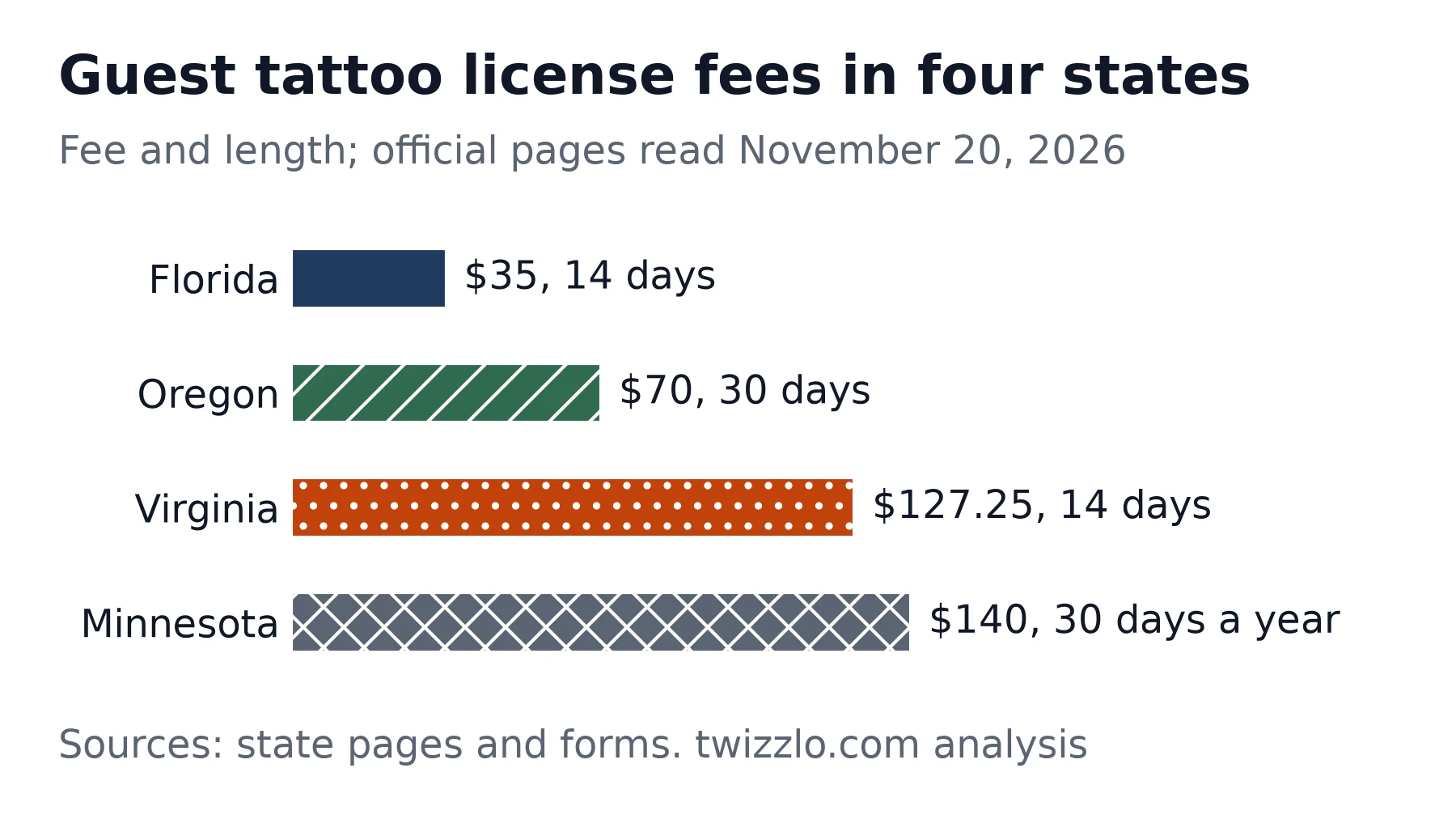
Of the four, Virginia puts the most on the host. Virginia's regulation makes the sponsoring parlor responsible for the guest tattooer's acts or omissions and requires a licensed tattooer to supervise the guest directly. Virginia residents cannot apply for the guest license at all, its application form says.
Florida's registration fits an artist who is already licensed, registered or certified somewhere else. If the artist's home state licenses no tattoo artists, the Florida Department of Health says to apply for Florida's full artist license instead.
Minnesota's 30 days are a yearly cap: a guest who goes past them must apply for a Minnesota technician's license. Oregon's form asks the applicant to attest to six months of tattoo training or experience within the last two years.
Working somewhere else? Our guide on how to get a tattoo license covers short-stay permits in New York City, Oklahoma and Tennessee and the full license in eight states.
What should a studio and a guest agree before the dates?
A studio and a guest should agree the dates, the fee model, supplies, the license paperwork, booking and payment, promotion and touch-ups in writing before the guest books travel.
- Dates and hours: the days the guest tattoos, the station, and the shop's opening hours. Artfolio's proposal email starts with requested dates and working hours.
- Fee model: a share or a flat day fee, when it is paid, and whether walk-ins carry a different cut.
- Supplies: what the shop provides and what the guest brings, since Artfolio's table ties the host's share to it.
- License: who files the state paperwork and by when. In Virginia the sponsoring parlor's management signs the guest's application, on rules read November 20, 2026.
- Booking and payment: whose booking link takes the appointments, who holds any deposit and how it is passed on. Our tattoo deposits guide has a policy draft to copy.
- Promotion: Artfolio gives the artist the teasers, flash sheets and booking form, and the host the local newsletter, front-desk inquiries and story reposts.
- After the stay: who handles touch-ups and where repeat clients are sent.
Clients need the plan too. Chronic Ink tells clients to learn a guest's rates up front, and warns that a week's stay may leave no time for a larger piece.
If hosting becomes a habit, write it into the shop's plan. The template in our tattoo shop business plan has a line for guest artists: the terms and how many weeks a year.
Where Twizzlo fits
Twizzlo is web-based online booking and appointment scheduling software for appointment-based service businesses; a host studio can give a guest a staff profile, an individual schedule and a shift for the stay.
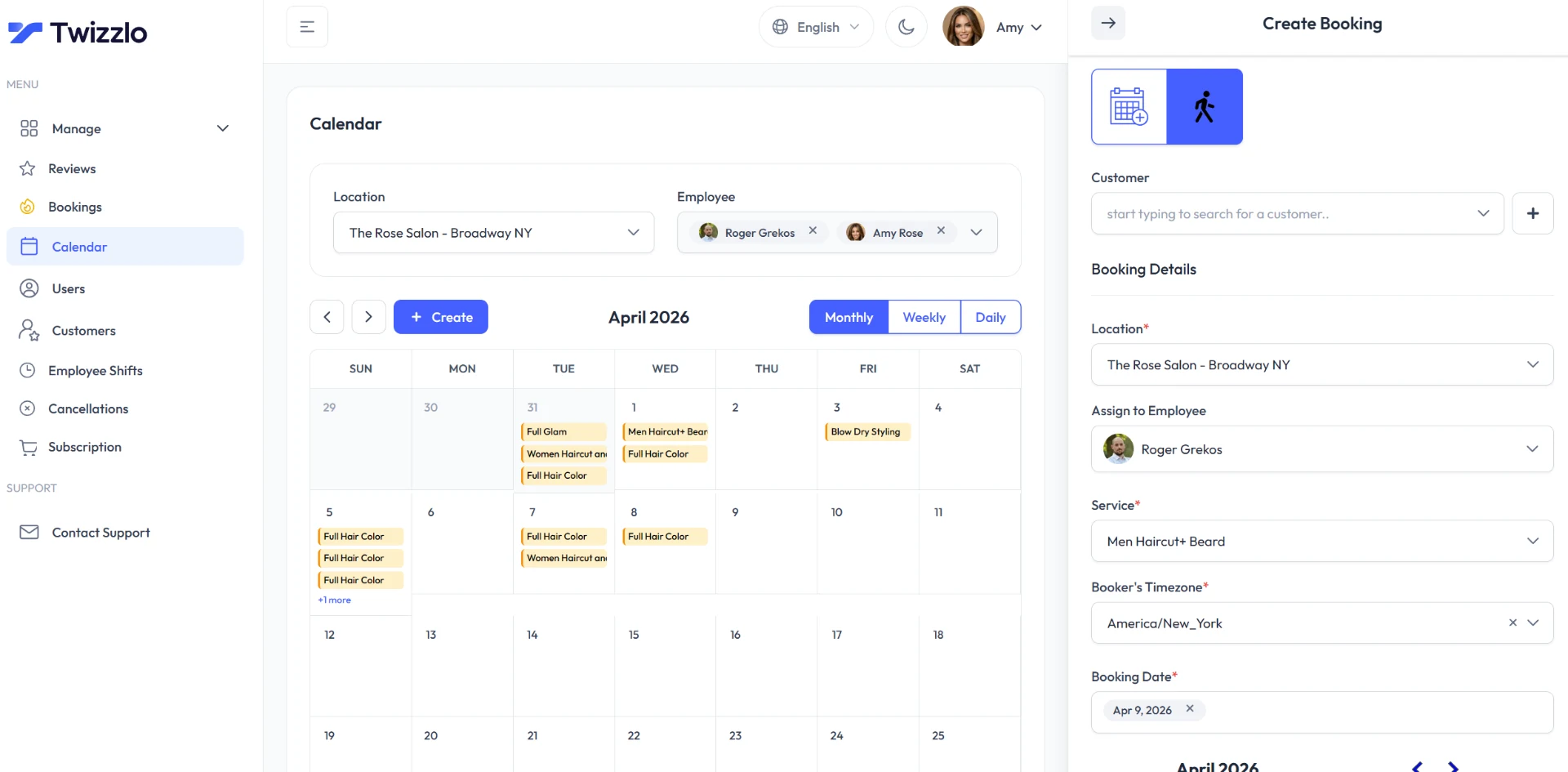
You assign the services the guest does, so a client booking one of them on your link sees the guest among the artists who offer it. Sessions can be prepaid bookings, where the client pays the full session price online through Stripe. If a client does not show, your studio decides whether to keep or refund that payment.
Twizzlo's /features/ page does not list commission or split tracking, so the split itself belongs in a spreadsheet or your accounting software, worked from the agreement you signed.
Worked example (hypothetical): three resident artists who each book 35 sessions a month give a studio 105 bookings (3 x 35 = 105). A guest who tattoos three clients a day for five days adds 15, and 20 consults bring the month to 140 bookings. That is 10 under the Free plan's limit of 150, so the month's bookings fit the Free plan at $0 a month in plan fees, with reminders by email.
A studio that wants text reminders moves to Business Pro at $29.99 a month. One text per booking, our assumption, means 140 texts: 50 are included and the other 90 cost $0.03 each, $2.70 in all, so the month comes to $32.69. Staff and locations are unlimited on both plans, so the guest's profile adds nothing to either price.
Online card payments cost the studio its Stripe processing rate plus Twizzlo's 1.5% platform fee on either plan. On a $900 day session that the client prepays in full, the platform fee is $13.50. The Twizzlo pricing page has the current plan details.
Weighing other tools? Our booking software comparisons set them side by side. To give a guest artist a profile and a calendar behind your booking link, start on the Free plan.
Frequently asked questions
What does guest spot tattoo mean?
It means tattoo work done by a visiting artist at a studio that is not the artist's home shop. The artist usually travels for a few days to several weeks, the host provides the station, and the two agree a day fee or a share of the work before the dates are announced.
How long does a tattoo guest spot last?
Most last from a few days to several weeks, the guides we read say. On official pages read November 20, 2026, Florida's guest registration lasts up to 14 consecutive days and Virginia's guest tattooer license 14 days. Oregon's temporary license lasts up to 30 consecutive days, and Minnesota caps a guest at 30 days per calendar year. Florida lets a guest register again, and Oregon allows two renewals in 12 months.
Who pays for supplies on a guest spot?
It depends on the agreement, so settle it before the trip. Melbourne Tattoo Supplies says most studios supply basic consumables while guests bring their own machines, inks and needles. In Artfolio's table, the artist brings all supplies under a flat chair rental with 0% to the host, and the host supplies the basics when it takes 30%.
How far ahead should you arrange a guest spot?
Start months ahead. Artfolio suggests contacting the host four to six months before the dates, and Painful Pleasures suggests announcing the stay at least two weeks to a month before. On forms read November 20, 2026, Virginia wanted the guest tattooer application 21 days before the first day. Oregon wanted its temporary license application at least 20 days before tattooing starts.
Can a client book a large tattoo with a guest artist?
Ask before you book. Chronic Ink, a studio that hosts guest artists, says a guest who is in town for a week will probably not have time for a larger tattoo. It tells clients not to compromise on a design to fit the artist's schedule and to choose a resident artist if they need more time.
Sources and methodology
Prices read
- Florida Department of Health, guest tattoo artist registration (opens in a new tab)Read . Supports: Florida: who must register, $35 fee that may vary by location, the named establishment, up to 14 consecutive days, an active license from outside Florida, the Florida license when the home state issues none (Tables 3 and 4, Figure 2)
- Florida Statutes section 381.00775 (Florida Senate) (opens in a new tab)Read . Supports: Florida: a guest registration is valid for 14 days and a guest may apply for reregistration (Table 4)
- Minnesota Statutes section 146B.04 (Minnesota Revisor of Statutes) (opens in a new tab)Read . Supports: Minnesota: temporary license for a guest artist, the sponsoring licensed technician, 30 days per calendar year, a technician's license beyond that (Table 4, Figure 2)
- Minnesota Statutes section 146B.10 (Minnesota Revisor of Statutes) (opens in a new tab)Read . Supports: Minnesota: $140 temporary guest artist license application fee (Table 4, Figure 2)
- Oregon Health Licensing Office, temporary 30-day tattoo license application (form revised June 1, 2024) (opens in a new tab)Read . Supports: Oregon: $50 application fee plus $20 license fee, 30 consecutive calendar days, two renewals in 12 months, received 20 days before services, a licensed facility, six months of training or experience (Table 4, Figure 2)
- Virginia Administrative Code 18VAC41-50, Tattooing Regulations (Virginia Law) (opens in a new tab)Read . Supports: Virginia: guest tattooer license of 14 days, up to five per calendar year, not renewable, the sponsor's signature, direct supervision and responsibility (Table 4, Figure 2)
- Virginia Administrative Code 18VAC41-50-130, fees (Virginia Law) (opens in a new tab)Read . Supports: Virginia: $120 individual application fee (Table 4)
- Virginia Board for Barbers and Cosmetology, guest tattooer license application (form dated August 7, 2026) (opens in a new tab)Read . Supports: Virginia: $127.25 fee with the $7.25 technology fee footnote, due 21 days before the first day, residents of Virginia cannot apply (Table 4, Figure 2)
- Painful Pleasures, Getting Started as a Guest Tattoo Artist, November 21, 2024 (named without a link)Read . Supports: A flat rate of $100 to $150 or 20% of the day's earnings, whichever is cheaper; announcing two weeks to a month ahead; walk-ins; the risk of arriving with no clients (Tables 1 and 2, Figure 1)
- Artfolio, Tattoo artist guest spots, October 6, 2025 (named without a link)Read . Supports: Flat chair rental, 50/50 and 70/30 models with who supplies what; contact four to six months ahead; marketing roles; repeat inquiries and touch-ups; liability cover out of state (Tables 1 and 2, Figure 1)
- Dojo Business, tattoo shop artist commission, October 22, 2025 (named without a link)Read . Supports: The shop keeps 20% to 40% on guest spot clients; visiting artists with strong reputations often keep 70% to 80% (Table 1)
- Melbourne Tattoo Supplies, How a Guest Spot can benefit you, August 28, 2025 (named without a link)Read . Supports: A few days or several weeks; consumables; a guest should pay 5% to 10% less than residents; the shop's usual cut on walk-ins; breaking even (Table 1)
- InkSearch, Guest Spot at the Tattoo Studio (named without a link)Read . Supports: Buying out the spot or a percentage of the tattoo fees; the Instagram poll; benefits to both sides (Table 1)
- InkFreakz, Guest Spots: Getting Started (help page) (named without a link)Read . Supports: A shop's listing states a percentage of earnings or a fixed rate; the portfolio is the most important part of an application (Table 1)
- InkFreakz, How to Apply for a Guest Spot (tutorial, last updated April 25, 2026) (named without a link)Read . Supports: A guest spot typically lasts a few days to a week
- Tattooed.co, How Tattoo Artists Can Secure Guest Spots at Tattoo Shops, February 20, 2026 (named without a link)Read . Supports: The email with portfolio links, date ranges and references; shop policies on payment splits, deposits and booking; respect for the staff, clients and studio space and a spotless station
- Alchemy Tattoo Collective, St. Louis, guest artist page (named without a link)Read . Supports: Stays of a weekend, a month or longer
- Chronic Ink, Getting A Tattoo From A Guest Tattoo Artist (named without a link)Read . Supports: Clients: learn the guest's rates; a week's stay and larger tattoos; do not fit a design to the artist's schedule
From our editorial policy
- We do not publish invented quotes, studies, statistics, customer stories or product tests, and we do not imply hands-on use of a product when the research came from the vendor's public documentation.
- To report an error, email support@twizzlo.com with the subject line "Correction: [page URL]". Tell us what is wrong and, if you can, link a source.
Start free, upgrade when you grow
Flat-rate booking software. No per-seat, per-chair or per-location fees.
- Free plan up to 150 bookings a month, not a trial
- Business Pro is $29.99 a month per business for unlimited bookings, with a 30-day money-back guarantee
- 24/7 support by email