
Tattoo Shop Insurance: Policies, Published Costs and What States Require

In short
Tattoo shop insurance is a set of policies: general liability, professional liability, a business owner's policy that adds property cover and, with employees, workers' compensation. Insureon's median premiums, read November 13, 2026, ran from $50 to $67 a month for each. New Jersey's body art code requires professional malpractice liability insurance for each practitioner; workers' compensation rules differ by state.
- A business owner's policy plus professional liability comes to $1,401 a year at Insureon's listed medians, read November 13, 2026, before workers' compensation.
- The City of Reading, Pennsylvania, asks for proof of at least $150,000 of liability insurance on its tattoo permit application, read November 13, 2026.
- Texas's page, read November 13, 2026, said workers' compensation is not required in most cases; California's required it even with one employee.
In this article9 sections
Tattoo shop insurance pays for losses that would otherwise come out of the shop's own money. Think of a visitor hurt on the premises, a client who says a tattoo went wrong, stolen machines or an injured employee. On November 13, 2026, we read eight insurance guides and five official pages to see what cover costs and what the law asks for.
The guides came from that day's search results for tattoo shop insurance. Insureon is linked because the premium figures here are its own. The other seven guides come from insurers, brokers, a marketplace, a comparison site and a business-formation site, and are named without links. Cross Agency, Trusted Choice and CompleteMarkets also ranked, but each page returned an error that day. Official rules are as each government page stated them. The guide covers policies and prices, not health or safety practice, which your health department's rules govern. Rules and prices change, and nothing here is legal or insurance advice; a licensed agent in your state can quote your shop.
Insurance protects the studio's money; bookings bring it in. Our tattoo booking software page shows how a studio takes consults and sessions from one booking link and gives every artist a calendar.
What does tattoo shop insurance cover?
Tattoo shop insurance covers injury or property damage to clients and visitors, claims about the tattoo work itself, damage to the shop's own property and injuries to employees, each under its own policy. Two more policies cover data breaches and business vehicles.
| Policy | What it pays for | Who it is aimed at |
|---|---|---|
| General liability | Claims from clients and visitors, such as customer bodily injury, damage to a client's personal property and advertising injury | Any shop that clients visit; a landlord may ask for a certificate before a lease is signed |
| Professional liability, also called errors and omissions (E&O) | Claims about the service itself, such as a tattoo that does not look the way the client envisioned | Artists and shops that tattoo clients, sole proprietors included |
| Business owner's policy (BOP) | General liability bundled with commercial property insurance, which covers damage to shop equipment and inventory | Shops with their own premises and equipment |
| Workers' compensation | Medical expenses for an employee with a work-related injury, and disability benefits while they recover | Shops with employees, under each state's rule |
| Cyber insurance | Recovery after a data breach or cyberattack, including customer notification costs | Shops that hold customers' personal information, such as card numbers |
| Commercial auto | Accidents in a vehicle the business owns | Shops that own a vehicle |
Table 1. Six policy types as Insureon's tattoo shop pages described them when read on November 13, 2026. The last column is our reading of those pages. Policy wording differs by insurer, so read your own policy for what it leaves out.
General liability insurance does not cover every claim a tattoo shop can face. Wexford Insurance's guide, read November 13, 2026, lists assuming that general liability covers everything among the common mistakes shop owners make. A claim about the tattoo itself belongs to professional liability, and an employee's injury to workers' compensation.
Workers' compensation can reach beyond the payroll. Insureon's cost page says owners typically must buy it for employees, guest artists and apprentices to meet their state's requirements.
Add-ons widen a policy. Insureon's cost page says tattoo liability cover often includes product liability, for a customer harmed by a product the shop uses. The same page names business interruption and equipment breakdown cover as endorsements to a business owner's policy.
How much does tattoo shop insurance cost?
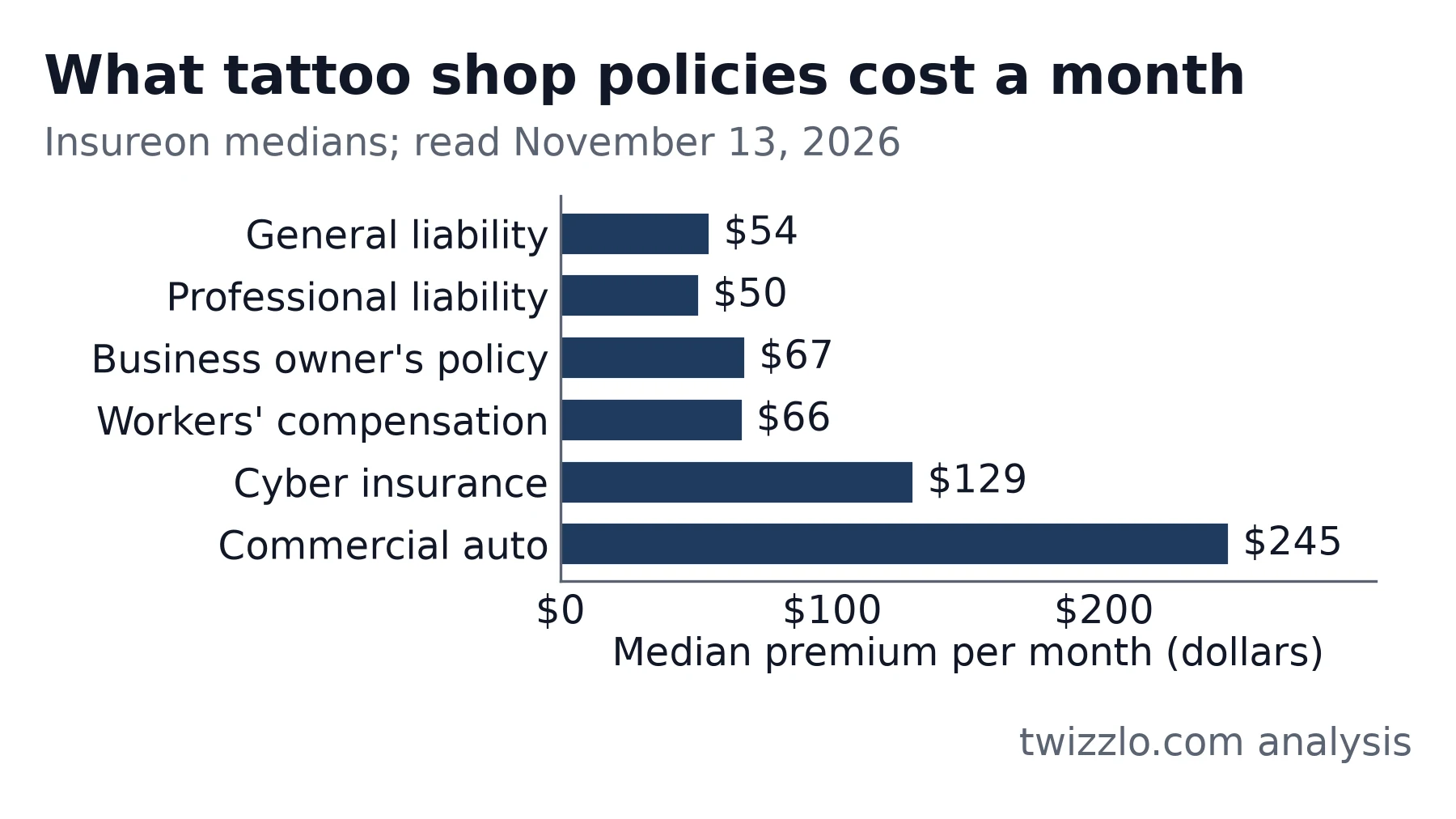
Tattoo shop insurance cost a median of $50 to $67 a month for each of four core policies among Insureon customers, on its cost page read November 13, 2026. Cyber insurance and commercial auto ran higher, at $129 and $245 a month.
| Policy | Median per month | Per year, as listed | Limits and deductible listed | Group the figure describes |
|---|---|---|---|---|
| General liability | $54 | $650 | $1 million per occurrence; $2 million aggregate | Tattoo studios |
| Professional liability | $50 | $596 | $1 million per occurrence; $1 million aggregate; $1,000 deductible | Tattooists, piercers and other personal care professionals |
| Business owner's policy | $67 | $805 | $1 million per occurrence; $2 million aggregate; $1,000 deductible | Tattoo artists and tattoo businesses |
| Workers' compensation | $66 | $792 | Not stated | Personal care businesses, including tattoo and piercing shops |
| Cyber insurance | $129 | $1,552 | Not stated | Tattoo artists and other small business owners |
| Commercial auto | $245 | $2,942 | Not stated | Small businesses, including tattoo shops |
Table 2. Median premiums on Insureon's tattoo shop cost page, read November 13, 2026, in dollars as listed; the page showed 'Updated: April 23, 2025'. Insureon says the figures are the median cost of policies its customers bought. They are not quotes, and four rows (professional liability, workers' compensation, cyber insurance and commercial auto) describe wider groups than tattoo shops.
Four other guides, read November 13, 2026, gave their own ranges, and three gave no figure.
| Guide | Cost it states | Page date |
|---|---|---|
| TRUiC (How to Start an LLC) | $450 to $750 a year for $1 million of general liability coverage | Last updated February 10, 2026 |
| InsuranceQuotes | Annual premiums that generally start around $650, quoting an insurance consultant; elsewhere, as little as $100 or more a month | Not stated |
| USA Business Insurance Services | Published medians of roughly $50 to $70 a month each for general liability, a business owner's policy or professional liability | Last updated March 6, 2026 |
| biBerk | A few hundred to a few thousand dollars a year for a group of basic policies | November 4, 2025 |
| XINSURANCE, Tivly and Wexford Insurance | No figure | Not stated |
Table 3. What seven other guides said about cost when read on November 13, 2026. 'No figure' means the page gives no dollar amount.
Your own quote depends on what the shop does. Insureon's cost page, read November 13, 2026, names the services offered, such as body piercing, microblading, tattoo removal and permanent makeup. It also names the value of equipment and property, yearly revenue, location, years of experience, the number of employees, and the limits and deductibles chosen.
What does a year of cover add up to?
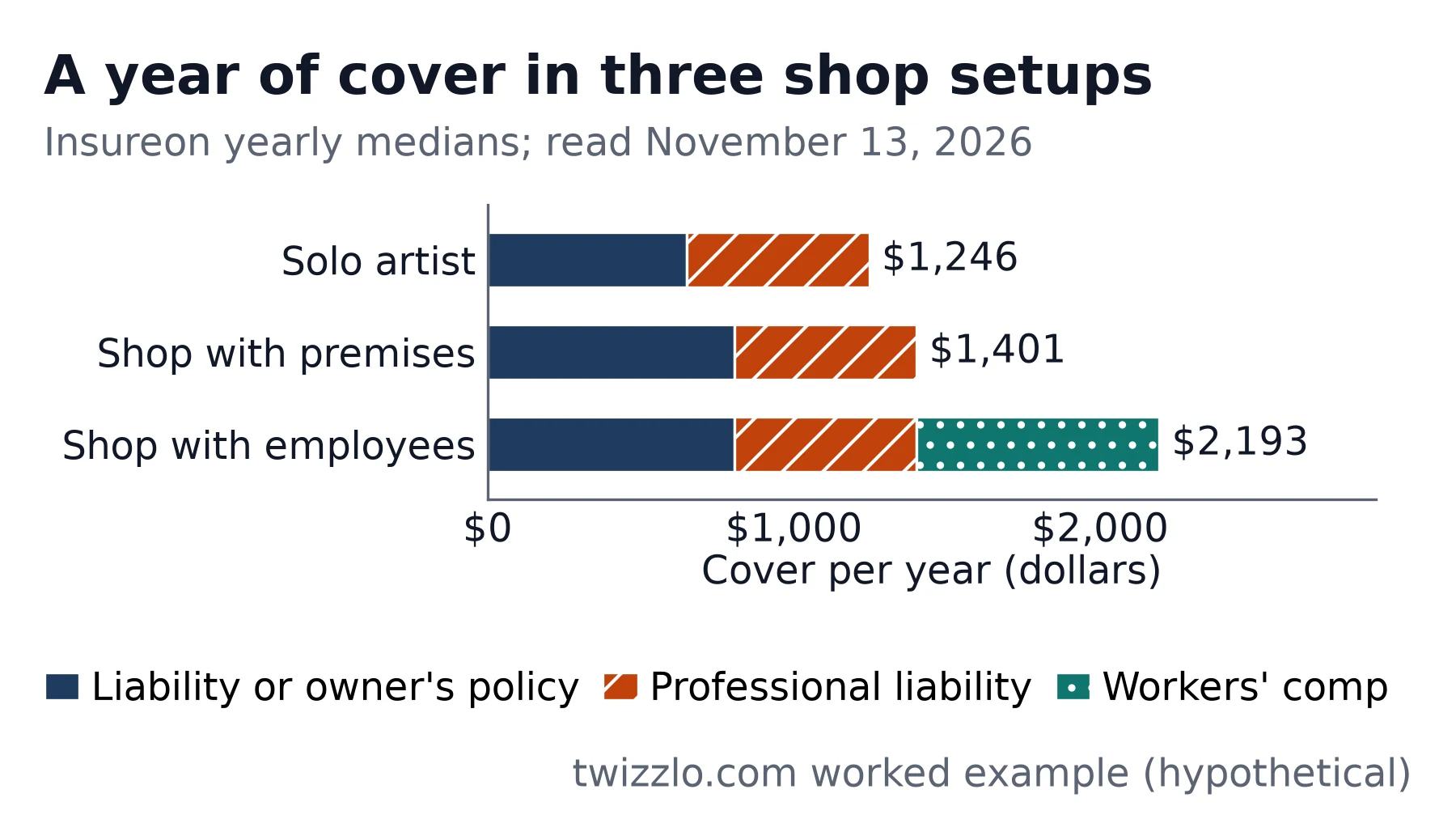
A year of cover adds up to $1,246 for a solo artist, $1,401 for a shop with premises and $2,193 with employees, at Insureon's medians read November 13, 2026. The three setups are a hypothetical worked example, and a real quote will differ.
| Hypothetical setup | Policies | Arithmetic at the yearly medians | Per year | Per month |
|---|---|---|---|---|
| Solo artist working in another owner's shop | General liability and professional liability | $650 + $596 | $1,246 | $103.83 |
| Shop with its own premises, no employees | Business owner's policy and professional liability | $805 + $596 | $1,401 | $116.75 |
| Shop with employees | Business owner's policy, professional liability and workers' compensation | $805 + $596 + $792 | $2,193 | $182.75 |
Table 4. Worked example (hypothetical setups) built from the yearly medians Insureon listed when read on November 13, 2026. Per month is the yearly total divided by 12. Planning figures, not quotes.
Sessions put the totals in shop terms. At a hypothetical $200 session, the $1,401 total equals the takings of eight sessions a year on the full ticket ($1,401 / $200 = 7.005), before supplies and other costs. On a hypothetical owner's share of 50 percent, or $100 a session, it takes 15 ($1,401 / $100 = 14.01).
Workers' compensation is the step up in the example, adding $792 a year. On the same basis, the $2,193 total takes 11 sessions on the full ticket or 22 on the owner's share. Put your own quote in the insurance line of a tattoo shop business plan, beside rent and licenses.
A business owner's policy typically costs less than buying general liability and property cover separately, Insureon's page says.
Is tattoo shop insurance required by law?
Tattoo shop insurance is required by law in some places only: New Jersey's body art code, read November 13, 2026, requires every practitioner to keep professional malpractice liability insurance. InsuranceQuotes' guide, read the same day, quotes a broker as saying most states do not require a shop or artist to carry business insurance.
Workers' compensation is a separate rule for employers. California's page required it with one employee, and Texas's page said it is not required of private employers in most cases.
| Place and source | Rule as the page states it | Who it applies to |
|---|---|---|
| New Jersey (N.J.A.C. 8:27-2.7 and 8:27-2.4, on the Department of Health site) | Each practitioner keeps current professional malpractice liability insurance; proof goes to the health authority with the first and each renewal license or permit application | Body art practitioners and the establishments that apply |
| City of Reading, Pennsylvania (tattoo and piercing establishment health permit application) | Proof of liability insurance, $150,000 minimum, is on the list of required documents | Establishments applying for the city health permit |
| Texas (Department of Insurance) | Private employers can choose to carry workers' compensation; it is not required in most cases | Private employers in Texas |
| California (Department of Industrial Relations) | Employers must have workers' compensation insurance, even with one employee | Employers in California |
| Florida (Division of Workers' Compensation) | Employers outside construction with four or more employees, counting owners who are corporate officers or LLC members, must have workers' compensation coverage | Non-construction employers in Florida |
Table 5. Insurance rules on five official pages, as each stated them when read on November 13, 2026. The Texas page was last updated June 8, 2026, and the California page is dated July 2025; the New Jersey and Reading documents show no date. LLC means limited liability company. Rules change, so check your own state, county and city; this table is not legal advice.
Contracts ask for cover as well: Insureon's page, read November 13, 2026, says many commercial leases require tenants to carry general liability insurance. XINSURANCE's page says many landlords, lenders and convention organizers require proof of liability insurance.
The proof a landlord or venue asks for is a certificate of insurance (COI). USA Business Insurance Services' guide, read November 13, 2026, says a landlord or venue may also ask for additional insured wording, which varies by contract. Artists checking their own state's license steps can start with our guide on how to get a tattoo license.
Insurance for tattoo artists: do you need your own policy?
Tattoo artists who work as independent contractors may need a policy of their own: Wexford Insurance's guide, read November 13, 2026, says a shop's policy may not automatically protect every artist for every exposure.
Ask the shop owner before you assume. XINSURANCE's page, read November 13, 2026, says a shop's policy can cover artists who rent booth space 'so long as it is scheduled', and that this depends on the policy's terms. The New Jersey rule in Table 5 names each practitioner.
- Ask whether the shop's policy covers artists who rent space, and ask for a certificate that shows it.
- Ask what the policy leaves out. Wexford's guide says coverage depends on the policy and on the relationship between the shop and the artist.
- Check convention and guest work. XINSURANCE's page says it can insure mobile artists and those who work at conventions.
- Price a policy of your own. Insureon's median for professional liability was $596 a year when read on November 13, 2026.
A policy is a cost of working for yourself. What artists keep after shop splits and costs is in our guide to tattoo artist salary.
How to buy tattoo insurance in five steps
Buying tattoo insurance takes five steps: list what the shop does, read your lease and license rules, compare quotes on the same limits, check what each policy leaves out and review the cover yearly.
- List every service and every person. An agent prices the shop on what it does and who works there, so bring the full list.
- Read the lease and your agency's rules before you ask for quotes. Table 5 shows what New Jersey and the City of Reading, Pennsylvania, ask for.
- Ask each agent for the same limits. Insureon's median general liability policy, read November 13, 2026, carried $1 million per occurrence and $2 million aggregate. A consultant quoted by InsuranceQuotes says most owners and independent artists seek $500,000 or $1 million.
- Read the exclusions before you pay. USA Business Insurance Services' guide lists professional services exclusions on general liability and work performed by independent artists among the items to review.
- Review the cover each year and after a change. Wexford's guide names hiring staff, adding services, buying equipment and opening a location as times to review.
Expect some insurers to say no. InsuranceQuotes' guide, read November 13, 2026, says tattoo artists and shop owners may have trouble obtaining business coverage. XINSURANCE says it can insure shops that were declined, canceled or non-renewed elsewhere. A licensed agent or broker, not booking software, is the right help for this job.
Where Twizzlo fits
Twizzlo is web-based online booking and appointment scheduling software for appointment-based service businesses, so it fits the booking side of a studio, not the insurance side. Cover comes from an agent or insurer; Twizzlo gives every artist a calendar and shows booking volume and revenue by day, week or month.
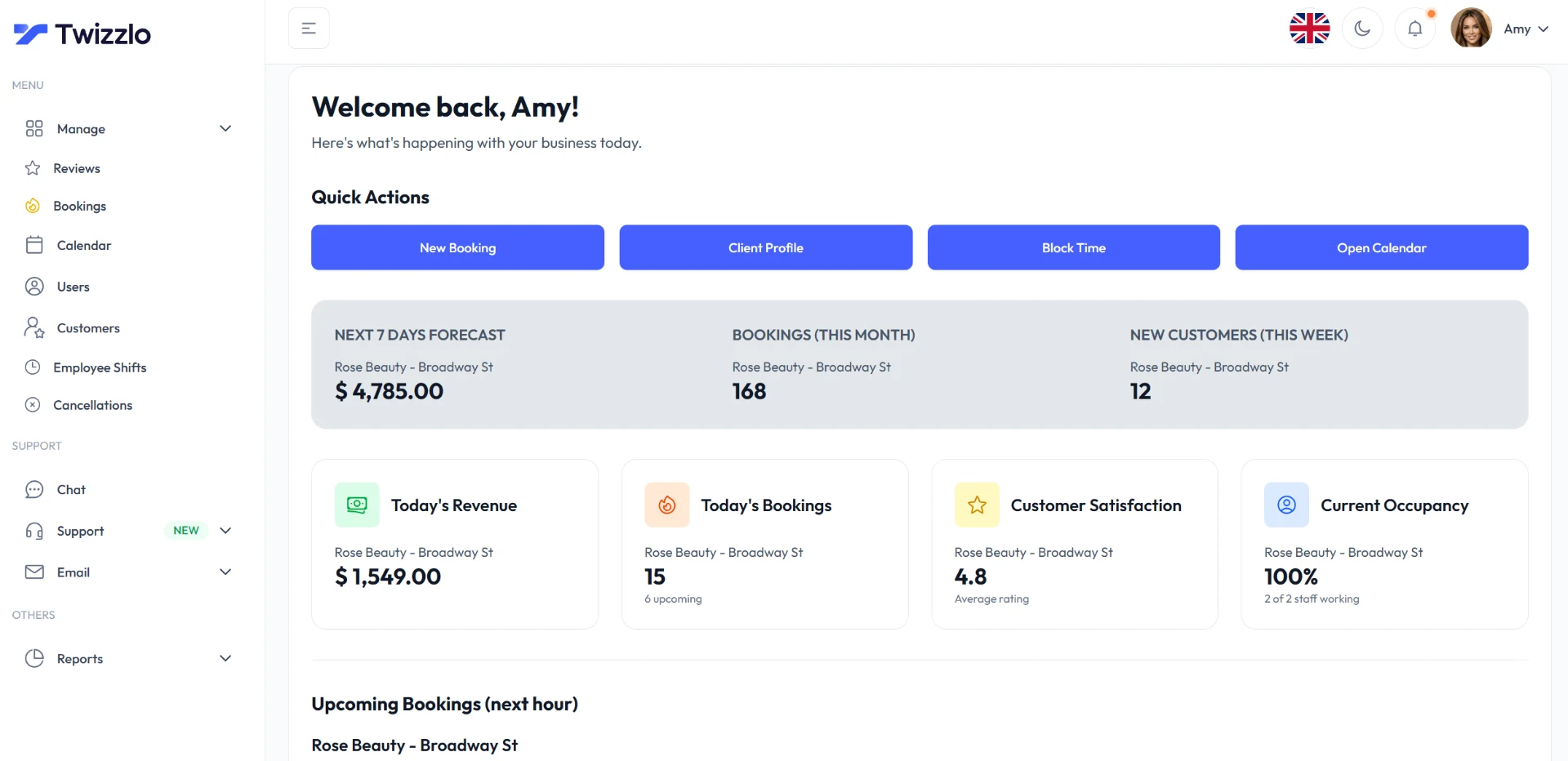
Revenue by month is worth having ready when you ask an agent for a quote. Twizzlo's figures cover the bookings and payments recorded in it, so take the full yearly figure from your own accounts. Twizzlo's /features/ page does not list a certificate tracker, so keep each artist's certificate in your own files.
Worked example (hypothetical): the solo artist above takes 40 sessions and 20 consults a month, or 60 bookings (40 + 20 = 60). That is inside the Free plan's limit of 150 bookings a month, at $0, with email reminders and no text reminders, as Twizzlo pricing listed on November 13, 2026.
The shop with employees has three artists at 70 bookings each, or 210 bookings (3 x 70 = 210). That is over the Free limit, so it runs on Business Pro at $29.99 a month per business. A year is $359.88 (12 x $29.99), beside the $2,193 of insurance in the same budget, or $2,552.88 together before payment fees and extra texts. Business Pro includes 50 text messages a month, then $0.03 each.
Staff and locations are unlimited on both plans. Online payments carry Stripe's processing rate plus a 1.5% Twizzlo platform fee; on a $200 prepaid session, the platform fee is $3.00 before Stripe's rate.
Weighing other tools for the studio? Our booking software comparisons list them side by side. When the policy is in place, start on the Free plan.
Frequently asked questions
How much is tattoo shop insurance a month?
Insureon's cost page, read November 13, 2026, listed median premiums of $54 a month for general liability, $50 for professional liability, $67 for a business owner's policy and $66 for workers' compensation. Those are medians of policies its customers bought, not quotes, so your own price depends on services, revenue, location and limits.
Is tattoo insurance required by law?
Tattoo insurance is required by law in some places only. New Jersey's body art code, read November 13, 2026, requires each practitioner to keep professional malpractice liability insurance. The City of Reading, Pennsylvania, asks for proof of at least $150,000 of liability insurance with its permit application. InsuranceQuotes' guide quotes a broker as saying most states do not require business insurance; workers' compensation for employees follows separate state rules.
Does a tattoo shop's policy cover the artists who work there?
A tattoo shop's policy does not always cover the artists who work there. Wexford Insurance's guide, read November 13, 2026, says independent contractors may need their own insurance coverage. XINSURANCE's page says a shop's policy can cover artists who rent booth space, subject to its terms. Ask the owner for a certificate that shows the cover.
What does professional liability insurance for tattoo artists cover?
Professional liability covers claims about the service itself. Insureon's page, read November 13, 2026, gives the example of a tattoo that does not look the way the client envisioned. It lists a median of $50 a month for tattooists, piercers and other personal care professionals. General liability is a separate policy for injuries and property damage to clients and visitors.
Do tattoo shops need workers' compensation insurance?
State rules on workers' compensation differ. On official pages read November 13, 2026, California required employers to carry workers' compensation even with one employee. Florida's Division of Workers' Compensation required it of non-construction employers with four or more employees. The Texas Department of Insurance said private employers can choose to carry it and that it is not required in most cases.
Sources and methodology
Prices read
- Insureon, Tattoo shop insurance cost (opens in a new tab)Read . Supports: median monthly and yearly premiums for six policies, the limits and deductibles listed, what each policy covers, add-ons, who workers' compensation is bought for, the cost factors, the page's 'Updated: April 23, 2025' line and the note that the figures are medians of policies its customers bought (Quick Answer, Tables 1, 2 and 4, Figures 1 and 2, takeaway 1, FAQ 1 and 4)
- Insureon, Tattoo shop insurance (opens in a new tab)Read . Supports: many commercial leases require general liability; sole proprietors and professional liability (law section, Table 1)
- TRUiC, Tattoo parlor business insurance (named without a link)Read . Supports: $450 to $750 a year for $1 million of general liability coverage; last updated February 10, 2026 (Table 3)
- InsuranceQuotes, Does your tattoo shop need business insurance? (named without a link)Read . Supports: annual premiums generally start around $650; as little as $100 or more a month; limits of $500,000 or $1 million; a broker's statement that most states do not require cover; trouble obtaining coverage (Table 3, law section, buying steps, FAQ 2)
- USA Business Insurance Services, Tattoo shop insurance (named without a link)Read . Supports: published medians of roughly $50 to $70 a month each; certificate of insurance and additional insured wording; exclusions to review; last updated March 6, 2026 (Table 3, law section, buying steps)
- biBerk, Tattoo insurance for shops and body art studios (named without a link)Read . Supports: a few hundred to a few thousand dollars a year for a group of basic policies; dated November 4, 2025 (Table 3)
- XINSURANCE, Tattoo shop insurance (named without a link)Read . Supports: many landlords, lenders and convention organizers require proof of liability insurance; a shop's policy can cover artists who rent booth space so long as it is scheduled; cover for convention work and for shops declined elsewhere; no cost figure (Table 3, law section, artists section, buying steps, FAQ 3)
- Tivly, Tattoo shop insurance coverage (named without a link)Read . Supports: no cost figure (Table 3)
- Wexford Insurance, Tattoo shop insurance: a complete coverage guide (named without a link)Read . Supports: assuming general liability covers everything is a common mistake; a shop's policy may not protect every artist for every exposure; independent contractors may need their own cover; coverage depends on the policy and the relationship between shop and artist; when to review; no cost figure (Table 3, cover section, artists section, buying steps, FAQ 3)
- New Jersey Administrative Code 8:27-2 (New Jersey Department of Health) (opens in a new tab)Read . Supports: each practitioner keeps current professional malpractice liability insurance; proof with the first and each renewal license or permit application (Quick Answer, Table 5, law section, FAQ 2)
- City of Reading, Pennsylvania, Tattoo and piercing establishment health permit application (opens in a new tab)Read . Supports: proof of liability insurance, $150,000 minimum (Table 5, takeaway 2, FAQ 2)
- Texas Department of Insurance, Employer resources (workers' compensation) (opens in a new tab)Read . Supports: private employers can choose to carry workers' compensation; not required in most cases; last updated June 8, 2026 (Table 5, law section, takeaway 3, FAQ 5)
- California Department of Industrial Relations, Employer information (workers' compensation) (opens in a new tab)Read . Supports: employers must have workers' compensation insurance even with one employee; dated July 2025 (Table 5, law section, takeaway 3, FAQ 5)
- Florida Division of Workers' Compensation, Coverage requirements (opens in a new tab)Read . Supports: non-construction employers with four or more employees, counting owners who are corporate officers or LLC members, must have coverage (Table 5, FAQ 5)
- Twizzlo, tattoo booking software for artists and studios (opens in a new tab)Read . Supports: consults and sessions from one booking link; a calendar for every artist; revenue and booking insights (intro bridge, Twizzlo section)
- Twizzlo, features (opens in a new tab)Read . Supports: booking volume and revenue by day, week or month; no certificate tracker listed (Twizzlo section, Figure 3)
- Twizzlo, pricing (opens in a new tab)Read . Supports: Free $0 for up to 150 bookings with no SMS; Business Pro $29.99 a month per business, 50 SMS then $0.03 each; unlimited staff and locations; 1.5% platform fee (Twizzlo section)
From our editorial policy
- We do not publish invented quotes, studies, statistics, customer stories or product tests, and we do not imply hands-on use of a product when the research came from the vendor's public documentation.
- To report an error, email support@twizzlo.com with the subject line "Correction: [page URL]". Tell us what is wrong and, if you can, link a source.
Start free, upgrade when you grow
Flat-rate booking software. No per-seat, per-chair or per-location fees.
- Free plan up to 150 bookings a month, not a trial
- Business Pro is $29.99 a month per business for unlimited bookings, with a 30-day money-back guarantee
- 24/7 support by email