
The Best Scheduling App for Hair Stylists Starts With Whose Chair You Are In

By Roger Grekos, founder and editor, Twizzlo. Prices were read first-hand from each vendor's own website on September 14, 2026.
Twizzlo publishes this page and competes with the products priced on it. Every competitor price stated here as current is read from that vendor's own website, its pricing page or help center, with the qualifier printed there, or recorded as not published.
Every guide to the best scheduling app for hair stylists compares the same eight or nine products. Vagaro for teams, GlossGenius for soloists, Fresha because it is free. Useful, as far as it goes. What none of them asks is the question that decides the answer: whose chair are you standing in, and who owns the phone number of the client sitting in it.
A commission stylist at a five chair salon and a suite renter two miles away are not shopping for the same thing, even though they do the same job with the same shears. One of them inherits whatever the owner already pays for. The other one is the owner. Six of the pages currently ranking for this term were read on 14 September 2026 for this guide, and exactly one has a heading that mentions booth renters, which it then uses as a polite word for solo.
Quick answer: The best scheduling app for hair stylists depends on who owns your client list. Booth and suite renters need their own booking link and client notes, so GlossGenius, Booksy, Twizzlo or Square fit. Commission employees usually inherit the salon's system and should push for reminders and notes.
Why does the best scheduling app for hair stylists depend on your chair arrangement?
Four arrangements cover almost every hair stylist in the United States, and they lead to different answers.
Commission employee
The salon owns the subscription, the calendar and, in most cases, the client record. You are unlikely to choose the software at all. What you can reasonably ask the owner for is narrow and worth asking for anyway: automatic reminders on your column, and a client notes field you are allowed to write in. Every app in this guide supports per-client notes, so if your salon's system does not surface them to you, that is a permissions setting rather than a missing feature.
Booth renter
You rent a chair, you file your own taxes, and your book is yours. That changes the shopping list completely. You need a booking link of your own, notes of your own, and a deposit rule of your own, because the salon's front desk is not going to enforce your cancellation policy for you. Sort out what the rental agreement actually says about client ownership before you pick software, because that is the part that bites later.
Suite renter
A suite renter has everything a booth renter has, plus no shared front desk at all. There is nobody to answer the phone while you are mid colour, so the booking page is the front desk. Response speed and a clean mobile booking flow matter more here than any reporting feature.
Mobile and freelance stylists
Travel time is the constraint nobody else has. Buffer times between appointments stop being a nicety and become the thing that decides whether the day works. Booking pages that let you set a gap around each appointment, and that show a client a realistic next opening rather than a theoretical one, are worth more than a marketing module.
Which apps let a client book from a link without downloading anything?
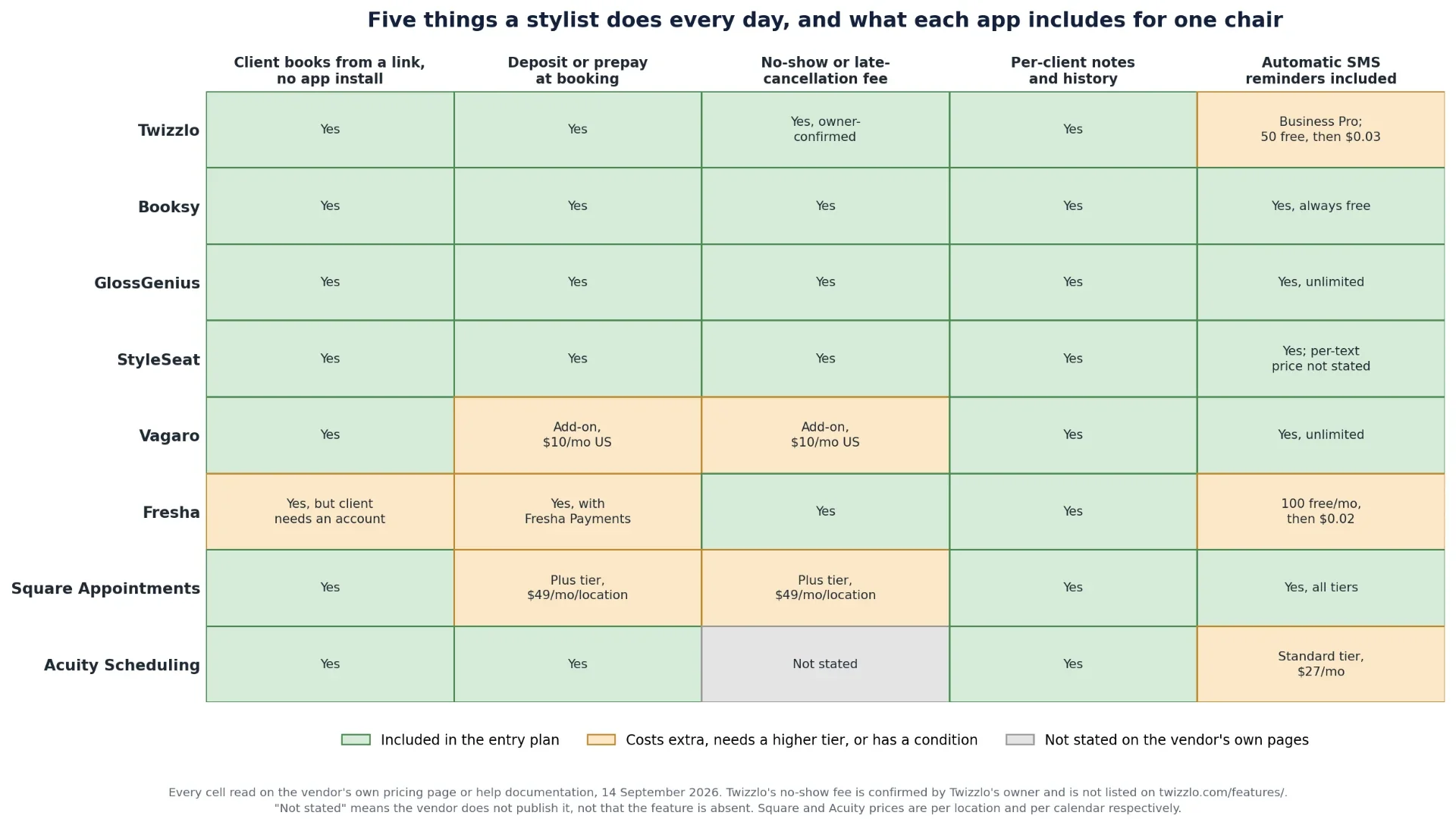
This is the question that decides whether your quietest clients rebook, and it separates the field more than price does. Figure 1 sets out five chair-level jobs against eight apps, with every cell read on the vendor's own pages on 14 September 2026.
Booksy and GlossGenius state it outright. Booksy's pricing page says clients can book "without downloading an app" and that they "book directly through your booking link." GlossGenius describes "login-free client booking, no app downloads required." For a stylist whose book skews older, that plain wording is worth more than a feature list.
Fresha carries a caveat the ranking guides do not mention. Its own help centre says clients "need to create or log in to a Fresha client account to book and confirm an appointment online." Browsing your availability is anonymous; confirming is not. No app install is required, but an account is, and an account is where a certain kind of client gives up.
Twizzlo, Square Appointments, Vagaro, StyleSeat and Acuity all publish a browser booking page with no install required. Twizzlo's own features page documents a 24/7 online booking page and per-location booking links. It is also worth saying plainly that Twizzlo has no native mobile app of its own, for you or for the client, and does not claim one. If having your business in an app icon on your phone matters to you, that is a real reason to look at Vagaro, GlossGenius or Booksy instead.
What does a new client's first visit cost you?
Marketplace apps do not really compete on subscription price. They compete on what they take when they send you someone, and that number is much larger than the monthly fee.
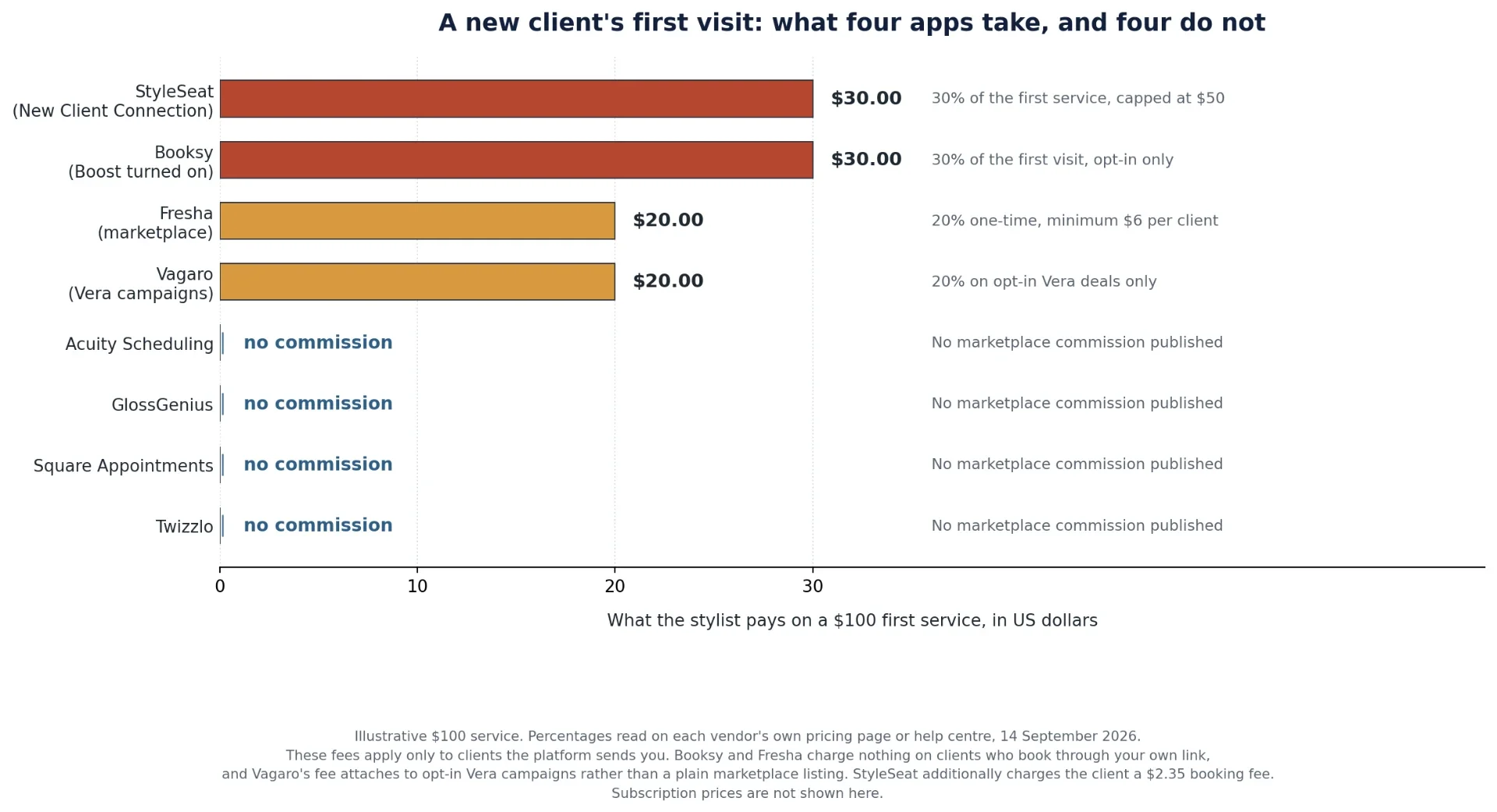
StyleSeat's help centre puts New Client Connection at "30% of the first appointment service cost, max $50," charged once per new client, and separately charges the client a $2.35 booking fee at the time of booking. Our StyleSeat alternative comparison works through what that adds up to over a year. Booksy's Boost is the same headline rate, a "one-time 30% fee based on the total cost of a Boost client's first visit," but it is off by default and Booksy tells you how to avoid it: "share your Booksy Profile Link with your clients and encourage them to book using this link to ensure you are not charged a commission when Boost is turned on."
Fresha takes "20% one-time commission" with a "minimum fee of $6 per client" on new marketplace clients, and nothing on returning ones. Vagaro's position needs care, because its own pages disagree with each other. The pricing page FAQ answers "No" to whether marketplace bookings carry fees, while the support documentation for its Vera campaigns describes a "20% fee when a new customer books with you for the first time" and 5% for a returning one. Both can be true, since the fee attaches to opt-in promotional campaigns rather than a plain listing, but the flat "No" is incomplete.
GlossGenius, Square Appointments, Acuity and Twizzlo publish no marketplace commission at all, because none of them runs a consumer marketplace that sends you strangers. That is a trade, not a win. A marketplace is how a new booth renter in an unfamiliar neighbourhood fills a Tuesday. If you already have a full book, you are paying a finder's fee for clients who found you anyway.
The stylist-level way to read Figure 2 is to ask how many genuinely new clients you need each month. At two new clients on a $100 service, a 30% marketplace rate costs $60, which is more than any subscription in this guide. At zero, it costs nothing at all.
Which entry plans quietly leave out text reminders?
Reminders are the feature stylists actually buy this software for, and they are the feature most often held back a tier. Three findings from the vendors' own pricing pages on 14 September 2026 are worth having before you sign up.
Acuity Scheduling's entry plan does not include them. Starter, at $16 a month billed annually, lists email reminders. Text reminders appear one tier up, on Standard at $27 a month billed annually. A stylist choosing Acuity on the $16 headline is choosing email-only reminders, and the guides quoting that figure do not say so.
Twizzlo's free plan has the same gap, and it is only fair to name it. Twizzlo's pricing page lists "No SMS" on the Free tier. Text reminders start on Business Pro at $29.99 a month, which includes 50 messages and then charges $0.03 each. The free plan is genuinely free forever rather than a trial, and it is capped at 150 bookings a month, but a stylist who wants text reminders is on the paid plan from day one.
Square Appointments beats both on this specific point. Automatic text and email reminders are included on every tier, including the $0 Square Free plan, with no per-message fee published anywhere on Square's own site. Booksy is equally clear: "Appointment confirmations and reminders are always free." Vagaro advertises "unlimited notifications and appointment reminders," and GlossGenius "unlimited Client Notifications at no extra cost." Fresha meters them, at 100 free a month and then $0.02 a text.
One distinction is easy to miss and costs real money. Text marketing is a separate product from text reminders at almost every vendor. Square's 3 cents and 1.5 cents per message, Vagaro's credit bundles from $20 a month, and Booksy's 2,000 free monthly messages are all marketing allowances. None of them governs whether your Tuesday client gets a reminder.
Where do deposits and no-show fees actually live?
Every app in this guide can take a deposit. The difference is what tier it sits on, and for a single chair that difference is the whole decision.
Vagaro puts it behind an add-on in the United States. Its Online Shopping Cart module, at $10 a month, is what lets you "set up deposits and cancellation fees for online appointments." The base subscription carries the policy settings; charging against them is the paid part. Square Appointments paywalls the enforcement rather than the deposit: its help article on cancellation policies is scoped to "Square Appointments Plus and Premium subscribers," and the comparison grid shows no-show fees excluded from Square Free. Plus is $49 a month per location.
Acuity confirms deposits plainly, answering "Absolutely" to whether you can require a deposit or full payment at booking. It does not state anywhere on its pricing or client management pages that you can charge a no-show fee, which is why that cell in Figure 1 reads "not stated" rather than "no." GlossGenius, Booksy, StyleSeat and Fresha all include both, with Fresha noting that a no-show fee must be a whole percentage and cannot be reversed once charged.
Twizzlo supports prepaid bookings on any service, per its features page, and Twizzlo's owner confirmed on 12 September 2026 that a business can charge a no-show fee, presented as a setting the business controls. That is stated here rather than implied because the feature is not currently listed on the public features page. Payments run through Stripe, and Twizzlo adds a 1.5% platform fee on top of Stripe's own processing fees on payments taken through the platform, which applies to deposits and no-show charges as much as to a normal checkout.
Whatever you pick, the policy matters more than the software. A fee the client never agreed to in writing is a chargeback waiting to happen, and our guide to setting a fair no-show charge covers the wording and the notice period.
Where are the guides currently ranking for this search out of date?
This matters because several of them are the pages you will read next, and three of the six carry figures that no longer match the vendor.
The page at position two prints Acuity's plans as "Emerging," "Growing" and "Powerhouse." Acuity's own pricing page on 14 September 2026 names them Starter, Standard and Premium. To be precise about it, the dollar figures on that page are still right, at $16, $27 and $49 billed annually. It is the tier names that were retired, which is a smaller error than it looks but still means a stylist walks into the signup flow looking for a plan that no longer exists.
The same page puts Vagaro at "$25 per month" rising "by $10 for every calendar you add." Vagaro's own support documentation says $23.99 and $10 per additional calendar "for up to seven licenses," after which further employees cost nothing. That cap is missing from every guide read for this article, and for a growing salon it is the single most useful thing about Vagaro's pricing.
The page ranking first is published by Zenoti, ranks Zenoti first, and gives Zenoti's own starting price as "Custom quote" while printing hard figures for all eight competitors, including the two that cost the most. Vagaro's own guide promises eight apps in its title and lists six in the body, with the numbering jumping from an unnumbered fourth entry to "7." StyleSeat's public pricing page, read the same day, still carried a visible internal note describing its own headline statistics as "Illustrative figures, replace with approved stats before launch."
One more worth checking before you sign anything: StyleSeat's pricing page advertises $19 a month as a limited-time new pro rate, while its own help centre articles still state $35 a month as the plain fact. Ask which one applies to you.
How do you move your book without losing clients?
Switching is the part stylists put off for a year. It is a week of mild annoyance, not a catastrophe, and it goes better with a plan.
Export your client list from the old system first and check it opens before you cancel anything. Run both systems in parallel for two weeks rather than cutting over on a Monday. Put the new booking link in your appointment confirmation texts and your social profiles before you announce anything, so the clients who book without reading find the right page anyway. Then tell people once, in plain words, at the chair. Block two quiet hours in the first week for the setup you will inevitably want to redo.
If you are weighing per-seat cost as a team rather than a single chair, the subscription maths is a different question from the one this guide answers. It is worked through vendor by vendor in our salon suite CRM pricing comparison and in our roundup of the best salon booking software.
Picking for a salon rather than a chair
The best scheduling app for hair stylists working a single chair is not automatically the right pick for a whole salon. Twizzlo is a flat $29.99 a month for the whole business, with unlimited staff, unlimited locations and no per-chair fee, plus a free plan capped at 150 bookings a month. If you are picking software for a salon rather than a single chair, our salon scheduling software page sets out what is included.
Frequently asked questions
What is the best scheduling app for hair stylists who rent a booth?+
Booth renters need a booking link, client notes and deposits that belong to them rather than the salon, so the practical shortlist is GlossGenius, Booksy, Twizzlo or Square Appointments. All four publish a browser booking page, per-client notes and deposit settings on their entry plan. Choose between them on whether you want a marketplace sending you new clients, which costs 30 percent of a first visit on Booksy Boost, or a flat subscription with no commission at all.
Can a commission stylist use their own booking app?+
Usually not for bookings the salon takes, because the salon owns the calendar, the client record and, in most agreements, the client relationship itself. Running a private booking page alongside your employer's system is a contract question rather than a software question, and it is worth reading your agreement before you try. What you can reasonably ask for is automatic reminders on your column and access to write client notes, both of which every app in this guide supports.
Which hair stylist scheduling apps are actually free?+
Two, on the vendors' own pages as of September 2026. Square Free is a genuine $0 per month tier rather than a trial, though no-show fee enforcement is excluded and sits on Square Plus at $49 a month per location. Twizzlo's Free plan is free forever and capped at 150 bookings a month, but it lists no SMS. GlossGenius, Booksy, Vagaro, Fresha and StyleSeat all offer trials rather than free plans, and GlossGenius states plainly that it does not offer a free plan.
Do my clients have to download an app to book with me?+
Not with any app in this guide, but read the fine print on Fresha. Booksy and GlossGenius both state explicitly that clients book from a link with no app download. Twizzlo, Square Appointments, Vagaro, StyleSeat and Acuity all publish browser booking pages. Fresha's help centre says clients need to create or log into a Fresha account to confirm a booking, so browsing is anonymous but finishing the booking is not.
How much does a new client cost me on a marketplace app?+
On a $100 first service, StyleSeat's New Client Connection takes $30, capped at $50 on larger services, and charges the client a separate $2.35 booking fee. Booksy Boost takes $30 as a one-time 30 percent fee on the first visit. Fresha takes $20, a 20 percent one-time commission with a $6 minimum. All three apply only to clients the platform sends you, and Booksy and Fresha charge nothing on clients who use your own link.
Which apps include text reminders on the cheapest plan?+
Square Appointments includes automatic SMS and email reminders on every tier including the free one, with no per-message fee published. Booksy states that appointment confirmations and reminders are always free. Vagaro and GlossGenius both describe unlimited reminders included. Fresha gives 100 free texts a month and then charges $0.02 each. Acuity's $16 Starter plan is email only, with text reminders starting on Standard at $27, and Twizzlo's free plan lists no SMS.
Can I charge a no-show fee as a hair stylist?+
The software supports it almost everywhere, but the policy is what makes it stick. GlossGenius, Booksy, StyleSeat, Fresha and Twizzlo all support charging a no-show or late-cancellation fee. Vagaro needs its $10 a month Online Shopping Cart add-on in the United States, and Square needs the $49 Plus plan. Acuity does not state it on its own pricing pages. In every case the client has to have agreed to the policy in advance, in writing.
Try Twizzlo free
Flat-rate booking software. No per-seat, per-chair or per-location fees.