
The Features Salon Owners Look For in Salon Management Software (and What They Cost)

In short
Salon owners look for online booking, deposits and no-show fees, reminders, client records, forms, memberships, gift cards, retail inventory, staff permissions and payroll. On five vendors' pricing pages read September 25 to 28, 2026, most of that list sits in the base plan; forms, payroll, phone lines and no-show fees are where add-ons and higher tiers start.
- Check the billing unit first: vendors charge per location, per user or per bookable calendar, and it moves the total as your team grows.
- Price your own column: the base plan, every add-on you will switch on, per-user or per-location fees, and payroll per person.
- Re-check vendor pages the week you buy: Vagaro's base price and Boulevard's Premier offer were both limited-time rates on September 25, 2026.
Source: Boulevard pricing page (opens in a new tab), read
In this article11 sections
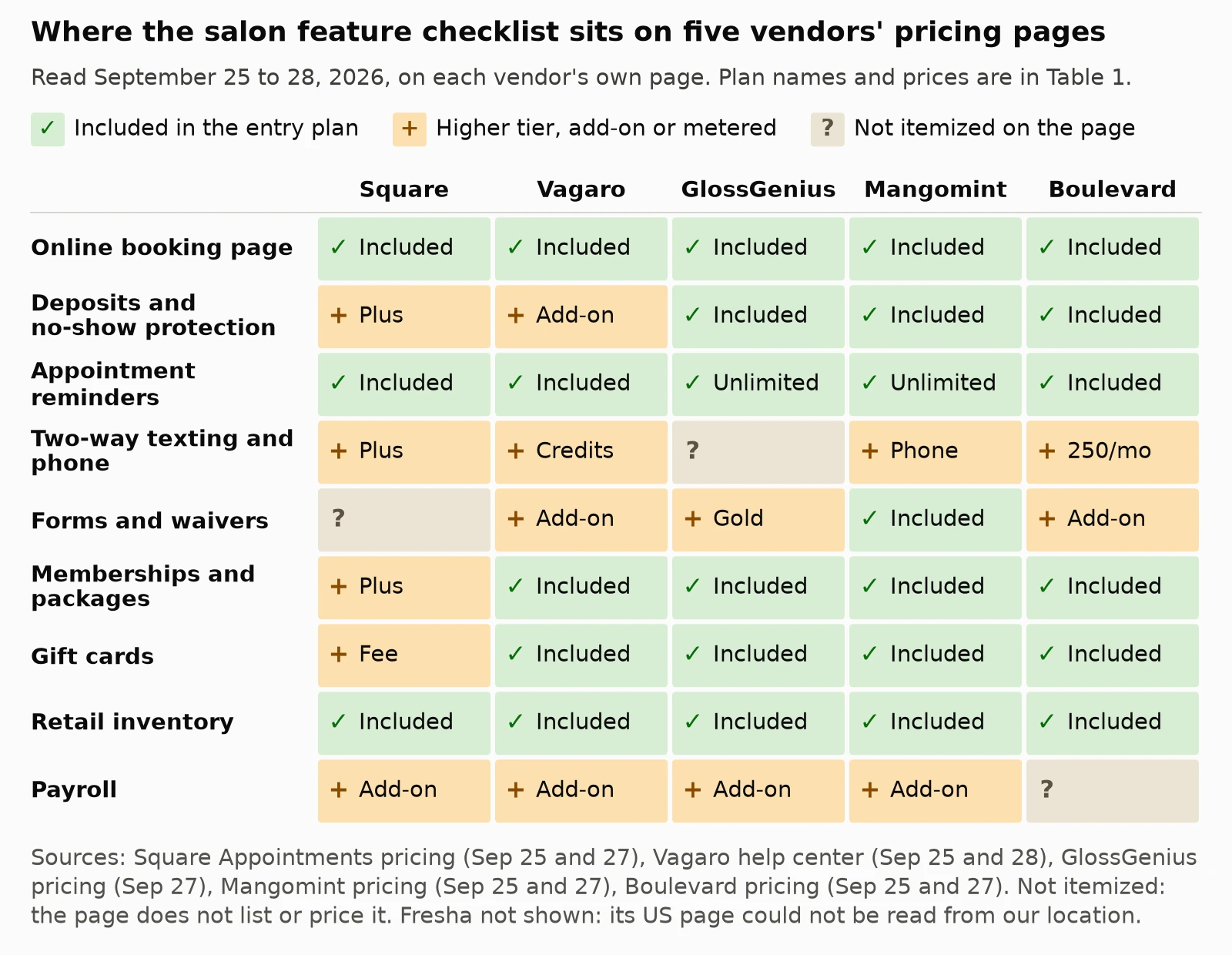
Most buying guides print a similar checklist, and the checklist is broadly right. What it leaves out is the pricing page. This article walks through the features salon owners look for in salon management software, then checks where each feature sits on five vendors’ own pricing pages and help centers, read September 25 to 28, 2026. Included in the base plan, gated to a higher tier, sold as an add-on, metered by usage, or not itemized at all. The same feature word can mean an included line on one page and a $70-a-month add-on on another: two-way texting comes with 250 free texts a month on Boulevard Essentials, while Mangomint sells calls and texting from one number as a Phone add-on at $70 a month per line.
Twizzlo, which publishes this guide, makes salon scheduling software; its plans are set out in their own section below. Fresha is not included: its US pricing page could not be read from our location on September 25, 2026.
What are the features salon owners look for in salon management software?
Most salon owners start from the same short list: online booking, no-show protection, reminders, client records, forms, memberships and gift cards, staff tools, inventory, reporting and payroll. In practice, they want an online booking page that works around the clock and does not force clients to create an account; deposits and no-show fees to protect the book; automated reminders by text and email; a client record that carries history, notes and preferences into every visit; digital forms and waivers; memberships, packages and gift cards for recurring revenue; staff schedules with per-person permissions and pricing; retail and backbar inventory where product is sold; reporting an owner will actually read; and payroll once the team is big enough to make Fridays complicated.
Two details separate a useful checklist from a brochure. First, login-free booking is a real conversion feature, prominent enough that GlossGenius sells it by name on its pricing page (read September 27, 2026). Second, the checklist tells you nothing about cost placement, and placement is where budgets go wrong. The rest of this guide prices the checklist.
Which booking features fill the calendar and protect it?
Online booking itself is included on every plan of the five vendors compared; none charges for the booking page. The protection layer is where the differences start. On pages read September 25 to 28, 2026, booking deposits are included on every plan at Square, GlossGenius and Boulevard, and at Mangomint when you use its own payment processing. Square adds cancellation and no-show fees from its Plus plan, $49 a month per location. Vagaro’s base subscription includes cancellation and no-show policies, while deposits and cancellation fees for online bookings come with its Online Shopping Cart add-on at $10 a month. Setting the fee itself is a separate decision, covered in the no-show charge guide.
Reminders are the other half of no-show protection, and every platform sends them; the differences are allowances and add-ons, which get their own section below. What reminders can and cannot fix, and how to sequence them, is covered in the appointment reminders guide.
Where do must-have features sit behind paywalls?
Fewer features sit behind paywalls than the checklist suggests: on the five vendors’ pages, forms, payroll, phone lines and no-show fees are where add-ons and higher tiers start. Table 1 shows each checklist row as the vendor’s own page prints it.
Table 1. The features salon owners look for in salon management software, and where each sits on five vendors’ own pages.
| Feature | Square | Vagaro | GlossGenius | Mangomint | Boulevard |
|---|---|---|---|---|---|
| Online booking page | Included on every plan | Included | Included on every plan, with login-free client booking | Included | Included on every plan |
| Deposits and no-show protection | Deposits and prepayment on every plan; no-show fees from Plus, $49 a month per location | Cancellation and no-show policies included; online deposits and cancellation fees need the Online Shopping Cart add-on, $10 a month | Deposits, card-on-file and no-show policies on every plan | Deposits and cards on file included, with Mangomint’s payment processing | Booking deposits and saved cards on every plan |
| Appointment reminders | Text and email reminders on every plan | Text and email reminders in the base subscription | Unlimited client notifications on every plan | Unlimited text and email reminders at no extra cost | Text and email reminders on every plan |
| Two-way texting and phone | Two-way texts on every plan; dedicated business phone number from Plus | Connect is free to start, with a text plan recommended, from $20 a month for 1,000 credits | Not itemized | Web chat included; calls and texting from one number: Phone add-on, $70 a month per line | 250 free two-way texts a month on Essentials; booking line on every plan |
| Forms and waivers | Intake forms not itemized; contracts with e-signature on every plan | Forms add-on, $10 a month | Gold and Platinum, from $56 a month; not on Standard | Included (forms and charting) | Add-on on Essentials and Premier; included on Prestige |
| Memberships and packages | Packages from Plus; service subscriptions on the website from Plus; memberships not itemized | Included in the base subscription | Included on every plan | Included | Included on every plan |
| Gift cards | Every plan; 2.5% load fee on Free and Plus, none on Premium | Included; online sales through the Online Shopping Cart | Included on every plan | Included | Included on every plan |
| Retail inventory | Low-stock alerts on every plan; inventory history from Plus | Inventory and retail in the base subscription | Included on every plan | Included | Included on every plan |
| Payroll | From $35 a month plus $6 per person paid | Vagaro Payroll, $34 a month plus $5 per employee | Add-on, $40 a month plus $6 per seat | Add-on, $50 a month plus $8 per worker | Not itemized |
Read on each vendor’s own page: Square September 25 and 27, Vagaro’s help center September 25 and 28, GlossGenius September 27, Mangomint September 25 and 27, Boulevard September 25 and 27, 2026. “Not itemized” means the page neither lists nor prices the feature. Fresha is not included: its US pricing page could not be read from our location.
The billing model changes the picture as much as the feature list. Mangomint’s pricing page, read September 27, 2026, includes forms, memberships, gift cards, web chat and multi-location support in one core platform at $120 a month per location plus $10 per user, and sells calls and texting from one business number as a Phone add-on at $70 a month per line. GlossGenius, read the same day, includes memberships, packages and gift cards on every plan but starts forms and waivers at Gold, $56 a month. Vagaro keeps a long feature list in its base subscription and sells forms, its online shopping cart and payroll as add-ons. Square gates most extras by plan; its appointments pricing page lists packages and service subscriptions from Plus but does not itemize intake forms or memberships.
A not-itemized cell cannot be budgeted from public information; ask for it in a demo.
What do text reminders really cost month to month?
On the five vendors’ pages read September 25 to 28, 2026, every entry plan lists automated appointment reminders, and GlossGenius and Mangomint say outright that they are unlimited. Two-way texting and phone lines are listed and priced separately.
Take a three-stylist salon sending about 400 reminder texts a month. GlossGenius prints unlimited client notifications, and Mangomint unlimited text and email confirmations and reminders at no additional cost. Square lists text and email reminders on every plan with no allowance printed. Boulevard lists text reminders on every plan and 250 free texts a month on Essentials, without saying whether reminders count toward them. Vagaro lists text and email reminders in its base subscription. Conversation is priced separately on the same pages: Mangomint’s Phone add-on is $70 a month per line, Square’s dedicated business number starts on Plus, and Connect by Vagaro, its messaging feature, is listed as free to start with a text plan recommended, from $20 a month for 1,000 credits.
Reminders are the feature owners use every day, so read the text terms before the logo.
Which client management features earn their keep?
The client record is the retention engine: history, notes, preferences, spend and the ability to greet a client like you remember them, because the software does. Every platform in Table 1 ships profiles and history in some form. The gates appear on structured intake, on pages read September 25 to 28, 2026: forms and waivers are included at Mangomint, start at Gold ($56 a month) on GlossGenius, cost $10 a month at Vagaro, are an add-on on Boulevard Essentials and Premier and included on Prestige, and are not itemized on Square’s appointments pricing page, which lists contracts with e-signature on every plan instead. A signed agreement for a wedding party is a different document from an intake form; our bridal hair and makeup contract template covers that job. Where the record itself stops and a true CRM begins is its own topic, covered in the salon CRM software guide.
Which back-office features matter once you grow?
On pages read September 25 to 28, 2026, staff permissions come with the plan at Vagaro and Boulevard, and Mangomint includes staff management in its core platform. GlossGenius adds staff management at Gold, for teams of fewer than 10, and Square’s custom permission sets start on Plus. Payroll is the clearest add-on economy in the category: from $35 a month plus $6 per person paid at Square, $34 plus $5 per employee at Vagaro, $40 plus $6 per seat at GlossGenius and $50 plus $8 per worker at Mangomint, while Boulevard’s pricing page does not itemize payroll. Commission tracking is listed on every Boulevard plan, in Vagaro’s base payroll reports and on Square from Plus; GlossGenius prints a commissions report on every plan and customizable commissions on Platinum.
Multi-location is the quiet multiplier, and on pages read September 25 to 28, 2026, each vendor bills it differently. Square prices each plan per location; GlossGenius bills each added location at the plan price less 15%; Mangomint charges $120 a month per location; Boulevard’s multi-location support starts on Premier, $325 a month per location at list price or $260 on a limited-time fall offer for new customers; and Vagaro’s help center prints no subscription price for an added location.
What does the whole checklist cost a three-stylist salon?
For one location with three bookable stylists that wants forms, memberships, gift cards, no-show protection and payroll for all three, the monthly bill runs from $112.99 on Vagaro, at its limited-time base rate, to $224 on Mangomint, on vendor pages read September 25 to 28, 2026. Square and Boulevard leave at least one row unpriced.
Table 2. Monthly cost of the full checklist: one location, three bookable stylists, billed monthly. Read on each vendor’s own page: Square September 25 and 27, Vagaro’s help center September 25 and 28, GlossGenius September 27, Mangomint September 25 and 27, Boulevard September 25 and 27, 2026.
| Platform | What the checklist needs | Monthly total |
|---|---|---|
| Vagaro | $23.99 base, a limited-time rate, with one calendar; two added calendars at $10; Forms $10; Online Shopping Cart $10; Vagaro Payroll $34 plus 3 x $5 | $112.99 |
| GlossGenius | Gold, $56 ($48 billed annually), which adds forms and staff management; payroll $40 plus 3 x $6 | $114 |
| Mangomint | $120 per location; 3 users at $10 (anyone with a profile counts as a user); payroll $50 plus 3 x $8 | $224 |
| Square Appointments | Plus, $49 per location (no-show fees, packages); payroll from $35 plus 3 x $6; intake forms and memberships not itemized; gift cards carry a 2.5% load fee on Plus | $102, with two rows unpriced |
| Boulevard | Essentials, $159 ($143 billed annually), up to 5 providers; the forms add-on, price not printed; payroll not itemized | $159, with two rows unpriced |
Totals are billed monthly and exclude card processing, texts beyond any allowance, optional add-ons such as Mangomint’s Phone line, and tax. Our Square Appointments pricing, Vagaro pricing and GlossGenius pricing comparisons break each bill down further.
Where Twizzlo fits on the salon feature checklist
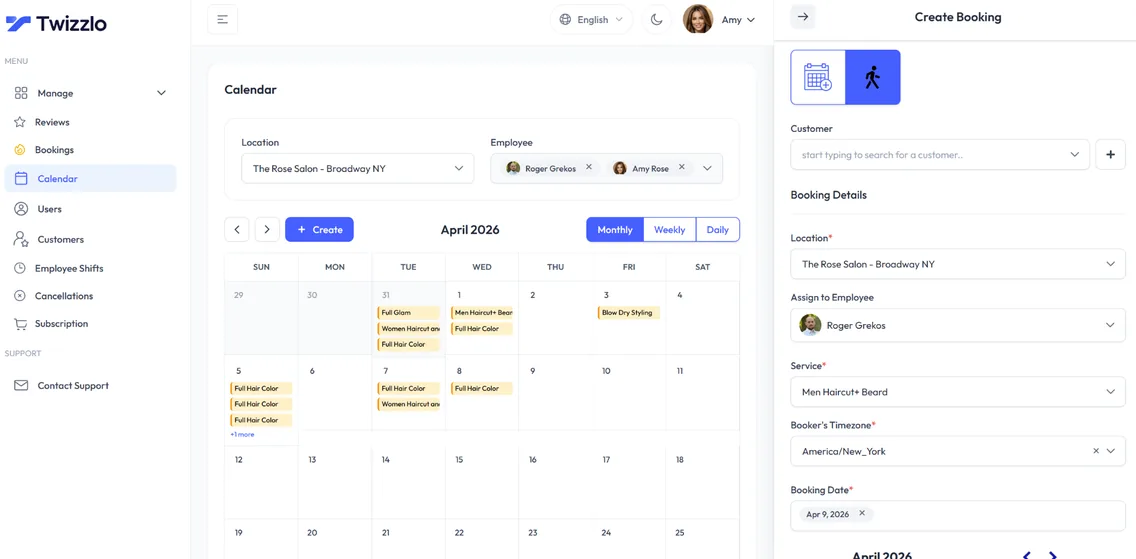
Twizzlo is web-based online booking and appointment scheduling software for appointment-based service businesses, and it covers online booking, reminders, client records and staff scheduling from the checklist, and Business Pro includes every Twizzlo feature with no add-on modules. Free is $0 a month for up to 150 bookings, with no SMS, and is free forever; it sends email reminders. Business Pro is $29.99 a month per business for unlimited bookings and 50 SMS a month, then $0.03 per additional SMS, with a 30-day money-back guarantee. Both plans include unlimited staff and locations, so a second stylist or a second location never raises the price. Online payments carry your Stripe processing rate plus a 1.5% Twizzlo platform fee. The details are on Twizzlo’s feature list and Twizzlo plans and pricing, both read September 28, 2026.
Clients can pay the full service price when they book with a prepaid booking, and no-show fees are supported, applied at the business’s discretion; whether a skipped prepaid booking is kept or refunded is the business’s decision. At 400 reminder texts a month, Business Pro’s 50 included texts leave 350 at $0.03, about $10.50 a month on top of the plan. Twizzlo does not run payroll, commission tracking or memberships. A salon that runs any of them inside its salon platform should compare the vendors in the tables above. Support runs 24/7.
How should you run this checklist before you buy?
First, mark your dealbreakers and delete columns: if gift cards are non-negotiable, the included and add-on cells in that row are your shortlist, and the not-itemized cells tell you which vendors need a sales call before they earn a place on it. Second, price your own column, not the advertised one: base plan, plus every add-on you will actually switch on, plus per-user or per-location fees and payroll per person. Third, book a test appointment on each finalist’s real booking page as a client, on a phone, and count the taps. Fourth, re-check the vendor pages the week you buy: on September 25, 2026, Vagaro’s base price was labeled a limited-time rate and Boulevard’s Premier plan showed a fall offer for new customers, so this article’s figures have a shelf life. When the checklist narrows to actual products, our best salon software guide compares the platforms side by side.
Frequently asked questions
What is salon management software?
Salon management software is the system that runs a salon's day: the online booking page, the appointment calendar, client records and visit history, reminders, payments and reporting. Broader platforms add retail inventory, memberships, gift cards, marketing and payroll, which is where products differ most and where pricing gets layered.
Which features matter most for a small salon?
Four features do most of the work for a small team: an online booking page clients can use without creating an account, deposits or card-on-file with a no-show fee, automated reminders, and a client record that keeps notes and history attached to every visit. Inventory, memberships and payroll start mattering as the team and retail shelf grow.
Which salon software features usually cost extra?
On vendor pages read September 25 to 28, 2026: forms and waivers ($10 a month at Vagaro, from Gold at $56 a month on GlossGenius, an add-on on Boulevard Essentials and Premier), payroll (from $34 to $50 a month plus a per-person fee at Vagaro, Square, GlossGenius and Mangomint), a business phone line ($70 a month per line at Mangomint), online deposits and cancellation fees at Vagaro ($10-a-month Online Shopping Cart) and no-show fees at Square, which start on the $49 Plus plan.
Do all salon platforms include text reminders?
Most do, but the terms differ. On vendor pages read September 25 to 28, 2026, GlossGenius includes unlimited client notifications and Mangomint unlimited text and email reminders at no additional cost. Square lists text and email reminders on every plan, Boulevard lists text reminders on every plan with 250 free texts a month on Essentials, and Vagaro lists text and email reminders in its base subscription. On Twizzlo's pricing page, read September 28, 2026, both plans send email reminders and Business Pro includes 50 SMS a month, then $0.03 each.
Which features does Twizzlo include, and which does it skip?
On Twizzlo's pricing and features pages, read September 28, 2026, Business Pro is $29.99 a month per business and includes every Twizzlo feature with no add-on modules: online booking, prepaid bookings for the full service price, email reminders and 50 SMS a month (then $0.03 each), client records with notes and visit history, staff schedules and shifts with role-based access, insights, and online payments and tips through Stripe. Free is $0 a month for up to 150 bookings, with no SMS. Both plans include unlimited staff and locations. Online payments carry your Stripe processing rate plus a 1.5% Twizzlo platform fee. Twizzlo does not run payroll, commission tracking or memberships.
Is retail inventory necessary for a service-only salon?
No. Inventory tracking earns its keep when products sit on a shelf: low-stock alerts, backbar deductions and retail margins. A salon that sells no product can drop the requirement entirely, which widens the software choice and usually lowers the price. If retail is a meaningful revenue line, treat inventory as a dealbreaker feature and shortlist accordingly.
How often does salon software pricing change?
Often enough to re-check the week you buy. On pages read September 25, 2026, Vagaro's $23.99 base was labeled a limited-time rate, and Boulevard's Premier plan listed $325 a month per location, or $260 on a limited-time fall offer for new customers. Mangomint priced per location and per user, at $120 and $10 a month, on its page read the same day.
Which salon platforms include memberships and packages in the base plan?
On vendor pages read September 25 to 28, 2026: GlossGenius includes memberships and packages on every plan, Standard included; Vagaro lists memberships and packages in its base subscription; Mangomint includes them in its core platform; and Boulevard lists memberships, and series and packages, on every plan. Square lists packages from its Plus plan, $49 a month per location, and does not itemize memberships on its appointments pricing page.
How do salon platforms price a second location?
Each vendor does it differently. On pages read September 25 to 27, 2026: Square prices each plan per location; GlossGenius bills each added location at the plan price less 15%; Mangomint charges $120 a month per location; Boulevard's multi-location support starts on Premier, priced per location; and Vagaro's help center prints no subscription price for an added location. Twizzlo includes unlimited locations on both plans.
Sources and methodology
Prices read
- Twizzlo pricing page (opens in a new tab)Read . Supports: Twizzlo's two plans, booking cap, SMS allowance and overage, unlimited staff and locations, money-back guarantee, 24/7 support and the online payment fee
- Twizzlo features page (opens in a new tab)Read . Supports: Twizzlo booking, prepaid bookings, reminders, client records, staff shifts, role-based access, insights and no-show fees; the calendar screenshot (same image)
- Square Appointments pricing page (opens in a new tab)Read . Supports: Square plan prices per location and the feature grid: deposits, no-show fees, packages, business phone number, gift card load fee, inventory, permissions, commissions and payroll
- Vagaro plans and pricing help article (US) (opens in a new tab)Read . Supports: Vagaro's limited-time base rate with one calendar, $10 per added calendar, the Forms, Online Shopping Cart and Payroll add-ons, Connect and the text plan
- Vagaro features included in the base subscription (help article) (opens in a new tab)Read . Supports: reminders, cancellation and no-show policies, memberships, packages, gift cards, inventory, access levels, payroll reporting with commission tiers and multi-location in the base subscription
- Vagaro Online Shopping Cart help article (opens in a new tab)Read . Supports: deposits, cancellation fees and online gift card sales through the $10-a-month Online Shopping Cart
- GlossGenius pricing page (opens in a new tab)Read . Supports: GlossGenius plan prices and compare table: login-free booking, deposits, memberships, packages, gift cards, forms from Gold, staff management, commissions, added-location discount and payroll add-on
- Mangomint pricing page (opens in a new tab)Read . Supports: Mangomint location and user prices, the included feature list, unlimited reminders, deposits with Mangomint processing, and the Phone and Payroll add-ons
- Boulevard pricing page (opens in a new tab)Read . Supports: Boulevard Essentials, Premier and Prestige prices, the fall offer, free texts, forms add-on and the compare table
From our editorial policy
- Twizzlo sells online booking and appointment scheduling software, the same category we write about. Twizzlo appears in our comparisons and roundups, and we have a commercial interest in you choosing it.
- We do not publish invented quotes, studies, statistics, customer stories or product tests, and we do not imply hands-on use of a product when the research came from the vendor's public documentation.
- To report an error, email support@twizzlo.com with the subject line "Correction: [page URL]". Tell us what is wrong and, if you can, link a source.
Update history
- : Re-read every vendor's pricing page and help center (September 25 to 28, 2026), rebuilt the feature table for five vendors, added a three-stylist cost table and two FAQs, removed Fresha figures we could not re-read from the US, and gave Twizzlo's plan details their own section.
Start free, upgrade when you grow
Flat-rate booking software. No per-seat, per-chair or per-location fees.
- Free plan up to 150 bookings a month, not a trial
- Business Pro is $29.99 a month per business for unlimited bookings, with a 30-day money-back guarantee
- 24/7 support by email