
Mangomint vs Vagaro in 2026: What Each One Actually Charges

In short
Vagaro costs less than Mangomint at every team size. Vagaro's US help center, read September 25, 2026, listed $23.99 a month on a limited-time rate plus $10 per added calendar, reaching $83.99 at seven calendars and staying there. Mangomint's pricing page, read the same day, listed $120 per location plus $10 per user; it includes forms and unlimited reminders.
- Vagaro stops charging for calendars after seven licenses: $83.99 a month from seven bookable staff up, on the limited-time rate read September 25, 2026.
- Mangomint bills every profile as a user, front desk staff and booth renters included, so count logins, not stylists.
- Forms and deposits are $10 add-ons each on Vagaro and included on Mangomint; on both, deposits need the vendor's own card processing.
Source: Vagaro plans and pricing help article (US) (opens in a new tab), read
In this article10 sections
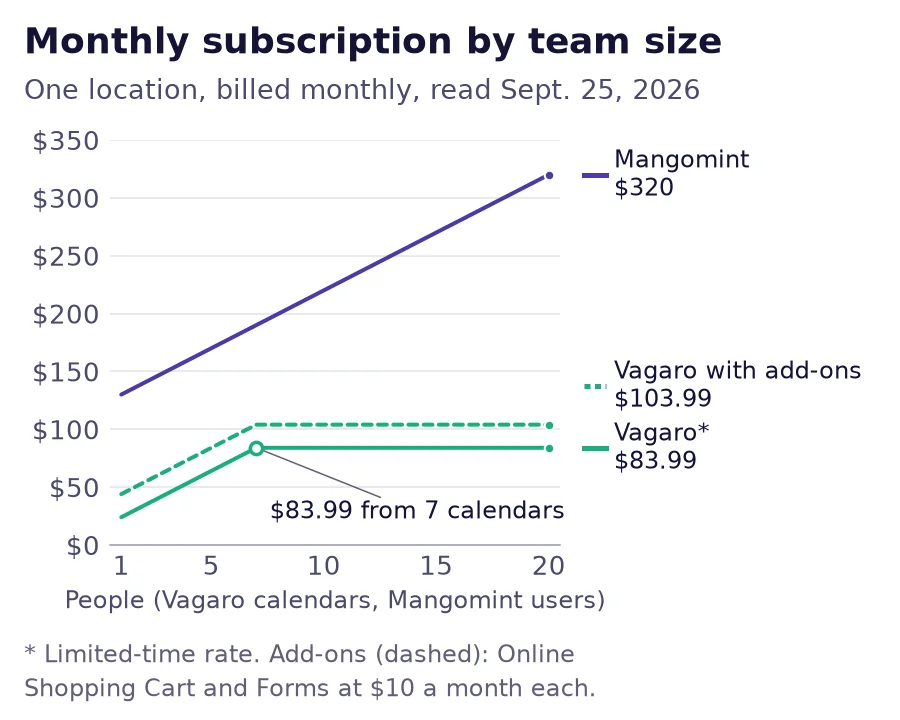
Mangomint and Vagaro are both salon scheduling software with card payments built in, and they bill in opposite ways. Vagaro starts low and sells features as monthly add-ons; Mangomint charges per location and per user and includes more. This Mangomint vs Vagaro comparison prices both from each company’s own pages, read September 25 to 28, 2026, for teams of one to twenty.
Should your salon choose Mangomint or Vagaro?
Verdict
Choose Mangomint if
- you want forms, memberships and packages, retail and inventory, gift cards and unlimited text and email reminders in one price.
- you will take payments through Mangomint, which its pricing-page FAQ requires for deposits, cards on file, self checkout and Express Booking.
Choose Vagaro if
- the subscription comes first: $23.99 a month on a limited-time rate, $10 per added calendar and $83.99 from seven calendars (US help center, read September 25, 2026).
- you want a free US listing on Vagaro Marketplace, which Vagaro says can also reach Google, Google Maps and Apple Maps.
| Aspect | Mangomint | Vagaro |
|---|---|---|
| Subscription, 1 person | $130 a month | $23.99 a month (limited-time rate) |
| Subscription, 7 people | $190 a month | $83.99 a month |
| Subscription, 20 people | $320 a month | $83.99 a month (no charge after seven licenses) |
| Deposits and forms | Included; deposits need Mangomint's payment processing | $10 a month each (Online Shopping Cart, Forms); the cart needs Vagaro's card processing |
| In-person card rate | 2.45% + $0.15 | 2.6% + $0.10 under $4,000 a month in card sales; 2.29% + $0.19 above it, plus $10 a month |
One location, billed monthly, before tax. Vagaro totals build on its limited-time $23.99 rate. Mangomint pricing page, read September 25, 2026 (prices) and September 27 (inclusions). Vagaro US help center, read September 25, 2026 (subscription and add-ons), September 27 (card rates) and September 28 (Online Shopping Cart).
Mangomint vs Vagaro: how much does each one cost in 2026?
Vagaro’s subscription is lower at every team size. Read September 25, 2026, Vagaro’s help center listed $23.99 a month in the US, marked “Only for a limited time,” with one calendar and $10 for each added calendar up to seven licenses, while Mangomint’s pricing page listed $120 per location and $10 per user.
Vagaro’s license rule decides the larger teams. The help center says: “One calendar license is included in your base subscription. Each additional employee calendar is $10 per month for up to seven licenses. After paying for seven licenses, you can add new employees to your account at no additional charge.” Read that way, the subscription stops at $83.99 a month from seven calendars. Mangomint’s page prints no cap: each user adds $10 a month and each location adds $120.
Table 1. Vagaro vs Mangomint, side by side, for one US location, billed monthly, before tax. Vagaro totals build on its limited-time $23.99 rate. Vagaro: US help center, subscription and add-ons read September 25, 2026, card rates September 27, base-subscription features and the Online Shopping Cart September 28. Mangomint: pricing page, prices read September 25, 2026, inclusions and FAQ September 27.
| Item | Vagaro | Mangomint |
|---|---|---|
| Billing unit | Base subscription with one bookable calendar, plus $10 a month per added calendar up to seven licenses | $120 a month per location plus $10 a month per user |
| 1 person | $23.99 (limited-time rate) | $130 |
| 7 people | $83.99 | $190 |
| 20 people | $83.99 | $320 |
| Who counts | Each bookable employee calendar | Anyone with a profile, including front desk staff and booth renters |
| Added location | The help center prints no subscription price for an added location | $120 a month each |
| Deposits and cancellation fees | Online Shopping Cart, $10 a month; requires Vagaro’s card processing | Included; deposits need Mangomint’s payment processing |
| Consent forms and waivers | Forms add-on, $10 a month | Included (Forms & Charting) |
| Appointment reminders | Confirmations and reminders by text and email listed in the base subscription; the help center does not say whether reminder texts use text-marketing credits (read September 28, 2026) | Unlimited text and email confirmations and reminders included |
| In-person card rate | 2.6% + $0.10 under $4,000 a month in card sales; 2.29% + $0.19 above it, with a $10 monthly Large Merchant fee; FANF and Mastercard location fees apply, amounts not printed | 2.45% + $0.15; large businesses may qualify for custom rates |
| Needs own card processing | Online Shopping Cart; auto-renewing memberships | Deposits, cards on file, self checkout, Express Booking |
What each charges as the team grows
Table 2. Monthly subscription for one location by team size, counting each person as one Vagaro calendar and one Mangomint user, before tax and card processing. Vagaro: US help center, read September 25, 2026, on the limited-time rate; Mangomint: pricing page, read September 25, 2026. The chart above the article plots the same figures.
| People | Vagaro subscription | Vagaro with Online Shopping Cart and Forms | Mangomint, one location |
|---|---|---|---|
| 1 | $23.99 | $43.99 | $130 |
| 2 | $33.99 | $53.99 | $140 |
| 3 | $43.99 | $63.99 | $150 |
| 5 | $63.99 | $83.99 | $170 |
| 7 | $83.99 | $103.99 | $190 |
| 8 | $83.99 | $103.99 | $200 |
| 10 | $83.99 | $103.99 | $220 |
| 12 | $83.99 | $103.99 | $240 |
| 15 | $83.99 | $103.99 | $270 |
| 20 | $83.99 | $103.99 | $320 |
Mangomint costs $106.01 a month more from one to seven people, because both add $10 a person. After that the gap widens by $10 a person, to $136.01 at ten and $236.01 at twenty, or $2,832.12 a year.
Mangomint pricing: who counts as a user and which add-ons cost extra
Mangomint sells one price structure with three optional add-ons. Its pricing page, read September 25, 2026, says “Monthly price is $120 per location and $10 per user,” counts anyone with a profile as a user, and adds Phone at $70 a month per line, Marketing from $30 a month and Payroll at $50 plus $8 per worker.
The user rule reaches past the stylists. The page’s FAQ, read September 27, 2026, names service providers and front desk employees, and adds that “any booth renter using your Mangomint account counts as a user.” One user at one location is $130 a month.
Marketing is the add-on that covers “Campaigns and Automated Flows.” On September 27, 2026, its plans were 3,500 credits for $30 a month, 6,000 for $50, 15,000 for $100, 35,000 for $200 and 60,000 for $300.
Everything else on the page’s “What’s included” list comes with the location and user price: Calendar & Scheduling, Payments & Point-of-Sale, Online Booking, Express Booking, Virtual Waiting Room, Mobile Apps, Client Management, Web Chat, Memberships & Packages, Forms & Charting, Offers & Discounts, Gift Cards, Retail & Inventory, Staff Management, Reporting, Multi-Location and Integrations. The page also lists free onboarding, free data transfer and no contracts, says teams of two or more providers get a dedicated onboarding specialist and offers a free trial account. Asked whether it takes a fee for appointments booked in the platform, its FAQ answers: “Nope. Never.”
Some third-party pages still print $165 a month. Mangomint’s page, read September 25 and 27, 2026, shows no such plan; one location with four users is $160 and with five is $170.
What does Vagaro’s $23.99 actually include?
Vagaro’s base subscription covers one bookable calendar and its core tools; deposits, forms, a website and accounting sync are monthly add-ons. Vagaro’s US help center, read September 25, 2026, prices the Online Shopping Cart, which turns on deposits and cancellation fees, at $10 a month, Forms at $10 and the MySite website at $20.
The core list is long. Vagaro’s article on features included in the base subscription, read September 28, 2026, names cancellation, no-show and rescheduling policies, text and email confirmations and reminders, loyalty points, memberships, packages, gift cards, inventory and retail, and payroll reporting with custom commission tiers.
Table 3. Vagaro premium features and their US monthly prices as printed in its help center, read September 25, 2026; the top text plan was read September 28.
| Add-on | US price | What it covers |
|---|---|---|
| Online Shopping Cart | $10 a month | Deposits and cancellation fees for online appointments; online sales of packages, memberships, products and gift cards |
| Forms | $10 a month | Consent forms, liability waivers, intake forms and electronic signatures |
| Vagaro MySite | $20 a month | A business website |
| Vagaro Drive | From $10 a month | Storage for photos, files and forms |
| Check-In App | $10 a month | Client sign-up, check-in and booking of future visits |
| QuickBooks or Xero | $10 a month each | Accounting sync |
| Vagaro Payroll | $34 a month plus $5 per employee | Pay by direct deposit and manage time off |
| Branded App | $100 a month (Limited Time) plus $100 one time | A personalized client app in the App Store and Google Play |
| Text messaging | $20 for 1,000 credits up to $2,500 for 500,000 | Monthly text credit plans |
| Email marketing | 1,000 credits free; 5,000 for $10 | Email campaigns |
Vagaro’s calendar ladder and card rates are also on our Vagaro pricing page. Seven items are billed forward, meaning the charge runs to the end of the billing cycle even if you switch them off: Email Marketing, Text Marketing, QuickBooks Integration, Vagaro Drive, Vagaro Payroll, Xero Integration and the Large Merchant Plan (read September 27, 2026).
Two features depend on Vagaro’s card processing. Vagaro’s Online Shopping Cart article, read September 28, 2026, lists Credit Card Processing as a prerequisite; owners setting a card-hold policy can read how to handle a no-show charge. Memberships are available to every Vagaro business, but its Create a Membership article, read September 27, 2026, says auto-renewing memberships require Credit Card Processing.
Example: a solo stylist who wants deposits and forms pays $23.99 + $10 + $10 = $43.99 a month. Adding the Small text plan (1,000 credits for $20) makes $63.99, and a MySite website makes $83.99.
Which one is cheaper on card processing?
Whether Vagaro or Mangomint costs less per card payment depends on your monthly card volume. Vagaro’s US help center, read September 27, 2026, listed 2.6% plus 10 cents per in-person card payment for businesses processing under $4,000 a month and 2.29% plus 19 cents above that, with a $10 monthly fee, while Mangomint’s pricing page listed 2.45% plus 15 cents in person.
Table 4. Card fees on a $150 service paid in person (swipe, dip or tap). Vagaro: US help center, read September 27, 2026, before its FANF and Mastercard location fees, which have no printed amounts. Mangomint: pricing page, read September 25, 2026, before any custom rate.
| Case | Vagaro | Mangomint |
|---|---|---|
| One $150 payment | $4.00 as a Small Merchant; $3.63 as a Large Merchant | $3.83 |
| 20 payments, $3,000 a month | $80.00 (Small Merchant rate) | $76.50 |
| 100 payments, $15,000 a month | $372.50 (Large Merchant rate plus the $10 monthly fee) | $382.50 |
At $3,000 a month Mangomint costs $3.50 less; at $15,000 Vagaro costs $10 less, even with its $10 fee. Vagaro’s help center adds that merchants selected their plan when they signed up for its card processing.
Other rates differ too. Vagaro charges 3.5% plus 19 cents on keyed-in cards at both tiers, and 2.6% plus 16 cents or 2.29% plus 25 cents for Tap to Phone. Mangomint charges 2.90% plus 30 cents on virtual payments and says “Large businesses may qualify for custom rates.” Vagaro’s article lists no separate rate for payments taken online, and it says “Additional monthly FANF and Mastercard location fees apply” without an amount, so any Vagaro total, including the ones above, is short by an unknown sum.
Which salon should buy Mangomint?
A salon that wants forms, memberships, retail tools and unlimited reminders in one bill, and will take payments through Mangomint. Its pricing page, read September 27, 2026, lists Memberships & Packages, Forms & Charting, Retail & Inventory and Gift Cards as included, along with unlimited text and email appointment reminders.
Not everything is in the price. Campaigns and Automated Flows come with the Marketing add-on from $30 a month, and Phone and Payroll are add-ons too. The reminders are the clearest inclusion: asked about fees for text or email appointment notifications, Mangomint’s FAQ answers “Nope. Nada. Nyet.” Its page also lists no contracts and cancellation at any time.
A front counter is covered as well. Mangomint includes Payments & Point-of-Sale and Retail & Inventory; for the wider field of counter tools, see our guide to salon POS software.
Two points count against it. First, the user count. Example: a salon with six stylists and two receptionists who all log in has eight Mangomint users, so one location costs $200 a month. On Vagaro the same salon needs six bookable calendars, $73.99 a month on the limited-time rate; Vagaro’s pricing article does not say whether a staff login without a bookable calendar needs a license.
Second, the processor. Mangomint lets you use your own card processor, but its FAQ says Mangomint’s processing is needed for Express Booking, self checkout, cards on file and deposits. A salon buying for no-show protection should budget for Mangomint’s processing: 2.45% plus 15 cents in person and 2.90% plus 30 cents on virtual payments.
Choose Mangomint if its included tools replace add-ons you would otherwise buy and you are ready to process cards through it.
Which salon should buy Vagaro?
A salon that puts the subscription first, especially one with seven or more bookable staff. On the limited-time rate read September 25, 2026, Vagaro stays at $83.99 a month from seven calendars up, against $190 for Mangomint at seven users and $320 at twenty.
The add-ons keep that lead. Twenty stylists with the Online Shopping Cart and Forms pay $103.99 a month on Vagaro; a solo stylist with both pays $43.99, against $130 on Mangomint.
Vagaro also brings reach. Its help center, read September 27, 2026, lists the Vagaro Marketplace listing as free in the US and says businesses can list on the Vagaro Marketplace, Google, Google Maps and Apple Maps. Its Fill My Books tool, which creates deals to promote open times, charges a booking fee of 20% of a new customer’s first booking, or 5% for a returning customer when it fills gaps in your schedule (help center, read September 27, 2026).
The case against Vagaro is the bill’s moving parts: separately priced add-ons, seven items billed forward, FANF and Mastercard location fees with no printed amounts, and a base rate marked limited-time with no price printed for after the offer. Owners weighing Vagaro against other platforms can read Vagaro vs Fresha, GlossGenius vs Vagaro and Vagaro vs Square Appointments.
Choose Vagaro if a low subscription matters most, your team has seven or more bookable staff, and you will switch on only the add-ons you use.
Where does Twizzlo sit against both, and where does it fall short?
Twizzlo Business Pro, at $29.99 a month per business, costs less than Vagaro’s subscription from the second calendar ($33.99) and less than Mangomint at every team size. It also does less: Twizzlo has no memberships, payroll or commission tracking.
Twizzlo is web-based online booking and appointment scheduling software for appointment-based service businesses, with a public booking page, email and SMS reminders, client records, staff schedules and shifts, and Stripe payments and tips. Free is $0 a month for up to 150 bookings with no SMS. Business Pro is $29.99 a month per business for unlimited bookings and 50 SMS a month, with a 30-day money-back guarantee. Both plans include unlimited staff and locations.
The features page lists a booking page open 24/7 with a booking link for each location, a calendar with drag-to-reschedule, individual staff schedules and buffer times, and client profiles with notes and visit history. Prepaid bookings run through Stripe, and the client pays the full service price at booking. Reminders go out by email on both plans and by SMS on Business Pro, 50 a month and then $0.03 each, so texts are metered where Mangomint’s are unlimited. Tips are taken at checkout, and no-show fees apply at the business’s discretion. Online payments carry your Stripe processing rate plus a 1.5% Twizzlo platform fee.
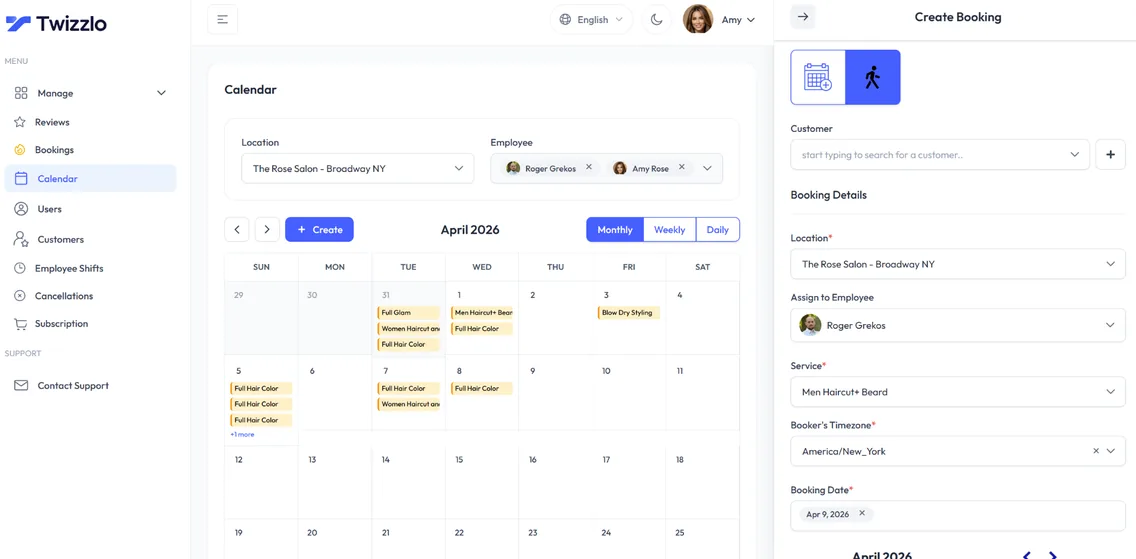
A salon that runs memberships, payroll or commissions should choose between Mangomint and Vagaro. A salon that mainly needs online booking, reminders and prepaid bookings can compare plans on Twizzlo’s pricing page, see how it fits as salon appointment software, or read the wider field in our best salon booking software guide. The Free plan is $0 a month for up to 150 bookings, with no SMS.
Frequently asked questions
Is Mangomint or Vagaro cheaper?
Vagaro, at every team size we priced. At prices read September 25, 2026, a solo operator pays $23.99 a month on Vagaro's limited-time rate against $130 on Mangomint, and a twenty-person salon pays $83.99 against $320. Adding Vagaro's Online Shopping Cart and Forms at $10 a month each narrows the gap without closing it.
How much does Mangomint cost per month in 2026?
Mangomint's pricing page, read September 25, 2026, says "Monthly price is $120 per location and $10 per user." One location with one user is $130, with five users $170 and with ten $220. Optional add-ons were Phone at $70 a month per line, Marketing from $30 a month and Payroll at $50 a month plus $8 per worker.
Does Vagaro really charge only 23.99 a month?
Only for the base subscription with one calendar. The $23.99 rate is marked "Only for a limited time" in Vagaro's US help center, read September 25, 2026, which prints no later price. Deposits and cancellation fees need the $10 Online Shopping Cart, consent forms need the $10 Forms add-on, and a MySite website is $20 a month.
Does Vagaro charge per staff member forever?
No. Vagaro's US help center, read September 25, 2026, includes one calendar license in the base subscription and charges $10 a month for each added employee calendar "for up to seven licenses," after which new employees are added "at no additional charge." Read that way, the subscription stops at $83.99 a month from seven calendars on the limited-time rate.
Who counts as a user in Mangomint?
Anyone with a profile, says the FAQ on Mangomint's pricing page, read September 27, 2026, naming service providers and front desk employees; booth renters using your account count too. Six stylists and two receptionists are eight users, so one location costs $200 a month, not the $180 a headcount of six stylists suggests.
Can I use my own card processor with Mangomint?
Yes, with a condition. Mangomint's pricing-page FAQ, read September 27, 2026, lets you use your own processor instead of or alongside its own, but says Mangomint's processing is needed for Express Booking, self checkout, cards on file and deposits. If deposits are why you are buying, budget for Mangomint's processing: 2.45% plus 15 cents in person and 2.90% plus 30 cents on virtual payments.
Why do comparison sites list Mangomint at 165 dollars a month?
Because they quote a figure Mangomint's own page does not print. Its pricing page, read September 25 and 27, 2026, says "Monthly price is $120 per location and $10 per user" and shows no $165 plan. Under that structure $165 is not a price at all: one location with four users is $160 and with five is $170.
Which is better for salon marketing, Mangomint or Vagaro?
It depends on the channel. Mangomint's pricing page, read September 27, 2026, includes unlimited text and email appointment reminders and sells Campaigns and Automated Flows as a Marketing add-on from $30 a month. Vagaro's US help center, read the same day, lists a free Marketplace listing, 1,000 free email marketing credits and text plans from $20 for 1,000 credits.
Sources and methodology
Prices read
- Vagaro plans and pricing help article (US) (opens in a new tab)Read . Supports: Vagaro base subscription, calendar licenses, premium add-on prices, text and email marketing plans
- Vagaro plans and pricing help article (US), card rates (opens in a new tab)Read . Supports: Vagaro US card processing rates and the $4,000 merchant line, FANF and Mastercard location fees, billed-forward features, Marketplace listing, Fill My Books booking fee
- Vagaro help article: Create a Membership (opens in a new tab)Read . Supports: Memberships for all Vagaro businesses; auto-renewing memberships require Vagaro's card processing
- Vagaro help article: Activate the Online Shopping Cart (opens in a new tab)Read . Supports: Deposits, card capture and no-show fees at booking; Credit Card Processing required
- Vagaro help article: Features Included in Your Base Subscription (opens in a new tab)Read . Supports: Text and email confirmations and reminders, policies, loyalty, memberships, packages, gift cards, retail and payroll reporting in the base subscription
- Mangomint pricing page (opens in a new tab)Read . Supports: Mangomint location and user prices, who counts as a user, add-ons and card processing rates
- Mangomint pricing page, included features and FAQ (opens in a new tab)Read . Supports: Included features, Marketing credit plans, booth renters as users, own-processor condition, unlimited reminders, no booking fee, onboarding and contracts
- Twizzlo pricing page (opens in a new tab)Read . Supports: Twizzlo plans, booking cap, SMS allowance, money-back guarantee and online payment fee
- Twizzlo features page (opens in a new tab)Read . Supports: Twizzlo booking page and links, drag-to-reschedule, staff schedules, client profiles, prepaid bookings, tips, no-show fees; the calendar screenshot (same image)
- Vagaro Fill My Books (US help center) (opens in a new tab)Read . Supports: Fill My Books booking fee: 20% of a new customer's first booking, or 5% for a returning customer when it fills gaps in your schedule
From our editorial policy
- Twizzlo sells online booking and appointment scheduling software, the same category we write about. Twizzlo appears in our comparisons and roundups, and we have a commercial interest in you choosing it.
- We do not publish invented quotes, studies, statistics, customer stories or product tests, and we do not imply hands-on use of a product when the research came from the vendor's public documentation.
- To report an error, email support@twizzlo.com with the subject line "Correction: [page URL]". Tell us what is wrong and, if you can, link a source.
Update history
- : Re-read both vendors' prices on September 25 to 28, 2026, corrected Vagaro's calendar cap to seven licenses and Mangomint's add-ons, rebuilt the team-size table, and added side-by-side and card-cost tables and a marketing FAQ.
Start free, upgrade when you grow
Flat-rate booking software. No per-seat, per-chair or per-location fees.
- Free plan up to 150 bookings a month, not a trial
- Business Pro is $29.99 a month per business for unlimited bookings, with a 30-day money-back guarantee
- 24/7 support by email