
Tattoo Apprenticeship Portfolio: What to Include, How Many Pieces and How to Show It

In short
A tattoo apprenticeship portfolio is a curated book of finished drawings that shows a studio you can draw and are worth training. Across 15 guides read November 15, 2026, most ask for a physical book, an online copy and a range of styles. The guides that give a number suggest anywhere from 10 to 100 pieces.
- Nine guides ask for original work or warn against traced or copied designs, and one mentor calls artwork made by artificial intelligence a red flag.
- Florida's health department says students and apprentices who tattoo people as part of training need a Florida license; other states set their own rules.
- Half of the guides that give a range stop at 50 pieces or fewer, so a short book of strong work is a defensible choice.
In this article9 sections
Studios that take apprentices ask to see drawings before anything else. On November 15, 2026, we read 15 guides to the tattoo apprenticeship portfolio from that day's search results. We counted what each tells applicants to include, how many pieces each suggests and where they disagree.
Fourteen guides came from the results for tattoo apprenticeship portfolio. GlossGenius's came from the results for tattoo portfolio and is counted for its section on apprenticeship books. All 15 are blogs run by portfolio site builders, suppliers, schools, studios, software companies, a print retailer, a tattoo news site and working artists, and they are named without links. The counts are our own: a script matched each piece of advice on the saved pages, and we read every matched sentence. They describe what the guides advise, not what any one studio requires, and nothing here is legal advice.
Portfolios for working artists, built from photos of finished tattoos, are a different job and are left out. So are the site-builder walkthroughs in two guides, because they describe each company's own product.
The book gets you in the door; paying clients come later. Once you take bookings of your own, our tattoo booking software page shows how clients book consults and sessions from one link.
What is a tattoo apprenticeship portfolio?
A tattoo apprenticeship portfolio is a curated set of finished drawings that shows a mentor how well you draw now and how far training could take you. Tommy's Supplies, a tattoo supplier, says in its guide that studios will teach you to tattoo but cannot teach you to draw.
Mentors do not expect a record of tattoos. Tommy's Supplies calls the idea that applicants need tattoo experience the most common misconception. The Broken Puppet Book's guide is written by an artist who says he has looked through hundreds of these books and taken on five apprentices. He writes that the book does not need to look like the work of an experienced tattoo artist. Finding a mentor and agreeing terms are covered in our tattoo apprenticeship guide.
What should a tattoo apprenticeship portfolio include?
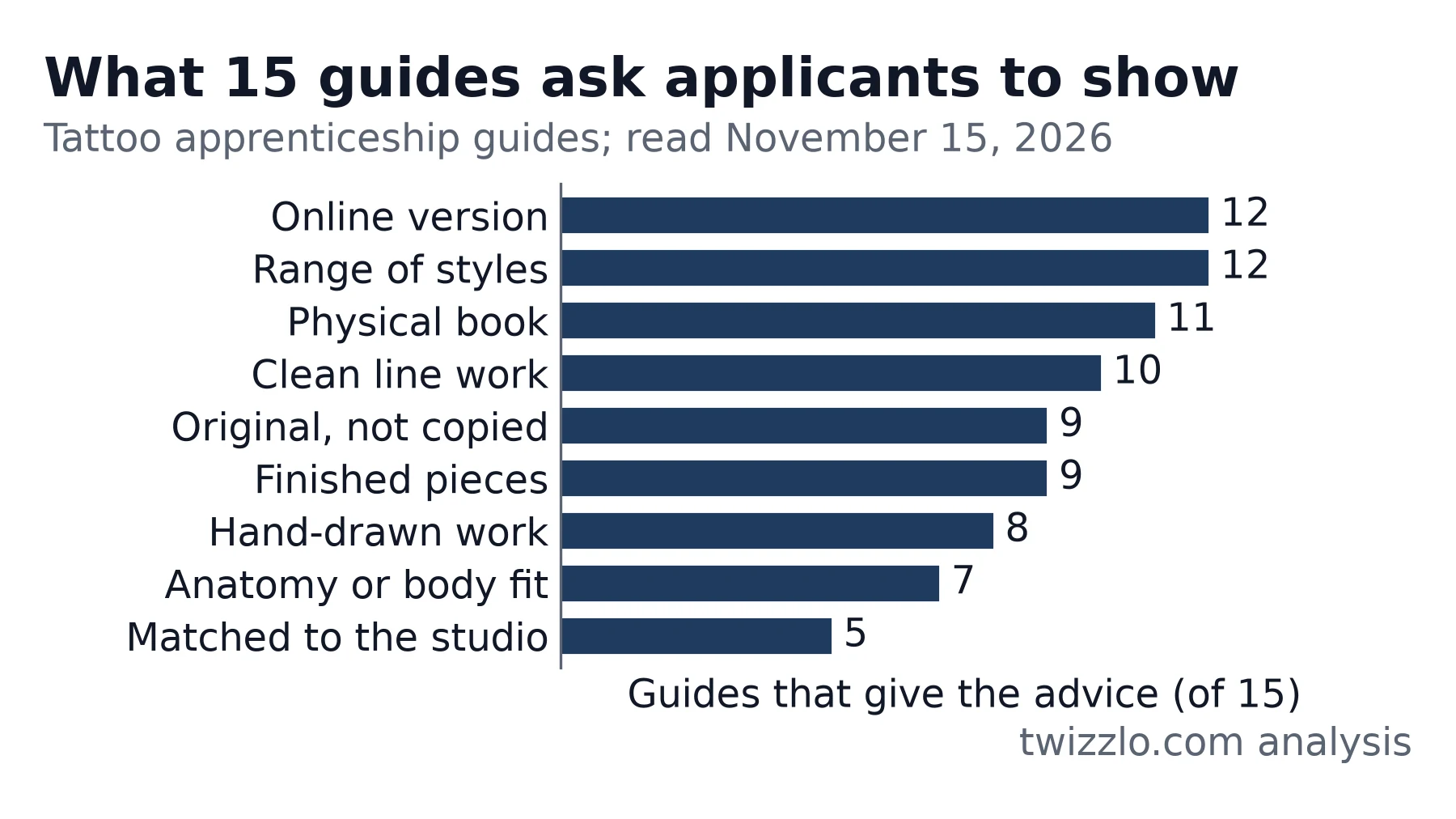
A tattoo apprenticeship portfolio should include finished drawings with clean line work in more than one style, kept in a physical book with an online copy. Most of the 15 guides read November 15, 2026, agree on those items; Table 1 counts the rest of the advice.
| Advice | Guides that give it | Share of 15 |
|---|---|---|
| An online version (site or Instagram) | 12 | 80.0% |
| A range of styles or subjects | 12 | 80.0% |
| A physical book to bring in person | 11 | 73.3% |
| Clean line work | 10 | 66.7% |
| Original work; no traced or copied designs | 9 | 60.0% |
| Finished pieces, not loose sketches | 9 | 60.0% |
| Hand-drawn work on paper | 8 | 53.3% |
| Anatomy studies or designs that fit the body | 7 | 46.7% |
| Work matched to the studio approached | 5 | 33.3% |
Table 1. Advice in 15 guides to the tattoo apprenticeship portfolio, counted by script on pages read November 15, 2026, with every matched sentence read by hand. A guide counts when its article body gives the advice; silence is not disagreement.
Read the bottom of the table as closely as the top. Matching the work to the studio appears in five guides, yet it can decide a visit. Tattoo Studio Pro's guide warns that a book of hyperrealism portraits shown at a Japanese blackwork studio suggests the applicant did no research.
Finished has a strict meaning in these guides. Tattooing 101 wants drawings that are 100 percent done and could be tattooed on someone right away, each designed for a specific part of the body. Painful Pleasures, a supplier, rules out incomplete artwork and more than one piece on a page.
Table 2 lists the kinds of pieces the guides name, with the guide that describes each.
| Kind of piece | What the guide says | Guide |
|---|---|---|
| Line drawings | Include 10 to 15 clean line drawings, in black and grey | Certified Tattoo Academy |
| Color pieces | Include at least five to six colored pieces, even if color is not your specialty | Certified Tattoo Academy |
| Shading studies | Show smooth gradients and black-and-grey work | Apprentice |
| Flash sheets | Original tattoo designs, even if you have not tattooed anyone yet | TattooNOW |
| Life drawing | Life drawing studies show you understand how the human body moves | Certified Tattoo Studios |
| Lettering | Part of a mix of styles alongside landscapes, fantasy and tribal designs | Painful Pleasures |
| Other art | Paintings and illustrations belong in a separate section | Tattoo Studio Pro |
Table 2. Kinds of pieces named in the guides read November 15, 2026. The wording is a summary of each guide's own advice.
Flash shows whether a drawing would work as a tattoo. Alchemy Tattoo Collective, a St. Louis studio, points out that flash designs do not fill the whole page but have a shape of their own, which makes them easier to move to skin. Sheet sizes and copyright are covered in our guide to tattoo flash sheets.
How many pieces should a tattoo apprenticeship portfolio have?
Guides that give a number suggest between 10 and 100 pieces: five of the 10 ranges, read November 15, 2026, run from 50 to 100, and the other five stop at 50 or fewer. Table 3 lists each range with the guide's wording.
| Guide | Kind of site | Suggested pieces | The guide's wording |
|---|---|---|---|
| Pixpa | Portfolio site builder | 50 to 100 | Complete and colored pieces |
| Format | Portfolio site builder | 50 to 100 | Best tattoo designs |
| Prints4sure | Print retailer | 50 to 100 | Polished designs |
| Painful Pleasures | Tattoo supplier | 50 to 100 | At least 50 to 100 completed art pieces |
| Certified Tattoo Studios | Tattoo studio | 50 to 100 | Solid pieces |
| The Broken Puppet Book | Artist's book site | 40 to 50 | Strong pieces; 20 finished pieces is about the minimum |
| Apprentice | Studio software blog | 20 to 50 | Strong pieces |
| Tattoo Studio Pro | Studio software blog | 25 to 40 | 15 to 25 tattoo pieces plus 10 to 15 pieces of other art |
| TattooNOW | Tattoo news site | 15 to 25 | Pieces of your best work |
| Tommy's Supplies | Tattoo supplier | 10 to 20 | Pieces of strong drawing work |
Table 3. Piece counts suggested by 10 of the 15 guides, read November 15, 2026. Tattoo Studio Pro's range is the sum of its two sections; the guide itself describes a binder of roughly 35 to 40 pages. The other five guides give no range.
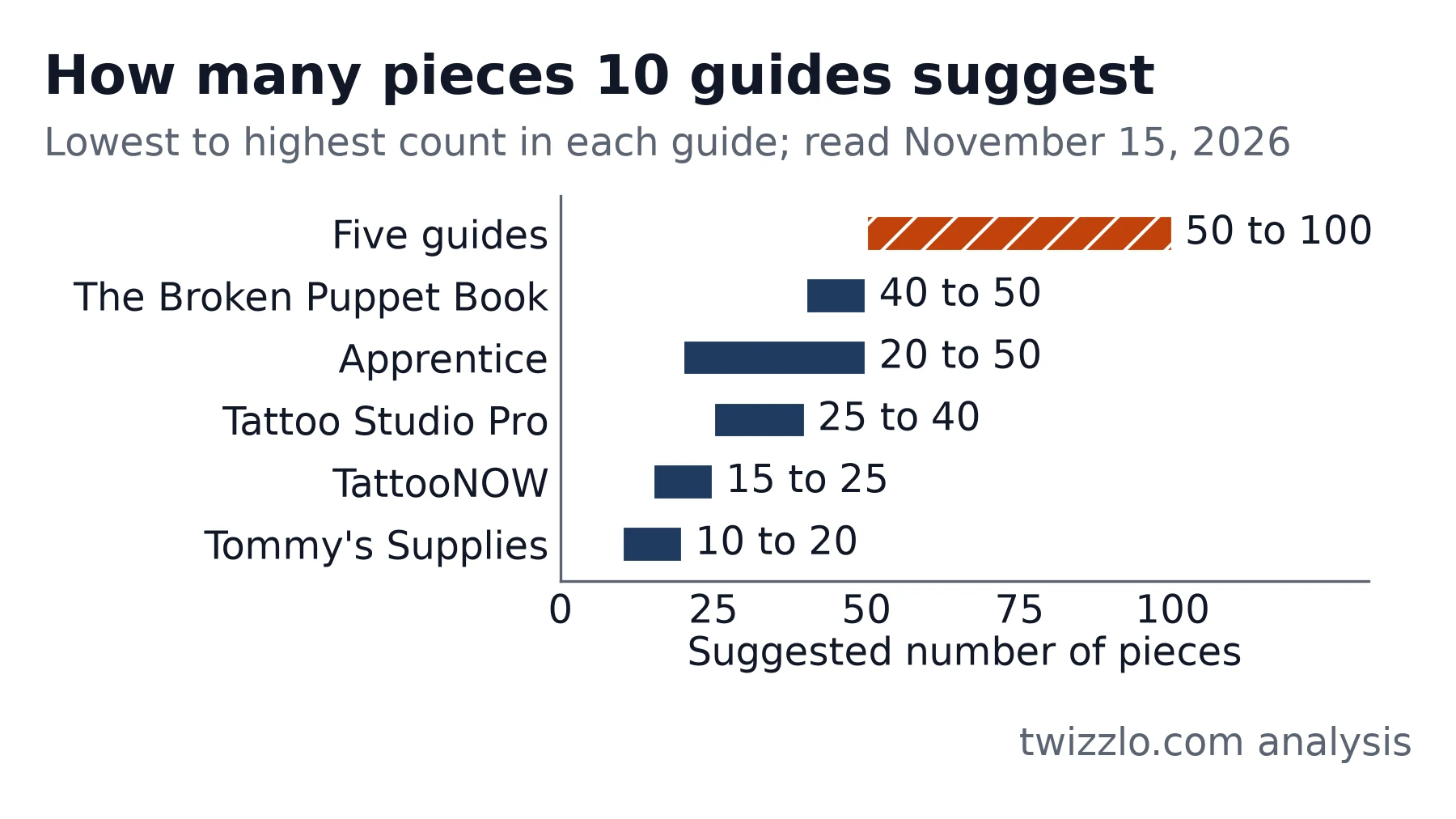
The 50 to 100 ranges come from two portfolio site builders, a print retailer, a supplier and a studio. The artist's guide, both studio software blogs, the news site and the other supplier stop at 50 or fewer.
The five guides without a range lean toward a short book. Tattooing 101 says 10 excellent designs beat 50 that are merely fine. Certified Tattoo Academy says to keep the book under 30 pages and cites an artist who wants to see 10 pieces the applicant cares about, not 100. InkMentor tells applicants not to think about the total, and Alchemy Tattoo Collective and GlossGenius give no number.
Padding is the shared warning. The Broken Puppet Book's author would sooner see 20 excellent pieces than 50 pieces that contain 20 excellent ones. Tattoo Studio Pro says studios tend to judge a book by its weakest pieces.
A target also sets a pace. The Broken Puppet Book imagines a serious applicant with six months to build about 50 finished pieces. Table 4 turns that six months, taken as 26 weeks, into the pace each target in Table 3 needs.
| Target | Where it comes from | Pieces a week over 26 weeks | Days for each piece |
|---|---|---|---|
| 20 pieces | The Broken Puppet Book's minimum; top of Tommy's Supplies' range | 0.8 | 9.1 |
| 25 pieces | Top of TattooNOW's range | 1.0 | 7.3 |
| 40 pieces | Top of Tattoo Studio Pro's range | 1.5 | 4.6 |
| 50 pieces | The Broken Puppet Book's six-month plan | 1.9 | 3.6 |
| 100 pieces | Top of the 50 to 100 ranges | 3.8 | 1.8 |
Table 4. Worked example (hypothetical): the pace each target needs if every piece is finished within 26 weeks, or 182 days. Pieces a week is the target divided by 26; days for each piece is 182 divided by the target. Both are rounded to one decimal place.
At 100 pieces, each drawing gets less than two days. At 20, each gets nine. Pick the target that leaves time to finish every piece properly.
Where do the guides disagree?
The guides split on sketchbook pages, digital art, practice tattoos and which format to build first. Table 5 sets the two sides of each question next to each other, as read November 15, 2026.
| Question | One view | Another view |
|---|---|---|
| Do sketchbook pages belong? | GlossGenius: share sketchbook pages to show how you develop ideas | Alchemy Tattoo Collective: a portfolio is solid, completed art, not a sketchbook |
| How much digital art? | Tommy's Supplies: pencil, pen, digital or mixed media are all appropriate; the medium matters less than the quality of the line | The Broken Puppet Book: an entirely digital book is a major red flag; about 70 percent physical artwork is the ideal |
| Should practice tattoos be shown? | Tattoo Studio Pro: include photos of work on practice skin, clearly labeled | Alchemy Tattoo Collective: do not include tattoos you have done |
| Which format comes first? | InkMentor: work on the online portfolio first; an Instagram feed is a must | Tattooing 101: you need a physical copy; do not walk in with only photos on your phone |
Table 5. Four questions on which the guides read November 15, 2026, give different advice. Each cell is a summary of that guide's own wording.
Practice tattoos raise a legal question as well as a matter of taste. The Florida Department of Health, on its licensure page read November 15, 2026, says a Florida license is required for students or apprentices who tattoo other people as part of their training. Rules differ by state, so read your own state's page before you pick up a machine. Our guide on how to get a tattoo license compares what several states ask for.
The Broken Puppet Book's author goes further and would prefer applicants had never touched a machine, practice skin included, because self-taught habits are hard to undo. He also rules out artwork generated by artificial intelligence (AI).
When advice conflicts, the studio you are approaching settles it. One of the same author's rules is to research and plan for that studio, so look at what its artists post before you choose what to show.
How do you put the book together in six steps?
Build the book in six steps: choose the format, pick the pieces, give each its own page, lead with the strongest, add your details and make an online copy. Each step below names the guide it comes from.
- Choose the format. Tattooing 101 and Painful Pleasures both recommend an A4 black hardcover folder with plastic sleeves, and The Broken Puppet Book suggests A3 or A2.
- Pick the pieces. Apprentice's guide gives the rule: if you are not proud of a piece, leave it out.
- Give each piece its own page. Tattooing 101 makes flash sheets the one exception, while The Broken Puppet Book groups pieces on larger sheets.
- Lead with the strongest work and group similar styles. Certified Tattoo Academy and TattooNOW both say so.
- Add your name, contact details, a resume, references and a short introduction. The Broken Puppet Book lists all five and notes that applicants forget the contact details.
- Make an online copy. Certified Tattoo Academy suggests a clean PDF or a private Instagram account kept for the application.
InkMentor adds that an art account should hold artwork and nothing else. When you take clients, that gallery can grow into a tattoo artist website.
Before you show the book, ask a working artist to look through it. TattooNOW's guide recommends getting feedback from other artists first.
How do you show the portfolio to a studio?
Show the portfolio in person, at a quiet time, to a studio whose work matches what is in the book. InkMentor describes the traditional way: visit the shop, ask for the manager, the owner or a specific artist, and show the book yourself. The same guide says emailing a shop a link to an online portfolio has become the more common way.
Timing helps. Tattooing 101 suggests going in the late afternoon, around 3 p.m., when artists are least busy, and avoiding weekends. It also advises going alone.
Be ready to talk about the work. TattooNOW's guide says to discuss your pieces with confidence while staying open to feedback. Alchemy Tattoo Collective tells applicants who are turned away to move on to the next shop and not take it personally.
A refusal with comments is useful. Tattooing 101 says to listen, fix the book and come back in a few months. The full path from first drawings to a license is in our guide on how to become a tattoo artist.
Where Twizzlo fits
Twizzlo is web-based online booking and appointment scheduling software for appointment-based service businesses, so it comes in after the portfolio has done its job. In a studio, each artist can have a staff profile and a calendar view of their own, and an apprentice who starts taking clients can be added the same way.
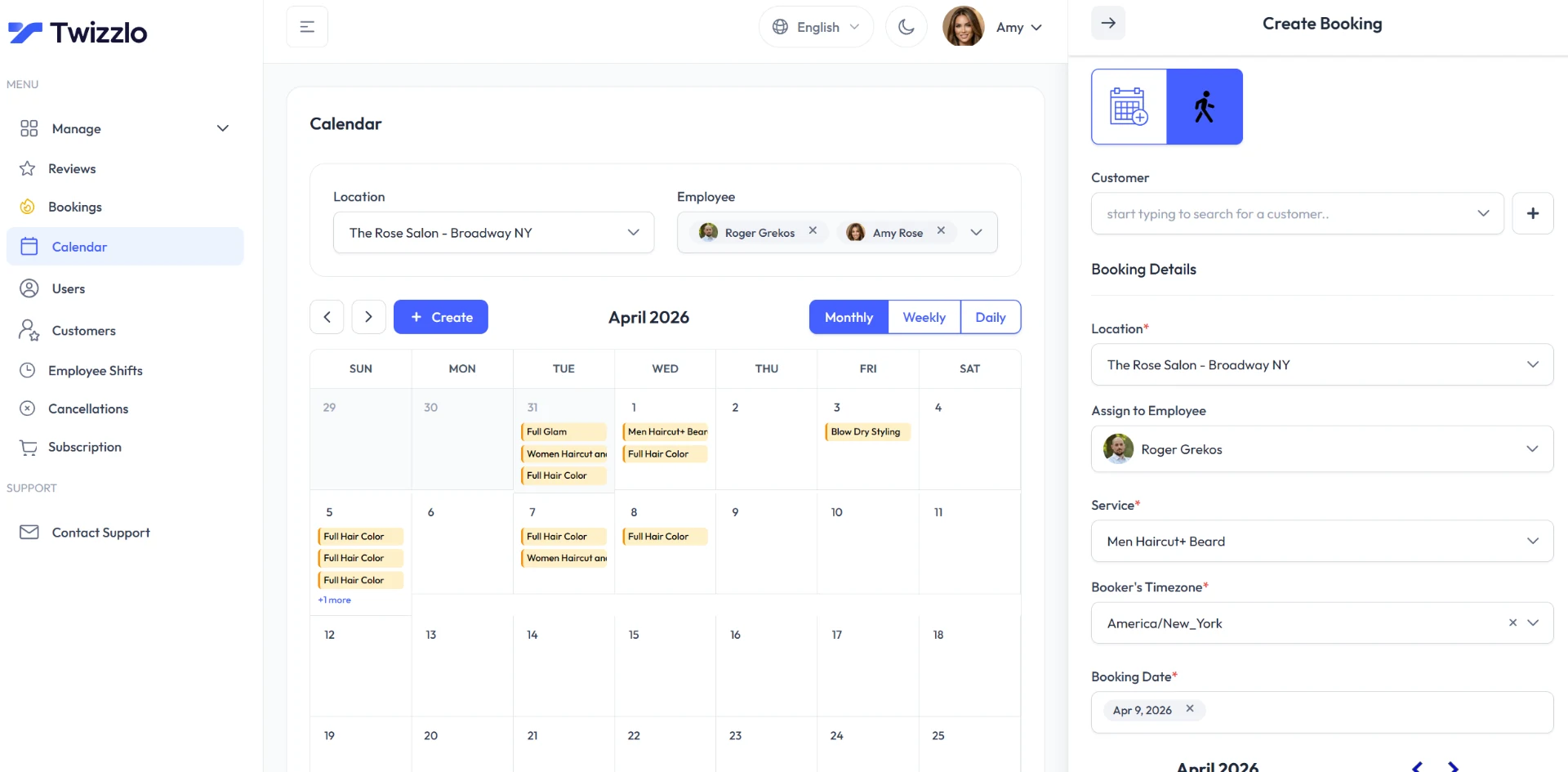
Twizzlo's /features/ page does not list a portfolio or gallery tool, so keep your work in the book and on your own site or Instagram, and link your booking page from there.
Worked example (hypothetical): an apprentice cleared for supervised client work tattoos two clients a day, three days a week. Over four weeks that is 24 bookings (2 x 3 x 4 = 24). That is inside the Free plan's limit of 150 bookings a month, at $0, with email reminders and no text reminders, as Twizzlo pricing listed on November 15, 2026.
A studio is a different sum. Four artists, each taking three bookings a day for 22 days, make 264 bookings (4 x 3 x 22 = 264). That is over the Free limit, so the studio runs on Business Pro at $29.99 a month per business. One text reminder per booking means 214 texts beyond the 50 included, at $0.03 each, or $6.42, for $36.41 a month before payment fees.
Staff and locations are unlimited on both plans. Online payments carry Stripe's processing rate plus a 1.5% Twizzlo platform fee; on a $200 prepaid session, the platform fee is $3.00 before Stripe's rate.
Weighing other tools for a studio? Our booking software comparisons list them side by side. When your first clients are ready to book, start on the Free plan.
Frequently asked questions
How many drawings do you need for a tattoo apprenticeship portfolio?
There is no agreed number. Of 15 guides read November 15, 2026, 10 give a range, from 10 to 20 pieces at the low end to 50 to 100 at the high end. Several add that a short book of strong work beats a long one padded with weaker pieces.
Do you need tattoo experience to make a tattoo apprenticeship portfolio?
No. Tommy's Supplies' guide, read November 15, 2026, says most studios that take apprentices look for drawing ability, not existing tattoo knowledge. Alchemy Tattoo Collective, a studio, tells applicants to leave out tattoos they have done. Florida's health department says apprentices who tattoo people during training need a Florida license; other states set their own rules.
Should a tattoo apprenticeship portfolio be physical or digital?
Most guides say both. Eleven of the 15 guides read November 15, 2026, advise a physical book, and 12 advise an online version. Tattooing 101 says applicants need a physical copy when they approach a shop, while InkMentor says to build the online portfolio first.
Can you use digital art in a tattoo apprenticeship portfolio?
Yes, alongside work on paper. The Broken Puppet Book's guide, read November 15, 2026, calls an all-digital book a major red flag and prefers about 70 percent physical artwork. Certified Tattoo Studios advises showing both kinds, and Apprentice's guide says to skip digital-only work unless hand-drawn pieces are included too.
What size should a tattoo apprenticeship portfolio book be?
Two guides name A4. Tattooing 101 and Painful Pleasures, in guides read November 15, 2026, each describe an A4 black hardcover folder with plastic sleeves. The Broken Puppet Book suggests A3 or A2, which leaves room to group several pieces together.
Sources and methodology
Prices read
- Florida Department of Health, Tattoo Artist Licensure (opens in a new tab)Read . Supports: a Florida license is required for students or apprentices who tattoo other humans as part of their tattoo training (disagreement section, takeaway 2, FAQ 2)
- Pixpa, How to Create a Tattoo Apprenticeship Portfolio (named without a link)Read . Supports: 50 to 100 complete and colored pieces; advice counted (Tables 1 and 3, Figures 1 and 2)
- Format, How to Create a Tattoo Apprenticeship Portfolio (named without a link)Read . Supports: 50 to 100 of your best tattoo designs; advice counted (Tables 1 and 3, Figures 1 and 2)
- TattooNOW, How to Build your Apprenticeship Portfolio (named without a link)Read . Supports: 15 to 25 pieces; flash sheets; strongest pieces first; feedback; discussing the work (Tables 1 to 3, steps, showing section)
- Tommy's Supplies, How to Build a Tattoo Portfolio That Gets You Hired or Booked (named without a link)Read . Supports: studios teach tattooing, not drawing; 10 to 20 pieces; drawing ability over tattoo knowledge (definition section, Tables 1 and 3, FAQ 2)
- InkMentor, Apprenticeship Advice: What Tattoo Artists Look For in a Portfolio (named without a link)Read . Supports: online portfolio first; art-only account; showing the book in person; no total to aim for (Tables 1 and 5, steps, showing section, FAQ 3)
- Certified Tattoo Academy, Tattoo Apprenticeship Portfolio: What to Include to Get Noticed in 2025 (named without a link)Read . Supports: 10 to 15 line drawings; five to six colored pieces; under 30 pages; strongest first; PDF or private Instagram (Tables 1 and 2, count section, steps)
- Alchemy Tattoo Collective, 5 Portfolio Tips To Get A Tattoo Apprenticeship (named without a link)Read . Supports: not a sketchbook; flash has a shape of its own; leave out tattoos you have done; move on to the next shop (Tables 1 and 5, include section, showing section, FAQ 2)
- Painful Pleasures, Creating Your Tattoo Portfolio (named without a link)Read . Supports: at least 50 to 100 completed pieces; no incomplete artwork; A4 black hardcover; lettering in a mix of styles (Tables 1 to 3, steps, FAQ 5)
- Prints4sure, Tattoo Portfolio Mastery (named without a link)Read . Supports: 50 to 100 polished designs; advice counted (Tables 1 and 3, Figures 1 and 2)
- Tattoo Studio Pro, Tattoo Apprentice Portfolio: What Studios Actually Want to See (named without a link)Read . Supports: 15 to 25 tattoo pieces plus 10 to 15 other; weakest pieces; practice skin photos; studio research (Tables 1 to 3 and 5, include section)
- GlossGenius, How To Make a Tattoo Portfolio and Grow Your Career (named without a link)Read . Supports: share sketchbook pages; no piece count (Tables 1 and 5, count section)
- Tattooing 101, How to Start a Tattoo Portfolio (named without a link)Read . Supports: physical copy needed; A4 black folder; 100 percent done; one piece a page; ten designs over 50; when to visit (Tables 1 and 5, include section, steps, showing section, FAQ 3 and 5)
- Certified Tattoo Studios, How to Put Together a Portfolio for Tattoo Apprenticeships (named without a link)Read . Supports: 50 to 100 solid pieces; both digital and hand-drawn work; life drawing studies (Tables 1 to 3 and 5, FAQ 4)
- Apprentice, How to Build a Tattoo Artist Portfolio (Apprentice to Pro) (named without a link)Read . Supports: 20 to 50 strong pieces; shading studies; skip digital-only work (Tables 1 to 3, FAQ 4)
- The Broken Puppet Book, How to Build a Tattoo Apprenticeship Portfolio (named without a link)Read . Supports: 40 to 50 strong pieces, 20 the minimum; six months for about 50; 70 percent physical; no AI; A3 or A2; contact details; research the studio (definition section, Tables 1, 3, 4 and 5, steps, FAQ 4 and 5)
- Twizzlo, tattoo booking software for artists and studios (opens in a new tab)Read . Supports: clients book consults and sessions from one link (intro bridge)
- Twizzlo, features (opens in a new tab)Read . Supports: staff profiles and a calendar view per staff member; no portfolio or gallery tool listed (Twizzlo section, Figure 3)
- Twizzlo, pricing (opens in a new tab)Read . Supports: Free $0 for up to 150 bookings with no SMS; Business Pro $29.99 a month per business, 50 SMS then $0.03 each; unlimited staff and locations; 1.5% platform fee (Twizzlo section)
From our editorial policy
- We do not publish invented quotes, studies, statistics, customer stories or product tests, and we do not imply hands-on use of a product when the research came from the vendor's public documentation.
- To report an error, email support@twizzlo.com with the subject line "Correction: [page URL]". Tell us what is wrong and, if you can, link a source.
Start free, upgrade when you grow
Flat-rate booking software. No per-seat, per-chair or per-location fees.
- Free plan up to 150 bookings a month, not a trial
- Business Pro is $29.99 a month per business for unlimited bookings, with a 30-day money-back guarantee
- 24/7 support by email