
Spa Business Plan: A Day Spa Template With Real Numbers

In short
A spa business plan should prove your rooms can pay for staff, rent and debt. Our hypothetical four-room day spa, using May 2025 federal wages and a $123.10 national ticket, breaks even near 43% room utilization. Copy the eight-section template below, then replace every example input with your own quotes.
- Therapist pay runs about $45.59 a treatment at median federal wages, assuming therapists stay busy for 80% of paid hours.
- Cutting the average ticket to $100 pushes the example's break-even to about 62% of available slots.
- In the example, paid time on a missed 75-minute slot costs about $36.47, so 30% covers it before card fees and about 31% after.
In this article12 sections
A spa business plan has one job: to show that your treatment rooms can pay for therapists, rent and debt before the cash runs out. This guide gives you a day spa template to copy and a worked four-room model built from federal wage data and industry figures.
If you are also planning how guests will book, our spa booking software page shows how each therapist gets a calendar with buffer times and how guests book online at any hour.
We read federal wage data, license pages from two states, the International SPA Association (ISPA) statistics and eight software vendors' pricing pages on October 30, 2026. We also read 11 top-ranking planning guides to see what they cover and what they leave out. We ran no spa and tested no product, and the model is hypothetical. Twizzlo, which publishes this guide, stays out of the tables and has its own section. This guide covers day spas; a medical spa adds clinical rules that it does not address.
What must a spa business plan prove to a lender?
A spa business plan must prove that enough treatments will sell, at a high enough ticket, to cover pay, rent and debt. The U.S. Small Business Administration (SBA) says lenders and investors commonly request a traditional plan, the detailed format with standard sections.
Room utilization is the share of available treatment slots you sell, and it ties a plan's sections together. The spa software vendor Zenoti says in its 'Spa Business Planning' guide, read October 30, 2026, that spas generally need 65% to 70% or more to reach profitability. Among the guides we read, Upmetrics alone works utilization: its two-room sample breaks even at about 45% to 50%. OGS Capital's sample plan shows a break-even in units, and the rest describe what to include without working one.
Public benchmarks are thin. Spa Business reported in December 2014 that the UK Spa Association's first data showed 41% treatment room utilization and 81% therapist utilization. That figure is old and British, and we found no public U.S. benchmark. So the model below tests a range instead of assuming one figure.
Copy this day spa plan, section by section
Copy the eight sections below into your own document and replace every bracket. The eight sections are executive summary, concept and treatment menu, market and competition, location and licenses, team and pay, operations and guest policies, marketing and launch, and financial plan. Sentences that start with a verb are instructions, so replace those with your own text too. This is a copy-and-paste template, not a file, and the numbers in the later sections show how to fill in section 8. Write the executive summary last, once the numbers are settled. If you also run hair services, our salon business plan template covers that side.
1. Executive summary
[Spa name] is a [number]-room day spa in [city] offering [massage, facials, body treatments] to [target guest]. We are seeking $[amount] to fund [build-out, equipment and reserve]. At [percent] room utilization and a $[amount] average ticket, we expect to break even in month [number].
2. Concept and treatment menu
Our mission is [one sentence]. Guests choose us for [reason]. List each treatment with its minutes, price, therapist type and supply cost, then state the average ticket you expect. If you plan retail, memberships or packages, give each its own revenue line, so a lender can see the treatment business without them.
3. Market and competition
Our guests are [age, income, distance from the spa]. The U.S. has [number] spa locations and [number] visits a year (ISPA), and we expect [number] visits a year. Name five nearby competitors with the price of a 60-minute massage at each.
4. Location, rooms and licenses
We will lease [square feet] at [address], with [number] treatment rooms. List your zoning status, your build-out quote, every state and local license with its fee, and who holds each one. Show that the lease term covers the loan term.
5. Team and pay
We will hire [number] massage therapists, [number] skincare specialists and [number] front desk staff. State how you pay them (hourly, commission or both), who manages the schedule and who checks each license.
6. Operations and guest policies
We open [days] from [time] to [time], with [minutes] between treatments for room turnover. Write out your deposit and cancellation policy, your laundry and supply routine, and the software line for booking and payments.
7. Marketing and launch
Before opening we will [claim our Google Business Profile, take bookings, run an opening offer]. After opening we will [channels and monthly budget]. Send marketing texts and emails only to guests who opted in.
8. Financial plan
Include the startup budget, a monthly profit and loss forecast, a cash flow forecast, the break-even point and the funding request. Use the capacity, pay and break-even tables below as your working model, and state the source of every input.
How many treatments can four rooms sell?
Four rooms open nine hours a day, 26 days a month, can sell 728 treatments at 75 minutes a slot. Each slot is a 60-minute treatment plus 15 minutes to turn the room, which leaves seven slots per room per day.
| Input | Value | Source |
|---|---|---|
| Treatment rooms | 4 | Example |
| Open hours | 9 a day, 26 days a month | Example |
| Slot length | 75 minutes (60 treatment, 15 turnover) | Example |
| Available slots | 728 a month (4 x 7 x 26) | Calculated |
| Average ticket | $123.10 | ISPA 2025 revenue per spa visit |
| Therapists busy | 80% of paid hours | Example, near the 2014 UK figure |
| Payroll load | 10% on top of wages | Example |
| Supplies | 6% of ticket | Example |
| Card processing | 2.6% + 15 cents a ticket | Example, near the top of Table 7 |
Table 1. Capacity and unit inputs for a hypothetical four-room day spa. ISPA read October 30, 2026. Replace each example with your own figure.
The $123.10 ticket is ISPA's 2025 revenue per spa visit, a national figure across its whole count of spas. It is revenue per visit, not a day spa's service price, so it is the input to replace first: build your own ticket from your menu. We treat one visit as one booked slot, which is a simplification.
For an industry check, ISPA reports 22,060 U.S. spa locations and 191 million visits in 2025, which works out to about 8,658 visits a location. The example at 55% utilization sells 4,800 treatments a year, which is below that average, as you would expect from a small single site.
What should the plan budget for therapists?
Budget about $45.59 of therapist pay per treatment, using median federal wages read October 30, 2026, and assuming therapists stay busy for 80% of paid hours. Pay is the largest cost per treatment in the example.
| Role | Median hourly wage | Mean hourly wage | Median annual wage |
|---|---|---|---|
| Massage therapists | $28.10 | $30.69 | $58,450 |
| Skincare specialists | $21.79 | $24.93 | $45,330 |
| Receptionists and information clerks | $18.27 | $18.97 | $38,010 |
Table 2. U.S. wages for May 2025 from the Bureau of Labor Statistics (BLS), read October 30, 2026, through its public data series for massage therapists, skincare specialists and receptionists. National figures; local pay differs.
The example staffs three massage therapists for every skincare specialist, which blends the medians to $26.52 an hour. A 75-minute slot at 80% busy time means 1.5625 paid hours, and a 10% payroll load brings that to $45.59. At 55% utilization that comes to 625 paid hours a month. BLS says part-time work is common for massage therapists, so six bookable providers at about 104 hours each is a realistic way to staff it.
Commission changes the shape of the cost. Zenoti's guide says therapist pay typically combines base pay with commission, and that 30% to 50% of service revenue is common. Our test uses commission alone: at 40%, a therapist earns $49.24 on a $123.10 ticket. The 10% payroll load brings that to $54.16, which leaves the owner $68.94 before supplies and card fees. Idle hours cost you less, but your pay line rises with every price increase.
Tips sit outside this model. Under the federal Fair Labor Standards Act, an employer taking a tip credit must pay at least $2.13 an hour in cash wages, and tips must bring the total to at least $7.25. Where state law differs, the rule most protective of the employee applies, so check your state before you plan on a credit.
At what room utilization does a day spa break even?
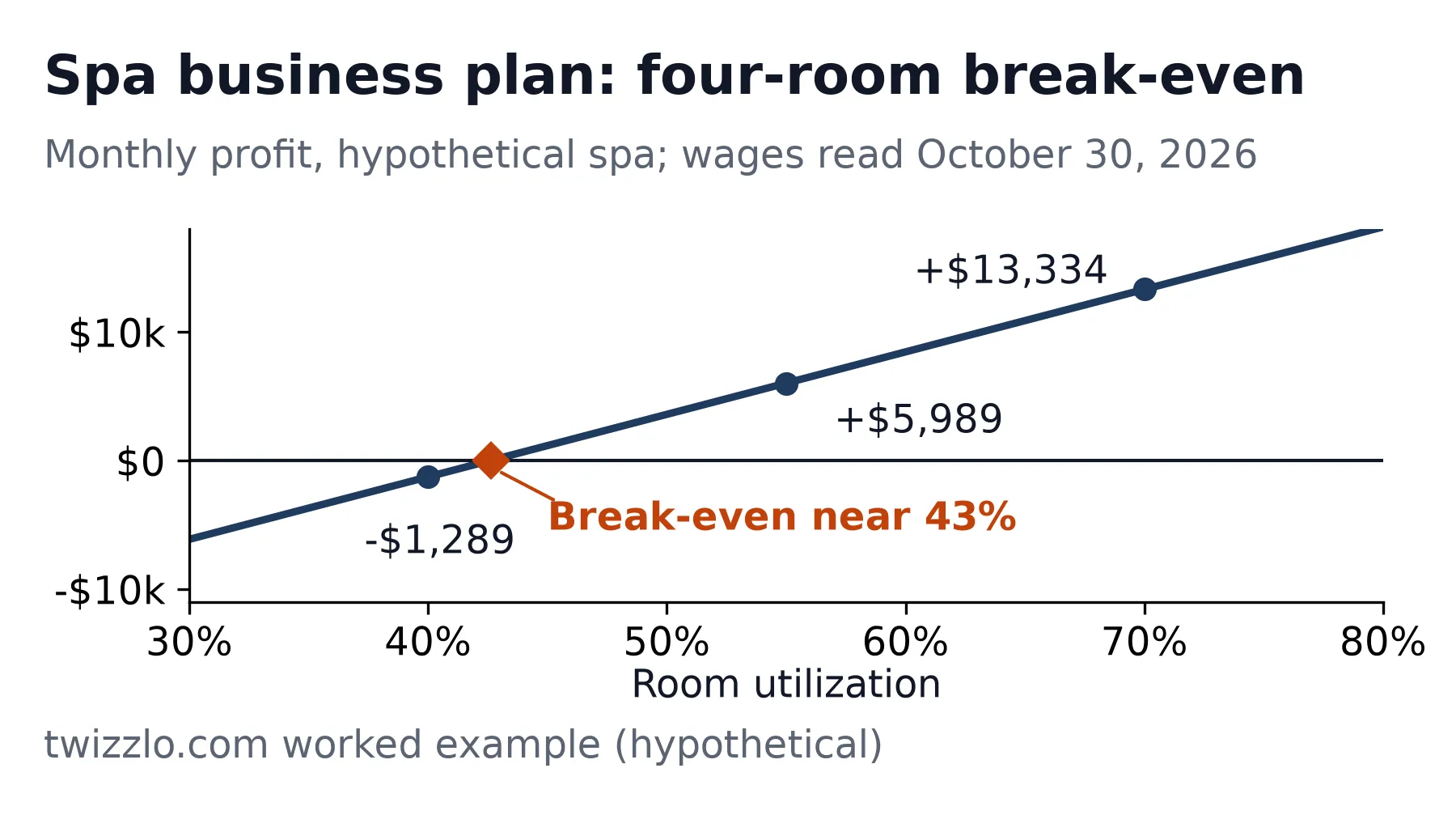
The hypothetical spa breaks even at 311 treatments a month, about 43% room utilization, at ISPA's national $123.10 ticket read October 30, 2026. Each treatment leaves $66.77 after variable costs ($123.10 less $45.59 pay, $7.39 supplies and $3.35 card fees), and fixed costs total $20,718.95 a month.
| Fixed cost | Monthly | Basis |
|---|---|---|
| Rent | $4,500.00 | Example, use your lease quote |
| Front desk pay | $4,702.70 | 234 hours x $18.27 BLS median, plus 10% load |
| Owner pay | $6,000.00 | Example |
| Loan payment | $2,066.25 | Example: $150,000 at 11% over 10 years |
| Insurance | $500.00 | Example, use your quote |
| Utilities and laundry | $1,200.00 | Example |
| Software | $150.00 | Example, see Table 7 |
| Marketing | $1,000.00 | Example |
| Accounting and other | $600.00 | Example |
| Total | $20,718.95 | Calculated |
Table 3. Monthly fixed costs for the hypothetical spa. BLS median read October 30, 2026; every other figure is an example input.
| Room utilization | Treatments | Revenue | Therapist pay | Supplies and card | Fixed costs | Monthly profit |
|---|---|---|---|---|---|---|
| 40% | 291 | $35,822.10 | $13,266.69 | $3,125.34 | $20,718.95 | -$1,288.88 |
| 55% | 400 | $49,240.00 | $18,236.00 | $4,296.00 | $20,718.95 | $5,989.05 |
| 70% | 510 | $62,781.00 | $23,250.90 | $5,477.40 | $20,718.95 | $13,333.75 |
Table 4. Monthly results for the hypothetical spa at three utilization levels, from the inputs in Tables 1 to 3. Wages and the ISPA ticket read October 30, 2026. Profit is after owner pay and the loan payment.
Plan your reserve the same way. If utilization starts at 20% and climbs four points a month, the example loses money for six months, and those losses total about $36,778. That figure belongs in the funding request as working capital.
Which inputs move break-even the most?
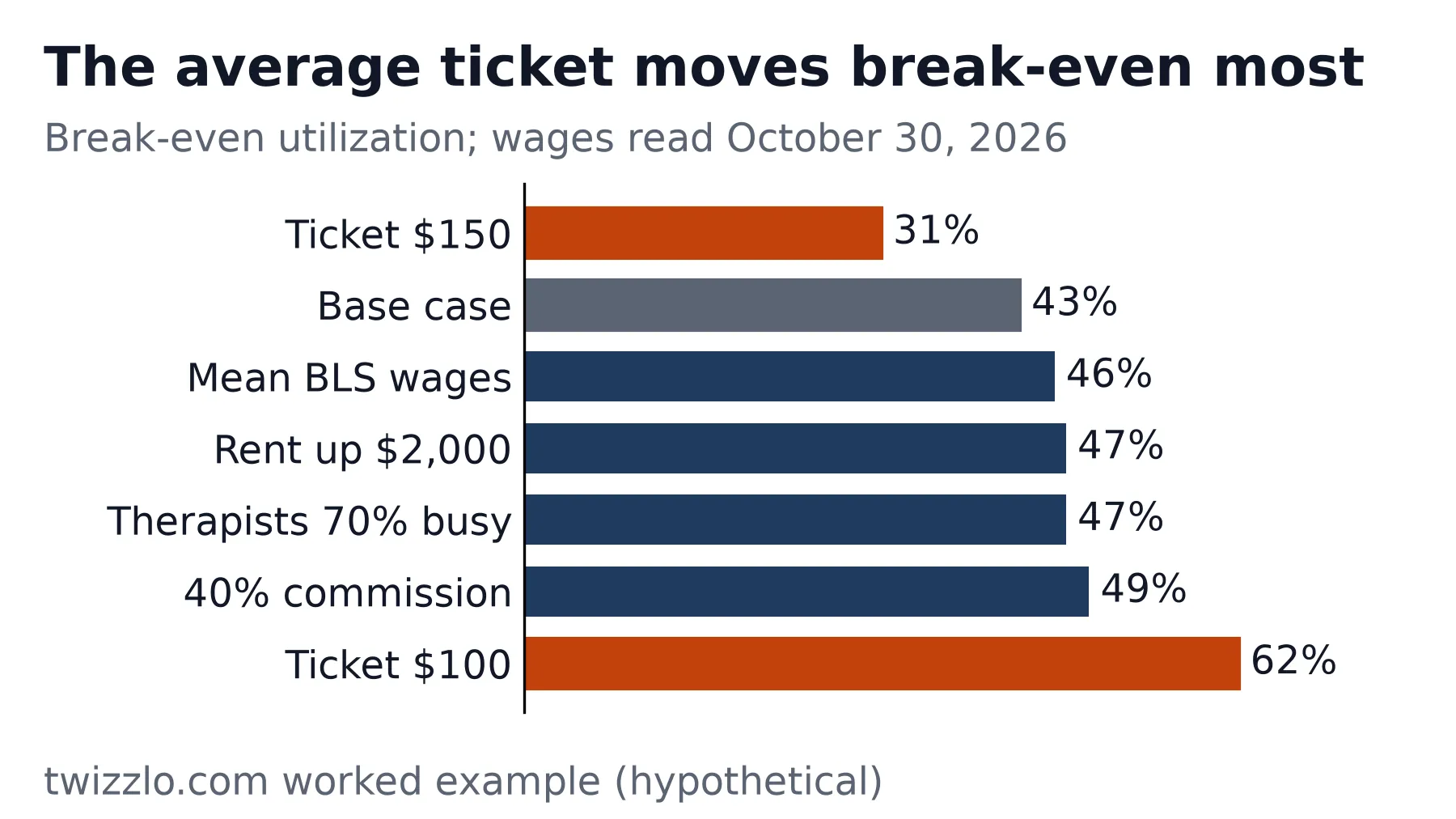
The average ticket moves break-even more than any other input we tested: $100 pushes it to about 62% of slots, and $150 pulls it to about 31%.
| Change from the base case | Break-even utilization |
|---|---|
| Base case | 43% |
| Average ticket $150 | 31% |
| Average ticket $100 | 62% |
| Mean BLS wages instead of median | 46% |
| Therapists busy 70% of paid hours | 47% |
| Rent up $2,000 a month | 47% |
| 40% commission alone instead of hourly pay | 49% |
Table 5. Break-even utilization with one input changed at a time, hypothetical four-room spa. The commission test carries the 10% payroll load ($54.16 a treatment). Wages read October 30, 2026.
Zenoti's profitability range sits close to the $100 ticket result, and well above our base case. Neither is a rule. Run your own menu, rent and pay through the same steps, and show the lender both your base case and your worst case.
How much should a spa deposit be?
In our hypothetical spa, using wages read October 30, 2026, a deposit of about 30% of the ticket covers a missed visit's paid time before card fees, and about 31% covers it after them. In this model, 75 minutes of blended pay plus the 10% load costs $36.47, less than the $45.59 per treatment because it leaves out idle paid time.
| Deposit share | Deposit on $123.10 | Card fee | Left after card fee | Covers paid time? | Left after paid time |
|---|---|---|---|---|---|
| 25% | $30.78 | $0.95 | $29.83 | No | -$6.64 |
| 30% | $36.93 | $1.11 | $35.82 | No | -$0.65 |
| 31% | $38.16 | $1.14 | $37.02 | Yes | $0.55 |
| 50% | $61.55 | $1.75 | $59.80 | Yes | $23.33 |
| 100% | $123.10 | $3.35 | $119.75 | Yes | $83.28 |
Table 6. Deposit sizes against $36.47 of paid time on one missed 75-minute slot, after the Table 1 card fee, hypothetical spa. Before card fees, 30% clears paid time by 46 cents. Wages read October 30, 2026.
Put the cost in the plan too. If 3% of 400 monthly bookings were missed, an example rate and not a benchmark, that is 12 slots, $1,477.20 of revenue and $437.64 of paid time. You can adapt this policy for section 6. It is a sample, not legal advice, so check your state's rules:
- Booking: A deposit of [percent] holds your treatment and counts toward the final price.
- Changes: Give us [number] hours' notice and your deposit moves to a new date.
- Missed visits: If you miss your treatment or give less notice, you lose the deposit.
- Exceptions: We waive this for [illness, emergencies] at the manager's discretion.
Our guide to setting a no-show charge covers how to word and apply a fee.
What does the software line cost?
On October 30, 2026, the plans in Table 7 ran from $49 to $325 a month for six bookable providers. Card fees on $49,240 of monthly sales came to more than $1,200 at every vendor we could price, using Boulevard's starting rate, so the plan price is the smaller line. Judge the two together.
| Vendor and plan | Monthly plan price | Listed in-person rate | Card cost at 400 tickets | Plan plus card |
|---|---|---|---|---|
| Square Appointments Plus | $49 per location | 2.5% + 15 cents | $1,291.00 | $1,340.00 |
| Square Appointments Premium | $149 per location | 2.4% + 15 cents | $1,241.76 | $1,390.76 |
| Vagaro | $73.99 at six calendars ($23.99 a month, a limited-time rate, plus $10 per added calendar, up to seven licenses) | 2.29% + 19 cents above $4,000 a month in card sales, plus a $10 monthly Large Merchant fee | $1,213.60 | $1,287.59 |
| GlossGenius Gold | $56 ($48 billed annually), up to 9 staff | 2.4% + 15 cents | $1,241.76 | $1,297.76 |
| Mangomint | $190 ($120 per location plus $10 per user, anyone with a profile; six providers plus one front desk user) | 2.45% + 15 cents | $1,266.38 | $1,456.38 |
| Boulevard Premier | $325 ($293 billed annually) | Starting at 2.65%, or as low as 1% with Boulevard Offset; per-ticket fee not stated; not labeled in-person | $1,304.86 at 2.65% | $1,629.86 at 2.65% |
| Mindbody | Starting at $79 USD/month per location (North America and Asia) | Rate not listed; $0.10 to $0.30 per transaction | Not stated | Not stated |
Table 7. Prices as listed on each vendor's page, read October 30, 2026; Square's and Vagaro's figures come from their U.S. pages, and the rest are shown as listed to a Canadian connection. Card cost uses the example month: 400 tickets, $49,240, all in person. Vagaro's cost excludes the Fixed Acquirer Network Fee (FANF, $2.00 at one to three locations, $2.90 for high-volume industries) and the $1.25 Mastercard location fee it lists. Vagaro lists deposits and cancellation fees for online appointments under its $10-a-month Online Shopping Cart add-on, which would bring its plan price to $83.99 and its total to $1,297.59. GlossGenius's rate is as read October 30, 2026; on September 27, 2026, its page showed a flat 2.6%, and our older pages may still show that. Re-read each page before you finalize the plan.
Square Appointments Premium adds resource management, which assigns rooms to services, but its lower rate does not pay for itself: the extra $100 a month takes $100,000 in monthly card sales to recover. Square Appointments also lists a Free plan at $0, but cancellation and no-show fees start on Plus. Read the same day, Boulevard's fall offer lists Premier at $260 for new customers, and its Essentials plan, $159 a month, stops at five providers. Zenoti's pricing page, read that day, lists no price and asks you to get a quote, so it is not in the table. Fresha's pricing page showed only Canadian dollars to our Toronto connection that day, so it is left out too.
For the full vendor detail, see Square Appointments pricing, Vagaro pricing, GlossGenius pricing and Mindbody pricing. Our guide to spa software for small business covers when rooms need their own schedule, and our spa POS system guide covers card costs. Our roundup of the best spa management software compares the larger platforms.
What do licenses and startup costs add?
State licenses are a small line: on October 30, 2026, Texas listed $200 and Florida $255 for a massage establishment, while third-party startup estimates ran from $75,000 to $400,000.
In Texas, the Department of Licensing and Regulation lists a non-refundable $200 application fee for a massage establishment license, valid for two years, and a $200 renewal. In Florida, the Board of Massage Therapy lists $255 in total: a $50 application fee, a $100 licensing fee, a $100 inspection fee and a $5 unlicensed activity fee. Florida also says you may not operate until the license is issued. Rules differ elsewhere. BLS says most states regulate massage therapy, and it tells skincare specialists to contact their state board.
The startup estimates disagree, so build yours from quotes. Zenoti's guide is inconsistent: it puts a modest three-room day spa at $75,000 to $150,000 in startup capital, yet says a 2,000-square-foot three-room spa might cost $200,000 to $400,000 to build out. Sharp Sheets, which sells financial models, puts a new day spa at $203,000 to $328,000.
Zenoti's sizing rule gives a way to test them: 120 to 150 square feet a room, plus 20% to 30% for shared space, makes 576 to 780 square feet for four rooms. At its $100 to $300 per square foot, plus at least 15% contingency, build-out alone runs about $66,240 to $269,100. That space is far smaller than the guide's own 2,000-square-foot example, so treat the result as a low-end test. The $150,000 loan in Table 3 is a placeholder inside that range, not a recommendation.
Where Twizzlo fits
Twizzlo is web-based online booking and appointment scheduling software for appointment-based service businesses, and in this plan it would fill the booking part of the software line in section 6.
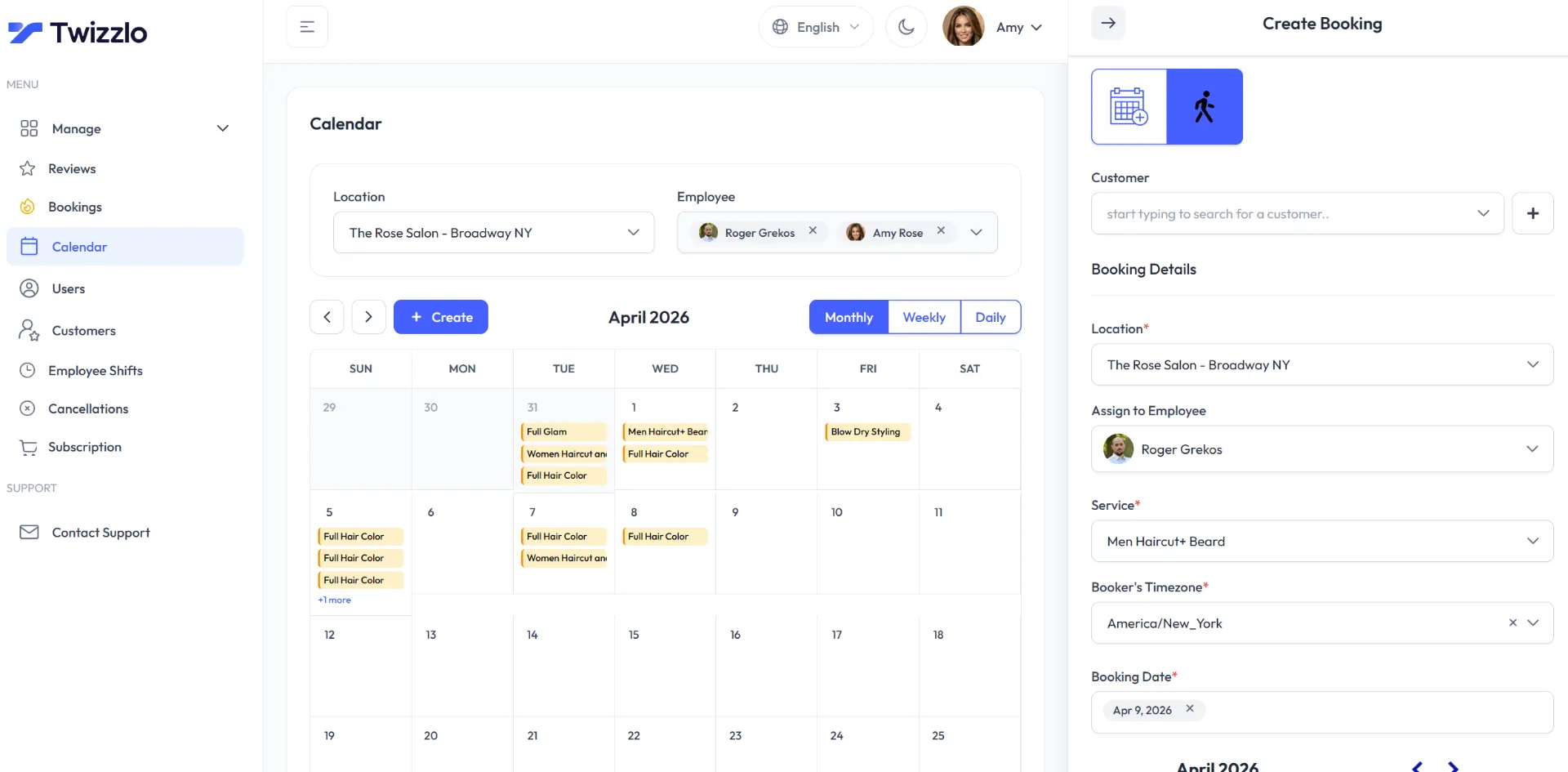
At 55% utilization the example takes 400 bookings a month, past the Free plan's limit of 150 bookings a month, which equals about 21% of the example's 728 slots. So the model points to Business Pro, $29.99 a month per business for unlimited bookings. It includes 50 SMS a month, then $0.03 each, so one text per booking adds 350 texts, or $10.50, for $40.49 a month. A spa with up to 150 bookings a month can use Free at $0 a month, which sends email reminders and no SMS. See Twizzlo pricing for the current plans.
Both plans include unlimited staff and locations. Online payments carry Stripe processing plus a 1.5% platform fee, so a $123.10 prepaid booking adds $1.85 before Stripe's own charge. Twizzlo's insights also show staff availability and utilization, so you can see where the schedule has room once you open.
Twizzlo's prepaid bookings charge the full service price, so a spa that wants a partial deposit like those in Table 6 needs a tool that takes one. Twizzlo's /features/ page does not list room or resource scheduling, and it does not list memberships, packages or gift cards. A spa that plans around those features should choose a platform that lists them. If per-therapist calendars and prepaid bookings fit your plan, you can start on the Free plan.
Frequently asked questions
How much does it cost to open a day spa?
Third-party estimates read October 30, 2026, disagree. Zenoti's guide gives $75,000 to $150,000 for a modest three-room spa, but its own build-out example for a 2,000-square-foot three-room spa reaches $200,000 to $400,000. Sharp Sheets gives $203,000 to $328,000 for a new day spa. Get quotes for your own space, since rent, build-out and equipment decide the total.
What room utilization should a spa business plan assume?
Test a range rather than one figure. Our hypothetical four-room spa breaks even near 43% of slots, Zenoti's guide, read October 30, 2026, says 65% to 70% or more, and the UK Spa Association reported 41% in 2014. Show a lender a base case and a worst case.
Is a spa a profitable business?
It can be, but that depends on ticket, rent and how full the rooms are. Our example earned $5,989 a month at 55% utilization and lost $1,289 at 40%, after owner pay and a loan payment. Those are hypothetical results, not an industry average.
What wage should a spa business plan use?
Start with BLS data, then adjust for your area. Read October 30, 2026, the May 2025 median was $28.10 an hour for massage therapists and $21.79 for skincare specialists. Add payroll costs, and check local job listings before you settle on a figure.
Should a day spa charge a deposit?
A deposit protects paid time on long treatments. In our model, with wages read October 30, 2026, about 31% of a $123.10 ticket covers the therapist's pay for a missed 75-minute slot after card fees. State the amount, the notice period and what happens to the money, and check your state's rules.
Can I use this spa business plan template for a med spa?
No. This template covers day spas with massage and skincare services. A medical spa adds clinical licensing and oversight rules that it does not address, so use a guide written for that business and take advice from a qualified professional.
Sources and methodology
Prices read
- BLS Occupational Outlook: Massage Therapists (opens in a new tab)Read . Supports: May 2025 median pay, part-time work, state regulation
- BLS Occupational Outlook: Skincare Specialists (opens in a new tab)Read . Supports: May 2025 median pay, state licensing note
- BLS public data API: massage therapists, May 2025 (series OEUN000000000000031901108; mean in ...03, annual in ...13) (opens in a new tab)Read . Supports: median and mean hourly wage, annual median
- BLS public data API: skincare specialists, May 2025 (series OEUN000000000000039509408; mean in ...03, annual in ...13) (opens in a new tab)Read . Supports: median and mean hourly wage, annual median
- BLS public data API: receptionists and information clerks, May 2025 (series OEUN000000000000043417108; mean in ...03, annual in ...13) (opens in a new tab)Read . Supports: median and mean hourly wage, annual median
- ISPA 2026 Big Five statistics (opens in a new tab)Read . Supports: 2025 revenue per visit, visits and locations
- Spa Business, UK Spa Association first data, December 2014 (opens in a new tab)Read . Supports: 41% room and 81% therapist utilization, UK, 2014
- U.S. Small Business Administration: business plans (opens in a new tab)Read . Supports: traditional plan format
- U.S. Department of Labor Fact Sheet 15 (opens in a new tab)Read . Supports: federal tip credit and cash wage
- Texas TDLR: massage establishment license (opens in a new tab)Read . Supports: application fee and two-year term
- Texas TDLR: renew a massage establishment license (opens in a new tab)Read . Supports: renewal fee
- Florida Board of Massage Therapy: fees (opens in a new tab)Read . Supports: establishment fees
- Florida Board of Massage Therapy: licensed massage establishment (opens in a new tab)Read . Supports: no operation before license issue
- Square Appointments pricing (opens in a new tab)Read . Supports: Plus and Premium prices, rates, resource management
- Vagaro Plans, Pricing and Premium Features (opens in a new tab)Read . Supports: U.S. base price, calendar fee and Online Shopping Cart add-on
- Vagaro U.S. card processing rates (opens in a new tab)Read . Supports: Large Merchant rate, FANF and Mastercard location fees
- GlossGenius pricing (opens in a new tab)Read . Supports: Gold price and rate
- Mangomint pricing (opens in a new tab)Read . Supports: location and user prices, rate
- Boulevard pricing (opens in a new tab)Read . Supports: Essentials and Premier prices, rate
- Mindbody pricing (opens in a new tab)Read . Supports: starting price and per-transaction fixed fee
- Zenoti pricing (opens in a new tab)Read . Supports: no listed price; quote request
- Fresha pricing (opens in a new tab)Read . Supports: page shown in Canadian dollars from a Canadian connection; no figure used
From our editorial policy
- Our templates, such as consent forms, contracts and confirmation messages, are text to copy and adapt to your business. They are not legal advice. Have a qualified local professional review anything you rely on.
- We do not publish invented quotes, studies, statistics, customer stories or product tests, and we do not imply hands-on use of a product when the research came from the vendor's public documentation.
- To report an error, email support@twizzlo.com with the subject line "Correction: [page URL]". Tell us what is wrong and, if you can, link a source.
Start free, upgrade when you grow
Flat-rate booking software. No per-seat, per-chair or per-location fees.
- Free plan up to 150 bookings a month, not a trial
- Business Pro is $29.99 a month per business for unlimited bookings, with a 30-day money-back guarantee
- 24/7 support by email