
Marketing for Tattoo Artists: What 10 Guides Recommend and Which Rules Apply

In short
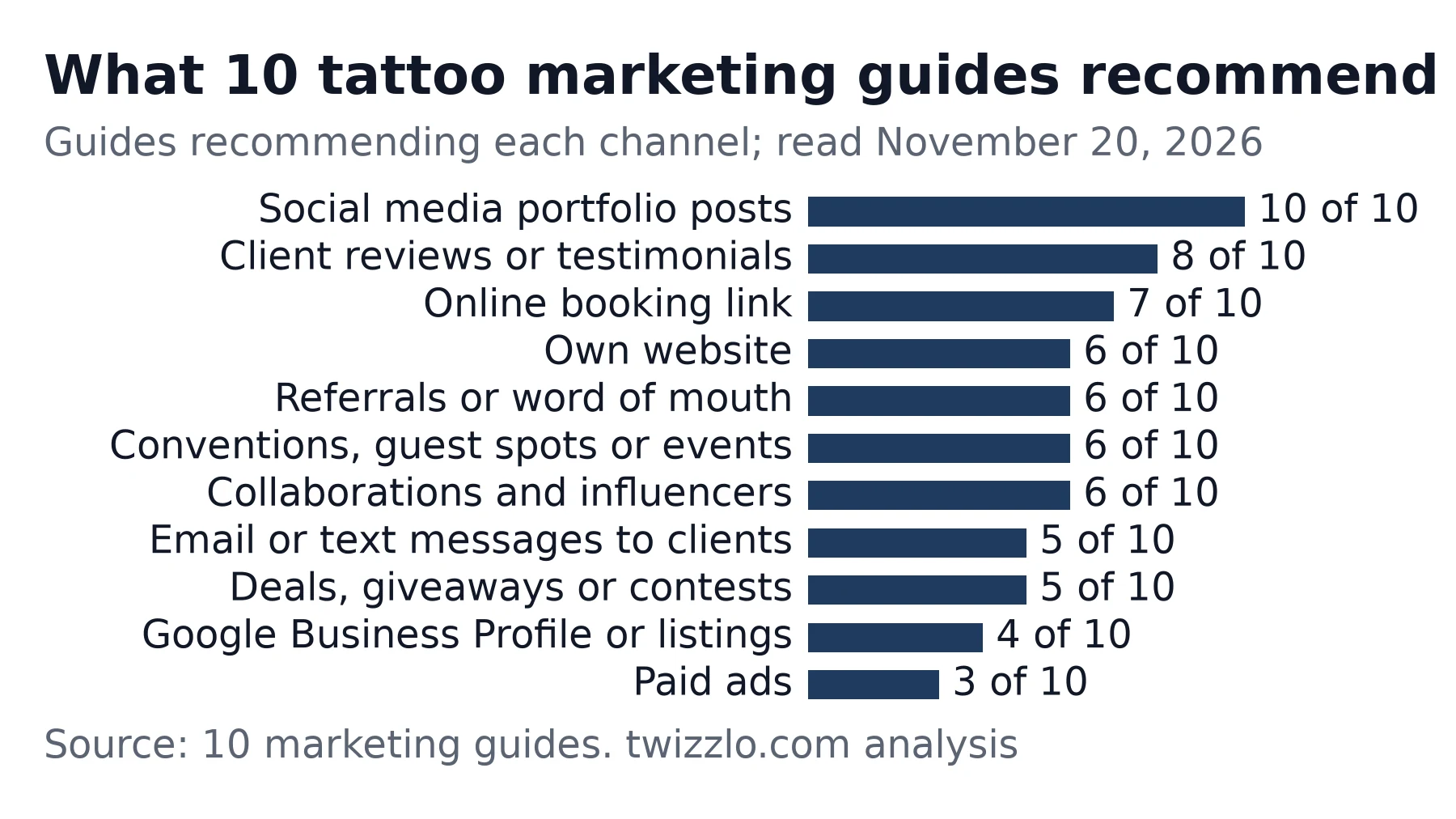
Marketing for tattoo artists starts with a portfolio feed, client reviews and a booking link. All 10 guides we read on November 20, 2026, recommend social media posts, eight recommend reviews or testimonials and seven online booking. Three recommend paid ads. Google's Maps contribution policy, read that day, bars rewards for reviews, so ask every client and offer nothing.
- Nine of the 10 guides we read on November 20, 2026, name Instagram as a place to post, and six recommend hashtags or location tags.
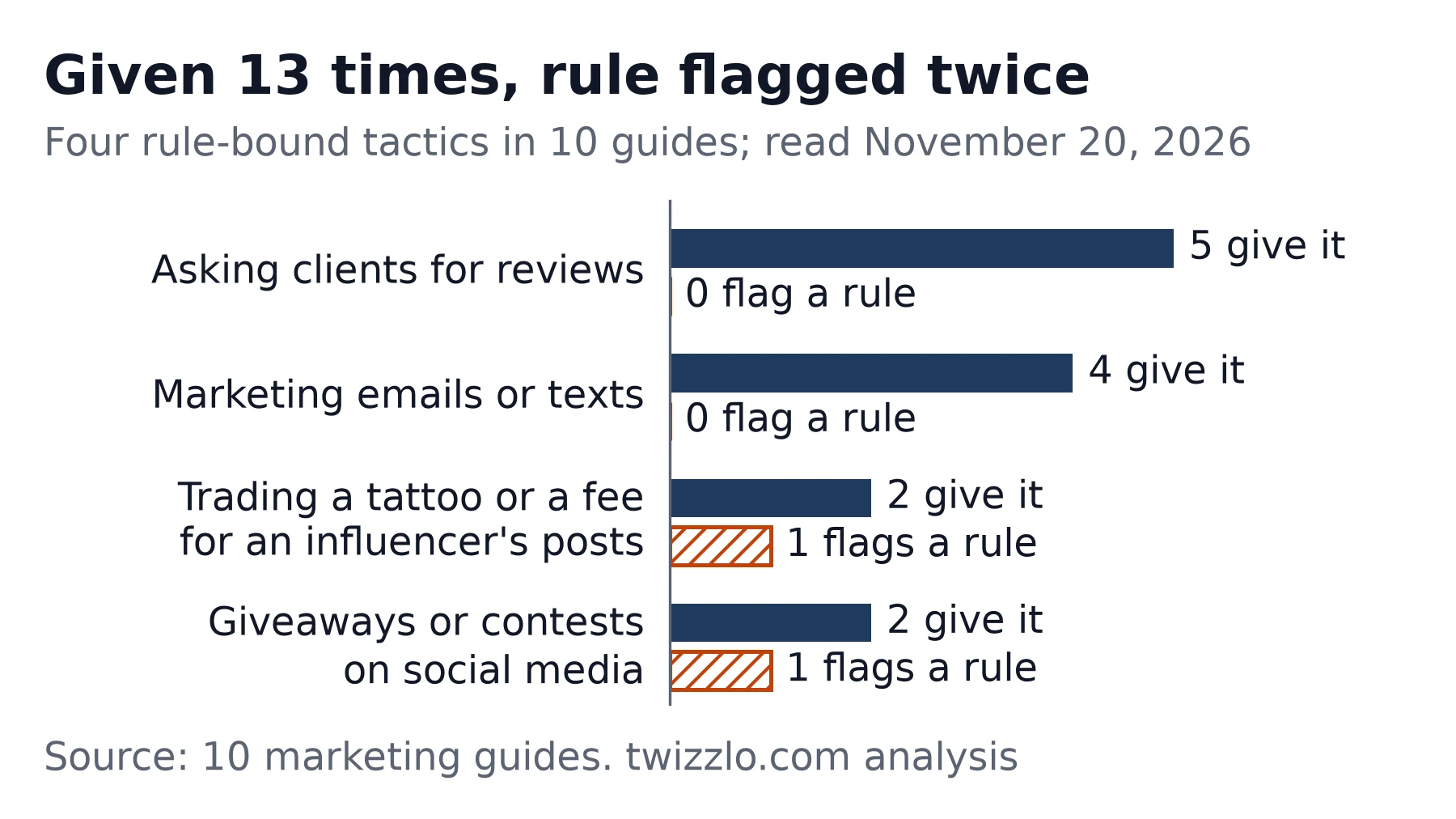
- The 10 guides gave rule-bound tactics 13 times and flagged a rule twice; none of the five that say to ask for reviews names one.
- Under U.S. federal rules read November 20, 2026, a client who replies stop to a marketing text revokes consent, and commercial emails need an opt-out.
In this article9 sections
Marketing for tattoo artists comes down to four jobs: show your work where clients look, get found by city, earn reviews and referrals, and make booking one tap. On November 20, 2026, we read 10 marketing guides and the official rules behind their advice.
The guides came from our searches that day for this topic and for social media and Instagram marketing. They are by Brandignity, Booksy, Micky Weis, Mangomint, Goldie, GoDaddy, Bookedin, Painful Pleasures and DaySmart Body Art, which has two. The oldest is dated 2017. A script matched each channel on the saved pages, and we read the matched passages before counting a guide. All nine publishers sell something to studios: software, websites, marketing services or supplies.
We left out two results that did not open as articles and three that are not guides: a software list and two agency sales pages. Some guides give percentages with no source named, and we repeat none of them. Health and aftercare content is outside this guide.
This guide is not legal advice. The platform policies and U.S. federal rules cited here change, so re-read the linked pages before you act.
Whichever channel brings a client, the next step is a booking link. Our tattoo booking software page shows how clients tap one link from your Instagram bio, pick a service and an artist, see open times and book.
What do guides on marketing for tattoo artists recommend?
Guides on marketing for tattoo artists agree most on social media portfolio posts, recommended by all 10 we read on November 20, 2026. Client reviews or testimonials come next with eight guides, then an online booking link with seven.
| Channel | Guides that recommend it (of 10) | What the guides tell you to do |
|---|---|---|
| Social media portfolio posts | 10 | Post finished pieces, process clips and flash where clients already look |
| Client reviews or testimonials | 8 | Ask for reviews, or share client reviews and testimonials on your site and feed |
| Online booking link | 7 | Put one booking link in your bio, on your site and on your Google listing |
| Own website | 6 | Keep a site with your portfolio, hours, prices and contact details |
| Referrals or word of mouth | 6 | Ask clients to refer friends; some suggest a referral discount or credit |
| Conventions, guest spots or events | 6 | Work conventions and guest spots, or host a charity or community event |
| Collaborations and influencers | 6 | Work with other artists, local businesses or local influencers |
| Email or text messages to clients | 5 | Email or text clients with news, offers or review links (send only to clients who opted in; see the rules section) |
| Deals, giveaways or contests | 5 | Run specials, first-visit offers, giveaways or contests |
| Google Business Profile or listings | 4 | Claim and fill in your Google listing; some add Yelp |
| Paid ads | 3 | Run Instagram or search ads aimed at people near you |
Table 1. Channels recommended by 10 tattoo marketing guides, by our count of pages read November 20, 2026. A guide counts when it tells the reader to use the channel, not when it only mentions it. The last column reports the guides' advice; the words in parentheses are ours.
Paid ads come last. Three guides recommend them, and Bookedin's guide sticks to tactics that need no ad spend.
Four guides also mention print: business cards, flyers, stickers or a printed QR code that opens the booking page.
Read the counts as agreement, not proof: a channel that many guides repeat is not shown to fill more chairs. Your own source log, covered below, decides what works for you.
Marketing is one of the seven parts of a tattoo shop business plan; its template has lines for your portfolio channels and how often you post.
What social media marketing for tattoo artists do the guides name most?
Social media marketing for tattoo artists means Instagram first: nine of the 10 guides we read on November 20, 2026, name it as a place to post. Seven recommend short video, six recommend hashtags or location tags, and five recommend Pinterest.
| Social media advice | Guides that give it (of 10) | Example from the guides |
|---|---|---|
| Names Instagram as a place to post | 9 | Post finished pieces, process shots and flash on a profile that works as your portfolio |
| Short video (Reels, TikTok or time-lapse clips) | 7 | Film a time-lapse of a session, or the stencil going on and then the finished piece |
| Hashtags or location tags | 6 | Tag your city or your studio's location on each post |
| 5 | Pin portfolio images so clients collecting ideas can find your style | |
| States how often to post | 4 | From at least a couple of times a week to three to five posts a week |
| Says to ask the client before posting their tattoo | 4 | Get permission before you photograph, post or tag a client |
Table 2. Social media advice in the same 10 guides, by our count of pages read November 20, 2026.
Three of the four guides that give a number land between two and five posts a week. Painful Pleasures' guide says at least a couple of times a week, Bookedin's says three to four, and DaySmart Body Art's says three to five. Booksy's sets a cadence for each format, including three to five short videos a week.
Bookedin's guide adds that a steady schedule beats a burst of posts followed by silence.
Four guides add a step the others leave out: ask the client before you post or tag their tattoo.
Flash gives you ready content between client pieces; our guide to tattoo flash sheets covers sheet sizes and what studios charge for flash.
How does Instagram marketing for tattoo artists turn followers into bookings?
Instagram marketing for tattoo artists turns followers into bookings when the profile says what you do, where you work and how to book, with a booking link in the bio.
- Use a business account. Painful Pleasures' guide says a business profile shows which days and times your posts do best.
- Pick a handle close to the name clients already call you, so they can find you.
- Write a bio that names your styles and your city or studio.
- Link the bio straight to your booking page. Bookedin's guide warns against a link that drops clients on a homepage where they must hunt for the schedule.
- Tag your location on every post and Reel, and put your city in the caption.
- Comment on and share other artists' work. Two of the guides say this brings shares, guest spot invitations and referrals back.
Instagram's own Help Center pages on business accounts and promotions did not load for us on November 20, 2026, so we state no Instagram rule here. Read Instagram's own rules for promotions before you run a giveaway.
Buying followers is no shortcut: a U.S. federal rule in the Code of Federal Regulations (CFR) covers it. Under 16 CFR 465.8, read November 20, 2026, that federal rule bars buying followers you know or should know are fake, such as bot-generated ones, when they materially misrepresent your influence for a commercial purpose.
An Instagram bio has no room for your policies, prices and hours. Our tattoo artist website checklist shows what 16 shop sites tell clients before they book.
How do tattoo artists show up on Google Search and Maps?
Tattoo artists show up on Google Search and Maps through a verified, complete Google Business Profile. Google says local results rest mainly on relevance, distance and popularity, on its local ranking help page read November 20, 2026.
That page lists four steps a studio controls: verify the business, keep its details and hours complete and accurate, reply to reviews, and add photos and videos. A fifth step is for retail stores.
Google adds that more reviews and positive ratings can help a local ranking, so the review habit in the next section does double duty.
Four of the 10 guides recommend a Google listing, half as many as recommend reviews or testimonials.
An artist who rents a booth or works under a studio's name should read Google's Business Profile guidelines before creating a separate profile. On the page read November 20, 2026, they define an individual practitioner as a public-facing professional who typically has their own customer base. Doctors, lawyers and real estate agents are among the examples; tattoo artists are not named.
The guidelines give a practitioner a profile of their own only if they work in a public-facing role and can be contacted directly at the verified location during stated hours.
Where a practitioner is one of several at a location, the guidelines say the organization creates its own profile, and the practitioner's profile carries the practitioner's name without the organization's. A practitioner who is the only public-facing one at a branded location is told it is best to share one profile with the organization, titled with the brand, a colon and the practitioner's name.
What rules apply to reviews, emails, texts, influencer posts and giveaways?
Platform policies and U.S. federal rules, including those of the Federal Trade Commission (FTC), cover four tactics the guides recommend: asking for reviews, marketing emails or texts, paid or gifted influencer posts, and giveaways. The guides gave these tactics 13 times and flagged a rule twice, on pages read November 20, 2026.
| Tactic | Guides that give it (of 10) | Of those, guides that flag a rule | Rule we read November 20, 2026 |
|---|---|---|---|
| Asking clients for reviews | 5 | 0 | Google's Maps contribution policy allows asking and bars rewards for reviews and selectively soliciting positive ones; the U.S. federal rule at 16 CFR 465.4 bars incentives conditioned on a review's sentiment |
| Marketing emails or texts | 4 | 0 | U.S. federal CAN-SPAM Act, per the FTC's guide: requirements include an accurate subject line, a postal address and an opt-out honored within 10 business days; U.S. federal rule 47 CFR 64.1200 on consent for autodialed advertising calls and on revoking consent to calls or texts |
| Trading a tattoo or a fee for an influencer's posts | 2 | 1 | U.S. federal: FTC staff's Endorsement Guides FAQ puts a clear disclosure of the connection on both the brand and the influencer |
| Giveaways or contests on social media | 2 | 1 | The platform's promotion rules; Instagram's page did not load for us, so none is stated here. On a Google Business Profile, Google's guidelines ask for a clear link to the terms |
Table 3. Rule-bound tactics in the 10 guides, by our count of pages read November 20, 2026, with the official page that covers each. A guide counts as flagging a rule when it tells the reader to disclose the deal or points to giveaway rules; neither guide names a law or a policy. The rows are narrower than Table 1's, so the counts are lower. A reading of public pages, not legal advice.
Reviews: ask every client and offer nothing
Ask every client for a review the same way, and offer nothing in return. Google's policy for Maps contributions, read November 20, 2026, allows a business to ask for reviews of a genuine experience. It bars offering "payment, discounts, free goods and/or services" for a review, and it bars a business that would "selectively solicit positive reviews from customers."
The same Google policy says a business should not pressure clients to leave a review while on the premises or ask for specific content.
Google's tips for getting reviews, read the same day, are plain: share a review link or a QR code, and reply to reviews. Google adds that negative reviews have value too, because a mix of feedback often feels more trustworthy.
Two of the 10 guides tie an ask to a happy or super-satisfied client: one for a testimonial, the other for a recommendation on Nextdoor. FTC staff's questions and answers on the U.S. federal reviews rule, read November 20, 2026, cover that habit for reviews. Asking only customers you think are happy is not specifically banned by that federal rule, FTC staff say, but it could violate the FTC Act.
U.S. federal law adds its own limit on paid praise. Under 16 CFR 465.4, read November 20, 2026, that federal rule says a business may not give compensation or other incentives conditioned on reviews that express a particular sentiment, positive or negative. Google's policy is wider and bars any reward for a review, so offer nothing.
Emails and texts: send only to clients who asked
Send marketing emails and texts only to clients who asked for them, and make stopping easy. That is our advice; the U.S. federal email law itself works by opt-out.
The FTC's CAN-SPAM guide, read November 20, 2026, lists the main requirements of that U.S. federal law for a commercial email. Under that federal law they include an accurate subject line, your valid physical postal address and a clear way to opt out, and an opt-out request must be honored within 10 business days.
Texts fall under a separate U.S. federal rule, 47 CFR 64.1200, read November 20, 2026. That federal rule requires prior express written consent before advertising calls are made with an autodialer to a cell phone. The federal rule's paragraph on revoking consent names text messages: a client who replies "stop" has revoked consent. The page carried a link to an amendment to that federal rule published October 26, 2026, which we did not read, so check the current text.
Four guides suggest marketing emails or texts, and none flags either rule. A fifth, Booksy's, suggests automated texts with a review link after each session. Send those only to clients who agreed to get texts from you.
Influencer posts: disclose the trade
Disclose any trade with an influencer in the post itself. FTC staff's Endorsement Guides FAQ, read November 20, 2026, explains how the FTC Act, a U.S. federal law, applies. The Act covers a recommendation when an advertiser pays the person or gives them something of value to mention a product. The FAQ puts the responsibility for a clear disclosure on both the influencer and the brand, not the platform.
The same federal FAQ accepts "Gifted by" plus the brand name when a free product is all the person received. Mangomint's guide is the one of the two that says to label the post as paid or gifted.
Giveaways: read the platform's rules first
Read the platform's promotion rules before you post a giveaway, and never make a review the entry ticket. Google's Maps contribution policy, read November 20, 2026, bars rewards for reviews. Two guides suggest giveaways; Goldie's points readers to a rules guide, and the other flags none.
If you announce one on your Google Business Profile, Google's Business Profile guidelines, read the same day, say a contest or giveaway should clearly link to its terms and give clear guidelines and qualifications.
How do you track which marketing brings bookings?
Track marketing by asking every new client one question at booking, "How did you find us?", and counting the answers each month.
| Source the client names | New clients (hypothetical month) | Share of new clients (hypothetical) |
|---|---|---|
| 5 | 42% | |
| Google Search or Maps | 3 | 25% |
| Referred by a client | 3 | 25% |
| Convention or guest spot | 1 | 8% |
| Total | 12 | 100% |
Table 4. A source log for one artist. Hypothetical month, not measured data: twizzlo.com worked example.
In that hypothetical month, Instagram and Google together bring eight of 12 new clients, so those two get next month's hours first. Booksy's guide makes the same point about budgets: compare channels by the bookings they bring, then move your effort. It also suggests checking whether site visitors come from organic search, Instagram bio links or convention QR codes.
Keep the log simple enough to fill in every time: one line per new client, written when the booking is made.
Where Twizzlo fits
Twizzlo is web-based online booking and appointment scheduling software for appointment-based service businesses; for a tattoo artist it is the booking link behind the marketing. Clients open it from your Instagram bio, your Google Business Profile or your website.
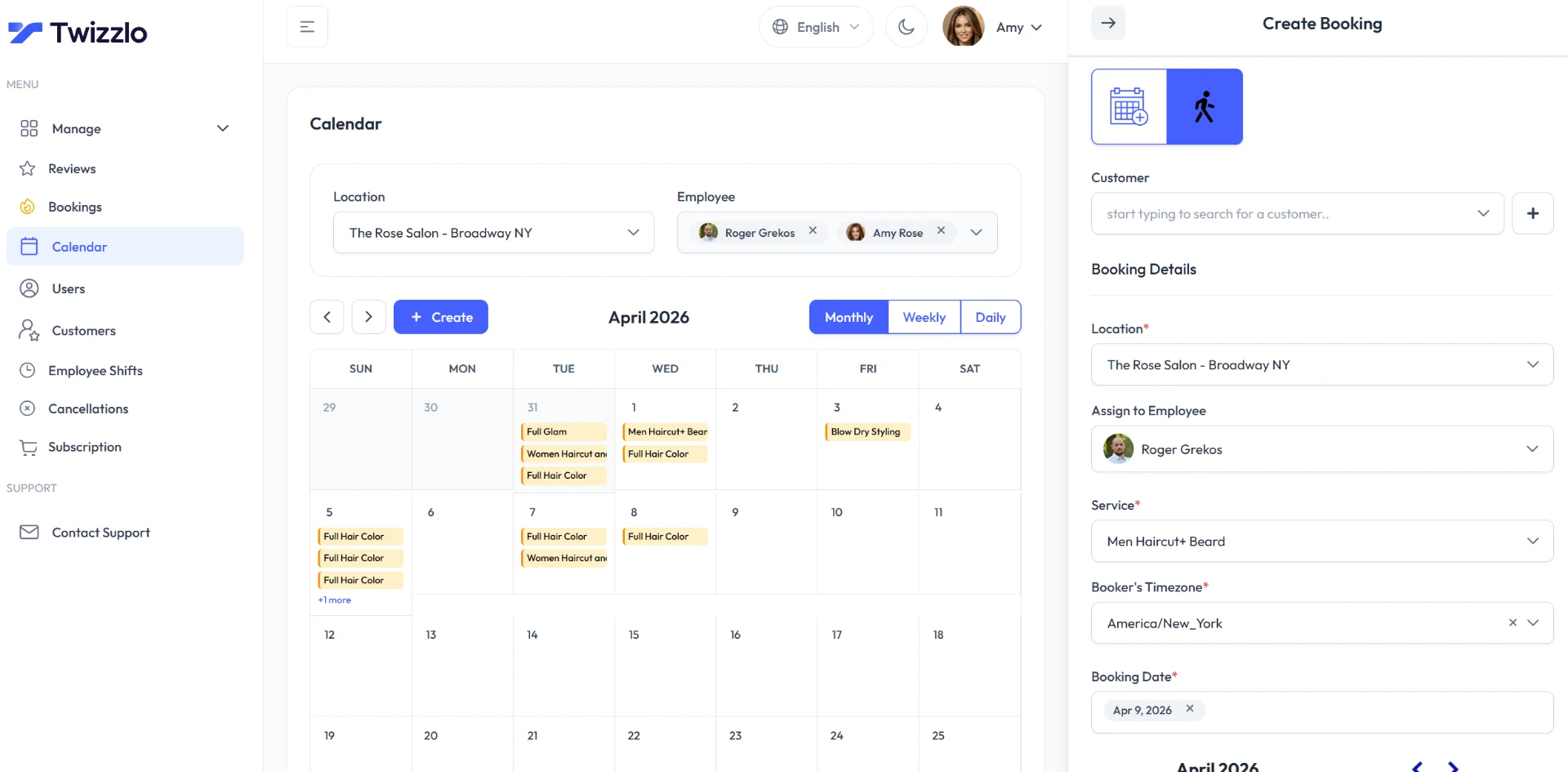
Twizzlo's /features/ page does not list marketing emails, review requests or a giveaway tool. Its texts are appointment reminders, sent on Business Pro.
Worked example (hypothetical): the artist in Table 4 already books 10 sessions and eight consults a week, 18 bookings. Over a year that averages 78 a month (18 x 52 / 12 = 78). If each of the 12 new clients books one consult and one session, the month holds 102 bookings (78 + 24 = 102). That is 48 under the Free plan's limit of 150, so Free covers it at $0, with email reminders.
Two artists at that pace reach 204 bookings a month (2 x 102 = 204), over the Free limit, so the studio needs Business Pro at $29.99 a month. With one reminder text per booking, our assumption, 50 texts are included and the other 154 cost $0.03 each, $4.62 in all, so the month comes to $34.61 before card fees. Staff and locations are unlimited on both plans.
Online card payments cost the studio its Stripe processing rate plus Twizzlo's 1.5% platform fee, whichever plan it uses. On a $200 session that the client pays in full at booking, the platform fee is $3.00. The Twizzlo pricing page has the current plan details.
A studio that wants marketing emails or review requests inside its booking tool should check each vendor's own feature list; our booking software comparisons set several tools side by side. To put one booking link behind your marketing, start on the Free plan.
Frequently asked questions
What is the best way to market yourself as a tattoo artist?
Start with the three channels marketing guides agree on most: a social media portfolio, client reviews and a booking link. Of the 10 guides we read on November 20, 2026, all recommend social media posts, eight reviews or testimonials, and seven online booking. Then add a Google Business Profile so nearby clients find you by city.
How often should a tattoo artist post on Instagram?
Two to five times a week, going by three of the four guides that gave a number when we read them on November 20, 2026. Painful Pleasures' guide sets a floor of a couple of posts a week, Bookedin's says three to four and DaySmart Body Art's three to five. Booksy's sets a cadence per format, with three to five short videos a week. A schedule you can keep matters more than volume, Bookedin's guide adds.
Can a tattoo shop offer a discount for a Google review?
No. Google's policy for Maps contributions, read November 20, 2026, bars offering payment, discounts or free goods or services in exchange for a review, and it bars selectively soliciting positive reviews. A shop may ask clients to review a genuine experience, and Google's tips page suggests sharing a review link or a QR code.
Do tattoo artists need a website if they have Instagram?
Most guides we read recommend one. Six of the 10 marketing guides we read on November 20, 2026, advise a website of your own for the portfolio, hours, prices and contact details that a short bio cannot hold. A site also gives search engines a page to show for your name and city.
Should a tattoo artist pay for ads?
Not first, going by most of the guides. Three of the 10 we read on November 20, 2026, recommend paid ads, the lowest count of the 11 channels. Mangomint's guide suggests them for when unpaid search and social posts are not bringing in enough new clients. Fill in your Google listing and post your work before you spend.
Sources and methodology
Prices read
- Google, Maps user-generated content policy: prohibited and restricted content (opens in a new tab)Read . Supports: asking for reviews of a genuine experience is allowed; incentives for reviews, selectively soliciting positive reviews and pressure to review on the premises are not (Quick Answer, Table 3, reviews and giveaways sections, FAQ 3)
- Google Business Profile Help, Tips to get more reviews (opens in a new tab)Read . Supports: review link or QR code, replying to reviews, valuing all reviews; no incentives for reviews (reviews section, FAQ 3)
- Google Business Profile Help, Tips to improve your local ranking on Google (opens in a new tab)Read . Supports: local results mainly based on relevance, distance and popularity; verify, complete information, reply to reviews, photos and videos; reviews can help local ranking (Google section)
- Google Business Profile Help, Guidelines for representing your business on Google (opens in a new tab)Read . Supports: definition of an individual practitioner and when one has a profile of their own; several practitioners at one location; the only practitioner at a branded location; promotions, contests and giveaways link to their terms (Google section, Table 3, giveaways section)
- 16 CFR part 465, Rule on the Use of Consumer Reviews and Testimonials (eCFR, up to date as of November 18, 2026) (opens in a new tab)Read . Supports: U.S. federal: section 465.4, no incentives conditioned on a review's sentiment; section 465.8, no buying of fake indicators of social media influence (Instagram section, Table 3, reviews section)
- Federal Trade Commission, The Consumer Reviews and Testimonials Rule: Questions and Answers (FTC staff answers) (opens in a new tab)Read . Supports: U.S. federal: asking only customers thought to be happy is not specifically prohibited by the rule but could violate the FTC Act; the rule itself does not bar incentives that are not tied to sentiment (reviews section)
- Federal Trade Commission, FTC's Endorsement Guides: What People Are Asking (opens in a new tab)Read . Supports: U.S. federal: something of value given for a mention; disclosure responsibility on the influencer and the brand; 'Gifted by' plus the brand name (Table 3, influencer section)
- Federal Trade Commission, CAN-SPAM Act: A Compliance Guide for Business (opens in a new tab)Read . Supports: U.S. federal: main requirements include an accurate subject line, a valid physical postal address and an opt-out explained and honored within 10 business days; the law works by opt-out (Table 3, emails and texts section, takeaway 3)
- 47 CFR 64.1200, Delivery restrictions (eCFR; the page carried a cross-reference to an amendment at 91 FR 67219, October 26, 2026, not read) (opens in a new tab)Read . Supports: U.S. federal: prior express written consent for autodialed advertising calls to cell phones; a reply of stop to a text revokes consent (Table 3, emails and texts section, takeaway 3)
- Brandignity, Marketing for Tattoo Artists: 10 Creative Ways to Build Your Brand (named without a link)Read . Supports: advice counted (Tables 1 to 3, Figures 1 and 2)
- Booksy, Tattoo Studio Marketing Guide: Client Acquisition, SEO & ROI Metrics (named without a link)Read . Supports: advice counted; a posting cadence per format with three to five short videos a week; automated review-link texts; compare channels by bookings and check where visitors come from (Tables 1 to 3, Figures 1 and 2, emails and texts section, tracking section, FAQ 2)
- Micky Weis, How to market a tattoo artist: Step-by-step guide (named without a link)Read . Supports: advice counted (Tables 1 to 3, Figures 1 and 2)
- Mangomint, 23 Tattoo shop marketing ideas to get new clients (named without a link)Read . Supports: advice counted; label an influencer post as paid or gifted; a recommendation ask on Nextdoor; paid ads when unpaid search and social fall short (Tables 1 to 3, Figures 1 and 2, reviews section, FAQ 5)
- DaySmart Body Art, How to Measure Your Tattoo Artist Marketing Strategy (named without a link)Read . Supports: advice counted; a testimonial ask; asking before photographing and posting (Tables 1 to 3, Figures 1 and 2, reviews section)
- Goldie, 11 Best Tattoo Shop Marketing Ideas In 2026 (named without a link)Read . Supports: advice counted; points to an Instagram giveaway rules guide (Tables 1 to 3, Figures 1 and 2)
- GoDaddy, 9 ways for a tattoo artist to get more clients (named without a link)Read . Supports: advice counted; dated 2017, the oldest of the 10 (Tables 1 to 3, Figures 1 and 2, method paragraph)
- Bookedin, Social Media for Tattoo Artists: Practical Tips & Content Ideas (named without a link)Read . Supports: advice counted; three to four posts a week on a steady schedule; bio link to the booking page; location tags; tactics with no ad spend (Tables 1 to 3, Instagram steps, FAQ 2)
- Painful Pleasures, A Tattoo Artist's Guide to Instagram: How to Promote Your Tattoo Business (named without a link)Read . Supports: advice counted; business account analytics; at least a couple of posts a week (Tables 1 to 3, Instagram steps, FAQ 2)
- DaySmart Body Art, Instagram Marketing Strategies for Tattoo Studios (named without a link)Read . Supports: advice counted; three to five posts a week (Tables 1 to 3, Figures 1 and 2, FAQ 2)
- Twizzlo, tattoo booking software for artists and studios (opens in a new tab)Read . Supports: clients tap one link, pick a service and an artist, see open times and book; the link goes in the Instagram bio, the Google Business Profile and the website (intro bridge, Twizzlo section)
- Twizzlo, features (opens in a new tab)Read . Supports: reminders by email, and by SMS on Business Pro; no marketing email, review request or giveaway tool listed (Twizzlo section, Figure 3)
- Twizzlo, pricing (opens in a new tab)Read . Supports: Free $0 for up to 150 bookings with no SMS; Business Pro $29.99 a month per business, 50 SMS then $0.03 each; unlimited staff and locations; 1.5% platform fee (Twizzlo section)
From our editorial policy
- We do not publish invented quotes, studies, statistics, customer stories or product tests, and we do not imply hands-on use of a product when the research came from the vendor's public documentation.
- To report an error, email support@twizzlo.com with the subject line "Correction: [page URL]". Tell us what is wrong and, if you can, link a source.
Start free, upgrade when you grow
Flat-rate booking software. No per-seat, per-chair or per-location fees.
- Free plan up to 150 bookings a month, not a trial
- Business Pro is $29.99 a month per business for unlimited bookings, with a 30-day money-back guarantee
- 24/7 support by email