
How to Price a Tattoo: Build Your Hourly Rate, Shop Minimum and Day Rate

In short
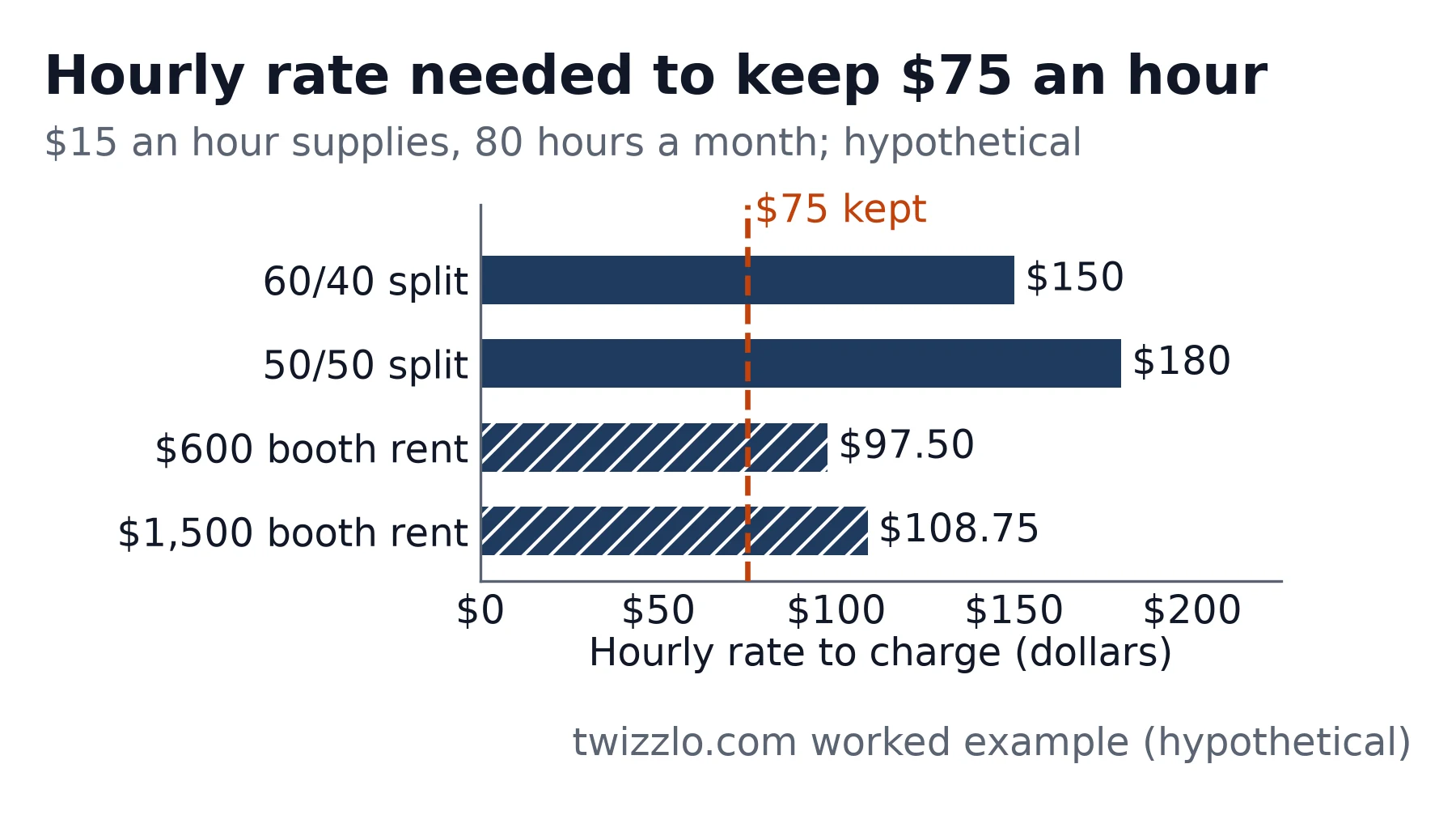
To price a tattoo, set an hourly rate that covers your costs, the shop's share or your booth rent, and the pay you want to keep. Then build a shop minimum, flat prices and a day rate from it. In our hypothetical example, keeping $75 an hour after $15 of supplies under a 60/40 split means charging $150.
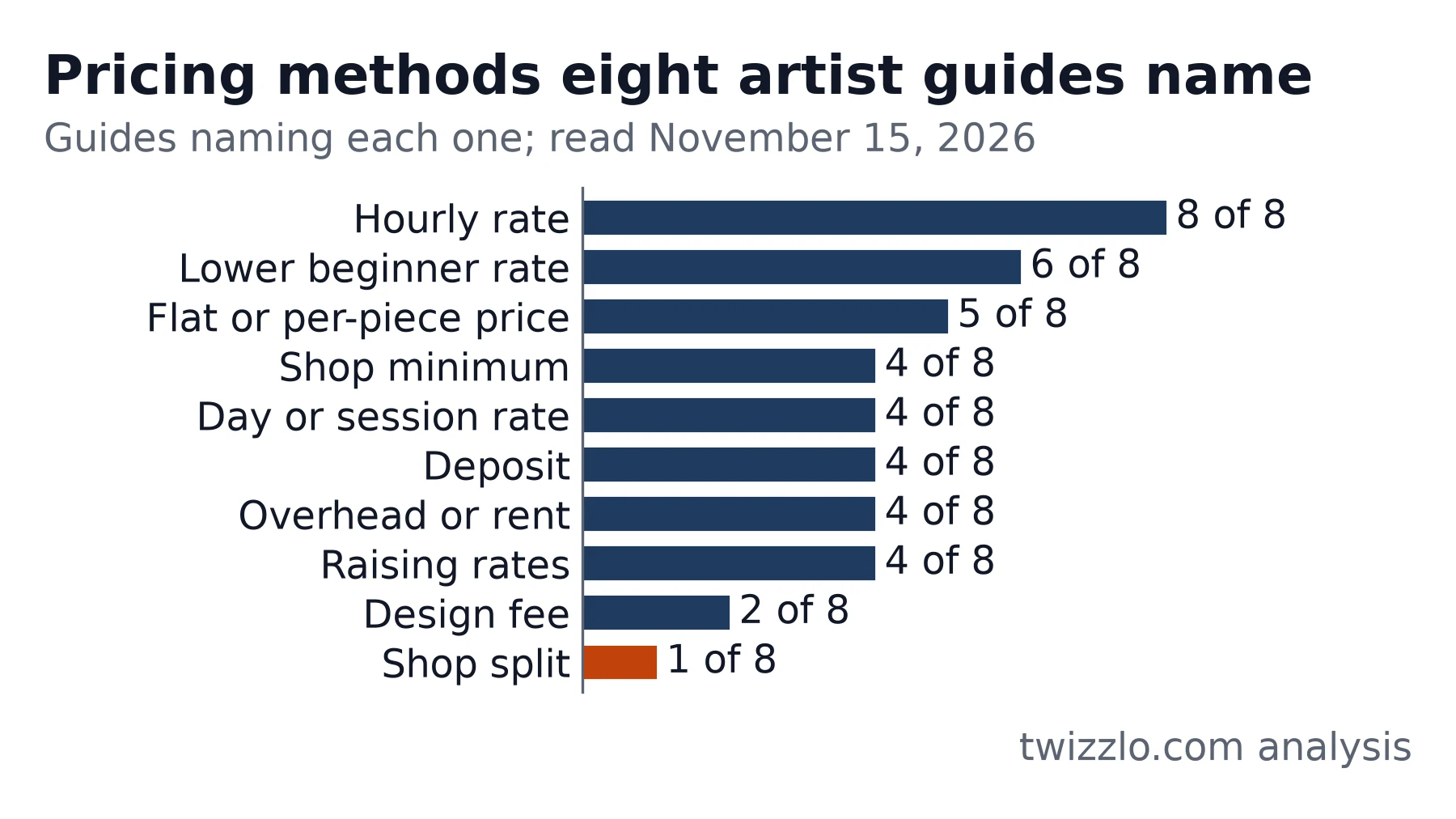
- All eight artist guides read November 15, 2026, name an hourly rate, four name a shop minimum and one names the shop's split.
- BookedIn's example, $40 of overhead plus $80 of pay with a 20% buffer, is $144 an hour when the buffer is added on top.
- Quote custom work as a narrow range, and state the deposit, the shop minimum and any design fee before the client books.
In this article9 sections
Working out how to price a tattoo comes down to one number, your hourly rate. Every other price follows from it: the shop minimum, the flat price for a small piece and the day rate for a big one. Set the rate too low and each of those prices is too low with it.
On November 15, 2026, we read eight guides that tell artists how to charge and counted the pricing methods each one names. The guides came from that day's search results for the question and its beginner variant. Two are from BookedIn, and one each comes from GlossGenius, Porter, Certified Tattoo Academy, Needle Supply and Ink Fanatic, with a post on DEV Community as the eighth. Needle Supply and Certified Tattoo Academy write for clients as well as artists.
The eight are company blogs, a tattoo school's site, a personal site and a community post, and are named without links. Client-side price guides from the same results, such as Tommy's Supplies and Painful Pleasures, are left out of the count because they tell clients what to expect, not artists what to charge. Every worked example below is hypothetical and says so, and the guides' figures are their own estimates, so check a guide again before you rely on one of its numbers.
Once your rates are set, each one becomes a service clients can book. Our tattoo booking software page shows how a consult, a session and a touch-up each get their own length and price, and clients pick the one they need from your booking link.
Which pricing methods do tattoo artists use?
Tattoo artists price by the hour, by the piece or by the day, with a shop minimum under all three. All eight guides name an hourly rate, five name a flat or per-piece price, four name a shop minimum and four name a day or session rate.
The methods fit different jobs. BookedIn's pricing guide describes a common setup: a shop minimum for small pieces, an hourly rate for mid-sized work and a day rate for big projects. Its second guide adds who carries the risk when a session runs long. On an hourly rate the client pays for the extra time, and on a flat price the artist absorbs it.
The count also shows what the guides skip. GlossGenius is the one guide of the eight that names the shop's split, yet the split decides how much of any price a commission artist keeps. Four guides name overhead or rent as part of the rate.
| Method or price element | Guides naming it | Guides that do not name it |
|---|---|---|
| Hourly rate | 8 of 8 | None |
| A lower rate for beginners or apprentices | 6 of 8 | BookedIn (hourly vs. flat), DEV Community post |
| Flat or per-piece price | 5 of 8 | Certified Tattoo Academy, Ink Fanatic, DEV Community post |
| Shop minimum | 4 of 8 | Porter, Certified Tattoo Academy, Ink Fanatic, DEV Community post |
| Day or session rate | 4 of 8 | GlossGenius, Certified Tattoo Academy, Needle Supply, Ink Fanatic |
| Deposit | 4 of 8 | BookedIn (hourly vs. flat), GlossGenius, Certified Tattoo Academy, Ink Fanatic |
| Overhead or rent in the rate | 4 of 8 | BookedIn (hourly vs. flat), Certified Tattoo Academy, Ink Fanatic, DEV Community post |
| Raising rates over time | 4 of 8 | BookedIn (hourly vs. flat), Certified Tattoo Academy, Needle Supply, DEV Community post |
| Design fee | 2 of 8 | All but BookedIn (pricing) and Certified Tattoo Academy |
| Shop split or percentage | 1 of 8 | All but GlossGenius |
Table 1. Methods and price elements named in the article text of eight artist guides, counted by script on pages read November 15, 2026. The eight are BookedIn's pricing guide, BookedIn's hourly and flat-rate guide, GlossGenius, Porter, Certified Tattoo Academy, Needle Supply, Ink Fanatic and a DEV Community post. A guide counts when its article text names the method at least once; sign-up banners and product feature lists are not counted, and a mention is not a recommendation.
What hourly rates and minimums do the guides suggest?
Four guides read November 15, 2026, put a new artist at $80 to $150 an hour, and three give $150 to $250 for an experienced one. Three list shop minimums, which run from $60 to $150.
Table 2 sets the figures side by side. They are estimates, not survey data, and they differ by market. BookedIn's hourly guide calls its own dollar figures rough illustrations, not benchmarks. Ink Fanatic's guide makes the practical point: walk into several studios in your area and find out what they charge. Rates that studios publish on their own sites are compared in our guide to how much do tattoos cost, and price-by-size charts for clients are left to that guide.
| Guide | New or beginner artist, per hour | Experienced artist, per hour | Shop minimum | Day rate |
|---|---|---|---|---|
| BookedIn (two guides) | Not stated | $150 to $250 | $80 to $150 | $800 to $2,000 or more, for six to eight hours; some studios $1,500 to $2,500 a session for large work |
| GlossGenius | $80; apprentices typically half the experienced rate | Up to $500 for famous artists | $60 to $100 | Not stated |
| Porter | $100 to $150 | $150 to $250 | Not stated | $2,000 in a sample client message |
| Certified Tattoo Academy | $80 to $120; $80 to $100 as a new artist | $120 to $180 at mid-level | Not stated | Not stated |
| Needle Supply | $80 to $150 | $150 to $250 | $80 to $150 | Not stated |
| Ink Fanatic | $50 to $300 for a one-hour session, all artists | Same range | Not stated | Not stated |
Table 2. Hourly rates, shop minimums and day rates as seven of the eight guides give them, read November 15, 2026; BookedIn's two guides share a row. They are the guides' own estimates, and '$' is as each page lists it.
How to calculate tattoo price from your costs
To calculate a tattoo price from your costs, add your hourly costs to the pay you want to keep, then divide by your share of the price if the shop takes a split.
BookedIn calls this the cost-plus framework. Its example, read November 15, 2026, has $40 an hour of overhead, $80 an hour of take-home pay and a 20% buffer for taxes and downtime, and BookedIn puts the result at around $150. The figure depends on how the buffer is read. Adding 20% to the $120 of costs and pay gives $144, and treating $120 as the 80% left after the buffer gives $150.
GlossGenius ties the rate to rent in the same way. In its example, read November 15, 2026, an artist renting a studio for $1,500 a month might charge $100 an hour, and one paying $3,000 might charge $200.
Neither example includes a split. GlossGenius describes a 60/40 split, in which the artist keeps 60% and the studio takes 40%, and says artists on a split can charge higher rates to make up for it. The steps below show how much higher.
- Count your tattooing hours in a month, not your hours in the shop. BookedIn's guide notes that consults, design work, messages, prep and cleanup are time you do not bill for directly.
- Add up your own costs for each tattooing hour: supplies, plus booth rent divided by those hours if you rent.
- Add the pay you want to keep for each tattooing hour, before tax.
- On a split, divide that total by your share of the price: 0.60 for a 60/40 split, 0.50 for a 50/50 split.
- Add a buffer for slow weeks and unpaid time if you want one, as BookedIn's example does.
Table 3 runs those steps for one hypothetical artist who wants to keep $75 for each tattooing hour, spends $15 an hour on supplies and tattoos 80 hours a month. At that pace $75 an hour is $6,000 a month before tax. Under a 60/40 split the rate is $150: the artist's 60% share is $90, and supplies take $15 of it, which leaves $75. Under a 50/50 split the same pay needs $180. A booth renter paying $600 a month spreads the rent over 80 hours, which is $7.50 an hour, and needs $97.50.
| Arrangement | Shop's share or rent, per hour | Hourly rate to charge | Left after the shop's share or rent, before supplies | Artist keeps, after $15 of supplies | Rate with a 20% buffer |
|---|---|---|---|---|---|
| 60/40 split (artist keeps 60%) | $60.00 | $150.00 | $90.00 | $75.00 | $180.00 |
| 50/50 split | $90.00 | $180.00 | $90.00 | $75.00 | $216.00 |
| Booth rent of $600 a month | $7.50 | $97.50 | $90.00 | $75.00 | $117.00 |
| Booth rent of $1,500 a month | $18.75 | $108.75 | $90.00 | $75.00 | $130.50 |
Table 3. Worked example (hypothetical): the hourly rate one artist needs in order to keep $75 per tattooing hour before tax, with $15 an hour of supplies and 80 tattooing hours a month. The 60/40 split is the one GlossGenius names, read November 15, 2026; the 50/50 split and both rents are hypothetical inputs. The last column multiplies the rate by 1.20.
Change an input and the answer moves. At 40 tattooing hours a month, the $600 rent is $15 an hour and the renter's rate rises to $105. If a 50/50 shop supplies the disposables, the $15 drops out of the sum and the rate falls from $180 to $150. Which split applies, and what the shop provides under it, is covered in our guide to tattoo artist salary.
The buffer has a tax side too. Under federal rules, the self-employment tax rate is 15.3%: 12.4% for Social Security and 2.9% for Medicare. That is the federal rate on the Internal Revenue Service (IRS) page on self-employment tax, reviewed October 30, 2026, and read November 15, 2026. Whether that tax applies depends on how an artist is classed, and nothing here is tax advice.
How to turn an hourly rate into a shop minimum, flat prices and a day rate
Multiply the hourly rate by the tattooing hours each kind of job takes, with a one-hour floor for small pieces, and you have a shop minimum, flat prices and a day rate.
A shop minimum is the least you charge for any tattoo, however small. BookedIn's pricing guide, read November 15, 2026, describes a minimum that covers anything up to a time threshold, usually the first hour, and uses $150 as its example. The floor exists because a small tattoo takes more of the day than its needle time. In a hypothetical case, a 15-minute tattoo with 45 minutes of consult, setup, stencil and cleanup fills an hour, and the one-hour floor at a $150 rate makes the minimum $150.
A flat price is one number agreed before the session, and it follows from a time estimate. A flash design you have already drawn is the easiest piece to time, which is why a flat price suits it; our guide to tattoo flash sheets covers how artists price and sell sheets. For custom work, estimate a low and a high number of hours and price both ends.
Size, placement, detail and color change a price through the hours they add. BookedIn's pricing guide notes that ribs, hands and feet are slower to work on, so a small rib piece can take longer than a bigger one on a forearm. Put those factors into the time estimate and the rate does the rest. The DEV Community post takes the other route and adds a modifier for placement and detail on top of the hourly floor.
A day rate is the hourly rate for the tattooing hours in a full session. BookedIn puts the full session at six to eight hours and suggests a half-day option for smaller large-scale work. Table 4 prices each of these from a $150 rate and shows the artist's 60% share beside the full price.
| Price type | Tattooing hours counted | Full price | Artist's share (60%) | Shop's share (40%) |
|---|---|---|---|---|
| Shop minimum, up to the first hour | 1 | $150 | $90 | $60 |
| Flat price, two-hour flash piece | 2 | $300 | $180 | $120 |
| Custom piece, low end of the range | 3 | $450 | $270 | $180 |
| Custom piece, high end of the range | 4 | $600 | $360 | $240 |
| Half day | 3 | $450 | $270 | $180 |
| Day rate | 6 | $900 | $540 | $360 |
Table 4. Worked example (hypothetical): prices built from a $150 hourly rate, with the artist's share under a 60/40 split beside the full price, before supplies and tax. The hours are hypothetical.
BookedIn's tiered framework adds one refinement. A base rate covers line work, small flash and simple lettering, a mid tier covers color and detailed shading, and a premium tier covers large custom work and specialty styles. A tier changes the rate for one kind of work without raising every price on the list.
How to price tattoos for beginners
A beginner prices tattoos from costs first, at a lower rate that still covers those costs and rises as the portfolio and the bookings grow.
That is BookedIn's advice, read November 15, 2026: price a little lower than established artists while you build a portfolio, make sure the rate still covers your costs, and treat it as a starting point. Certified Tattoo Academy suggests $80 to $100 an hour for a new artist. GlossGenius says apprentices typically charge half of what experienced artists charge, and its example is $75 an hour beside an experienced artist's $150.
Half the rate is less than half the pay once costs are counted. With the hypothetical inputs from Table 3, an apprentice charging $75 an hour on a 60/40 split has a $45 share, and $15 of supplies leaves $30. That is 40% of the $75 the full-rate artist keeps. On a hypothetical 40/60 split the same apprentice has a $30 share and keeps $15, which is 20%. Knowing that number before agreeing to a rate is the point of doing the sum.
GlossGenius also describes charging for the cost of supplies alone while a portfolio is thin: enough to pay for ink, cartridges and disposables. Its third idea, tattooing for free before an apprenticeship, sets no price, and it raises licensing questions that our guide on how to get a tattoo license covers.
A starting rate is meant to move. BookedIn says to review rates regularly, and Porter lists failing to raise rates over time as a pricing mistake. GlossGenius adds two cautions: send clients notice well in advance, and avoid raising prices more than once or twice a year.
How to quote a tattoo price to a client
Quote a narrow price range built from your estimated hours, and state the deposit, the shop minimum and any design fee before the client books.
BookedIn's pricing guide, read November 15, 2026, says to give a range and not a single number for anything beyond flash or flat-rate work. Its example is a piece likely to land between $400 and $550, and it warns that a range of $200 to $900 tells the client too little. The DEV Community post builds the quote from an hourly floor: at $150 an hour, a four-hour piece starts at $600 before anything is added for placement or detail.
An example quote you can copy and adapt, using the hypothetical numbers from Table 4:
- Piece: palm-sized custom design on the forearm.
- Estimated time: three to four hours at $150 an hour.
- Price range: $450 to $600.
- Deposit to book: $120, taken off the final price.
- What could change the price: added elements, more detail or a larger size.
The deposit line follows the guides. The DEV Community post describes a common structure of 20% to 30% of the estimated total, applied to the final session, which is $120 to $180 on a $600 estimate. Needle Supply lists $50 to $100 for beginner artists and $100 to $300 for experienced ones, both read November 15, 2026. Policy wording and refund terms are in our guide to tattoo deposits.
A design fee is a separate line. Certified Tattoo Academy, read November 15, 2026, lists $30 to $100 for a basic design and $100 to $500 for detailed custom work when an artist draws without tattooing.
Where Twizzlo fits
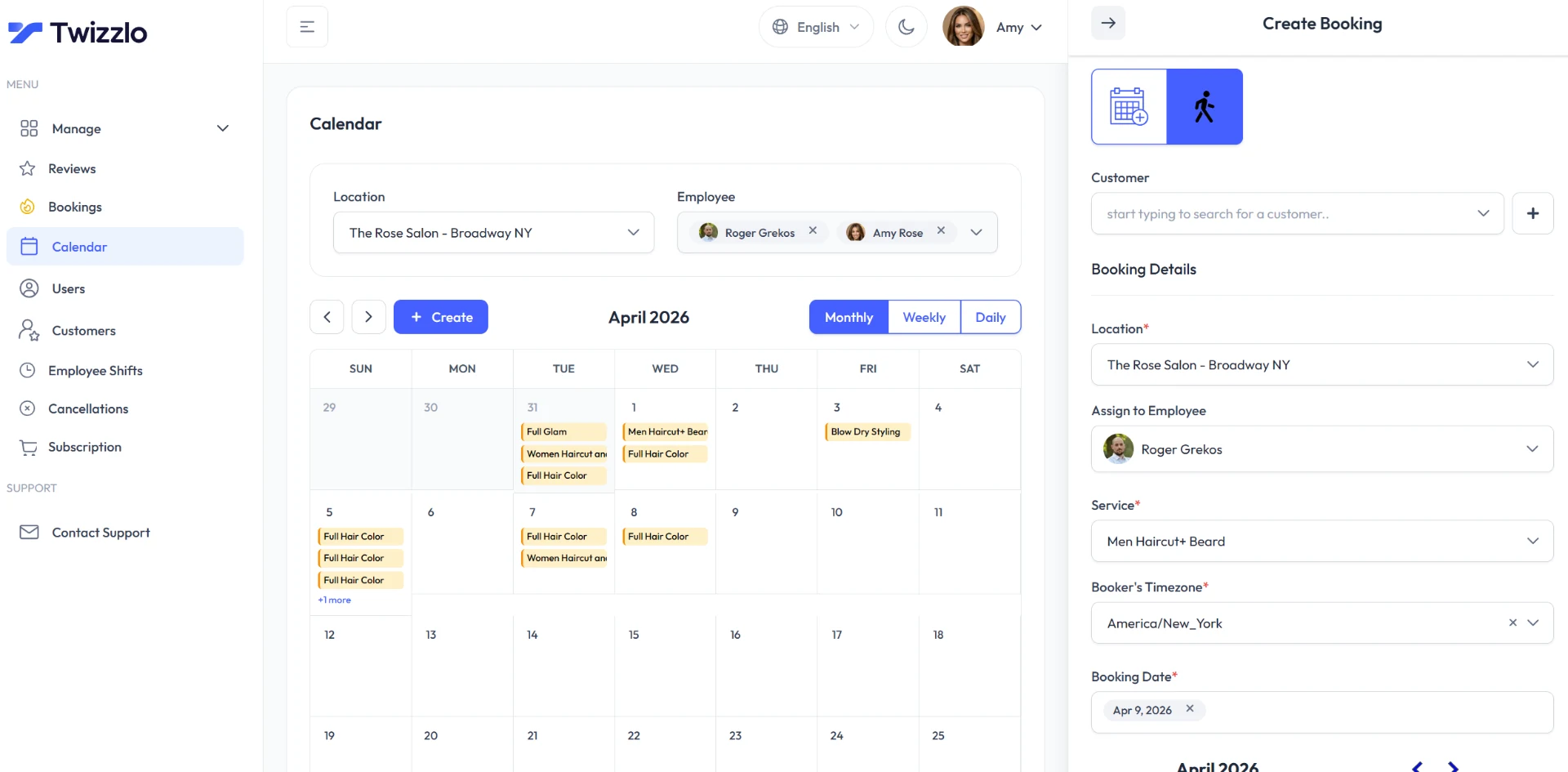
Twizzlo is web-based online booking and appointment scheduling software for appointment-based service businesses, and it is where the prices you set become services a client can book.
Each price in Table 4 can be its own service with its own length and price: a shop-minimum piece, a two-hour flash piece, a half day and a full day. With prepaid bookings turned on for a service, the client pays the full service price through Stripe when they book. That is the whole price, not a part payment, and if the client does not show, the studio decides whether to keep or refund it.
Twizzlo has two plans. Free is $0 a month for up to 150 bookings a month, with email reminders and no SMS text messages. Business Pro is $29.99 a month per business for unlimited bookings, with 50 SMS a month, then $0.03 each, and a 30-day money-back guarantee. Both plans include unlimited staff and locations, and online payments carry Stripe processing plus a 1.5% platform fee.
The hypothetical artist in Table 3 tattoos 80 hours a month. At an assumed average of two hours a session that is 40 bookings, which fits the Free plan. A studio of five such artists has 200 bookings a month, more than 150, so it needs Business Pro.
If that studio sends one text reminder for each booking, 150 texts fall outside the 50 included. At $0.03 each they add $4.50, for $34.49 a month before payment fees. On a $300 flash piece paid in full at booking, the 1.5% platform fee is $4.50, on top of Stripe's processing.
Some pricing jobs sit outside Twizzlo. Twizzlo's /features/ page does not list a split or booth-rent calculator, so the arithmetic in Table 3 stays in your own spreadsheet. A studio that holds dates with a part-payment deposit is better served by a tool that takes one.
Plan details are on Twizzlo pricing, and our booking software comparisons set other tools side by side. To put your price list on a booking page, start on the Free plan.
Frequently asked questions
How to price a tattoo: by the hour or by the piece?
Either works, and BookedIn's pricing guide, read November 15, 2026, says many artists use a mix. It pairs a flat price with small, predictable pieces and flash, and an hourly rate with larger work where the time can vary. On a flat price you carry the cost of a session that runs long, so set flat prices from honest time estimates.
What is a fair shop minimum for a tattoo?
Three guides read November 15, 2026, put shop minimums between $60 and $150: GlossGenius says $60 to $100, and BookedIn and Needle Supply say $80 to $150. A workable test is whether the minimum pays for the whole hour a small tattoo takes once the consult, setup and cleanup are counted.
How much should a beginner tattoo artist charge?
For new artists, guides read November 15, 2026, give hourly figures between $80 and $150: $80 to $100 at Certified Tattoo Academy, $80 to $150 at Needle Supply and $100 to $150 at Porter. GlossGenius puts apprentices at about half an experienced artist's rate. BookedIn's test is simpler: the rate must still pay for what the work costs you.
How do I price a tattoo when the shop takes a split?
Divide the amount you need per hour by your share of the price. In a hypothetical example, an artist who needs $90 an hour for pay and supplies charges $150 under a 60/40 split and $180 under a 50/50 split. GlossGenius, read November 15, 2026, treats a split as a reason to set a higher rate.
What is a day rate for a tattoo?
A day rate is one agreed price for a full session, used for sleeves, back pieces and other large work. BookedIn's pricing guide, read November 15, 2026, puts day rates between $800 and $2,000 or more for six to eight hours. In a hypothetical example, six tattooing hours at $150 an hour make a $900 day rate.
Sources and methodology
Prices read
- Internal Revenue Service, Self-employment tax (Social Security and Medicare taxes) (opens in a new tab)Read . Supports: federal self-employment tax rate 15.3%: 12.4% Social Security and 2.9% Medicare; page reviewed October 30, 2026 (cost section)
- BookedIn, How to price your tattoo services (named without a link)Read . Supports: cost-plus example of $40 overhead, $80 pay and a 20% buffer, around $150; tiers; a minimum of $150 up to the first hour; day rates of $800 to $2,000 or more for six to eight hours and a half-day option; a range of $400 to $550; deposit, minimum and design fee stated before booking; unbilled time; placement and time; beginner advice; reviewing rates; many artists use a mix (methods, cost, prices, beginner and quote sections, Tables 1 and 2, Figure 1, takeaways 2 and 3, FAQ 1, 3 and 5)
- BookedIn, How do tattoo artists charge? Hourly vs. flat rate explained (named without a link)Read . Supports: who carries the risk of a long session; a shop minimum as the least charged for any tattoo; its figures are rough illustrations, not benchmarks; some studios quote $1,500 to $2,500 a session for large work; U.S. minimums around $80 to $150; experienced artists around $150 to $250 an hour (methods section, Tables 1 and 2, Figure 1, FAQ 1 and 2)
- GlossGenius, How to price a tattoo: a guide for studio owners and artists (named without a link)Read . Supports: rent example of $1,500 and $100 an hour, $3,000 and $200; a 60/40 split and higher rates to make up for it; apprentices half the experienced rate, $75 beside $150; minimums of $60 to $100; $80 for beginners to $500 for famous artists; supplies-only and free options; raise prices gradually, with notice, no more than once or twice a year (methods, cost and beginner sections, Tables 1 to 3, Figures 1 and 2, FAQ 2 to 4)
- Porter, Tattoo pricing guide 2025 (named without a link)Read . Supports: beginner artists $100 to $150 an hour, experienced $150 to $250; a $2,000 full-day rate in a sample message; failing to raise rates as a mistake (Tables 1 and 2, Figure 1, beginner section, FAQ 3)
- Certified Tattoo Academy, How much does a tattoo artist charge in 2025 (named without a link)Read . Supports: beginner or new artists $80 to $120 an hour, mid-level $120 to $180, $80 to $100 as a new artist; design fees of $30 to $100 and $100 to $500 (Tables 1 and 2, Figure 1, beginner and quote sections, FAQ 3)
- Needle Supply, Tattoo artist pricing explained (named without a link)Read . Supports: beginner artists $80 to $150 an hour, experienced $150 to $250; deposits of $50 to $100 and $100 to $300; minimums of $80 to $150 (Tables 1 and 2, Figure 1, quote section, FAQ 2 and 3)
- Ink Fanatic, Tattoo pricing for studio owners and artists (named without a link)Read . Supports: $50 to $300 for a one-hour session; check what studios in your area charge (Tables 1 and 2, Figure 1, benchmark section)
- DEV Community, How to price a custom tattoo without undercharging (named without a link)Read . Supports: an hourly floor of $150 for four hours is $600; a modifier for placement and detail; a deposit of 20% to 30% of the estimated total, applied to the final session (Table 1, Figure 1, prices and quote sections)
- Twizzlo, tattoo booking software for artists and studios (opens in a new tab)Read . Supports: each appointment type is its own service with its own length, price and buffer time, picked from the booking link; sessions by length as separate services; flash services with their own duration and price (intro bridge, Twizzlo section)
- Twizzlo, features (opens in a new tab)Read . Supports: prepaid bookings: the client pays the full service price at booking and the business decides whether to keep or refund it after a no-show; no split or booth-rent calculator listed (Twizzlo section, Figure 3)
- Twizzlo, pricing (opens in a new tab)Read . Supports: Free $0 for up to 150 bookings a month with no SMS; Business Pro $29.99 a month per business, 50 SMS then $0.03 each; unlimited staff and locations; 1.5% platform fee (Twizzlo section)
From our editorial policy
- We do not publish invented quotes, studies, statistics, customer stories or product tests, and we do not imply hands-on use of a product when the research came from the vendor's public documentation.
- To report an error, email support@twizzlo.com with the subject line "Correction: [page URL]". Tell us what is wrong and, if you can, link a source.
Start free, upgrade when you grow
Flat-rate booking software. No per-seat, per-chair or per-location fees.
- Free plan up to 150 bookings a month, not a trial
- Business Pro is $29.99 a month per business for unlimited bookings, with a 30-day money-back guarantee
- 24/7 support by email