
10 Fresha Alternatives: Costs for a Five-Person Salon

In short
The main Fresha alternatives are Square Appointments, Vagaro, Booksy, GlossGenius, Acuity Scheduling, Mangomint, Boulevard, Mindbody, Zenoti and Twizzlo. Choose by billing unit first: per location, per calendar, per team member, per user, per business or by sales quote. Then decide whether you still need a consumer marketplace, because marketplace new-client fees sit outside the subscription.
- Fresha's US price could not be confirmed for this guide, so record your own Fresha bill before comparing alternatives to Fresha.
- At five people, published subscriptions run from $0 (Square Appointments Free) to $170 a month (Mangomint), read September 25, 2026.
- Per-person billing grows with each hire: Booksy goes from $29.99 plus tax for one person to $209.99 plus tax for ten (read September 25, 2026).
In this article19 sections

Fresha alternatives fall into six billing models, and the one you pick decides what happens to your bill when you hire or open a second location. If Fresha’s calendar already works for you, the case for switching rests on how the bill behaves.
Fresha uses separate Independent and Team subscriptions and charges a fee on qualifying new clients from its marketplace; our page on Fresha pricing tracks its plans. If you are choosing a Fresha alternative, compare the billing unit first and the price second, then record your own Fresha bill with the checklist near the end of this guide.
Twizzlo publishes this guide and is one of the ten options; the list is grouped by billing unit, not ranked. Every price below was read on the vendor’s own pricing page or help center and is linked so you can re-verify it. Where a vendor doesn’t publish pricing, we say so rather than guessing.
Fresha alternatives at a glance, by billing unit
Each Fresha alternative below bills in one of six ways: per location, per calendar, per team member, per location plus user, per business or plan, or by sales quote. Tools are listed alphabetically inside each group.
- Per location: Mindbody, for classes, memberships and wellness; Square Appointments, for businesses in the Square ecosystem.
- Per calendar: Acuity Scheduling, simple booking beyond the beauty industry; Vagaro, a base price plus each added calendar.
- Per team member: Booksy, marketplace exposure for barbers and stylists.
- Per location plus per user: Mangomint, salon and spa operations.
- Per business or plan: Boulevard Essentials, for small teams; GlossGenius, with staff limits by plan; Twizzlo Business Pro.
- By sales quote: Zenoti, for chains and franchises.
Fresha alternatives comparison table
Entry prices for Fresha alternatives run from $0 on Square Appointments Free to $159 a month on Boulevard Essentials, and Zenoti publishes none (vendor pricing pages, read September 25, 2026). The table lists each tool’s billing unit and entry price as printed on its own pricing page; Fresha is the reference row.
| Platform | Billing unit | Entry price (vendor page, read September 25, 2026) | Best for |
|---|---|---|---|
| Fresha (for reference) | Independent and Team plans + marketplace fee | US price not confirmed | Businesses that want marketplace demand |
| Twizzlo | Per business, two plans | Free $0 (up to 150 bookings a month, no SMS); Business Pro $29.99 a month | Teams and multi-location businesses that don’t want per-staff fees |
| Vagaro | Base + per bookable calendar + add-ons | $23.99 a month, limited-time rate (1 calendar) + $10 per extra calendar | Single-location salons that want deep features |
| Square Appointments | Free tier + per-location paid plans | $0; paid plans $49 and $149 a month per location | Businesses already running Square payments |
| Booksy | Base + per team member | $29.99 a month plus tax + $20 per extra member | Barbers and stylists who want marketplace discovery |
| GlossGenius | Per business, staff limits by plan | From $28 a month ($24 billed annually) | Solo pros and small teams that want one card rate |
| Mangomint | Per location + per user | $120 a month per location + $10 a month per user | Established salons and spas |
| Mindbody | Per location; tiers by quote | From $79 a month per location | Wellness businesses mixing classes and appointments |
| Boulevard | Essentials to 5 providers; then per location | $159 a month ($143 billed annually) | Premium salons that can budget per location |
| Acuity Scheduling | Tiers by calendar count | $20 a month ($16 billed annually, 1 calendar) | Solo operators and non-beauty service businesses |
| Zenoti | Custom enterprise quotes | Not published; quote-based | Chains and franchises |
Prices as printed on each vendor’s own pricing page or help center, read September 25, 2026 (Twizzlo’s pricing page read September 27, 2026); payment processing excluded.
How we compared the Fresha alternatives
We evaluated each Fresha alternative on five criteria: pricing transparency (is the full price published?), per-staff fees (does the bill rise when you hire?), multi-location support (and what each added site costs), appointment reminders (whether SMS and email are included or metered), and payments (processing rates and lock-in). All subscription and fee figures were pulled from each vendor’s own pricing page or official documentation on September 25, 2026 (Twizzlo’s own pricing page on September 27, 2026), and each is linked inline. Where vendors only sell through sales calls, we note that the pricing is quote-based instead of repeating third-party estimates.
Fresha’s pricing page shows prices by country, and a US price list could not be read for this comparison, so no Fresha figure appears here. Phorest, which prices by quote on its pricing page (read September 25, 2026), is covered in our Phorest alternatives guide.
1. Twizzlo
What it is: Twizzlo is web-based online booking and appointment scheduling software for appointment-based service businesses. As salon scheduling software, it covers online booking with real-time availability, a client CRM with visit history and notes, staff scheduling, and employee shifts across one or several locations.
Published pricing: Twizzlo has two plans, according to its pricing page (read September 27, 2026). Free is $0 a month for up to 150 bookings, with no SMS. Business Pro is $29.99 a month per business for unlimited bookings and 50 SMS a month, then $0.03 each, with a 30-day money-back guarantee. Both plans include unlimited staff and locations, and Business Pro includes every Twizzlo feature (full feature list). Online payments carry your Stripe processing rate plus a 1.5% Twizzlo platform fee. Payment availability also depends on Stripe supporting your country and business type.
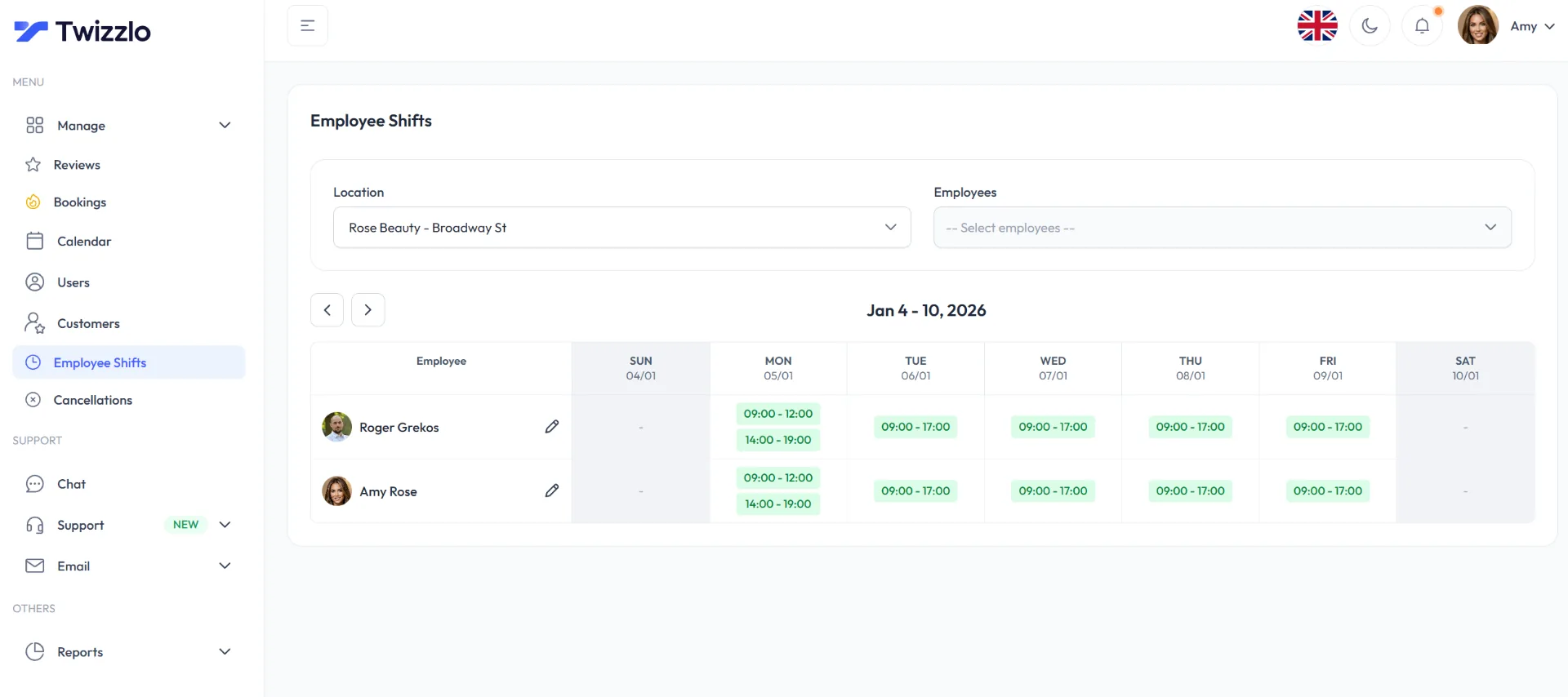
Strongest use case: teams that are hiring or adding a location, because staff and location counts never change the Business Pro price.
Honest limitation: Twizzlo does not run a consumer marketplace, so it fits businesses that already bring in their own clients. Clients book through your own booking page and per-location links.
2. Vagaro
What it is: Vagaro is an all-in-one platform for beauty, wellness and fitness, with point of sale, memberships, inventory and a consumer marketplace, according to its business homepage (read September 27, 2026). Schedulicity’s site now redirects to Vagaro, whose Schedulicity page says “Schedulicity is now Vagaro.” (read September 25, 2026).
Published pricing: per Vagaro’s US help center (read September 25, 2026), the US base subscription is $23.99 a month, a limited-time rate (list price not printed), and includes one bookable calendar. Each additional calendar is $10 a month up to seven; calendars beyond seven are free. The help center prints no subscription price for an added location. According to the same page, Forms ($10 a month), the MySite website builder ($20 a month) and text marketing (from $20 a month for 1,000 credits) are paid add-ons. See Vagaro pricing.
Strongest use case: a single-location salon that wants marketplace visibility, point of sale and deep features at a low starting price, and is comfortable choosing add-ons.
Honest limitation: the modular model stacks. For example, five calendars plus Forms, 1,000 text-marketing credits and MySite come to $113.99 a month at the limited-time base rate, according to the help center’s prices. Compare configured totals; our Vagaro vs Booksy comparison works through that math. For a two-way breakdown, see our Vagaro vs Fresha comparison.
3. Square Appointments
What it is: the scheduling arm of the Square ecosystem, sharing one system with Square’s payments, hardware, invoices, banking and payroll.
Published pricing: per Square’s pricing page (read September 25, 2026), the Free plan is $0 a month per location and includes unlimited staff calendars, a booking site, appointment reminders, prepayments and appointment deposits; you pay processing (2.6% + 15¢ in person). Square Plus is $49 a month per location and adds no-show fees, cancellation policies, multi-staff booking, waitlists and multi-location management (plan grid, read September 27, 2026); Square Premium is $149 a month per location with lower processing (2.4% + 15¢). See Square Appointments pricing.
Strongest use case: businesses already standardized on Square for checkout, and solo or mobile professionals who want unlimited calendars on the $0 plan.
Honest limitation: the features salons rely on to protect revenue (no-show fees, cancellation policies, waitlists) sit behind the $49-a-month Plus tier, and paid plans are billed per location, so a three-site business on Plus pays $147 a month before processing.
4. Booksy
What it is: booking software attached to a consumer marketplace; its pricing page sells Boost for “better visibility on Booksy Marketplace” (read September 27, 2026).
Published pricing: Booksy’s pricing page lists $29.99 a month plus tax with all features included and one team member, plus $20 a month for each additional team member (read September 25, 2026). The optional Boost marketing feature has no monthly fee but charges a one-time 30% fee based on the total cost of a Boost client’s first visit. Processing runs 2.49% + $0.10 on Booksy’s card reader and 2.69% + $0.30 for mobile or keyed-in payments. According to the same page, confirmations and reminders are free, and plans include 2,000 SMS marketing messages a month. See Booksy pricing.
Strongest use case: a solo barber or stylist with open chair time, where Boost can fill hours that would otherwise sit empty.
Honest limitation: per-member pricing scales fast: a five-person shop pays $109.99 a month plus tax, against $29.99 plus tax for one person. And a 30% Boost fee on a $200 color service, for example, is $60 for a client who may have found you anyway. For the two marketplaces side by side, see our Fresha vs Booksy comparison.
5. GlossGenius
What it is: salon software with a login-free client booking flow and a single flat payment-processing rate, according to its pricing page (read September 27, 2026).
Published pricing: per glossgenius.com/pricing (read September 25, 2026): Standard $28 a month, Gold $56 and Platinum $168 billed monthly ($24, $48 and $148 billed annually). Every plan includes flat 2.6% card processing with no extra fee for card-on-file or manual entry. The plans carry no per-seat charge, but Gold is for businesses up to 9 staff (Platinum for teams of 10 or more), and each additional location is charged the plan price at a 15% discount. See GlossGenius pricing.
Strongest use case: solo professionals and small teams that want predictable processing costs; the flat 2.6% is easy to model.
Honest limitation: staff limits. Standard has no staff management, payroll is a $40-a-month add-on plus $6 per seat, and a team of ten needs the $168 Platinum plan ($148 billed annually).
6. Mangomint
What it is: salon and spa software whose pricing page lists Express Booking, a Virtual Waiting Room, memberships and packages, and forms and charting among its core features (read September 27, 2026).
Published pricing: per mangomint.com/pricing, $120 a month per location plus $10 a month per user, and anyone with a profile counts as a user, including front-desk staff (read September 25, 2026; re-read September 27, 2026). Add-ons include Phone ($70 a month per line), Marketing (from $30 a month) and payroll ($50 a month + $8 per worker). Processing is 2.45% + 15¢ in person and 2.90% + 30¢ for virtual payments. It charges no fee for appointments booked in the platform (“Nope. Never.” in its pricing FAQ).
Strongest use case: an established salon or spa where front-desk efficiency and checkout automation convert into revenue; the pricing page lists free onboarding and free data transfer.
Honest limitation: per-user billing counts every profile: five providers plus one front-desk profile is $180 a month at one location.
7. Mindbody
What it is: fitness and wellness management software for businesses that book both classes and appointments and manage memberships, such as yoga studios, gyms and day spas, according to its business homepage (read September 27, 2026).
Published pricing: Mindbody’s pricing page lists plans starting at $79 a month per location across its tiers (Starter, Accelerate, Ultimate), read September 25, 2026, but individual tier prices still require a sales call; every plan includes unlimited users. Budget accordingly and get the full quote in writing, including add-ons and contract terms. See what Mindbody costs per location.
Strongest use case: a business whose revenue spans class schedules, memberships and appointments. Consolidating those in one system can replace several subscriptions and reduce reconciliation work.
Honest limitation: opacity and complexity. You cannot screen it on price without a sales conversation, and the configuration depth that serves class-based studios is overhead for a pure appointment business. If you mainly need scheduling, reminders and client records across staff or locations, a flat-rate Mindbody alternative is easier to budget and run.
8. Boulevard
What it is: a client-experience platform for salons and spas, sold in published plans from Essentials, “for small teams with simple operations,” to Premier and Prestige, which are billed per location (pricing page, read September 25, 2026).
Published pricing: per joinblvd.com/pricing (read September 25, 2026): Essentials is $159 a month billed monthly ($143 billed annually) and covers up to 5 providers; Premier is normally $325 a month per location ($293 billed annually), or $260 ($234) on a limited-time fall offer for new customers, with unlimited professionals; Prestige is normally $455 ($410), or $364 ($328) on the same offer; Enterprise is by quote. Card processing starts at 2.65%.
Strongest use case: premium multi-location salons where appointment value is high enough that a refined client journey pays for itself.
Honest limitation: cost and process. Essentials caps at five providers, so growing teams move to Premier at $325 a month per location normally, and the pricing page offers a demo, with no trial printed.
9. Acuity Scheduling
What it is: Squarespace’s general-purpose scheduling tool, with booking pages, custom client forms and online payments, used across business services, coaching, health and beauty rather than being salon-specific (site read September 27, 2026).
Published pricing: per acuityscheduling.com/pricing (read September 25, 2026): Starter $20 a month for one calendar, Standard $34 a month for up to six calendars (where text reminders begin, per a September 27, 2026 re-read), Premium $61 a month for up to 36 calendars, about 20% less on annual billing ($16, $27 and $49). The trial is 7 days with no credit card needed, and payments connect to Stripe, Square, PayPal or Venmo. See Acuity pricing.
Strongest use case: a solo operator or mixed service business that mainly needs reliable self-scheduling embedded in an existing website.
Honest limitation: calendar count sets the plan. The seventh staff calendar moves you to Premium at $61 a month, and text reminders are not on the $20 Starter plan.
10. Zenoti
What it is: enterprise software for salon and spa chains; its pricing page describes “every workflow from booking to payroll” in one system and AI agents on its AI Plus package (read September 25, 2026).
Published pricing: quote-based. Zenoti’s pricing page shows no price, only “Get a Quote,” as of September 25, 2026; it says multi-location pricing “is customized” and that voice, SMS and messaging usage is “billed based on consumption with optional base packs.” If a vendor quote is the starting point, plan for implementation and training costs alongside the subscription.
Strongest use case: multi-location chains and franchises that need standardized operations, consolidated reporting and enterprise controls more than they need a low sticker price.
Honest limitation: it’s a heavy purchase. Procurement, onboarding and configuration take real time, and single-location businesses that buy enterprise software “to grow into” can end up paying for complexity they don’t use.
What a five-person salon pays on each Fresha alternative
A five-person salon at one location pays between $0 and $170 a month in published subscriptions across these tools, based on each vendor’s pricing page read September 25, 2026 (Twizzlo’s on September 27, 2026). The table is ordered by cost.
| Platform | Monthly cost, 5 bookable staff | How it’s calculated |
|---|---|---|
| Square Appointments | $0 (Free) or $49 (Plus) | Plus adds no-show fees and waitlists |
| Twizzlo | $0 (Free, up to 150 bookings a month) or $29.99 (Business Pro) | Per business; staff count doesn’t change it |
| Acuity Scheduling | $34 ($27 billed annually) | Standard, up to 6 calendars |
| GlossGenius | $56 ($48 billed annually) | Gold, up to 9 staff |
| Vagaro | $63.99 | $23.99 limited-time base + 4 calendars at $10 |
| Mindbody | From $79 | Per location; tiers by quote |
| Booksy | $109.99 plus tax | $29.99 + 4 members at $20 |
| Boulevard | $159 ($143 billed annually) | Essentials, 5-provider cap |
| Mangomint | $170 | $120 location + 5 users at $10 |
| Zenoti | Quote-based | No price published |
| Fresha | US price not confirmed | Get the US Team price for five |
Monthly billing, subscriptions only, vendor pages read September 25, 2026 (Twizzlo September 27, 2026); taxes, processing, texts and add-ons excluded; Vagaro’s base is a limited-time rate.
Two patterns stand out. Free tiers stay free under conditions: Square Appointments Free leaves no-show fees and waitlists to Plus, and Twizzlo Free stops at 150 bookings a month. Per-member bills grow with each hire (Booksy: $29.99 plus tax for one person, $209.99 plus tax for ten), while per-business pricing (GlossGenius within a staff limit, Twizzlo Business Pro) does not. For a broader look, see our guide to the best salon booking software.
When you hire or open a second location
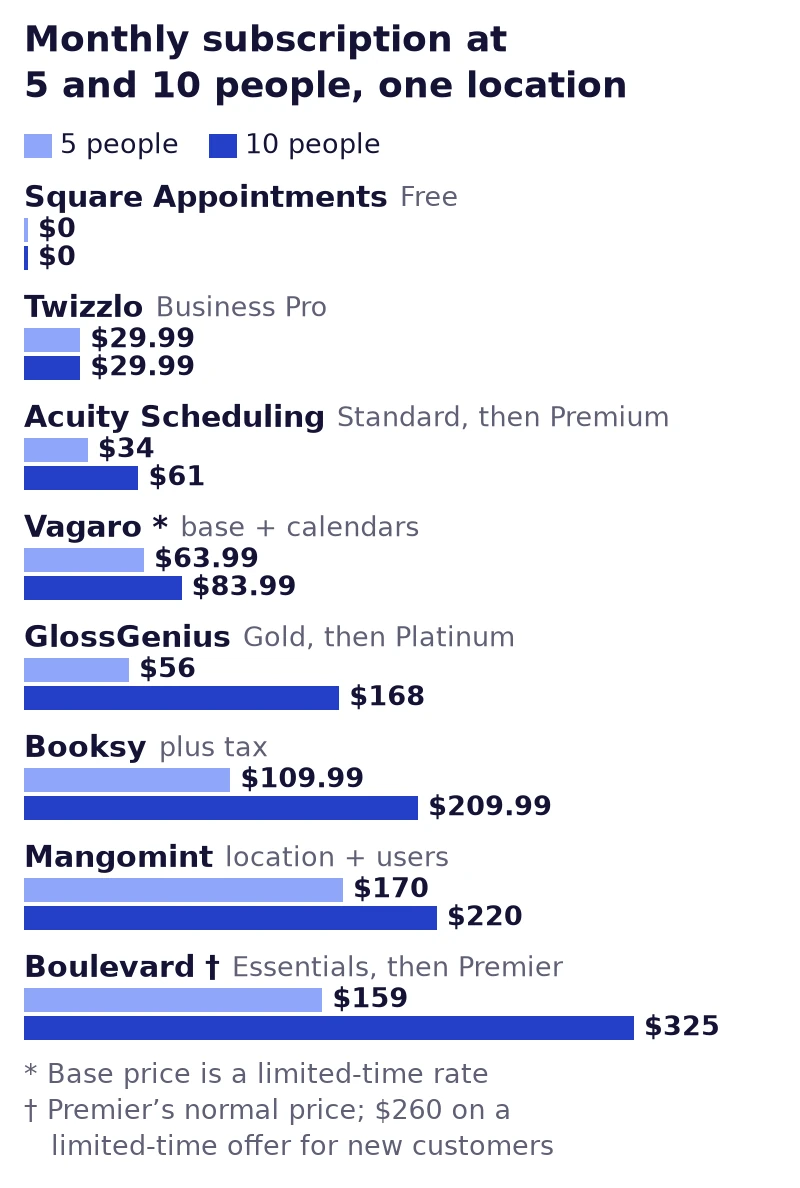
When a salon grows from five to ten people, Booksy’s subscription rises from $109.99 to $209.99 plus tax and Mangomint’s from $170 to $220, while Square Appointments Free and Twizzlo Business Pro stay the same, based on vendor pages read September 25, 2026 (Twizzlo’s on September 27, 2026).
| Tool | Billing unit | 1 person | 5 people | 10 people | Second location adds |
|---|---|---|---|---|---|
| Square Appointments | Per location | $0 or $49 | $0 or $49 | $0 or $49 | $49 on Plus (multi-location tools start on Plus) |
| Twizzlo | Per business | $0 or $29.99 | $0 or $29.99 | $0 or $29.99 | $0 (unlimited locations) |
| Acuity Scheduling | Per account, by calendars | $20 | $34 | $61 | Calendar count decides |
| GlossGenius | Per business, by plan | $28 | $56 | $168 | Plan price less 15% |
| Vagaro | Base + calendar | $23.99 | $63.99 | $83.99 | Not printed |
| Booksy | Per business + member | $29.99 + tax | $109.99 + tax | $209.99 + tax | Not printed |
| Mangomint | Per location + user | $130 | $170 | $220 | $120 + users |
| Boulevard | Essentials to 5; Premier per location | $159 | $159 | $325 ($260 fall offer) | Premier per location |
| Mindbody | Per location | From $79 | From $79 | From $79 | Per location (quote) |
| Zenoti | Quote | Quote | Quote | Quote | Quote |
| Fresha | Independent or Team | Not confirmed | Not confirmed | Not confirmed | Not confirmed |
Same basis and read dates as the table above. Vagaro’s base and Boulevard’s fall offer are limited-time rates; Vagaro’s help center prints no subscription price for an added location and does not say how calendar licenses count across locations.
Before you switch from Fresha: what to record on its US pricing page
A fair Fresha alternative comparison starts with your own Fresha bill, because Fresha’s pricing page changes by country. Open Fresha’s pricing page from the United States, or your latest invoice, and record six things:
- Your plan and its billing unit: Independent for one professional, or Team, billed for each team member.
- The one-time fee on qualifying new clients from the Fresha marketplace, and any minimum per client.
- Which clients count as returning, since the page lists no marketplace fee for them.
- Card rates for in-person, online and manually entered payments.
- Your text allowance and the price of each extra text.
- The trial length and any monthly add-ons, per member or per location.
Then fill in the Fresha row of the five-person table. This guide read Fresha’s pricing page on September 25, 2026, but it was served in Canada, so no Fresha figure is printed here. If your account dates from before the rebrand, when the platform was called Shedul, our Shedul alternative guide shows what changed.
Is a marketplace fee worth paying?
Yes, when the marketplace sends clients you would not have found and who come back. Count last quarter’s marketplace clients and how many rebooked, then set the fees against what those clients would have cost through your own booking page.
Frequently Asked Questions
Is Fresha really free?
No. Fresha’s pricing page lists paid Independent and Team subscriptions and a one-time fee on qualifying new marketplace clients (read September 25, 2026; the US price list could not be read). Square Appointments Free ($0 a month per location, read September 25, 2026) and Twizzlo Free ($0 a month for up to 150 bookings, with no SMS, read September 27, 2026) are the $0 plans in this guide.
What is the cheapest Fresha alternative?
For a solo operator, Square Appointments Free is $0 a month with unlimited calendars (read September 25, 2026), and Twizzlo Free is $0 for up to 150 bookings a month, with no SMS (read September 27, 2026). Among paid options, Acuity starts at $20 a month ($16 billed annually) and Vagaro at $23.99, a limited-time rate (both read September 25, 2026). At five people, on the same read dates, Twizzlo Business Pro is $29.99 a month, Vagaro $63.99 and Booksy $109.99 plus tax.
Does Fresha charge commission on bookings?
Only in one case, according to Fresha’s pricing page (read September 25, 2026, served in Canada): a one-time commission when a qualifying new client finds your business through the Fresha marketplace. The page lists no marketplace fee for returning clients. Treat bookings from your own links, website and social channels as direct, and confirm the US percentage and any minimum per client on Fresha’s US pricing page.
Which Fresha alternatives have no per-staff fees?
Square Appointments lists unlimited staff calendars on every plan and bills per location (plan grid read September 27, 2026). Mindbody lists unlimited users from $79 a month per location; GlossGenius sets staff limits by plan instead of seat fees, with Platinum at $168 a month for 10 or more; Boulevard Premier covers unlimited professionals at $325 a month per location normally, or $260 on a limited-time fall offer for new customers (all read September 25, 2026). Twizzlo includes unlimited staff on both plans (read September 27, 2026).
What happened to Schedulicity?
When we checked on September 25, 2026, Schedulicity’s site redirected to Vagaro, whose Schedulicity page says “Schedulicity is now Vagaro.” If you’re a former Schedulicity user comparing options, evaluate Vagaro’s per-calendar pricing against the other billing models in this guide before defaulting to the migration path.
What is the best Fresha alternative for multiple locations?
Check what each added site costs (pricing pages read September 25, 2026): Square Plus adds $49 a month per location, Mangomint $120 plus $10 per user, and GlossGenius the plan price less 15%; Boulevard Premier and Prestige and Mindbody bill per location, and Zenoti prices chains by quote. Vagaro’s help center prints no subscription price for an added location. Twizzlo includes unlimited locations on both plans (read September 27, 2026).
How does Fresha compare to Booksy on price?
Compare them on the same headcount. Booksy’s pricing page (read September 25, 2026) lists $29.99 a month plus tax and $20 a month per additional team member, or $109.99 plus tax at five people, and its optional Boost takes a one-time 30% fee on a Boost client’s first visit. Fresha’s US Team price for five people could not be confirmed for this guide, so get it from Fresha’s US pricing page first.
Is Square Appointments really free compared to Fresha?
Square’s Free plan is $0 a month per location with unlimited staff calendars, a booking site and reminders; you pay card processing, 2.6% + 15¢ in person (pricing page read September 25, 2026). Its plan grid (read September 27, 2026) puts no-show fees, cancellation policies and waitlists on Plus at $49 a month per location. Fresha lists paid Independent and Team subscriptions (read September 25, 2026); its US price is not confirmed.
What does a five-person salon pay on Fresha alternatives?
Between $0 and $170 a month in published subscriptions (pricing pages read September 25, 2026; Twizzlo’s September 27): Square Appointments Free $0, Twizzlo $0 on Free within 150 bookings a month or $29.99 on Business Pro, Acuity $34, GlossGenius $56, Vagaro $63.99 at its limited-time rate, Booksy $109.99 plus tax, Boulevard $159 and Mangomint $170. Mindbody starts at $79, Zenoti is quote-based and Fresha’s US figure is not confirmed.
Who are Fresha’s competitors for salon booking?
By type, not by rank: Booksy is marketplace-led; Vagaro is all-in-one, billed per calendar; Square Appointments has a free plan with per-location upgrades; GlossGenius prices by plan; Mangomint and Boulevard are premium platforms billed per user or per location; Mindbody serves class and membership businesses; Zenoti sells enterprise software by quote; Acuity Scheduling is general scheduling; and Twizzlo offers direct booking with a Free plan and a per-business paid plan.
The bottom line
If you’re looking at apps like Fresha, remember that Fresha remains a capable platform, and if marketplace demand fills your calendar, its fees can be worth paying. If the bill is the problem, match the pricing model to your growth plan: free with processing (Square Appointments), low base plus add-ons (Vagaro), per member with marketplace reach (Booksy), per plan with staff limits (GlossGenius), per user or per location (Mangomint, Boulevard), or per business (Twizzlo).
Trying Twizzlo next to your Fresha bill
Twizzlo has two plans, so you can test it before you move your calendar. Free is $0 a month for up to 150 bookings, with no SMS, and it is free forever, not a trial. Business Pro is $29.99 a month per business for unlimited bookings and 50 SMS a month, then $0.03 each. Both plans include unlimited staff and locations. Online payments carry your Stripe processing rate plus a 1.5% Twizzlo platform fee. Business Pro has a 30-day money-back guarantee: email support@twizzlo.com within 30 days of your first Business Pro payment and we refund that payment in full. You can compare Twizzlo’s plans or start at twizzlo.com.
Sources and methodology
Prices read
- Twizzlo pricing page (opens in a new tab)Read . Supports: Twizzlo plans, booking cap, SMS allowance, money-back guarantee and online payment fee
- Twizzlo features page (opens in a new tab)Read . Supports: Twizzlo booking page, reminders by plan, client CRM, employee shifts and locations; the Employee Shifts screenshot (same image)
- Fresha pricing page (read outside the US) (opens in a new tab)Read . Supports: Fresha's Independent and Team subscriptions and the one-time fee on new marketplace clients (wording only; the page showed Canadian prices, so no Fresha figure is stated)
- Vagaro plans and pricing help article (US) (opens in a new tab)Read . Supports: Vagaro base rate, calendar fees and add-ons; no subscription price printed for an added location (re-read September 27, 2026)
- Vagaro business homepage (opens in a new tab)Read . Supports: Vagaro's marketplace, memberships, inventory and point of sale (no price used)
- Vagaro's Schedulicity page (opens in a new tab)Read . Supports: Schedulicity's site redirects to Vagaro, whose page says 'Schedulicity is now Vagaro.' (re-read September 27, 2026)
- Square Appointments pricing page (US) (opens in a new tab)Read . Supports: Square plans, per-location billing and card rates; plan features re-read September 27, 2026
- Booksy pricing page (opens in a new tab)Read . Supports: Booksy price, added team members, Boost fee, card rates, reminders and marketing texts (re-read September 27, 2026)
- GlossGenius pricing page (opens in a new tab)Read . Supports: GlossGenius plans, staff limits, flat card rate, added-location discount and payroll add-on (re-read September 27, 2026)
- Mangomint pricing page (opens in a new tab)Read . Supports: Mangomint location and user prices, who counts as a user, add-ons, card rates and core features (re-read September 27, 2026)
- Mindbody pricing page (opens in a new tab)Read . Supports: Mindbody starting price per location, quote-only tiers and unlimited users
- Mindbody business homepage (opens in a new tab)Read . Supports: Mindbody's business types (fitness, wellness and beauty), class and appointment booking and memberships (no price used)
- Boulevard pricing page (opens in a new tab)Read . Supports: Boulevard plans, provider limit, fall offer, Enterprise quote and card rate
- Acuity Scheduling pricing page (opens in a new tab)Read . Supports: Acuity plans by calendar count, trial, text reminders and payment options (re-read September 27, 2026)
- Zenoti pricing page (opens in a new tab)Read . Supports: Zenoti quote-only pricing, multi-location quotes and consumption billing
- Phorest pricing page (US) (opens in a new tab)Read . Supports: Phorest sells every plan by quote
From our editorial policy
- Twizzlo sells online booking and appointment scheduling software, the same category we write about. Twizzlo appears in our comparisons and roundups, and we have a commercial interest in you choosing it.
- We do not publish invented quotes, studies, statistics, customer stories or product tests, and we do not imply hands-on use of a product when the research came from the vendor's public documentation.
- To report an error, email support@twizzlo.com with the subject line "Correction: [page URL]". Tell us what is wrong and, if you can, link a source.
Update history
- : Re-read every vendor price on the vendor's own pages, removed Fresha prices we could not confirm for the US, corrected the Mangomint, Mindbody, Boulevard and GlossGenius pricing, and added costs at 1, 5 and 10 people and for a second location.
Start free, upgrade when you grow
Flat-rate booking software. No per-seat, per-chair or per-location fees.
- Free plan up to 150 bookings a month, not a trial
- Business Pro is $29.99 a month per business for unlimited bookings, with a 30-day money-back guarantee
- 24/7 support by email