Create a Winning Salon Mission Statement

A lot of salon owners already know what they stand for. They care about client experience, quality work, team standards, and building a place people want to return to. The problem is that none of that helps much if it lives only in your head.

A strong salon mission statement gives your business a usable filter for hiring, service design, client communication, and daily decision-making. It also keeps the salon from drifting into mixed messages: premium pricing with bargain-brand language, a wellness promise with rushed consultations, or a team-first culture that only talks about sales. When the mission is clear and used consistently, clients feel it and staff can work from the same playbook.

Why Your Salon’s Purpose Must Be Written Down

Many owners treat a mission statement like décor. Something you write for the website, frame near reception, and forget. In practice, it works better as a management tool.

In a $428 billion global hair salon market, salons with client-centric missions reported 28% higher Net Promoter Scores and 35% improved loyalty rates, according to a GlossGenius article citing a 2021 survey of 2,500 U.S. beauty businesses. The same source says businesses that embedded specific goals in their missions achieved 18% average revenue growth over five years, compared with 7% for those without.

A professional woman in a bright office carefully reading a framed mission statement held in her hands.

That gap matters because salons rarely fail from lack of talent alone. More often, they struggle because the experience is inconsistent. One stylist gives detailed consultations. Another rushes through them. One front-desk team member reinforces the brand. Another sounds transactional. A written mission tightens that spread.

What a written mission actually does

A useful mission statement answers four operational questions:

  • Who do we serve
  • What experience do we promise
  • What standards guide the team
  • What kind of growth are we pursuing

If those answers stay vague, the business usually becomes reactive. Owners start copying promotions from other salons, adding services that don’t fit, or hiring people who can fill a chair but don’t fit the culture.

Practical rule: If your mission can’t help you say no to a bad-fit service, promotion, or hire, it’s too generic.

Why it matters to clients and staff

Clients don’t read every line on an About page, but they do notice whether a salon feels coherent. They notice whether the tone online matches the greeting at the desk. They notice whether the consultation style reflects the positioning. They notice whether every provider seems to understand the same standard of care.

Staff notice something else. They notice whether leadership stands for anything beyond staying booked. A written mission gives managers a fair way to coach performance without sounding arbitrary.

Business area Without a clear mission With a clear mission
Hiring Decisions based on availability Decisions based on fit and service style
Training Inconsistent shadowing and feedback Shared service standards
Marketing Trend-chasing and mixed messaging Consistent brand voice
Client experience Depends on who’s working More predictable experience

For salons trying to build a stronger brand foundation, the bigger lesson is this: purpose isn’t soft. It’s operational. If you’re refining your positioning alongside education, pricing, and owner growth, resources for hair salon owners can help connect brand decisions to day-to-day management.

How to Write Your Salon Mission Statement Step by Step

Direct answer: To write a salon mission statement, gather your team, define your core values, identify your ideal client, clarify what makes your service experience different, and turn that into one or two plainspoken sentences. Keep it specific, test it for clarity, and make sure it can guide real decisions inside the salon.

The fastest way to get stuck is to start with wording. Start with truth instead. The mission should come from how your salon wants to operate, not from whatever sounds polished on another website.

A six-step infographic on how to craft a salon mission statement with icons for each process step.

A Yocale guide on salon mission statements recommends a 1 to 2 hour team workshop to define 5 to 7 core values. It also notes that salons that skip this step experience 40% higher misalignment in operations. The same source warns that 60% of failed statements lack uniqueness, which leads to 18% lower brand differentiation.

Start with values, not slogans

Bring in the people who shape the client experience. That usually means the owner, lead stylist or service lead, front-desk lead, and one or two trusted team members. Ask simple questions:

  1. What do we refuse to compromise on?
  2. What do our best clients thank us for?
  3. What kind of salon experience are we trying to create?
  4. What behaviors do we want every team member to show?

You are not looking for trendy words. You are looking for usable words. “Luxury” is vague unless your team can explain what it means in consultation length, timing, service pacing, and guest care. “Confidence” is better if your salon builds services around education, personalization, and aftercare.

A good list often includes values such as care, artistry, calm, precision, warmth, honesty, inclusivity, education, or sustainability. Narrow the list down until it feels uncomfortable. That pressure is useful.

Define your ideal client and your real difference

A mission statement falls apart when it tries to serve everyone. A color-focused salon in a fashion district should not sound like a family walk-in salon. A wellness-led scalp and haircare studio should not sound like a trend-driven blowout bar.

Ask these questions:

  • Who is our best-fit client?
  • What are they trying to feel, fix, maintain, or express?
  • Why do they choose us instead of a cheaper or closer option?
  • What do we do consistently that they can’t get everywhere?

The strongest salon mission statement usually says as much about the experience as it does about the service.

Sometimes the unique angle is technical. Sometimes it’s emotional. Sometimes it’s process. A salon may stand out through in-depth consultations, textured-hair expertise, eco-conscious product choices, or a calmer appointment flow that never feels rushed.

Your service menu can help clarify this. If your offers are broad, overlapping, or worded inconsistently, the mission will sound muddy too. Tightening your positioning often starts with your service language, pricing logic, and package structure. A thoughtful menu for hair salon planning guide can make that work easier.

Add business intent without sounding corporate

A mission statement isn’t a full business plan, but it should still reflect what the business is trying to build. That could include retention, education, multi-location consistency, community reputation, premium positioning, or a healthier team culture.

Use prompts like:

  • Are we building around loyalty or volume?
  • Do we want to be known for transformation, maintenance, wellness, or convenience?
  • What should grow because we live this mission well?

Here, many owners overcorrect and write something stiff. Don’t force strategic language into the final sentence if it doesn’t sound like your brand. Let the mission stay client-facing and values-led, while your internal notes hold the deeper operational goals.

Draft, cut, and test

Write three versions. One should be warm. One should be direct. One should be bold. Then strip out anything that sounds interchangeable.

A few editing rules help:

  • Keep it short. One or two sentences is enough.
  • Use plain words. If staff wouldn’t say it out loud, rewrite it.
  • Avoid stacked buzzwords. “Optimize, synergize, leverage” says very little.
  • Make it ownable. Another salon shouldn’t be able to swap in its name and use it.

Here are a few checks I use with owners:

Test Good sign Bad sign
Read-aloud test Sounds natural in a team meeting Sounds like brochure copy
Hiring test Helps you identify culture fit Could apply to any applicant
Client test Matches what guests actually experience Overpromises
Decision test Helps you choose between two options Too vague to guide anything

If your team reads the final draft and says, “Yes, that’s us,” you’re close. If they nod politely but can’t connect it to daily work, keep refining.

Salon Mission Statement Examples and Templates

The easiest way to understand a mission statement is to look at one in context. Not as a quote on a wall, but as an expression of a real business model.

A close-up view of an open book page featuring mission statements for a sustainable hair salon.

Formal mission statements helped small salons stand out in crowded markets, and salons that included themes like client satisfaction and team skill enhancement saw 25% higher profitability in a 2015 Small Business Administration study of 500 beauty firms. The same source notes that client-centric values have boosted retention rates by up to 30% globally, as summarized in this Booksy article on beauty salon mission statements.

Example one for the high-touch color studio

This salon isn’t trying to be everything. It wants guests who value expertise, consultation, and long-term hair health.

Mission statement example
We create customized color and haircare experiences that help every client feel confident, cared for, and fully seen. Our team combines technical education with honest guidance so great hair stays healthy between visits.

Why it works: it speaks to personalization, standards, and client outcomes. It also gives the team a clear identity rooted in education and honesty.

Example two for the eco-conscious wellness salon

This salon blends beauty with restoration. The atmosphere matters as much as the treatment result.

Mission statement example
We provide calm, thoughtful beauty and wellness services that respect the client, the craft, and the environment. Every visit is designed to leave people feeling restored, confident, and supported.

That statement fits a salon or day spa built around slower service pacing, lower-tox choices, and a gentler client journey.

A strong service identity also needs strong presentation. If your offers don’t read clearly online or in print, the mission loses force before the appointment even starts. Reviewing your salon services list often reveals where your positioning still feels generic.

Here’s a short video if you want another perspective on crafting brand language for a service business:

Example three for the neighborhood nail studio

This business wins on warmth, consistency, and community. It doesn’t need luxury language to sound strong.

Mission statement example
We make self-care feel welcoming, polished, and personal by delivering consistent nail services in a space where clients feel known and valued. We grow by building trust, not by rushing appointments.

That last line does important work. It tells staff what not to do.

A good mission statement doesn’t just describe the brand. It protects the client experience from shortcuts.

A simple template you can actually use

If you need a starting point, use this and then edit hard:

We help [ideal client] feel [desired outcome] through [type of service experience]. We are committed to [core values or standards] so every visit reflects [brand promise].

Or use a tighter version:

Our mission is to provide [service style] for [ideal client], guided by [values], so clients leave feeling [result].

Write the first draft quickly. Spend your energy on revision.

Bringing Your Mission to Life Within Your Salon

A salon mission statement that never leaves the website is wasted effort. It might still look polished, but it won’t change retention, consistency, or team behavior.

The salons that get real value from a mission connect it to management. A benchmark-driven approach can achieve 40% higher client loyalty when the mission aligns with KPIs such as client retention with a target of 75% and revenue per client at +15%, according to Spa & Equipment’s salon mission statement guidance. The same source says salons that fail to align their mission with metrics face a 25% KPI failure rate, while those that audit annually sustain 30% higher success rates than businesses with static statements.

Turn values into observable behaviors

If your mission says you deliver thoughtful, confidence-building service, what should a new receptionist do differently at check-in? What should a stylist do during consultation? What should happen at checkout?

Translate every mission phrase into actions such as:

  • Consultation standard with time for questions, lifestyle fit, maintenance planning
  • Service pacing that matches your brand promise
  • Retail recommendations framed as support, not pressure
  • Follow-up communication that feels personal and helpful
  • Rebooking language that reinforces care continuity

That step is where most mission statements either become useful or become wallpaper.

Use it in onboarding, coaching, and reviews

A mission should show up in three places inside the salon:

  1. Onboarding
    New hires need to hear not only what the salon does, but how it behaves. Mission-led onboarding helps explain standards that aren’t visible on a checklist.

  2. Daily management
    Use the mission in huddles. If your salon claims calm expertise, don’t start the day with frantic instructions and mixed priorities.

  3. Performance conversations
    Coach to behaviors tied to the mission. This reduces fuzzy feedback and gives managers a fairer standard.

For teams refining their training process, a practical review of user onboarding best practices can help translate brand promises into repeatable internal habits.

Manager cue: Don’t ask, “Did they do a good job?” Ask, “Did their actions reflect the experience we promise?”

Track whether the mission is real

This doesn’t require turning the salon into a spreadsheet factory. It does require choosing a few measures that reflect the promise.

If your mission emphasizes loyalty and trust, review retention, rebooking patterns, client notes, and service consistency. If it emphasizes education, look at consultation quality and home-care conversations. If it emphasizes wellness, review timing, room turnover pressure, and whether the experience still feels calm at peak hours.

Owners who want to improve your customer’s journey often find that the friction isn’t dramatic. It’s small disconnects. Confirmation emails sound generic. New clients don’t know what to expect. Providers describe add-ons differently. The mission helps you spot those gaps faster because you finally have a standard to compare against.

Review it before the market forces you to

Salons outgrow mission statements when the business changes but the wording doesn’t. Maybe the team has matured. Maybe the service mix shifted. Maybe the salon moved from broad appeal to premium specialization.

Review the mission at least during your annual planning cycle. Not to rewrite it every year, but to test whether it still describes the salon you’re running.

Showcasing Your Mission Across Marketing and Booking Tools

Once the mission is alive inside the salon, put it where clients make decisions. Most owners stop at the About page. That’s not enough.

A hand holds a tablet displaying a salon website with the mission statement Enhancing Beauty, Nurturing Confidence.

Where your mission should appear

Use a short version of your salon mission statement in these touchpoints:

  • Website homepage so new visitors understand your positioning quickly
  • About page with a fuller explanation of your values
  • Online booking page to reinforce what kind of experience clients are booking
  • Confirmation emails so the brand voice stays consistent after the appointment is made
  • New client intake forms to set expectations around consultation style and care
  • Social media bios when your positioning is a key differentiator
  • Recruitment pages so applicants self-select for culture fit

This isn’t about pasting the same sentence everywhere. Adapt the wording to the moment. The homepage version should be crisp. The booking version should reduce uncertainty. The recruitment version should signal standards.

Use your booking flow as a brand moment

Booking is one of the clearest moments to communicate who you are. A premium color studio can mention consultation-led appointments. A wellness salon can explain pace and atmosphere. A neighborhood salon can emphasize warmth, consistency, and easy maintenance planning.

If you’re building visibility across digital touchpoints, tools that centralize profile links and creator campaigns can help beauty brands keep messaging consistent. Teams experimenting with partnerships or creator-led promotion may want to discover Linkie’s influencer features as part of that broader brand system.

Offline materials matter too. QR codes on mirrors, retail displays, or printed cards can send clients to your booking page, new client information, or a values-led service guide. If you’re refining those handoffs, this guide to business cards with QR codes is a practical place to start.

Your mission should be visible at the exact points where clients wonder, “Is this salon right for me?”

Frequently Asked Questions About Salon Mission Statements

Question Answer
What’s the difference between a mission and a vision statement? A mission explains what your salon does, for whom, and how it operates. A vision describes what you’re building toward over time.
How long should a salon mission statement be? Keep it to one or two sentences. If staff can’t remember it or say it naturally, it’s too long.
How often should I revisit it? Review it during annual planning, after a major repositioning, or when your service mix and culture have changed.
What if my salon has outgrown its current mission? Rewrite it based on your current client experience and business direction. Don’t preserve old wording if the business has clearly evolved.
Should clients see the exact mission statement? Yes, but adapt the format by channel. A website may show the full statement, while booking pages and emails may use a shorter version.

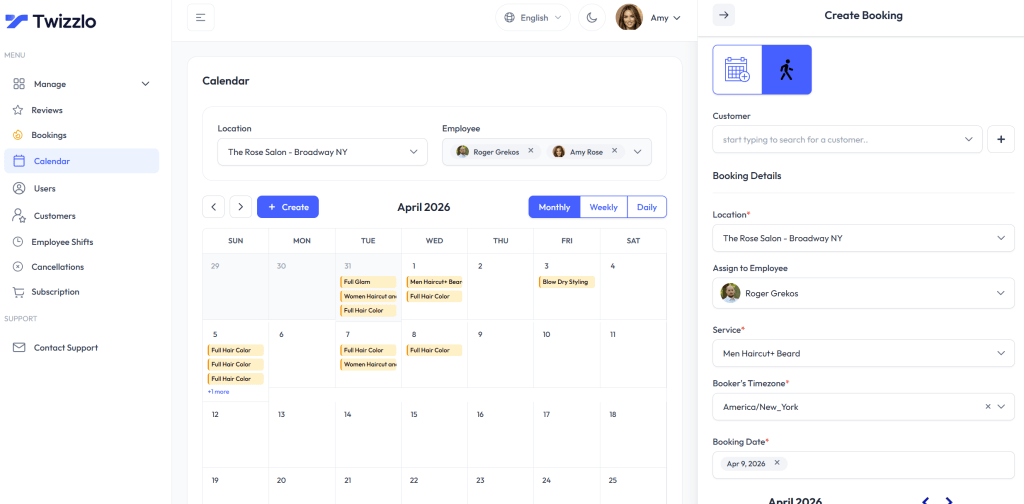
If you’re running an appointment-based business and tired of stitching together multiple tools, or getting hit with surprise fees every time you grow, Twizzlo is worth a look. It brings bookings, staff scheduling, client history, and performance insights into one platform, with one transparent plan and no feature lockouts.

author avatar
Roger Grekos Founder - Editor
Roger Grekos is the founder of Twizzlo, a flat-rate appointment booking platform built for salons, barbershops, spas, and service businesses. With over a decade in product management — including senior roles at Find.co and PayEm — he writes about the real operational challenges service business owners face every day.

Discover more from Twizzlo

Subscribe now to keep reading and get access to the full archive.

Continue reading