
Vagaro vs Acuity Scheduling: Which Costs Less for a Salon?

In short
In Vagaro vs Acuity, Acuity Scheduling costs less at one calendar and from three to 36: $20 a month for one, $34 for up to six. Vagaro charges $23.99, a limited-time rate, plus $10 per added calendar, up to $83.99 at seven. Choose Vagaro for checkout, inventory and payroll in one system. Prices read September 25, 2026.
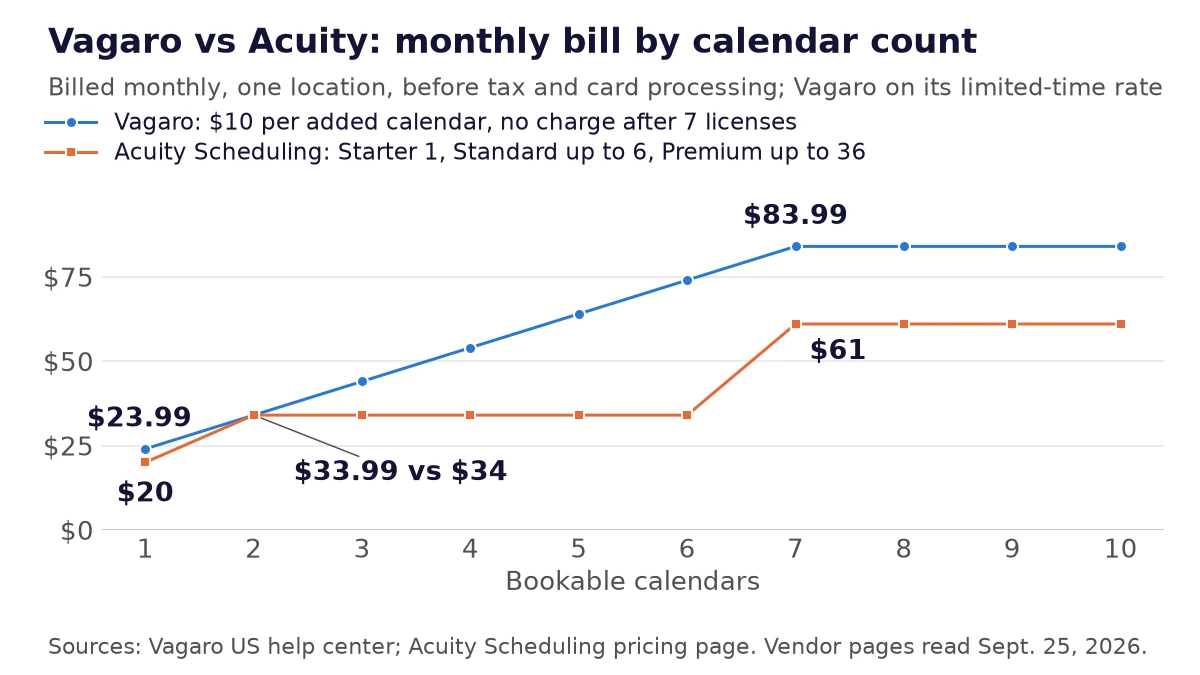
- At two calendars the bills are a cent apart: Vagaro $33.99 on its limited-time rate, Acuity Standard $34 (read September 25, 2026).
- Vagaro stops charging for calendars after seven licenses, at $83.99; Acuity Premium covers up to 36 calendars at $61 (both read September 25, 2026).
- Vagaro bills forms and online deposits as $10 add-ons; Acuity lists client forms and payments on every plan (read September 25 and 27, 2026).
In this article9 sections
Vagaro vs Acuity is a choice between two ways of billing a salon's calendar. Vagaro is an integrated salon and spa operations suite billed per bookable calendar, with paid add-ons; Acuity Scheduling is a scheduling engine billed by calendar tier. This guide prices both for one to 10 stylists from each vendor's own pages, read September 25 to 28, 2026, monthly billing first.
For every Acuity plan and billing option, see our Acuity pricing breakdown.
Vagaro vs Acuity Scheduling at a glance
Vagaro is a salon and spa operations suite billed per bookable calendar, with paid add-ons for extras such as intake forms and online deposits. Acuity Scheduling is a scheduling tool billed by calendar tier, with client forms, email reminders and online payments on every plan, according to each vendor's own pages read September 25 and 27, 2026.
Vagaro. Its US help center lists a base subscription of $23.99 a month, marked "Only for a limited time," with one calendar license included and $10 a month for each added employee calendar up to seven licenses. After seven, new employees are added "at no additional charge." The help center prints no price for after the offer (read September 25, 2026).
Acuity Scheduling. Its pricing page sells three published plans by calendar count: Starter for one calendar at $20 a month, Standard for up to six at $34 and Premium for up to 36 at $61, or $16, $27 and $49 a month billed annually. Enterprise pricing is not published, and there is no free plan, only a seven-day trial with no credit card (read September 25, 2026).
If Booksy is also on your list, the same calendar-count question runs through our comparison of Vagaro vs Booksy for salon operators.
Verdict
Choose Vagaro if
- you want inventory, payroll and marketing inside the booking system, or a listing on a consumer marketplace.
Choose Acuity Scheduling if
- you mainly need booking, client forms, reminders and online payments, and your team fits a calendar tier of one, six or 36.
| Aspect | Vagaro | Acuity Scheduling |
|---|---|---|
| Billing unit | Base with 1 calendar, $10 per added calendar up to seven licenses | Plan by calendar count: 1, up to 6, up to 36 |
| One calendar | $23.99 a month, a limited-time rate | $20 a month, $16 billed annually |
| Six calendars | $73.99 a month | $34 a month, $27 billed annually |
| Included | Calendar, checkout, inventory, payroll reporting; forms, online deposits and Vagaro Payroll are paid add-ons | Client forms, email reminders, payments via Stripe, Square, PayPal, Venmo |
| Beyond booking | Inventory, payroll, marketing, marketplace listing, MySite website builder ($20 a month) | Waitlist, memberships and packages, gift certificates from Standard; custom API from Premium |
Vagaro: US help center, plans article read September 25, 2026, base-features article read September 28, 2026. Acuity: pricing page read September 25 and 27, 2026. Monthly billing.
What is the main difference between Vagaro and Acuity?
The main difference is scope. Vagaro's US help center lists checkout, inventory, payroll reporting and marketing tools in its base subscription and sells forms and online deposits as $10 monthly add-ons. Acuity Scheduling's plan cards center on booking: client forms, reminders and payments through outside processors on every plan (vendor pages read September 25 to 28, 2026).
What Vagaro includes and what it bills extra. Vagaro's help article on the features included in the base subscription (read September 28, 2026) lists a calendar with a waitlist and online booking rules for cancellations, no-shows and rescheduling; text and email confirmations and reminders; checkout with Vagaro's own card processing and Vagaro hardware, including an EMV card reader, sold individually or in a bundle; inventory and retail; payroll reporting with custom commission tiers; and memberships, packages, gift cards and loyalty points. Its plans article (read September 25, 2026) prices the extras: Forms and the Online Shopping Cart at $10 a month each, the MySite website builder at $20 a month, and Vagaro Payroll, which pays staff by direct deposit, at $34 a month plus $5 per employee. The same article, re-read September 28, 2026, lists a US listing on the Vagaro Marketplace as free.
What Acuity includes by plan. Acuity's pricing page (read September 27, 2026) lists the same core on all three plans: client self-scheduling, payments through Stripe, Square, PayPal or Venmo, email reminders, custom client forms and automatic time zone conversion for clients. Standard adds text reminders (Acuity says to "check global availability"), an appointment waitlist, memberships and packages, and gift certificates. Premium adds multiple time zones for staff and locations and a custom API and CSS. The page lists no inventory, retail or payroll tool.
What do Vagaro and Acuity charge at 1 to 10 calendars?
At one calendar, Acuity Starter costs $20 a month against Vagaro's $23.99 limited-time rate. At two, Vagaro is a cent cheaper: $33.99 against $34 on Acuity Standard. From three to six calendars, Acuity stays at $34 while Vagaro climbs to $73.99, and from seven Vagaro stops at $83.99 against Acuity Premium's $61 (read September 25, 2026).
Read as Acuity vs Vagaro, the pattern is a staircase against a ramp: Acuity's price moves only at its tier edges, while Vagaro's moves with every stylist until the seventh license. Figure 1, at the top of this page, draws the same rows.
Table 1. Monthly subscription at 1 to 10 bookable calendars and at Acuity's plan edges of 36 and 37 or more, one location, billed monthly, before tax and card processing; Acuity's billed-annually price in parentheses (Vagaro's help center prints no annual price). Sources: Vagaro's US help center and Acuity Scheduling's pricing page, read September 25, 2026.
| Bookable calendars | Vagaro (limited-time base, $10 per added calendar) | Acuity Scheduling plan | Acuity, billed monthly (annually) | Lower monthly bill |
|---|---|---|---|---|
| 1 | $23.99 | Starter | $20 ($16) | Acuity, by $3.99 |
| 2 | $33.99 | Standard | $34 ($27) | Vagaro, by $0.01 |
| 3 | $43.99 | Standard | $34 ($27) | Acuity, by $9.99 |
| 4 | $53.99 | Standard | $34 ($27) | Acuity, by $19.99 |
| 5 | $63.99 | Standard | $34 ($27) | Acuity, by $29.99 |
| 6 | $73.99 | Standard | $34 ($27) | Acuity, by $39.99 |
| 7 | $83.99 | Premium | $61 ($49) | Acuity, by $22.99 |
| 10 | $83.99 | Premium | $61 ($49) | Acuity, by $22.99 |
| 36 | $83.99 | Premium | $61 ($49) | Acuity, by $22.99 |
| 37 or more | $83.99 | Enterprise | Not published | Ask Acuity for a quote |
Two notes change how to read the table. Acuity's page says "Prices do not include applicable taxes," and paying annually saves 20%. Vagaro's $23.99 is marked "Only for a limited time," its help center prints no price for after the offer, and "After paying for seven licenses, you can add new employees to your account at no additional charge." Vagaro's full price ladder is on our Vagaro pricing page.
What do three stylists with forms and deposits pay on each?
For three stylists who need online booking, intake forms and online deposits, Vagaro comes to $63.99 a month on its limited-time base with the Forms and Online Shopping Cart add-ons. Acuity Standard is $34 a month, or $27 billed annually, with custom client forms and online payments listed on every plan (read September 25 and 27, 2026).
Table 2. The same three jobs, not the same product: three bookable calendars at one location, billed monthly, before tax and card processing. Sources: Vagaro's US help center (prices read September 25, 2026; Online Shopping Cart terms read September 28, 2026) and Acuity Scheduling's pricing page (prices read September 25, 2026; plan features read September 27 and 28, 2026).
| Line item | Vagaro | Acuity Scheduling |
|---|---|---|
| Subscription with three bookable calendars | $43.99: $23.99 limited-time base with one calendar, plus $20 for two added calendars | $34: Standard, up to 6 calendars ($27 billed annually) |
| Intake forms | $10: Forms add-on | $0: custom client forms on every plan |
| Online deposits at booking | $10: Online Shopping Cart add-on, which requires Vagaro's card processing | $0: the compare table marks deposits as included on every plan, through Stripe, Square, PayPal or Venmo |
| Total a month | $63.99 | $34 ($27 billed annually) |
Neither total includes card processing. Vagaro's US help center lists 2.6% + $0.10 per in-person card payment for businesses under $4,000 a month in card sales, and 2.29% + $0.19 above that with a $10 monthly Large Merchant fee; keyed-in payments cost 3.5% + $0.19, and FANF and Mastercard location fees apply in amounts it does not print (read September 27, 2026). Acuity's pricing page names the processors but prints no rate of its own, so check the rate with the processor you connect. Acuity's prices also exclude applicable taxes, and Vagaro's text marketing starts at $20 a month for 1,000 credits (read September 25, 2026).
Which one fits your salon?
Choose Vagaro if you want checkout, inventory, payroll reporting and marketing in the same system as the calendar, or a listing on its consumer marketplace. Choose Acuity if the calendar mainly has to take bookings, collect forms, send reminders and take online payments, and your team fits one of its tiers of one, six or 36 calendars.
Table 3. Which vendor's published plan covers each salon need. Sources: Vagaro's US help center, plans article read September 25 and 28, 2026, and base-features article read September 28, 2026; Acuity Scheduling's pricing page, read September 25 and 27, 2026. Prices billed monthly.
| Your salon needs | Vagaro | Acuity Scheduling |
|---|---|---|
| One chair (solo stylist or booth renter) | $23.99 a month, a limited-time rate | Starter, $20 a month ($16 billed annually) |
| Two providers | $33.99 a month | Standard, $34 a month ($27 billed annually) |
| Three to six providers | $43.99 to $73.99 a month | Standard, $34 a month |
| Seven or more providers | $83.99 a month; more employees at no added charge | Premium, $61 a month, up to 36 calendars; Enterprise price not published |
| Retail stock | Inventory and retail in the base subscription | Not listed on its pricing page |
| Payroll and commission tiers | Payroll reporting with custom commission tiers included; Vagaro Payroll $34 a month plus $5 per employee | Not listed on its pricing page |
| Memberships, packages, gift certificates | Memberships, packages and gift cards in the base subscription | From Standard: memberships and packages, gift certificates |
| Marketplace listing | Free US listing on the Vagaro Marketplace, Google, Google Maps and Apple Maps | Not listed on its pricing page |
| Staff in several time zones | Not stated in the help articles read | Premium: multiple time zones for staff and locations |
Whichever you pick, the switch succeeds or fails on training: how fast a new front-desk hire can book correctly and how often a manager has to fix routine mistakes. Our guide to user onboarding best practices for service businesses covers that rollout.
If your front desk already takes payments through Square, compare Acuity vs Square Appointments; for a wider field, start from the best appointment scheduling software shortlist.
How do Vagaro and Acuity handle a second location?
Acuity counts calendars, not locations: its plan cards say to "use separate calendars per employee or location, depending on business needs," and Premium adds multiple time zones for staff and locations (read September 27, 2026). Vagaro's help center prints no subscription price for an added location, so get that price in writing before you open a second site.
Vagaro's base-features article (read September 28, 2026) says an account can add locations and share customer information, gift cards, packages, memberships and points between them, but it does not say how the seven-license calendar count applies across sites. Integrations are priced as printed: Vagaro's QuickBooks and Xero integrations cost $10 each and its APIs and Webhooks start at $10 (read September 25, 2026), while Acuity's custom API comes with Premium.
Put four questions to either vendor in writing:
- Price per site: what the subscription costs for each added location, and how calendars or licenses count across sites.
- Reporting: whether managers see every location's bookings and sales in one place.
- Shared staff: whether a stylist who works at two sites needs two calendars.
- Local rules: whether each location keeps its own hours, service menu and booking rules.
For how other tools handle several sites under one account, see our guide to multi-location scheduling software.
Where does Twizzlo fit next to Vagaro and Acuity?
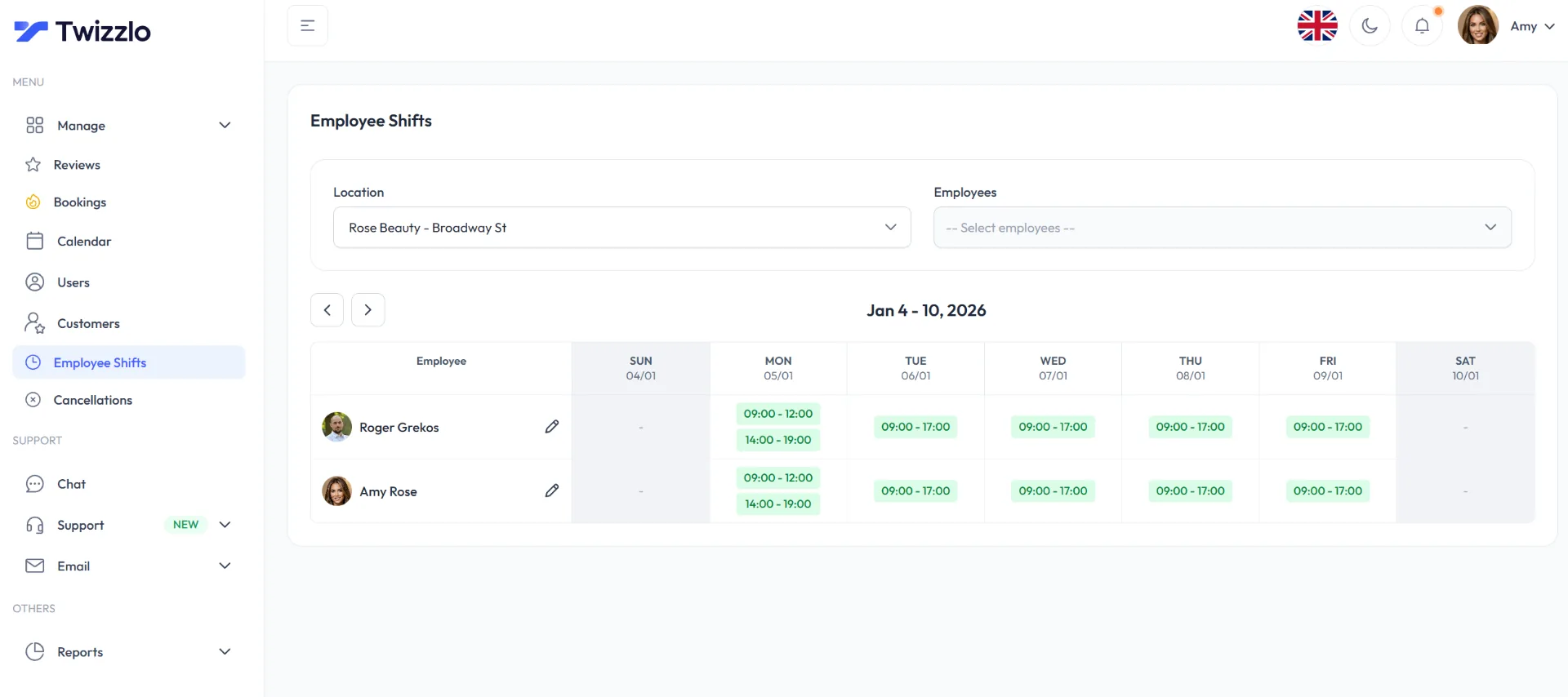
Twizzlo is web-based online booking and appointment scheduling software for appointment-based service businesses, with a public booking page, email and SMS reminders, client records, staff schedules and shifts, and Stripe payments and tips. It fits a salon that wants one price per business as it hires: both plans include unlimited staff and locations.
Free is $0 a month for up to 150 bookings with no SMS. Business Pro is $29.99 a month per business for unlimited bookings and 50 SMS a month, with a 30-day money-back guarantee. Extra SMS cost $0.03 each (pricing page, read September 28, 2026). Online payments carry your Stripe processing rate plus a 1.5% Twizzlo platform fee. Our guide to payment processing setup and cost tradeoffs shows how card fees add up.
At every row of Table 1, Business Pro stays $29.99 a month per business. Prepaid bookings take the full service price online when the client books, and Twizzlo's salon scheduling software page shows the salon setup.
Next to Twizzlo, Vagaro is the better fit for a salon that needs retail inventory and payroll inside the booking system, and Vagaro or Acuity, from its Standard plan, for one that sells memberships, packages or gift certificates or keeps a waitlist. Twizzlo does not run payroll, calculate commissions or sell memberships. Compare the two plans and start on Free.
Frequently Asked Questions
Is Vagaro or Acuity better for a single-location salon?
It depends on what the salon needs beyond booking. For one bookable calendar, Acuity Starter is $20 a month, or $16 billed annually, against Vagaro's $23.99, a limited-time rate (each vendor's page, read September 25, 2026). A salon that mainly needs booking, forms, reminders and payments may prefer Acuity's narrower focus; one that wants checkout, retail and payroll reporting in one system may lean toward Vagaro.
Which platform is easier to budget over time?
Acuity's bill changes at fewer points: three published tiers by calendar count at $20, $34 and $61 a month billed monthly, and its pricing page promises "no set-up fees, no cancellation fees, no support fees" (read September 25, 2026). Vagaro adds $10 a month per added calendar up to seven licenses plus any add-ons, on a $23.99 limited-time base whose later price its US help center does not print (read the same day).
What should franchise or multi-location operators ask during a demo?
Ask how each location is billed, how calendars or licenses count across sites, whether reports roll up across locations, and which tasks need add-ons or outside tools. Two facts frame the demo: Acuity's plan cards say to "use separate calendars per employee or location, depending on business needs" (read September 27, 2026), and Vagaro's US help center prints no subscription price for an added location (read September 25, 2026).
Does an all-in-one platform always reduce costs?
Not always. For three stylists who need online booking, intake forms and online deposits, Vagaro comes to $63.99 a month on its limited-time base with two $10 add-ons, Forms and the Online Shopping Cart, while Acuity Standard is $34 a month with forms and payments on the plan (vendor pages read September 25 and 27, 2026). The broader suite pays off only if the salon uses what it adds.
Is a scheduling-first platform risky for larger salons?
It can be, if the business outgrows the tools around the calendar. Acuity's pricing page lists no inventory, retail or payroll tool, so a larger salon runs those elsewhere; Premium, at $61 a month for up to 36 calendars, adds a "Custom API and CSS" for connecting them (read September 25 and 27, 2026). That doesn't make the model wrong. It means you need a deliberate integration plan.
What should I watch for during migration?
Don’t treat migration as calendar import alone. Review service setup, staff permissions, intake forms, client records, payment workflows, and location logic before switching. A platform can import appointments and still create operational issues if your pricing rules, add-on services, or staff assignment logic don’t transfer cleanly. The smoothest migrations start with workflow mapping, not just data export.
What is Vagaro used for?
Vagaro is business software built around an appointment calendar. Its US help center lists online booking, checkout with its own card processing, inventory and retail, payroll reporting, memberships and packages, and reminders in the base subscription, plus paid add-ons for forms, online deposits and a website builder (read September 25 and 28, 2026). Owners comparing the category should also review apps like Vagaro before committing.
How much is Vagaro per month?
Vagaro's US help center lists $23.99 a month, a limited-time rate, with one bookable calendar included and $10 a month for each added calendar up to seven licenses, so three calendars cost $43.99 against $34 on Acuity Standard (both read September 25, 2026). From seven licenses the bill stays at $83.99. Forms and the Online Shopping Cart cost $10 a month each, and the help center prints no price for after the offer.
Is Acuity cheaper than Vagaro?
At most team sizes, yes, on subscription alone. Billed monthly, Acuity is $20 against Vagaro's $23.99 limited-time rate at one calendar; $34 against $33.99 at two, the one count where Vagaro is a cent cheaper; $34 against $43.99 to $73.99 at three to six; and $61 against $83.99 from seven (vendor pages read September 25, 2026). If neither pricing model fits your growth plan, review a dedicated Acuity Scheduling alternative comparison before deciding.
Does Acuity Scheduling include intake forms and deposits on its cheapest plan?
Yes. Acuity's Starter plan card lists custom client forms and payments through Stripe, Square, PayPal or Venmo, and its compare table marks deposits as included on all three plans (pricing page, read September 27 and 28, 2026). On Vagaro, Forms and the Online Shopping Cart, which takes deposits at booking, cost $10 a month each (US help center, read September 25, 2026).
Do Vagaro and Acuity take card payments the same way?
No. Acuity connects outside processors (Stripe, Square, PayPal or Venmo) and prints no processing rate of its own (pricing page, read September 27, 2026). Vagaro runs its own processing: 2.6% + $0.10 per in-person payment under $4,000 a month in card sales, 2.29% + $0.19 above it with a $10 monthly Large Merchant fee, and FANF and Mastercard location fees it does not price (US help center, read September 27, 2026). It also sells Vagaro hardware, including an EMV card reader (read September 28, 2026).
Sources and methodology
Prices read
- Vagaro plans and pricing help article (US) (opens in a new tab)Read . Supports: Vagaro's $23.99 limited-time base rate, one included calendar, $10 per added calendar up to seven licenses, add-on prices and text credits; US card rates in the article's United States panel (re-read September 27, 2026); the free US Vagaro Marketplace listing (re-read September 28, 2026)
- Vagaro help article: features included in the base subscription (opens in a new tab)Read . Supports: Waitlist and booking rules, reminders, checkout and Vagaro hardware including an EMV reader, inventory and retail, payroll reporting with custom commission tiers, memberships, packages and gift cards, multi-location accounts
- Vagaro help article: Activate the Online Shopping Cart (opens in a new tab)Read . Supports: Online Shopping Cart: a card, a deposit or the full amount at booking; $10 a month in the US; requires Vagaro card processing
- Acuity Scheduling pricing page (opens in a new tab)Read . Supports: Starter, Standard and Premium prices billed monthly and annually, calendar limits, taxes excluded, 7-day trial, no free plan, no set-up, cancellation or support fees; plan-card features and the calendar-per-location line re-read September 27 and 28, 2026
- Twizzlo pricing page (opens in a new tab)Read . Supports: Twizzlo Free and Business Pro plans, SMS allowance, money-back guarantee, unlimited staff and locations, and the online payment fee
From our editorial policy
- Twizzlo sells online booking and appointment scheduling software, the same category we write about. Twizzlo appears in our comparisons and roundups, and we have a commercial interest in you choosing it.
- We do not publish invented quotes, studies, statistics, customer stories or product tests, and we do not imply hands-on use of a product when the research came from the vendor's public documentation.
- To report an error, email support@twizzlo.com with the subject line "Correction: [page URL]". Tell us what is wrong and, if you can, link a source.
Update history
- : Rebuilt on each vendor's own page: Acuity prices now shown monthly first, a cost table for 1 to 10 calendars and a three-stylist example added, third-party ratings and illustrations removed, Twizzlo payment fee added.
Start free, upgrade when you grow
Flat-rate booking software. No per-seat, per-chair or per-location fees.
- Free plan up to 150 bookings a month, not a trial
- Business Pro is $29.99 a month per business for unlimited bookings, with a 30-day money-back guarantee
- 24/7 support by email