
Barbershop booking software for appointments and walk-ins
Barbershop software that works like a barber app in any phone browser: clients book 24/7, peak slots are prepaid, reminders go out on their own, and every barber runs their own calendar.
Plans
- FreeUp to 150 bookings a month, not a trial
- $0/mo
- Business ProPer business: unlimited bookings, 50 SMS a month
- $29.99/mo
- Unlimited staff and locations on both plans
- 30-day money-back guarantee on Business Pro
- 24/7 support
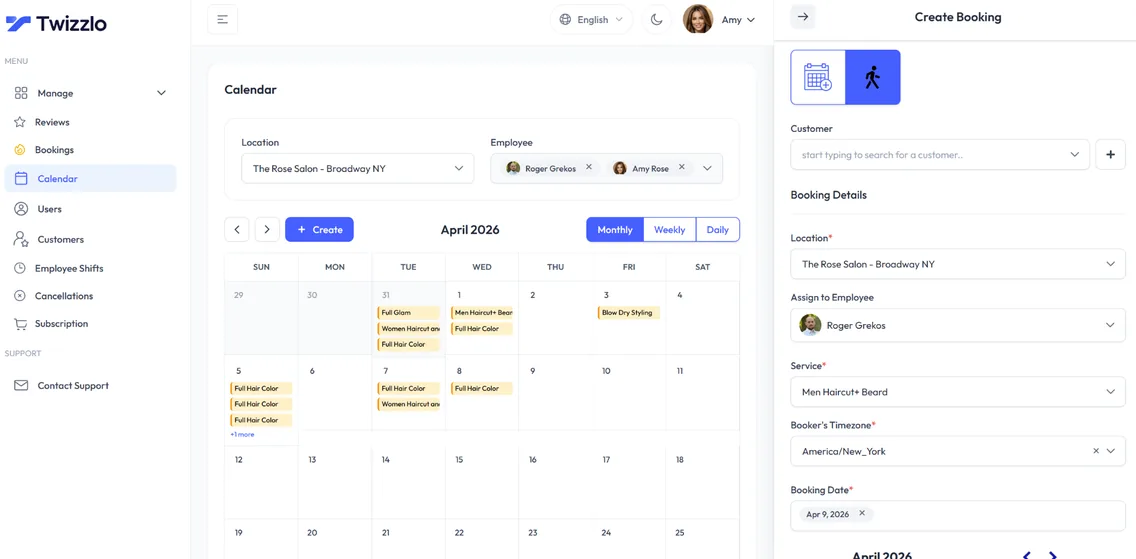
Twizzlo is barbershop software built for real chairs, not spreadsheets. It is barbershop booking software for a two-chair neighborhood shop or a multi-location brand: clients book 24/7 from your link in any phone browser, every appointment is confirmed by email (and by SMS on Business Pro), and you set a clear cancellation policy so your chair time is protected.
Twizzlo treats barbers as barbers. Assign fades, tapers, beard trims and hot-towel shaves to the barbers who do them, and take walk-ins alongside booked appointments on the same calendar. Prepaid bookings protect your peak slots, tips and Stripe checkout sit in the same flow, and the price is flat per shop, with no per-chair seat fees however many barbers you add.
Sound familiar?
Running a barbershop shouldn't feel like a full-time admin job.
Reschedules over DMs all day
Empty chairs at peak hours
Walk-ins and tips lost in paper books
On this page10 sections
Barbershop software and a barber app in one account
Barbershop software has two jobs: give clients an easy way to book from their phone, and give the shop a barbershop booking system it can run all day. Twizzlo does both from one account.
For clients, it works like a barber app without the download. They open your booking link, pick a service and a barber, see real-time availability and book. It is web-based, so it runs in any phone browser. Your team works from the same calendar on a phone, a tablet or the front-desk computer.
Still deciding between a barber shop app your clients download and software your shop runs on? Our guide to the best booking app for barbers splits the two.
Free barbershop booking software: what the Free plan covers
Twizzlo Free is $0 a month and free forever, not a trial. It includes the booking page, per-barber calendars, the client CRM, staff scheduling, insights and online payments with tips for up to 150 bookings a month. It does not include SMS, so confirmations and reminders go by email.
Text reminders and more than 150 bookings a month need Business Pro, and the cost table below shows both plans side by side. Start free, or see plans and payment charges.
What barbershop booking software costs in 2026
Per-barber pricing is where most shops feel the difference. The table prices a one-location shop with four bookable barbers, using each vendor's published plan prices on the date shown: the subscription and the payment charges you pay every month.
Monthly cost for a four-barber shop, one location, US prices before tax
Twizzlo Free
- How the plan is priced
- $0 per business: up to 150 bookings a month, staff unlimited, no SMS
- Monthly subscription, 4 barbers
- $0
- Online or card payment charges
- Stripe processing plus a 1.5% Twizzlo platform fee
Twizzlo Business Pro
- How the plan is priced
- $29.99/mo flat per business: unlimited bookings and staff, 50 SMS a month
- Monthly subscription, 4 barbers
- $29.99
- Online or card payment charges
- Stripe processing plus a 1.5% Twizzlo platform fee
Booksy (Sep 17, 2026)
- How the plan is priced
- $29.99/mo + tax with one team member, then $20/mo per additional member
- Monthly subscription, 4 barbers
- $89.99 + tax
- Online or card payment charges
- 2.69% + $0.30 for mobile payments or keyed entry. Optional Boost: 30% of a qualifying new client's first visit
Square Appointments (Sep 17, 2026)
- How the plan is priced
- Per location: Free $0, Plus $49/mo, Premium $149/mo. Staff calendars unlimited. Cancellation policy and no-show fees start on Plus
- Monthly subscription, 4 barbers
- $0 on Free, $49 on Plus
- Online or card payment charges
- Online: 3.3% + 30¢ on Free, 2.9% + 30¢ on Plus. In person: 2.6% + 15¢ on Free
Vagaro (Sep 8, 2026)
- How the plan is priced
- $23.99/mo base with one calendar (marked limited time), plus $10/mo per extra calendar up to seven
- Monthly subscription, 4 barbers
- $53.99
- Online or card payment charges
- Under $4,000 a month processed: 2.6% + $0.10 swipe or dip, 3.5% + $0.19 keyed in
GlossGenius (Sep 8, 2026)
- How the plan is priced
- Per business by tier. Standard has no staff management; Gold covers teams of fewer than 10
- Monthly subscription, 4 barbers
- Gold: $48 billed annually, $56 monthly
- Online or card payment charges
- Flat 2.6% on every plan
Setmore (Sep 8, 2026)
- How the plan is priced
- Per user: Free up to 4 users; Pro $12 per user a month, or $5 billed annually. SMS reminders and deposits need Pro
- Monthly subscription, 4 barbers
- $0 on Free; Pro $48 monthly or $20 billed annually
- Online or card payment charges
- Stripe at 2.9% + 30¢ in the US, per Setmore
Fresha (Jul 13, 2026)
- How the plan is priced
- Team plan: $14.95/mo per team member
- Monthly subscription, 4 barbers
- $59.80
- Online or card payment charges
- Processing varies by region. 20% (minimum $6) on new clients who find you through the Fresha marketplace
Prices are from each vendor's own pricing page on the date shown and can change, so check before you buy. Twizzlo's 1.5% platform fee applies to online payments, on top of your Stripe rate. Full breakdowns: Twizzlo vs Booksy, Twizzlo vs Square Appointments, Twizzlo vs Vagaro and every comparison.
Barber scheduling app features that matter at the chair
A barber scheduling app earns its keep on a busy Saturday, not in a demo. Here is the barber scheduling software a shop uses every day, all listed on the features page:
- A calendar per barber, with services assigned to the barbers who perform them
- Real-time availability, so a slot booked online disappears for every other client
- Buffer times between cuts for cleanup
- Individual schedules, staff shifts, time off and blackout dates
- Twizzlo access for each barber, with role-based access so staff see what they need
- Client self-rescheduling from the booking link, so fewer DMs land on your phone
- Email confirmations and reminders, plus SMS on Business Pro (50 a month, then $0.03 each)
Walk-ins plus appointments on one barbershop calendar
Most shops live on a mix of both. Twizzlo supports walk-in bookings, so when someone walks through the door you add them to a barber's calendar and the chair shows as taken. The booking page updates in real time, which stops an online client from grabbing the same slot a minute later.
That is the job of barbershop scheduling software: one book for the whole shop instead of a paper list for walk-ins and an app for appointments.
Payments follow the same flow: clients can tip when they pay online through Stripe, and staff can record manual payments such as cash.
Barber appointment software that protects your busiest hours
An empty chair at 5 pm on a Friday costs more than a slow Tuesday morning. Barber appointment software, and the barber appointment app your clients book from, should make those prime slots hard to waste. No barber shop appointment software can make every client show up, but it can make the cost of skipping clear before they book. For wording to post with it, including a late-arrival rule, start from our barber no-show policy template.
Need wording for the policy itself? See how to set a no-show charge. Then set it up with the tools Twizzlo's barbershop appointment software gives you:
- Prepaid bookings on any service: the client pays the full service price through Stripe when they book, and if they skip, you decide whether to keep or refund it
- No-show fees for missed appointments, under the policy you set
- Cancellation handling and custom booking rules for late changes
- Reminders by email before the appointment, plus SMS on Business Pro
Barbershop management software for a solo chair, booth rental or full shop
Barbershop management software should grow from a solo chair to a full floor without a new price every time you add a barber. Twizzlo prices by business, not by barber, so the plan does not change as you add chairs.
On the barber shop management software side, each barber gets a staff profile, their own Twizzlo access and a calendar of their own, and role-based access decides what each person can see and change. Front-desk staff can be set up as non-bookable, so they run the book without showing up as a barber clients can pick. Insights cover bookings, revenue and staff utilization, and unlimited locations cover a second shop when you open one.
A solo barber can run on Free (up to 150 bookings a month), and so can a booth renter who runs their own book: they open a separate Twizzlo account with their own booking link. A busy shop moves to Business Pro for unlimited bookings and SMS. If your shop also offers color and styling, see how Twizzlo works as salon scheduling software.
Opening or reorganizing a shop? Plan the floor with barber station dimensions and costs, and put chair rental terms in writing with a booth rental contract.
Barber booking system: one link for Instagram, Google and your website
A barber booking system only works if clients can find it. With Twizzlo's barber booking software, your booking page shows your services, prices and barbers with live availability, and each location gets its own booking link. Put that link in your Instagram bio, your Google Business Profile and your text replies, and it works as your shop's booking site from day one.
Online appointment software for barbershops should work the same way wherever a client finds you. Already have a website? Point its Book Now button at the same link, so Instagram, Google and your site all lead to one calendar and nobody types a booking in twice. To compare that route with a marketplace profile, a WordPress plugin or a custom site, read our guide to setting up a barber booking website. For more ways to bring new clients to your booking link, each with a cash cost and a time estimate, see our guide to barbershop marketing ideas.
Set up barbershop booking in six steps
- 1
Add your services
List cuts, fades, beard trims and shaves with a price, a duration and any buffer time.
- 2
Add your barbers
Create a profile for each barber, give them Twizzlo access and assign their services.
- 3
Set hours and shifts
Enter shop hours, each barber's schedule and shifts, and any time off.
- 4
Decide on prepayment
Turn on prepaid bookings for the slots you want to protect and write down your cancellation terms.
- 5
Connect Stripe
Take online payments and tips at booking. Online payments carry Stripe processing plus a 1.5% Twizzlo platform fee.
- 6
Share your booking link
Make a test booking, then post the link on Instagram, Google and your website. Add walk-ins as they arrive.
Built specifically for barbershops
24/7 online booking
Clients book appointments any time from your booking link, with real-time availability on any device.
Per-staff calendars
A calendar per staff member with real-time availability, buffer times, time off and blackout dates. Drag an appointment to reschedule it.
SMS & email reminders
Automated confirmations and reminders by email, plus SMS on Business Pro.
Client CRM
Every visit, note, preference, allergy and total spend saved to a searchable profile.
Prepaid bookings & tips
Collect online payments and tips at the time of booking through Stripe. Protect long slots with prepaid bookings: the client pays the full service price when they book.
Staff & shift management
Bookable and non-bookable staff, per-staff schedules, multi-location shifts, role-based access and assigned services, with unlimited staff.
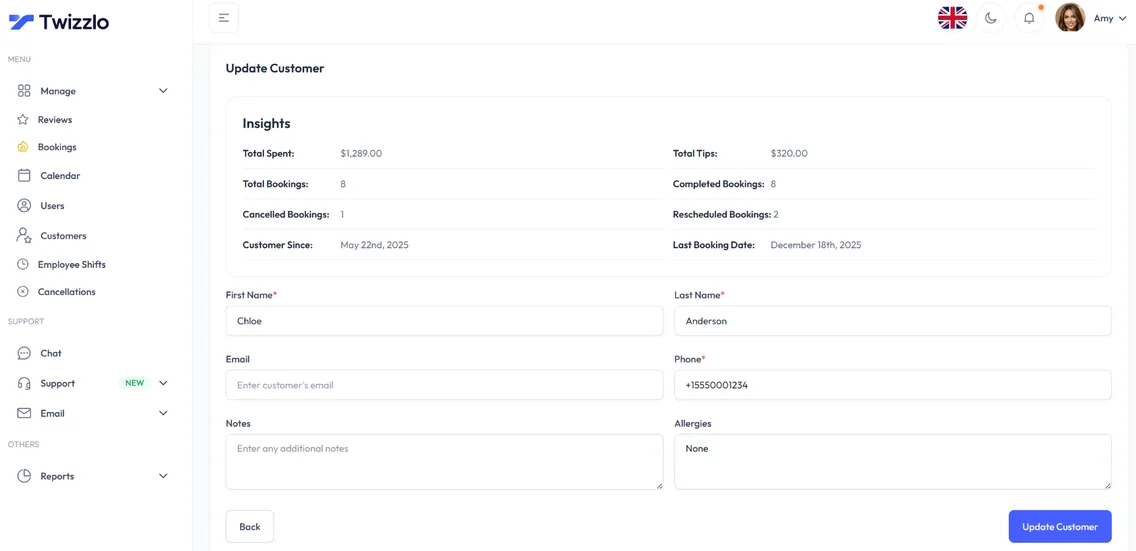
Know every client before they walk in
Total spend, bookings, last visit, notes and preferences sit on one client profile, so every barber knows the regular's usual before they sit down.
- Visit and spend history
- Notes, allergies and preferences
- Contact details on file
- Client search and filtering
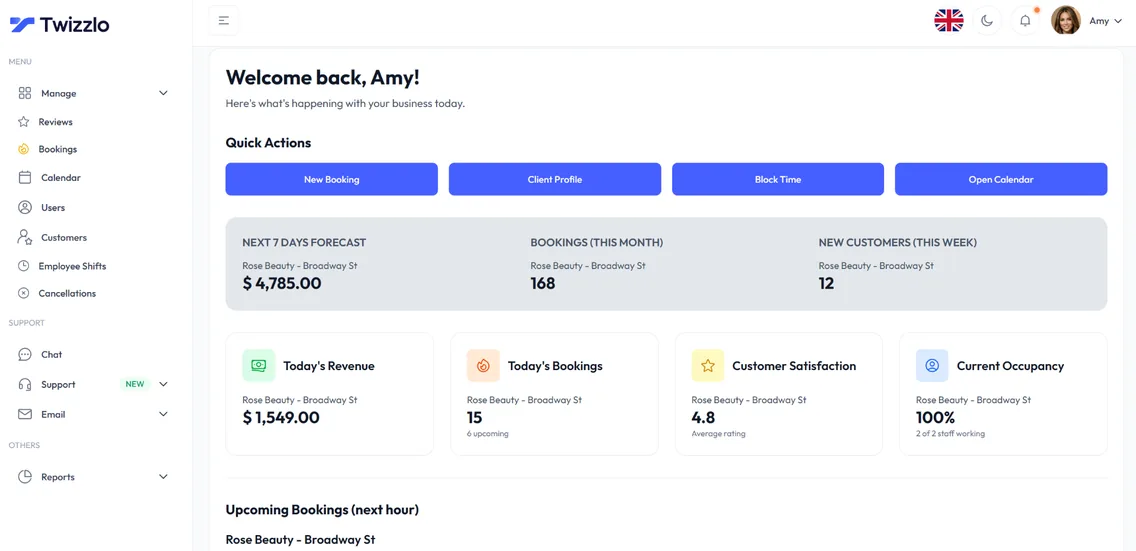
See what's working before the day starts
Bookings, revenue, next-hour insights and staff utilization are on the dashboard the moment you log in.
“Booking link everywhere, chairs full every Saturday. Reminders ended the no-show problem.”
Compare Twizzlo with other barbershop booking tools
Side-by-side comparisons of pricing, fees and features.
Barbershop booking software FAQ
What makes Twizzlo the right barbershop software for independent shops?
It covers booking, the calendar and payments at one flat price per shop, not per chair. Clients book 24/7 from your link, prepaid bookings protect peak slots, walk-ins share each barber's calendar, and tips come in through Stripe. Barbers are unlimited on both plans: Free covers up to 150 bookings a month, and Business Pro is $29.99 a month per shop for unlimited bookings and 50 SMS a month.
How do I stop double-booking barbers with scheduling software?
Twizzlo shows only open slots in real time. When a barber is booked at 3:00, the online booking page hides that slot from every client, on every device, in real time. Buffer times between appointments are respected too.
Can I use Twizzlo as a Squire or The Cut alternative?
Yes, if you need booking, client records, prepaid bookings, reminders and payments in one account. Barbers are unlimited on both plans: Twizzlo starts free for up to 150 bookings a month, and Business Pro is a flat $29.99 a month per shop for unlimited bookings and 50 SMS a month, with a 30-day money-back guarantee. Check any feature you rely on today before switching.
Is Twizzlo really free?
Yes. Free is $0 a month, free forever and not a trial. It covers up to 150 bookings a month with unlimited staff, locations and client records, real-time insights, email confirmations and reminders, and online payments and tips through Stripe. It does not include SMS reminders, which require Business Pro. There is no plan fee; online payments you take carry your Stripe processing rate plus a 1.5% Twizzlo platform fee.
How long does setup take?
There is nothing to install, and how long setup takes depends on how many services and staff you add. It is one short checklist: add your services with prices and durations, set your hours, add staff if you have a team, connect Stripe if you want online payments, then share your booking link.
Will Twizzlo reduce no-shows at my barbershop?
It helps. Reminders by email (and by SMS on Business Pro), prepaid bookings on long services and no-show fees give clients a reason to show up or reschedule in time, and clients can reschedule themselves from the booking link. If a client with a prepaid booking still does not show, you decide whether to keep or refund the payment.
Do clients need to download a barber app to book?
No. Twizzlo is web-based. Clients book from your link in any phone or computer browser, so there is nothing to install. Your barbers use the same calendar in their browser.
Can walk-ins and online appointments share one calendar?
Yes. Walk-in bookings are supported, so you add a walk-in to a barber's calendar and that time comes off the online booking page right away. One calendar covers both.
How do tips work in Twizzlo?
Clients can add a tip when they pay online through Stripe at booking or checkout. Staff can also record manual payments. Tips count toward each client's total spend on their profile.
What does Twizzlo cost for a four-chair barbershop?
Business Pro is $29.99 a month for the whole shop, with unlimited barbers and bookings and 50 SMS a month, then $0.03 each. Online payments carry Stripe processing plus a 1.5% Twizzlo platform fee. If the shop stays under 150 bookings a month and does not need SMS, Free is $0.
Does each barber get their own calendar and login?
Yes. Each barber gets a staff profile, their own Twizzlo access and a calendar of their own, with the services they perform assigned to them. Role-based access controls what each barber can see and change, and adding barbers never raises the price, because staff are unlimited on Free and on Business Pro.
Is there a barber appointment app for the shop, not just for clients?
Yes: Twizzlo is a web app. Owners and barbers open it in any browser on a phone, tablet or computer to check the day, add walk-ins and manage bookings, while clients book from your link. Nobody has to download anything.
Guides for barbershop owners
Best Booking App for Barbers in 2026: 8 Apps Compared
Best booking app for barbers in 2026: Booksy, SQUIRE, Square Appointments, StyleSeat and more, priced by shop size, with the fees each charges on new clients.
GuideBarber Station Ideas: Real Dimensions, Clearances and Costs
Barber station ideas measured: station and chair widths, the wall four chairs need, room depth for two rows, counter heights, prices and freight terms.
GuideBooth Rental Contract: A Guide for Salon and Spa Owners
What to put in writing before a barber rents a chair in your shop.
AlternativesBooksy Alternatives: Find Your Ideal Salon Platform
Booksy alternatives compared by billing unit and business type, with what each costs as your team grows and a seven-step plan to switch from Booksy.
Alternatives10 Best Apps Like Booksy for Businesses in 2026
Ten apps like Booksy compared on how clients find and book them, what each marketplace charges for a new client, and where your own booking page fits.
AlternativesStyleSeat alternatives: 8 apps priced against StyleSeat
StyleSeat alternatives and competitors: 8 apps like StyleSeat, from Squire to Vagaro, priced at 4 and 10 barbers against StyleSeat's 30% new-client fee.
ComparisonBooksy vs Square: What Each One Charges a Barbershop
Booksy vs Square Appointments for barbershops, chair by chair: subscriptions, card reader rates and break-even visit counts, from pages read September 25, 2026.
Start taking barbershop bookings online
Start with the Free plan, then choose Business Pro if you need unlimited bookings and SMS. Review the current plan limits and payment charges before choosing.
- Free plan, not a trial
- 30-day money-back guarantee on Business Pro
- 24/7 support