
Shedul Alternative for Scaling Businesses

In short
Shedul is Fresha's former name: the shedul.com homepage reads "Shedul has now rebranded to Fresha" and sends sign-ups to Fresha (read September 28, 2026). Fresha's pricing page lists paid Independent and Team plans and a one-time commission on new marketplace clients. Choosing a Shedul alternative means comparing how each platform bills: per location, per team member or per business.
- Square Appointments Free costs $0 per location with unlimited staff calendars; Plus is $49 a month per location (pricing page read September 25, 2026).
- Vagaro costs $23.99 a month, a limited-time rate, plus $10 a month per added employee calendar, up to seven licenses (read September 25, 2026).
- Before switching, list the client records, services and upcoming appointments you must keep, and confirm the new platform can import them.
Source: shedul.com homepage (opens in a new tab), read
In this article8 sections

Shedul is now Fresha, so anyone looking for a Shedul alternative is weighing Fresha's current plans against other booking platforms. This guide shows what changed, how four platforms bill a growing team and how to switch without losing bookings.
Twizzlo, which publishes this guide, is one of the platforms compared. Fresha's plan structure comes from its own pricing page (our Fresha pricing page covers it); other prices come from each vendor's own page, with read dates in the text and in the table's source column.
The Search for a Shedul Alternative Begins with Growth
A Shedul alternative matters most when the team or the location count grows, because platforms bill differently: per team member, per location or per business. The lowest price for one chair is not always the lowest for eight.

What operators should optimize for
Multi-location operators should prioritize:
- Budget predictability so hiring doesn’t trigger software surprises
- Centralized oversight across staff and locations
- Low admin burden for front-desk and management teams
- Fast rollout when opening or reorganizing locations
If your goal is stable growth, compare total cost of ownership rather than feature lists. Our guide to service business scaling strategies covers the rest of the growth plan.
What changes when you open another location
Single-location workarounds stop working. Managers need location-level visibility, schedule consistency, and reliable reporting. Owners need to compare performance without exporting data into spreadsheets every week.
That’s where friction shows up in practical ways:
- Booking control gets fragmented when multiple calendars are managed differently
- Training time rises when workflows aren’t intuitive across teams
- Reporting gets weaker when the dashboard wasn’t designed for operator oversight
- Budgeting gets harder when platform costs rise alongside growth
Our multi-location scheduling software guide compares how eight platforms bill a second site.
What features matter more than feature count
For a growing salon, these matter most:
| Priority | Why it matters operationally |
|---|---|
| Centralized calendar control | Reduces schedule conflicts and manual follow-up |
| Multi-staff visibility | Helps managers rebalance demand |
| Reliable reporting | Supports payroll, staffing, and marketing decisions |
| Stable pricing logic | Keeps the software bill predictable as the team grows |
If you need better visibility into service mix, staff performance or booking patterns, check which reports each platform includes; our guide to sales reporting software for service businesses lists the ones worth tracking.
Shedul Alternatives Comparison At a Glance
The table compares four platforms on how they bill and what one location pays each month at 3 and 8 team members, from each vendor's own page. Fresha's US prices could not be read, so its row shows the plan structure only.
On a small screen, scroll sideways to see all five columns.
| Platform | How it bills | 3 team members, per month | 8 team members, per month | Source and read date |
|---|---|---|---|---|
| Fresha | Paid Independent and Team plans; a one-time commission on new marketplace clients, returning clients free | US price not confirmed | US price not confirmed | Pricing page, September 25, 2026 (US prices not readable) |
| Square Appointments | Per location: Free $0, Plus $49, Premium $149 a month; unlimited staff calendars | $0 on Free, $49 on Plus | $0 on Free, $49 on Plus | Pricing page, September 25, 2026; plan grid, September 27, 2026 |
| Vagaro | $23.99 a month, a limited-time rate, with one calendar; $10 a month per added employee calendar up to seven licenses | $43.99 | $83.99 | US help center, September 25, 2026 |
| Twizzlo | Per business, two plans; unlimited staff and locations on both | $0 on Free (up to 150 bookings a month, no SMS) or $29.99 on Business Pro | $0 on Free (up to 150 bookings a month, no SMS) or $29.99 on Business Pro | Pricing page, September 28, 2026 |
Monthly subscriptions for one location before tax, card processing, texts and add-ons. Vagaro's $23.99 is a limited-time rate, and its help center prints no regular price. Square Appointments Free leaves no-show fees, cancellation policies and waitlists to Plus (plan grid, September 27, 2026).
Going from 3 to 8 team members raises Vagaro's subscription from $43.99 to $83.99 a month, while Square Appointments and Twizzlo stay the same at one location (vendor pages read September 25 and 28, 2026).
Read the table like an operator, not a shopper
The useful question is not which tool costs least today. It is which one stays manageable when you add staff, open another location and need better reporting.
That shifts attention to four buying criteria:
- How the vendor makes money
- Whether growth triggers extra fees
- Whether multi-location control is standard or an upgrade
- Whether the platform reduces admin or adds it
What Changed When Shedul Became Fresha
Shedul is Fresha's former name. The shedul.com homepage, still online, carries the line "Shedul has now rebranded to Fresha"; its LOG IN link opens Fresha's partner sign-in page and its sign-up buttons open Fresha's sign-up page (read September 28, 2026). Its older copy still calls Shedul free.
Fresha's pricing page, read September 25, 2026, lists paid Independent and Team plans, card processing fees and paid add-ons. It also charges a one-time commission on new clients who book through its marketplace; returning clients are free. That read showed Canadian prices, so Fresha's US prices are not confirmed here; check them from a US location.
Our Fresha alternatives guide compares ten options against Fresha's current plans.
In-Depth Review of Top Shedul Alternatives
A Shedul account has four main options: staying on Fresha, or moving to Square Appointments, Vagaro or Twizzlo. Each bills differently, which decides what a growing team pays.
Fresha fits owners who rely on its marketplace
Staying on Fresha avoids a migration, and its marketplace shows your business to new clients. Fresha charges a one-time commission on new clients who book through the marketplace, and returning clients are free (pricing page, read September 25, 2026). A salon that fills its book from Fresha's marketplace loses that channel when it leaves; a salon whose clients already book directly does not.
Square Appointments fits the Square ecosystem
Square Appointments charges per location: Free is $0, Plus $49 and Premium $149 a month (pricing page, read September 25, 2026). Every plan includes unlimited staff calendars, and Plus adds multi-staff booking, cancellation policies and no-show fees, a waitlist and multi-location management (plan grid, read September 27, 2026). Our Square Appointments pricing page lists the plans in full.
Square Appointments makes the most sense if your salon already depends on Square hardware, POS, or retail workflows. The benefit is ecosystem alignment. Payments, in-store transactions, and booking can sit closer together operationally.
The tradeoff is that you’re buying into a broader commerce system, not just an appointment engine. That’s unnecessary overhead for some operators, especially if services drive the business more than retail does. A salon with strong product sales and existing Square hardware may find the ecosystem efficient.
Vagaro fits feature-heavy operators
Vagaro appeals to businesses that want a broad all-in-one platform with many embedded options.
Vagaro's US help center lists $23.99 a month, a limited-time rate, with one calendar, plus $10 a month for each added employee calendar up to seven licenses (read September 25, 2026). Its base subscription includes memberships, packages, gift cards, classes, inventory and retail, and payroll reporting (features read September 28, 2026); Forms ($10 a month), MySite ($20 a month) and text marketing (from $20 a month for 1,000 credits) are paid add-ons (help center, read September 25, 2026). Our Vagaro pricing page lists its plan and add-ons.
Where Twizzlo fits a Shedul account
Twizzlo is web-based online booking and appointment scheduling software for appointment-based service businesses. It bills per business, not per team member or location. Twizzlo has two plans. Free is $0 a month for up to 150 bookings, with no SMS. Business Pro is $29.99 a month per business with unlimited bookings, 50 SMS a month (then $0.03 each) and a 30-day money-back guarantee. Hiring or opening a site does not change the price, because both plans include unlimited staff and locations. Online payments carry your Stripe processing rate plus a 1.5% Twizzlo platform fee. Support runs 24/7 by email at support@twizzlo.com.
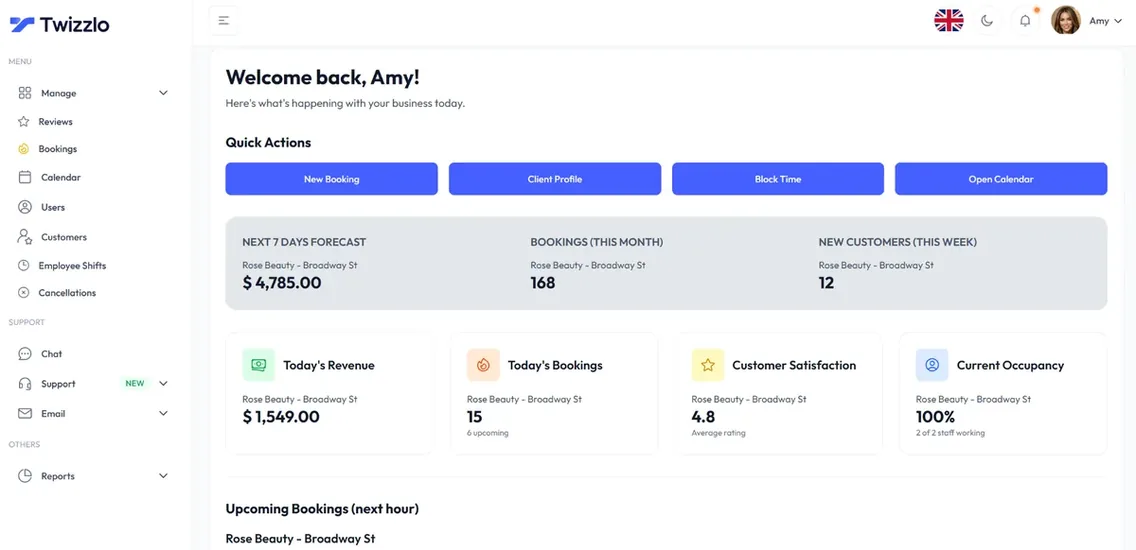
Twizzlo does not run a consumer marketplace, so it fits businesses that already bring in their own clients. Twizzlo does not run payroll, commission tracking or memberships.
See Free plan and Business Pro pricing, or our salon appointment software page for salons.
Which one is right for which operator
- Choose Fresha if its marketplace brings you new clients and you would rather not migrate; our fresha vs booksy comparison weighs its marketplace against Booksy's.
- Choose Square Appointments if your retail and payment operations already live inside Square.
- Choose Vagaro if you want memberships, packages and classes in one system and can budget per calendar; our vagaro vs fresha comparison sets the two side by side.
- Choose Twizzlo if you want one price per business as the team grows, with unlimited staff and locations.
How to Choose the Right Platform for Your Business Model
The right Shedul alternative depends less on industry labels and more on how your business operates. A single-location salon, a franchise group, and a hybrid mobile operator don’t need the same software economics.
The multi-location franchise
If you manage more than one location, predictable cost stability matters more than almost anything else. You need one operating model, one staff management approach, and one dashboard view that doesn’t become expensive every time you expand.
The growing single location
This operator isn’t a franchise yet, but the business is clearly beyond startup mode. You’ve added staff, service categories, and more front-desk coordination. You need fewer manual processes and cleaner reporting.
In this case, choose the platform that removes friction before you open the next location. The best time to switch is when the current system still works, but no longer fits where the business is headed.
The hybrid mobile and in-studio provider
If your staff serves clients in studio and in the field, the platform has to support location-flexible workflows without making scheduling messy. Check that it can hold travel time between visits and give each place its own hours.
Your Migration Checklist Moving from Shedul
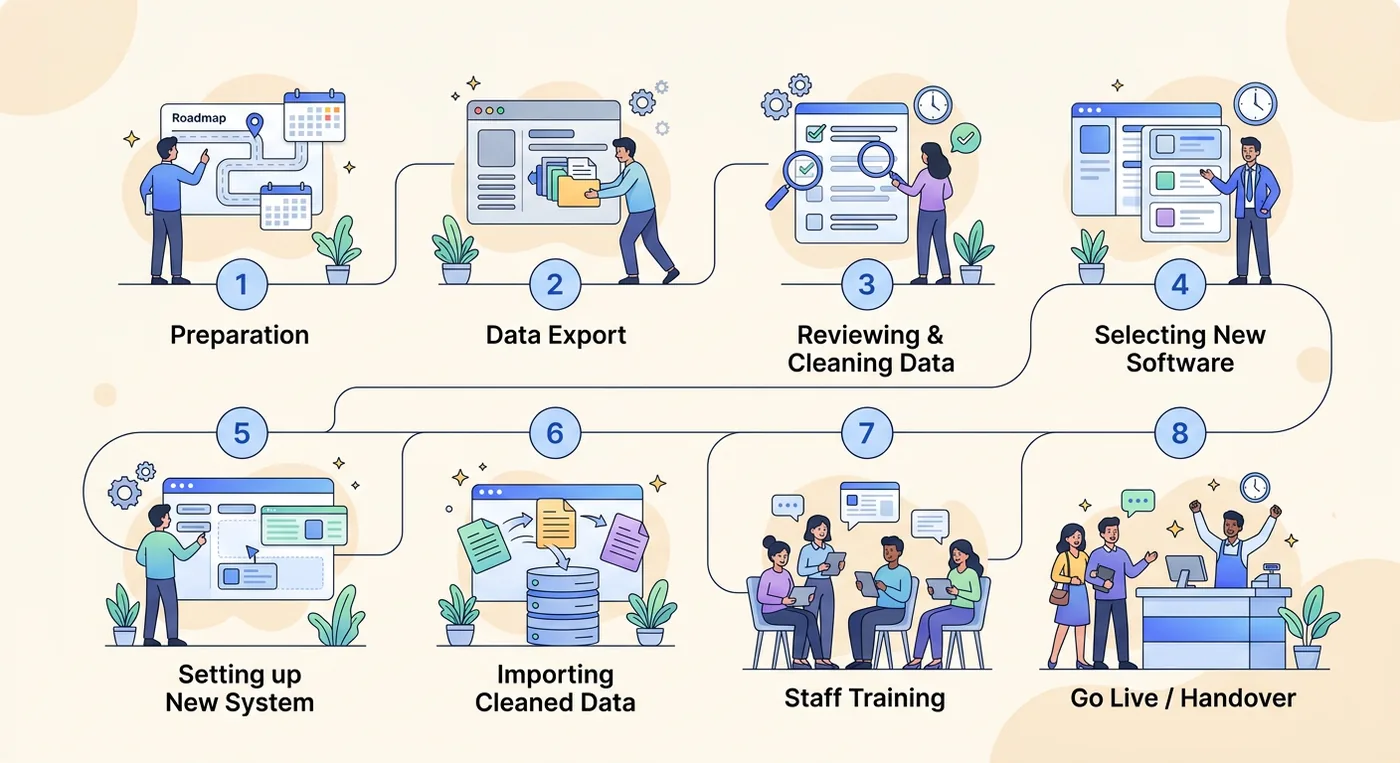
Moving off Shedul, now Fresha, starts with an audit of what your team uses every week, then moves through a staged rollout from data cleanup to the first live week.
Audit before you export
Start by listing what your team uses every week. That includes staff calendars, client records, service menus, recurring appointments, reminders, client notes, and reporting views. Decide what needs to survive the move before you export anything.
A simple salon example: if one location uses different service names or booking rules than the other, standardize them before import.
Roll out in phases
Use a staged plan.
- Clean your data before export
- Import core records first, including staff, services, and clients
- Publish booking pages and test internally
- Train managers first, then front-desk staff
- Notify clients with clear instructions
- Monitor the first live week closely for workflow issues
Our guide to user onboarding best practices for software rollout covers training staff on a new system.
Frequently Asked Questions
These answers cover moving data off Shedul, what alternatives cost and where Shedul accounts now live.
Can I migrate my client list from Shedul or Fresha
Yes, in most cases you can move core business data if the new platform supports import tools or assisted migration. Before switching, confirm that you can bring over client details, service lists, staff profiles, and upcoming appointments. Clean your data first so you don’t import duplicate clients, outdated services, or inconsistent staff naming.
What’s the main difference between a flat-rate platform and a free one
The business model. A flat-rate platform keeps your software cost stable as your operation grows. A free platform usually monetizes transactions, add-ons, or upgraded access. For a solo operator, that may be acceptable. For a multi-location salon, it creates budget uncertainty and makes software a variable cost tied to growth.
How long does a scheduling software switch usually take
It depends on your data quality and internal process discipline. A single-location salon with clean service and client records can move faster than a multi-location operation with inconsistent booking rules. The key variable is not the data export itself. It’s how quickly your team can configure services, train staff, and publish a live booking flow without front-desk confusion.
Do I need integrated payments to switch platforms
Not always. Some operators want booking and payments under one roof. Others prefer flexibility with separate payment workflows. The right answer depends on your checkout process, retail mix, and reporting needs. What matters most is clarity. Know whether the platform’s revenue model depends on payment usage before you commit.
What should I ask on a software demo
Ask questions tied to operations, not marketing. What is the all-in cost as you add staff and locations? How does the system handle peak booking periods? How quickly can a new location go live? What reporting can managers access without exporting spreadsheets? If the rep can’t answer cleanly, the platform probably won’t either.
Is Shedul still free
No. Shedul is now Fresha, as the shedul.com homepage states (read September 28, 2026), and Fresha sells paid Independent and Team plans. Its pricing page, read September 25, 2026, also lists card processing fees, paid add-ons and a one-time commission on new clients who book through its marketplace; returning clients are free. Fresha's US prices could not be read on that date, so check them from a US location.
What will a Shedul alternative cost each month
It depends on the billing unit more than the sticker price. On vendors' own pages read September 25, 2026, Square Appointments is $0 on Free or $49 a month per location on Plus, and Vagaro is $23.99 a month, a limited-time rate, plus $10 for each added employee calendar up to seven licenses. Fresha lists paid Independent and Team plans; its US prices could not be read on that date. Twizzlo Free is $0 a month for up to 150 bookings, with no SMS, and Business Pro is $29.99 a month per business, with unlimited staff and locations on both plans (Twizzlo pricing page, read September 28, 2026). For a growing team, multiply each model against next year's headcount before comparing numbers.
Is Shedul the same as Fresha
Yes. Shedul is Fresha's former name. The shedul.com homepage carries the line "Shedul has now rebranded to Fresha", and its sign-up buttons open Fresha's sign-up page (read September 28, 2026). Fresha's current plans and fees are therefore the ones to compare when you look for an alternative.
Where do Shedul users log in now
On Fresha. The LOG IN link on the shedul.com homepage opens Fresha's partner sign-in page at partners.fresha.com (read September 28, 2026). Owners planning a switch can sign in there to list the client records, services and upcoming appointments they want to move.
To test a switch, open a Free plan at Twizzlo and set up one service and one staff calendar before you move the rest.
Sources and methodology
Prices read
- shedul.com homepage (opens in a new tab)Read . Supports: the rebrand line, the LOG IN link to Fresha's partner sign-in page, the sign-up buttons to Fresha's sign-up page and the older copy that calls Shedul free
- Fresha pricing page (read outside the US) (opens in a new tab)Read . Supports: Fresha's Independent and Team plans, card processing fees, paid add-ons and the one-time commission on new marketplace clients, with returning clients free (wording only; the page showed Canadian prices, so no Fresha figure is stated)
- Square Appointments pricing page (US) (opens in a new tab)Read . Supports: Square Free, Plus and Premium prices per location; unlimited staff calendars and the features Plus adds (plan grid captured September 27, 2026)
- Vagaro plans and pricing (US help center) (opens in a new tab)Read . Supports: Vagaro limited-time base rate with one calendar, the price per added employee calendar up to seven licenses, and the Forms, MySite and text marketing add-ons
- Vagaro help center: Features Included in Your Base Subscription (opens in a new tab)Read . Supports: memberships, packages, gift cards, classes, inventory and retail, and payroll reporting in the base subscription
- Twizzlo pricing page (opens in a new tab)Read . Supports: Twizzlo plans, booking cap, SMS allowance, unlimited staff and locations, money-back guarantee, 24/7 support and the online payment fee
- Twizzlo homepage (opens in a new tab)Read . Supports: the home dashboard screenshot (same image)
From our editorial policy
- Twizzlo sells online booking and appointment scheduling software, the same category we write about. Twizzlo appears in our comparisons and roundups, and we have a commercial interest in you choosing it.
- We do not publish invented quotes, studies, statistics, customer stories or product tests, and we do not imply hands-on use of a product when the research came from the vendor's public documentation.
- To report an error, email support@twizzlo.com with the subject line "Correction: [page URL]". Tell us what is wrong and, if you can, link a source.
Update history
- : Explained the Shedul-to-Fresha rebrand with a dated source, replaced unconfirmed Fresha prices, added dated prices for three alternatives at 3 and 8 team members, and removed off-topic sections.
Start free, upgrade when you grow
Flat-rate booking software. No per-seat, per-chair or per-location fees.
- Free plan up to 150 bookings a month, not a trial
- Business Pro is $29.99 a month per business for unlimited bookings, with a 30-day money-back guarantee
- 24/7 support by email