
10 Best Apps Like Booksy for Businesses in 2026

In short
Apps like Booksy include Fresha, Vagaro, Square Appointments, GlossGenius, Timely, Boulevard, StyleSeat, Mindbody, Squarespace Scheduling (Acuity) and Twizzlo. Choose on two points: first, whether you want a client marketplace that finds new clients for you and what it charges for each one; second, how your monthly price changes as you add staff and locations.
In this article18 sections

Your booking app can gradually become your most expensive operational bottleneck. You add staff, open another room, extend hours, and suddenly the software that looked affordable at the start is charging more for the same core workflows you already depend on. Per-seat fees creep up. Messaging costs expand. Features you assumed were standard sit behind a higher plan.
If you’re evaluating apps like Booksy, treat this as a cost control decision, not a feature-shopping exercise. Booksy operates at real consumer scale: the Google Play listing for its customer app, read September 27, 2026, invites users to join over 50 million clients who use Booksy, which tells you mobile booking is now a mainstream expectation, not a nice-to-have. But mainstream demand doesn’t mean every pricing model works for a growing operator.
This guide focuses on total cost of ownership, operational fit, how each app reaches clients, and how each platform behaves when your business gets more complex. Twizzlo publishes this guide and is one of the ten apps in it. For Booksy’s own plans and fees next to Twizzlo’s, see Booksy pricing; if you have already decided to leave Booksy, our Booksy alternatives guide covers switching step by step.
Key Takeaways
- Booksy’s current model is a flat base plus per-staff fees: $29.99 a month plus tax with all features included, and each additional team member at $20 a month, per Booksy’s own pricing page, read September 25, 2026. Alternatives differ mainly in how they charge for growth, not in whether they can take bookings.
- Some marketplaces charge for demand: Fresha charges a one-time fee on new marketplace clients and Booksy’s optional Boost charges a one-time 30% fee based on the total cost of a Boost client’s first visit (same Booksy page, read September 25, 2026), so acquisition-priced software suits acquisition-led businesses.
- Price the platform for the team you’ll run in 12 to 24 months, not the team you have today. Per-seat fees, per-location tiers, and feature gates compound exactly when you add staff and rooms.
- Flat-rate options are easier to forecast: Twizzlo Business Pro ($29.99 a month per business) and StyleSeat (one price for up to 15 chairs) do not charge per team member; Booksy does, and so does Timely up to seven staff (vendors’ pricing pages, read September 25 and 27, 2026). Message and payment fees still grow with use.
What are apps like Booksy
Apps like Booksy are scheduling platforms for appointment-based businesses that combine online booking, calendar management, client records, staff coordination, reminders, payments, and sometimes marketplace discovery. A primary difference between vendors isn’t just booking UX. It’s how they charge as your team, locations, and operational complexity grow. Several of them, Booksy included, also run a client marketplace where people search for businesses near them, and Booksy, Fresha, StyleSeat and Vagaro publish a fee on certain new clients who book through it.
How apps like Booksy reach clients: marketplace apps and your own booking page
Apps and sites like Booksy reach clients in two ways: through a client marketplace app that lists your business next to others, or through your own booking page that clients open from your website, social profiles or a link you send. Booksy, Fresha, Vagaro, Square Appointments, StyleSeat and Mindbody offer both; the other five apps in the table describe your own booking page, links and website tools.
Table 1. How eleven apps reach clients, with Booksy as the reference row. “None” and “Not stated” mean not on the vendor pages we read.
| App | Client marketplace (as the vendor names it) | Fee for a new marketplace client (as published) | Where clients book with you |
|---|---|---|---|
| Booksy (reference) | Booksy Marketplace, on the Booksy website and customer app; listing free with the subscription | Only with Boost on: a one-time 30% fee based on the total cost of a Boost client’s first visit | Your Booksy profile and booking link, Instagram, Google, Facebook |
| Twizzlo | Your own Twizzlo booking page | Not applicable. Online payments carry your Stripe processing rate plus a 1.5% Twizzlo platform fee. | Online booking page, one link per location, open 24/7 |
| Fresha | Fresha marketplace and customer app | A one-time fee on new marketplace clients | Fresha marketplace, your website, Google, social media |
| Vagaro | Vagaro Marketplace and customer app | Marketplace listed as free; optional Fill My Books: 20% when a new customer books for the first time, 5% when a returning customer books | Your Vagaro Page; a MySite website (add-on) |
| Square Appointments | Square Go marketplace app, for eligible beauty and personal care businesses | None; Square says Square Go is “completely free for businesses and clients to use” | Booking website, Book Now button, QR code or embedded widget; the Square Go app |
| GlossGenius | None | Not stated | Booking website; no client login or app download |
| Timely | None | “No new client fees” | 24/7 online booking, mini website, Instagram, Facebook and Messenger buttons |
| Boulevard | None | Not stated | Client self-booking; an AI Receptionist that answers calls |
| StyleSeat | StyleSeat marketplace and Search | Optional New Client Connection: 30% of the new client’s first appointment, $50 maximum | Your StyleSeat profile, portfolio and open slots |
| Mindbody | Mindbody consumer app | Not stated | Mindbody app, your website, optional branded app |
| Squarespace Scheduling (Acuity) | None | Not stated | Branded scheduling page or embedded scheduler |
Sources, read September 25, 2026: Booksy’s pricing page, StyleSeat’s help center and Timely’s pricing page (USA region). Read September 27, 2026: Booksy Biz homepage, Fresha for business, Vagaro’s Pro page (Canadian edition served), Vagaro’s US help center on Fill My Books, Vagaro’s US plans article, Square’s Appointments pricing page, Square’s Appointments page, Square’s Square Go page, GlossGenius’ pricing page, Boulevard’s homepage, StyleSeat for pros, Mindbody’s business homepage, Acuity’s homepage and Acuity’s website builder page. Fresha’s fee amount is omitted because its US price list could not be read.
1. Twizzlo
Twizzlo is web-based online booking and appointment scheduling software for appointment-based service businesses, and its Business Pro plan costs $29.99 a month per business with unlimited staff, locations and bookings.
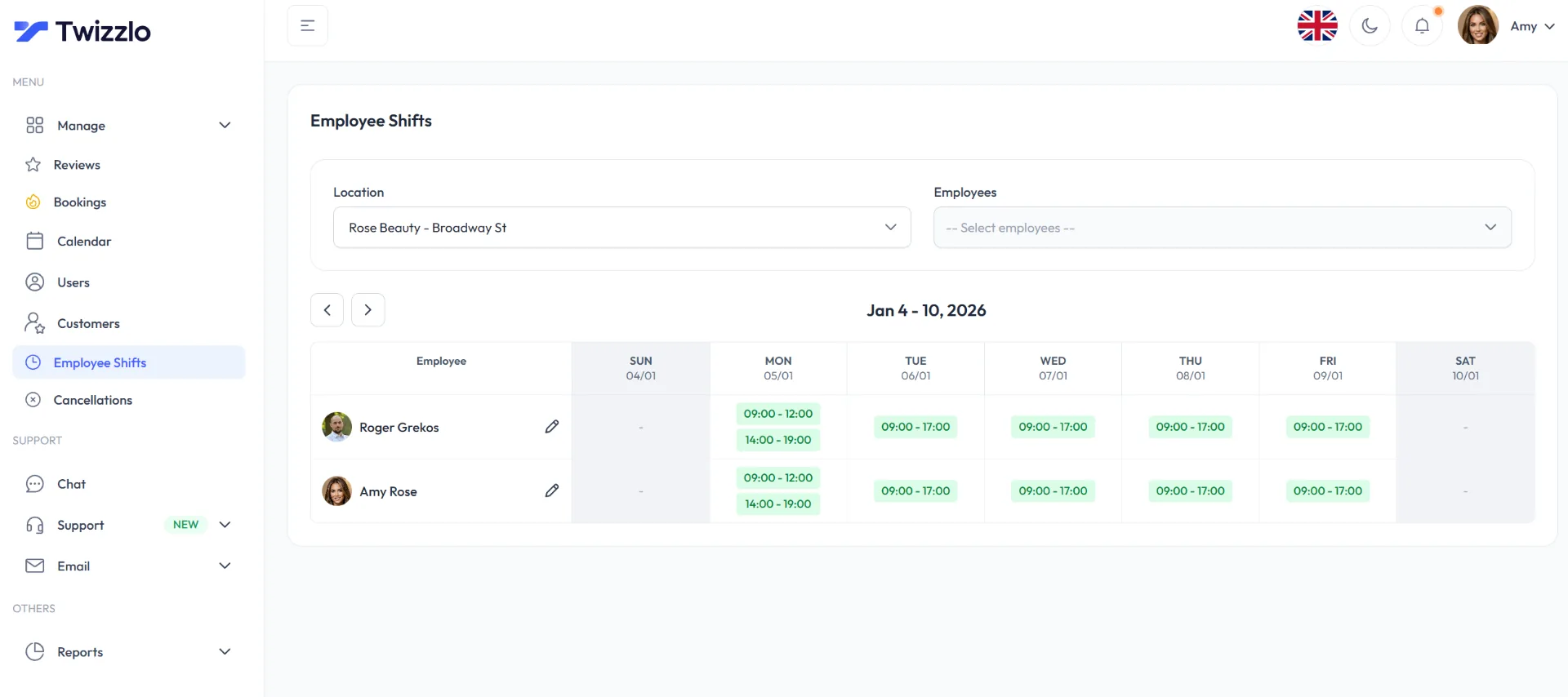
You hire two more providers, add a second location, and start relying on reminders to reduce no-shows. That is usually the point where scheduling software stops looking affordable. That is the point where a per-business price matters.
That pricing structure matters more than flashy feature lists.
Most Booksy alternatives get expensive as your operation gets healthier. Per-seat charges, per-location upgrades, and tiered feature gates push your software bill up right when you are expanding headcount and capacity. Twizzlo’s Business Pro price does not change with staff or location count. Other apps on this list bill by other units: StyleSeat’s one price covers up to 15 chairs, Square Appointments and Mindbody price per location, and Booksy adds a charge for each team member, as Timely does up to seven staff (vendors’ pricing pages, read September 25 and 27, 2026).
Twizzlo’s total cost of ownership
The model is simple. Twizzlo has two plans, Free and Business Pro, and both include unlimited staff and locations, with no per-user fees or location upcharges. Business Pro includes every Twizzlo feature, with no paid modules or add-ons.
For an owner comparing software across a one-year or two-year horizon, that changes the math. You can forecast software cost without guessing how many team members you will add or which admin features will sit behind a higher tier later.
Twizzlo covers the operational core you need to run the business: online booking, payments and tips, client CRM, automated reminders, prepaid bookings, cancellation controls, staff scheduling, and multi-location management. That gives you scheduling, revenue collection, and day-to-day control in one system instead of forcing workarounds.
Buying rule: If pricing increases every time you add staff or locations, your platform is increasing overhead instead of supporting scale.
Twizzlo Free is $0 a month for up to 150 bookings, with no SMS, and it is free forever, not a trial. It is useful if you are replacing manual booking, shared calendars, or a basic app that no longer fits, and you can test the workflow before committing.
Best fit
Choose Twizzlo if your priority is cost control as the business grows. It fits salons, spas, studios, barbershops, mobile service operators, and multi-location teams that want centralized scheduling and client management without tier-based surprises. Twizzlo does not run a consumer marketplace, so it fits businesses that already bring in their own clients.
If you want to compare direct scheduling workflows, Twizzlo’s Google appointment scheduler alternative is useful for evaluating how a controlled, direct-booking setup should work.
2. Fresha

Fresha is a good option if new client discovery matters as much as back-office control. It combines booking, POS, payments, marketing, and a consumer marketplace that can help salons and wellness businesses get found.
You don’t just get software. You get access to demand. For some operators, especially independents or early-stage teams, that can justify a marketplace-based model.
The tradeoff is control. Marketplace-led platforms can help fill the calendar, but they can also reduce your ownership over branding, repeat booking flow, and cost predictability as usage expands.
Where Fresha makes sense
Choose Fresha if your primary problem is getting discovered, not managing a complex multi-location operation. If you need built-in POS, payments and marketplace exposure in one system, it has strong coverage.
- Best for acquisition-first businesses: Good when client volume is the biggest immediate challenge.
- Strong commerce layer: Useful if taking payments online and in-store, including on a Fresha terminal, is central to your business model.
- Watch variable costs: Marketplace and messaging costs require closer review than the headline value proposition suggests.
An owner opening a new beauty studio in a competitive neighborhood may accept marketplace economics for faster visibility. An established brand with strong repeat business usually won’t want to keep paying for traffic it can generate through its own channels.
For the two marketplaces side by side, see Fresha vs Booksy.
Review the product at Fresha.
3. Vagaro

Vagaro is the platform for owners who want a broad feature set and are willing to manage a more modular setup. Scheduling, CRM, forms, marketing, website tools, and marketplace exposure are all in the mix. That breadth is useful. It also creates pricing complexity.
Many buyers make an error. They compare base plans instead of asking what the platform costs once they enable the features their staff will use every day.
The real buying question with Vagaro
Vagaro can work well for beauty, wellness, and fitness businesses that want flexibility. But flexibility often means add-ons, extra configuration, and more decisions during rollout.
A med spa manager, for example, might like the ability to assemble a stack around forms, payroll, and advanced operational tools. A small salon owner usually doesn’t want to assemble software. They want booking, reminders, deposits, and staff management to work without a pricing puzzle.
Marketplace software is rarely expensive at the point of comparison. It becomes expensive at the point of operational dependence.
If your team has someone who can own setup and vendor management, Vagaro is worth a close look.
Schedulicity, which earlier versions of this guide listed, is now part of Vagaro: on September 25, 2026, Schedulicity’s homepage and pricing page redirected to Vagaro, whose Schedulicity page says “Schedulicity is now Vagaro.” Former Schedulicity users can compare each Schedulicity alternative on its own terms.
Visit Vagaro Pro.
4. Square Appointments

Square Appointments is the logical choice if your business already runs on Square hardware, payments, or payroll. In that setup, adoption friction is low because the scheduling product plugs into systems your staff already know.
Its strength isn’t novelty. It’s ecosystem alignment.
Where Square wins
Square works best when the front desk, checkout flow, and reporting are already centered on Square. Salons, barbershops, and appointment-driven retail businesses can benefit from keeping booking and payment operations in one vendor stack.
It also supports deposits, cancellation fees, waitlists, resource management, and booking buttons across channels, with cancellation fees and the waitlist from Square Plus and resource management on Square Premium, per Square’s Appointments pricing page, read September 27, 2026. That’s enough for many owner-operators who need practical scheduling without a marketplace strategy.
- Best for Square-native businesses: Strong fit if replacing the scheduling layer only.
- Good operational continuity: Staff training is easier when payments and appointments live in the same ecosystem.
- Review tier boundaries carefully: Messaging, rate benefits, and some capabilities improve higher up the stack.
A barber shop with Square terminals at every station will usually move faster with Square Appointments than with a disconnected booking tool. But if your long-term plan includes multiple locations and centralized capacity management, compare the software cost path before committing.
For a head-to-head on what each charges a barbershop, see Booksy vs Square.
You can review it at Square Appointments.
5. GlossGenius

GlossGenius suits beauty businesses that want a polished client experience without wrestling with a complicated admin layer. It has strong visual presentation, straightforward onboarding, and good support for websites, payments, inventory, memberships, and packages.
The biggest appeal is clarity. Operators who are tired of clunky interfaces usually respond well to it.
When to pick GlossGenius
Choose GlossGenius if you’re a solo provider or small beauty team that values ease of use, brand presentation, and simple daily workflow over deep operational customization. It can be a very good fit for independent stylists, estheticians, and boutique studios.
The limitation is scale architecture. Once your needs shift toward broader admin control, more complex staffing structures, or specialized workflows, you’ll feel the edges sooner than you would on software built around multi-location operations.
A growing lash studio with a small team may find GlossGenius ideal at first because it removes admin friction. The same business may later want stronger centralized controls if it adds another location or expands service lines.
For its plan prices by team size, see GlossGenius pricing.
Review GlossGenius.
6. Timely

Timely is booking software priced by the number of bookable staff, like Booksy’s per-member add-on, so its bill also grows with each hire up to seven staff. Timely’s pricing page, read September 25, 2026, with the USA region selected, lists $26, $39 or $47 a month for one staff member on the Build, Elevate and Innovate plans, with 100, 200 or 350 SMS a month included for each staff member. The same page says part-time staff members are currently charged at the same rate and lists “No new client fees” on every plan. On September 27, 2026, the same US page showed that each staff member after the first adds $24, $29 or $36 a month up to seven staff; Build is offered only to salons with one to seven staff, and from eight to 19 staff Elevate and Innovate cost a flat $241 or $300 a month.
Where Timely fits
Not every business needs a marketplace, branded app, or multi-layered add-on ecosystem. Plenty of service businesses need online booking, dependable reminders, basic marketing, and a payment flow that staff can learn quickly.
Timely covers that list: its homepage and pricing page, read September 27, 2026, show 24/7 online booking, a mini website, social booking buttons, SMS and email reminders, consultation forms and payments. It suits a stable team that wants texts included and no fee on new clients, and a team of eight to 19 staff pays a flat total on Elevate or Innovate. The watch-out: up to seven staff, every added staff member, part-timers included, raises the monthly bill.
For plans and switching options, see our guide to Timely pricing.
Visit Timely.
7. Boulevard
Boulevard sells a flat Essentials plan for up to 5 providers and per-location Premier and Prestige plans, according to Boulevard’s pricing page, read September 25, 2026.

A salon with one location can absorb premium software. Add a second or third site, more front-desk staff, and tighter reporting requirements, and the cost structure starts to matter fast. That is the right lens for evaluating Boulevard.
Boulevard is built for established salons, spas, and med spas that want tighter control over scheduling logic, client records, messaging, reporting, and the in-store experience. It fits operators with formal processes and enough administrative discipline to use the system well.
Where Boulevard makes sense
Boulevard is a strong fit if you already run a structured business with a manager, defined workflows, and a front desk that follows process. In that setting, better service sequencing and cleaner reporting can improve utilization and reduce operational drag.
The problem is total cost of ownership.
Boulevard sits in the premium tier, and premium platforms often become more expensive as you add seats, providers, or locations. That matters if growth is your plan. Software that looks reasonable at one site can become a margin leak across a multi-unit business. If that is your direction, compare Boulevard against a flat-rate option for multi-location scheduling before you commit.
Buy Boulevard if your operation already behaves like a scaled business. Skip it if you are still building the systems, staff accountability, and reporting habits needed to justify enterprise-style software. Owners who want Boulevard’s structure with a simpler price can compare each Boulevard alternative on how it charges per location.
Visit Boulevard.
8. StyleSeat

StyleSeat is best understood as a marketplace-plus-software product for independent beauty professionals. If you’re solo and want visibility, booking, reminders, payments, and some revenue tooling in one place, it’s built for that model.
It is not the strongest choice for businesses trying to build fully owned operations across teams and locations.
Best for independents, not operators building infrastructure
The attraction is reach. Marketplace visibility can help solo professionals fill gaps in the calendar, particularly when they don’t yet have strong direct demand or referral momentum.
The tradeoff is familiar. The more you rely on a marketplace for client acquisition, the less control you have over cost stability and channel ownership.
A solo stylist renting a chair may get real value from StyleSeat because discovery matters more than operational complexity. A salon owner trying to build a branded repeat-booking engine should prioritize owned channels and direct client retention instead.
Visit StyleSeat.
9. Mindbody

Mindbody sits at the heavier end of this market. It supports fitness, wellness, spa, and beauty businesses with scheduling, POS, reporting, staff management, marketing, branded app options, and marketplace visibility through its consumer ecosystem.
This is software for operators with broader scope and more moving parts.
Who should shortlist Mindbody
Mindbody is a valid contender if you run a studio, spa, or wellness business with multiple service types, higher reporting needs, and growth plans that may include additional locations. It is especially relevant when one business spans classes, appointments, memberships, and layered customer journeys.
The downside is decision load. More capability often means more plan evaluation, more setup effort, and a less predictable total software bill over time.
A wellness operator with classes, treatment rooms, and retail may get value from Mindbody’s ecosystem breadth. A smaller appointment-only business usually won’t need that level of complexity. If you’re weighing simplification, this Mindbody alternative shows what a flatter pricing model looks like.
Review Mindbody.
10. Squarespace Scheduling (Acuity)

Squarespace Scheduling, still widely associated with Acuity, is a solid choice for solo and small service businesses that care about forms, calendar syncing, and easy website embedding. It works well when your booking flow is closely tied to your web presence.
It is less compelling when staffing complexity becomes the core problem.
A strong web-first option
For consultants, coaches, tutors, and small service brands, Acuity remains attractive because it’s flexible, recognizable, and simple to embed into an existing website. It also supports intake forms, reminders, packages, and processor flexibility, with payments through Stripe, Square, PayPal or Venmo, per Acuity’s pricing page, read September 27, 2026.
Where it starts to fall short is centralized operational control. Once you add more staff, more locations, or more front-desk coordination, you may want software that is built first for operations and second for web embedding.
A solo wellness practitioner can run smoothly on Acuity for years. A salon manager coordinating multiple providers usually needs something stronger. If that’s your situation, this Acuity Scheduling alternative is the right comparison path.
Visit Squarespace Scheduling.
Top 10 Apps Compared: Features and Pricing Models
Apps like Booksy differ most in what they bill for: Booksy, Timely and Vagaro charge more as you add team members or calendars, Square Appointments and Mindbody price each location, StyleSeat prices one account up to 15 chairs and Twizzlo prices per business. Table 2 compares all ten on core features, pricing model and audience, from each vendor’s own pages.
Table 2. Core features, pricing model, audience and selling points.
| Product | Core features | Pricing model | Target audience | Unique selling points |
|---|---|---|---|---|
| Twizzlo | All‑in‑one booking, CRM, Stripe payments, staff & multi‑location scheduling, email reminders and SMS on Business Pro | Business Pro $29.99 a month per business; Free $0 for up to 150 bookings a month, no SMS | Salons, spas, barbershops, studios, mobile services, multi‑location teams | Unlimited staff and locations on both plans; built‑in insights |
| Fresha | Booking, POS, payments, marketing, consumer marketplace | Paid plans and a one-time fee on new marketplace clients | Salons, spas, barbers, wellness businesses | Consumer marketplace for client discovery |
| Vagaro | Scheduling, CRM, POS, website builder, marketing, add‑ons | Per‑calendar pricing + paid add‑ons; flexible but can add up | Salons, spas, fitness studios, multi‑location shops | Modular add‑ons, including payroll |
| Square Appointments | Scheduling + Square POS/hardware, deposits, multi‑location, waitlists | Free, Plus and Premium, priced per location | Salons, barbers, service businesses using Square | Deep payments & hardware integration |
| GlossGenius | Booking site, payments, inventory, memberships, AI growth tools | Flat 2.6% processing, no free plan; plans by staff size | Salons, spas, solo pros | Clean UX, flat processing, free same‑day payouts Monday to Thursday |
| Timely | Online booking, SMS and email reminders, online and in-salon payments, consultation forms | Per staff member up to 7 staff, then a flat Elevate or Innovate total from 8 to 19; SMS included by plan; no new client fees | Salons and beauty teams with a stable staff count | Digital consultation forms; booking buttons on Instagram, Facebook and Messenger |
| Boulevard | Precision Scheduling, client self-booking, client profiles, AI Receptionist | Essentials flat up to 5 providers; Premier and Prestige per location | Multi‑location salons, med‑spas, established operations | Precision Scheduling for the calendar; AI Receptionist for calls |
| StyleSeat | Marketplace + booking, deposits, reminders, Smart Pricing | One price per account up to 15 chairs; optional new-client fee | Independent stylists, micro‑salons | Marketplace discovery and optional Smart Pricing |
| Mindbody | Scheduling, POS, marketplace, marketing, reporting | Quote-based, per location, unlimited users | Fitness studios, wellness centers, franchises | Mindbody consumer app, optional branded app, deep vertical tools |
| Squarespace Scheduling (Acuity) | Calendar sync, intake forms, packages, payment flexibility | Flat per account by number of calendars | Solo practitioners, website owners | Strong forms/intake, easy website embedding |
Sources, read September 25, 2026: Fresha’s pricing page, Vagaro’s help center, Square’s Appointments pricing page, GlossGenius’ pricing page, Timely’s pricing page (team totals by staff count read September 27, 2026), Boulevard’s pricing page, StyleSeat’s pricing page and help center, Mindbody’s pricing page and Acuity’s pricing page; feature lines from the Table 1 sources, read September 27, 2026; Twizzlo from twizzlo.com/pricing/.
Apps like Booksy: what a team pays each month
Apps like Booksy differ most in what happens to the bill as you add people. Booksy's published price, on Booksy’s pricing page, read September 25, 2026, is $29.99 a month plus tax for the first team member and $20 a month for each additional member, so the subscription climbs with every hire, while Twizzlo Business Pro stays at $29.99 a month per business.
Table 3. Monthly subscription by team size, before tax: Booksy from its pricing page, read September 25, 2026 ($29.99 plus $20 for each added team member); Twizzlo Business Pro from twizzlo.com/pricing/.
| Team size | Booksy, before tax | Twizzlo Business Pro |
|---|---|---|
| 1 | $29.99 | $29.99 |
| 3 | $69.99 | $29.99 |
| 5 | $109.99 | $29.99 |
| 10 | $209.99 | $29.99 |
Subscription only. Booksy's optional Boost adds a one-time 30% fee based on the total cost of a Boost client's first visit, per the same pricing page, and Fresha charges a one-time fee on new marketplace clients. On Twizzlo, SMS beyond the 50 included each month costs $0.03 each on Business Pro. Online payments carry your Stripe processing rate plus a 1.5% Twizzlo platform fee. Twizzlo Free covers up to 150 bookings a month without SMS.
To choose an app like Booksy from this list, price your team at today's size and at the size you expect in a year, then decide whether you still need a marketplace. Barbershops can see the flat-rate setup on the barbershop booking software page and salons on the salon scheduling software page.
FAQ: Apps Like Booksy
How much does Booksy cost per month?
Booksy’s published price on its pricing page, read September 25, 2026, is $29.99 per month plus tax, with every feature included, plus $20 per month for each additional team member. Payment processing is billed separately per transaction, and the optional Boost marketplace feature charges a one-time 30% fee based on the total cost of a Boost client’s first visit. For a multi-provider team, that structure prices out very differently than a flat-rate plan, which is why this guide focuses on cost at scale.
Is Booksy free for businesses?
No. The Booksy customer app is free for clients, but businesses pay the monthly subscription of $29.99 plus tax after a 14-day trial, and there is no permanently free business tier, according to Booksy’s pricing page (prices read September 25, 2026; the client app line read September 27, 2026). For comparison, Twizzlo Free is $0 a month for up to 150 bookings, with no SMS.
Does Booksy charge you for new clients?
Only if you turn on Boost. Booksy does not take commissions on bookings that come from your own marketing or from repeat clients, but with Boost enabled it charges a one-time 30% commission on the first visit of a new client who finds you through the marketplace, according to Booksy’s pricing page, read September 25, 2026. Booksy also advises sharing your Booksy Profile Link so existing clients book without a Boost charge (same page, read September 27, 2026). Weigh that the same way you would Fresha’s one-time fee on new marketplace clients: marketplace demand is real, but it is paid demand.
What is the best app like Booksy for a growing team?
Match the pricing model to your growth plan. Twizzlo Business Pro, at $29.99 a month per business with unlimited staff, locations and bookings, fits teams adding staff or locations. Fresha and StyleSeat fit acquisition-first independents, Square Appointments fits Square-native shops, and Boulevard or Mindbody fit structured multi-location operations that can absorb premium per-location pricing. A flat-rate booking platform that scales is the simplest comparison baseline.
How does Booksy work for salons and barbershops?
Booksy Biz combines a calendar, client records, staff management, marketing tools, and payments, and lists your business on the Booksy marketplace where clients can self-book 24/7 from the consumer app. The alternatives on this list cover the same core workflow. The differences that actually matter are pricing structure, marketplace dependence, and how much multi-location control you get as the operation grows.
How much do apps like Booksy cost for a five-person team?
On Booksy's published pricing, read September 25, 2026, a five-person team pays $109.99 a month plus tax: $29.99 for the first member and $20 for each of the other four. Twizzlo Business Pro is $29.99 a month per business at any team size, with unlimited staff and locations. Payment processing is extra on both, and Booksy's optional Boost adds a commission on new marketplace clients.
Which apps like Booksy have their own client marketplace app?
Booksy, Fresha, Vagaro, Square Appointments (through its Square Go app), StyleSeat and Mindbody each run a client marketplace where people search for businesses near them. Booksy Boost charges a one-time 30% fee based on the total cost of a Boost client’s first visit, and StyleSeat’s optional New Client Connection is 30% of the new client’s first appointment, up to $50, according to Booksy’s pricing page and StyleSeat’s help center, read September 25, 2026. Fresha charges a one-time fee on new marketplace clients. Vagaro’s US help center lists its marketplace as free and its optional Fill My Books program at 20% when a new customer books for the first time and 5% when a returning customer books, and Square says Square Go is free for businesses (both read September 27, 2026). Twizzlo instead gives each location its own online booking link.
Make the switch: where Twizzlo fits as your team grows
A booking platform looks affordable at one location with one or two staff members. The bill changes fast once you add providers, open another room, increase reminder volume, and need tighter operational control. That is where total cost of ownership gets real.
Booksy is a good example. Booksy’s pricing page, read September 25, 2026, lists a $29.99 monthly subscription plus tax with one team member included, $20 a month for each additional team member and an optional Boost fee on new marketplace clients. If your growth plan depends on both team expansion and customer acquisition, those fees directly affect margin.
Google Play also shows that Booksy Biz covers more than appointment booking. It includes calendar management, client records, staff access, and marketing tools, as shown on the Booksy Biz Google Play listing, read September 27, 2026. You are not choosing a simple scheduling app. You are choosing an operating system for front-desk workflow, client retention, and revenue capture.
Use two buying filters.
First, choose your growth model. Marketplace-driven demand and owned customer relationships are different business strategies. If repeat visits, referrals, social traffic, and branded search drive your pipeline, avoid software that gets more expensive as your calendar gets fuller.
Second, price the platform for the business you plan to run in 12 to 24 months. Per-seat fees, per-location tiers, add-on messaging charges, and feature gates usually look manageable at the start. They become expensive once you add staff, standardize operations, and need reporting across locations.
My recommendation is straightforward. Pick the platform with the clearest long-term cost structure.
Twizzlo Business Pro’s price stays the same while the business grows. If you want one paid plan, no seat-based charges, and support for multi-location operations without price changes, Twizzlo fits that brief. It includes online booking, reminders (SMS on Business Pro), payments, client CRM, and staff management for $29.99 a month per business. Business Pro comes with a 30-day money-back guarantee: email support@twizzlo.com within 30 days of your first Business Pro payment and we refund that payment in full. Online payments carry your Stripe processing rate plus a 1.5% Twizzlo platform fee. Compare Twizzlo plans and pricing.
Sources and methodology
Prices read
- Booksy pricing page (opens in a new tab)Read . Supports: Booksy's subscription price plus tax, the charge per added team member, the 14-day trial and the Boost fee (FAQ lines on the free client app and the Profile Link read again September 27, 2026)
- Booksy Biz homepage (opens in a new tab)Read . Supports: The Booksy Marketplace and clients booking themselves 24/7
- Booksy for Customers on Google Play (opens in a new tab)Read . Supports: The customer app listing and its line on over 50 million clients
- Booksy Biz on Google Play (opens in a new tab)Read . Supports: Booksy Biz features, booking channels and no charge for existing clients
- Twizzlo pricing page (opens in a new tab)Read . Supports: Twizzlo plans, booking cap, SMS allowance, money-back guarantee and online payment fee
- Twizzlo features page (opens in a new tab)Read . Supports: Online booking, staff shifts across locations (the Employee Shifts screenshot, same image) and the feature list
- Fresha pricing page (read outside the US) (opens in a new tab)Read . Supports: Fresha's paid plans and the one-time fee on new marketplace clients (wording only; no Fresha figure is stated)
- Fresha for business page (opens in a new tab)Read . Supports: Fresha's marketplace and mobile app, point of sale and payments
- Vagaro Pro page (opens in a new tab)Read . Supports: Vagaro's customer app, Vagaro Page and MySite (Canadian edition served)
- Vagaro plans and pricing help article (US) (opens in a new tab)Read . Supports: Vagaro's per-calendar pricing and paid add-ons (read again September 27, 2026: Vagaro Marketplace listed as free)
- Vagaro Fill My Books help article (US) (opens in a new tab)Read . Supports: Vagaro Fill My Books fees: 20% on a new customer's first booking, 5% on a returning customer
- Vagaro Schedulicity page (opens in a new tab)Read . Supports: Schedulicity's pages redirect to Vagaro, which says Schedulicity is now Vagaro
- Square Appointments pricing page (US) (opens in a new tab)Read . Supports: Square plans priced per location (plan grid read again September 27, 2026: cancellation fees and waitlist from Plus, resource management on Premium, booking website and channels)
- Square Appointments page (US) (opens in a new tab)Read . Supports: Square Go, Square's marketplace app, and booking links from Google and Instagram
- Square Go page (US) (opens in a new tab)Read . Supports: Square Go is free for businesses and clients; eligible Square Appointments businesses get a profile
- GlossGenius pricing page (opens in a new tab)Read . Supports: GlossGenius plans by staff size and the flat 2.6% card rate (read again September 27, 2026: booking site with no app download, same-day payouts Monday to Thursday, no free plan)
- Timely pricing page (USA region) (opens in a new tab)Read . Supports: Timely's US prices for one staff member on Build, Elevate and Innovate, SMS included per staff member, part-time staff at the same rate and no new client fees; the US selector read September 27, 2026: each added staff member up to seven, Build for one to seven staff only, flat Elevate and Innovate totals from 8 to 19 staff
- Timely homepage (opens in a new tab)Read . Supports: Timely's 24/7 online booking, mini website, social booking buttons, reminders, consultation forms and payments
- Boulevard pricing page (opens in a new tab)Read . Supports: Boulevard's Essentials plan for up to 5 providers and its per-location Premier and Prestige plans
- Boulevard homepage (opens in a new tab)Read . Supports: Boulevard client self-booking, Precision Scheduling and the AI Receptionist
- StyleSeat pricing page (opens in a new tab)Read . Supports: One StyleSeat account covers up to 15 chairs
- StyleSeat help center: cost (opens in a new tab)Read . Supports: StyleSeat's optional New Client Connection fee and Smart Pricing
- StyleSeat for professionals page (opens in a new tab)Read . Supports: StyleSeat's marketplace, Search, profile, portfolio and open slots
- Mindbody pricing page (opens in a new tab)Read . Supports: Mindbody plans by quote, per location, with unlimited users
- Mindbody business homepage (opens in a new tab)Read . Supports: The Mindbody consumer app, business app and branded app
- Acuity Scheduling pricing page (opens in a new tab)Read . Supports: Acuity plans by number of calendars (read again September 27, 2026: payments through Stripe, Square, PayPal or Venmo)
- Acuity Scheduling homepage (opens in a new tab)Read . Supports: Acuity's intake forms, calendar sync, packages and website embedding
- Acuity Scheduling website builder page (opens in a new tab)Read . Supports: Acuity's branded scheduling page and embedded scheduler
From our editorial policy
- Twizzlo sells online booking and appointment scheduling software, the same category we write about. Twizzlo appears in our comparisons and roundups, and we have a commercial interest in you choosing it.
- We do not publish invented quotes, studies, statistics, customer stories or product tests, and we do not imply hands-on use of a product when the research came from the vendor's public documentation.
- To report an error, email support@twizzlo.com with the subject line "Correction: [page URL]". Tell us what is wrong and, if you can, link a source.
Update history
- : Replaced Schedulicity, now part of Vagaro, with Timely; dated every price; added how each app reaches clients and what each marketplace charges for a new client.
Start free, upgrade when you grow
Flat-rate booking software. No per-seat, per-chair or per-location fees.
- Free plan up to 150 bookings a month, not a trial
- Business Pro is $29.99 a month per business for unlimited bookings, with a 30-day money-back guarantee
- 24/7 support by email