
8 Expert Marketing for Beauty Salon Strategies

In short
Marketing for beauty salon businesses works when every channel is judged by booked appointments, not likes or reach. Start with the four channels closest to a booking: a complete Google Business Profile with a direct booking link, a fast online booking page, a tracked referral offer and follow-up emails timed to each service. Then add social, partnerships and ads.
- Judge every channel by cost per booked appointment, show-up rate and repeat visits, not clicks or likes.
- Send every post, ad and email to the booking page for the exact service it promotes.
- Ask every client for a review, not only the ones you expect to be happy.
In this article13 sections
Marketing for beauty salon businesses has changed. You need a system that attracts attention, turns interest into bookings and keeps clients coming back, whether you run a hair, nail or lash salon or another cosmetology business. Twizzlo, which publishes this guide, sells salon scheduling software; the eight strategies below work with any booking tool.
These eight salon marketing ideas focus on return, not vanity. Use them to fill chairs, protect repeat business, and make your marketing easier to run.
1. Social Media Content Marketing and Visual Storytelling
Social media fills a salon’s book when each post shows a service clients can book, names it plainly and links to that service’s booking page. Before-and-after photos shared with the client’s permission, short technique videos and clear aftercare tips answer the questions that stop a first booking.
Beauty clients buy with their eyes first. Your social feed is not a side project. It is a sales asset that should show results, reduce hesitation, and send people straight into your booking flow.
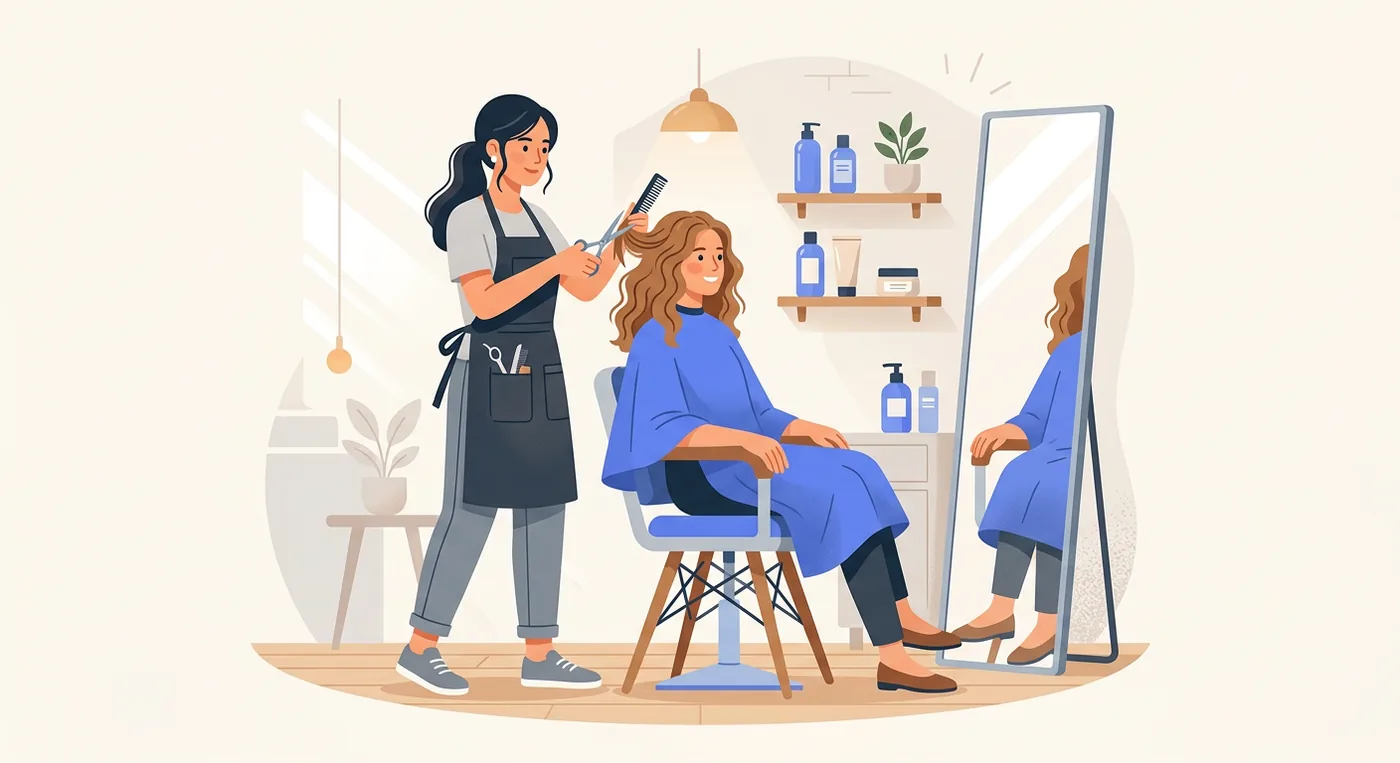
A local salon does not need massive reach. It needs credible proof. Post the work people book: color corrections, blonding results, textured cuts, nail sets, facials, lash fills, and bridal trials. Then make the next step obvious with a booking link in your bio, service tags in captions, and pinned posts that explain what to book and for whom.
What to publish
Stop posting random photos because the feed looks empty. Build content around the services that make money and the questions that slow bookings.
Use a weekly mix like this:
- Transformation posts: Before-and-after results with client permission.
- Service education: Maintenance advice, aftercare, timing, pricing context, and who the service fits best.
- Client proof: Reviews, video reactions, repeat client stories, and UGC.
- Team trust-builders: Stylist introductions, technique clips, consultation snippets, and salon standards.
Every post should do one job well. Get attention, answer a buying question, or drive a booking.
Before-and-after content works because it removes uncertainty. Short videos work because they show process, skill, and personality fast. Carousels work when you need to explain options, price tiers, or care steps.
How to turn content into booked appointments
Attention without a booking path wastes time. A strong post should connect directly to your scheduler, not send people into DMs, back-and-forth messages, or a front-desk callback list.
Set up the flow like a business system:
- Post content tied to a specific service.
- Link that content to the exact booking page.
- Track which posts produce clicks, consultations, and completed appointments.
- Follow up automatically with confirmations, reminders, and rebooking prompts.
That last step matters. Good marketing gets the lead. Good operations keep it from slipping. If your social content creates demand but your booking process is clunky, the campaign underperforms no matter how good the video looks.
Use captions with clear service names, location terms, and a direct CTA. “Book a balayage consultation in Austin” usually beats vague brand language.
A practical example: a stylist posts a color correction Reel, tags the city, lists the service duration, names the ideal client, and links to the exact consultation booking page. That is not “content strategy.” It is a revenue path you can measure.
2. Email Marketing and Loyalty Programs
Email and loyalty keep existing clients rebooking, and they reach people you have already paid to win. Time each message to the service cycle: aftercare the same day, a rebooking reminder when the service is usually due and a win-back note for clients who have lapsed.
Email keeps clients coming back. That makes it a profit channel, not a side tactic.
New client acquisition is expensive. Retention is cheaper, faster to improve, and easier to measure. If your salon already uses scheduling software, email should be tied directly to visit history, rebooking windows, retail purchases, and no-show risk. That is how marketing turns into booked appointments instead of vague “engagement.”
Build automations around the service cycle
Generic newsletters waste attention. Send messages that match how often each client needs you.
A balayage client does not need the same timing as a brow wax client. A facial client should get aftercare and a next-visit prompt based on the treatment they booked, not a broad monthly promotion. Set these emails to send automatically after the visit or when a client is due.
Start with four flows:
- Welcome series: Introduce your salon, set expectations, and push the second booking early.
- Post-visit follow-up: Send care instructions, retail recommendations, and a review request.
- Rebooking reminders: Trigger based on the normal maintenance window for each service.
- Lapsed client win-back: Target clients who have gone inactive with a clear reason to return.
Keep the copy short. Name the service. Give one CTA. Link to the exact booking page, not your homepage.
You can adapt this booking confirmation email template for reminders, follow-ups, and aftercare messages.
Subject lines affect open rates, but the offer matters more than clever phrasing.
Loyalty programs should increase visit frequency and spend
Discount-first loyalty programs cut margin and train clients to wait for deals.
Reward the behaviors that improve revenue. Give points or perks for pre-booking the next appointment, referring a friend, adding a treatment upgrade, or buying recommended retail after service. That structure protects pricing while raising client lifetime value.
A strong loyalty setup should answer four business questions:
- Which rewards increase repeat bookings?
- Which rewards improve average ticket size?
- Which rewards drive referrals?
- Which rewards can your front desk and software track without manual cleanup?
If your current system cannot answer those questions, the program is too loose to manage.
Use your booking system as the control center
This is the operational gap salon owners miss. Email and loyalty work better when they draw on the same client records your booking system keeps: services, visit dates and spend.
For example, sort clients by service, spend and last visit date in your client records. Then trigger the right message at the right interval. That reduces staff guesswork and gives you cleaner reporting on rebooking rate, retail attachment, and dormant-client recovery.
A practical setup looks like this. A blonding client gets a thank-you email the same day, home-care recommendations after 48 hours, and a rebooking prompt timed to the expected maintenance cycle. If they do not book, the system moves them into an overdue segment and sends a stronger return offer later. That is a real retention system.
Email also supports paid acquisition. If you run ads, use email to recover visitors who clicked but did not book and to convert first-time clients into repeat clients.
Measure this section like an operator, not a marketer. Track repeat booking rate, time between visits, average ticket, retail revenue per client, and win-back conversion. If those numbers do not improve, change the flow, offer, or timing.
3. Google Business Profile Optimization and Local SEO
A Google Business Profile turns local searches such as “hair salon near me” into bookings when it lists accurate categories, hours, plain service names and a direct booking link, shows recent photos and answers every review.
Local search wins clients fast. A person searching “hair salon near me” or “nail salon in [city]” usually wants an appointment, not inspiration. Treat your Google Business Profile like a revenue channel, not a directory listing.
An incomplete profile costs bookings. A weak one also wastes paid traffic, referrals, and email clicks because prospects still check Google before they commit.
Build a profile that sells
Start with the basics and get them right. Use accurate categories, current hours, your real phone number, and a direct booking URL. Add every core service with plain-language names clients search for. “Balayage,” “gel manicure,” and “brow lamination” usually beat vague menu labels.
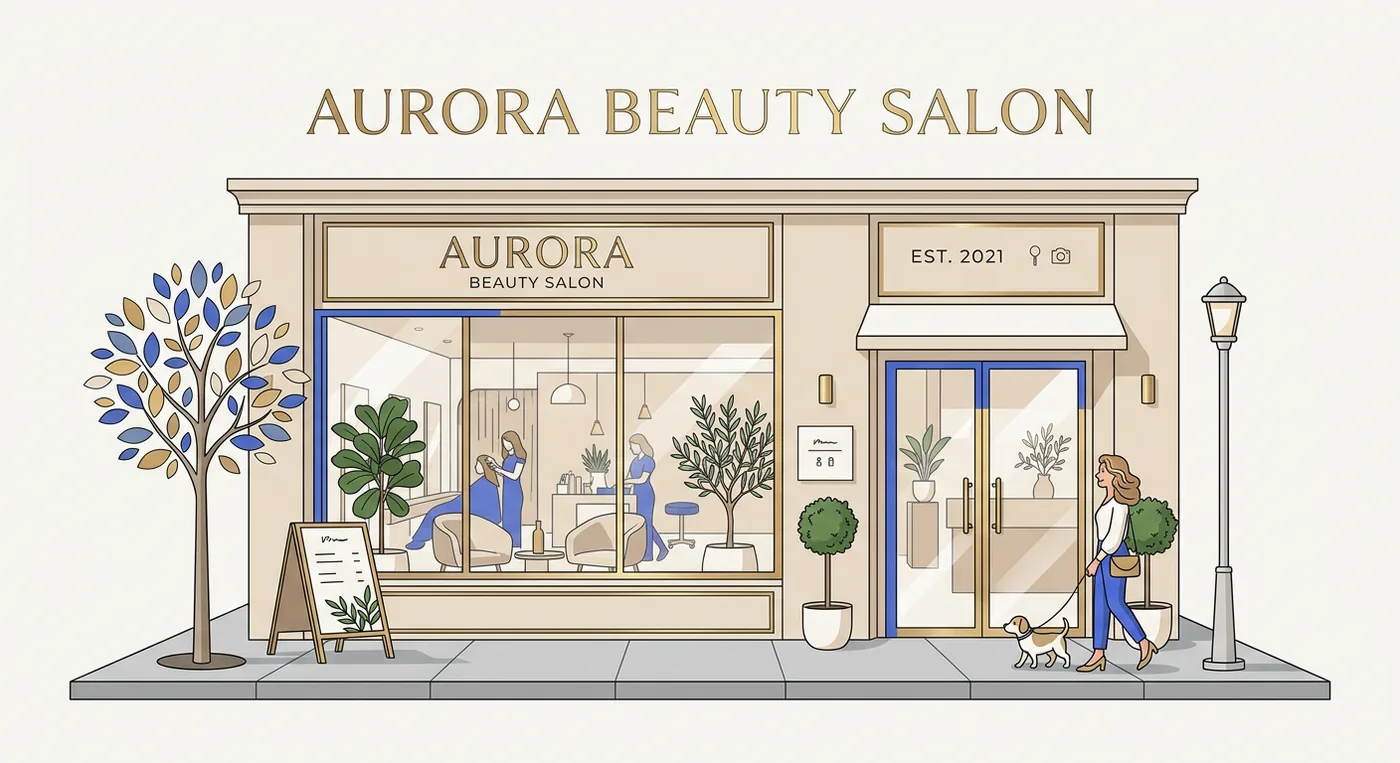
Upload photos that answer buying questions. Show the storefront so people can find you. Show the interior so the space feels credible. Show staff and finished results so first-time clients can judge fit before they call.
Reviews are the conversion layer. Ask every client for a review after the visit, not only the ones you expect to be happy, and respond to every review, good or bad. That protects trust and gives prospects proof that your business is active. Google’s content policy for Maps reviews, read September 28, 2026, bars businesses from discouraging negative reviews or selectively soliciting positive ones. Our guide to getting Google reviews covers the request-and-respond routine.
Connect Google visibility to your scheduler
Many salons lose bookings here: they improve visibility, then send the traffic to a homepage with too many choices.
Send Google visitors straight to booking. Google’s Business Profile Help page on local business links, read September 28, 2026, says a profile can carry up to 10 links per category, including links that let customers book an appointment. Let them choose a service, provider, and time slot on the first page. If your software supports service filtering, staff selection, deposits, reminders, and rebooking prompts, use all of it. Marketing gets the click. Scheduling software turns that click into a confirmed appointment and helps reduce drop-off after discovery. That matters because local SEO is not just about ranking. It is about protecting margin after the click.
Keep the profile active every week. Add new photos, post updates and check that links still work. A smaller salon can beat bigger competitors here because consistency matters more than brand size.
4. Referral and Word-of-Mouth Marketing Programs
A referral program works when both clients get a reward, the referrer’s reward waits until the new client completes a visit and every referral is logged by source, so you can see which clients send business and thank them.
Word-of-mouth feels free. It isn’t. It only works consistently when you build a system around it.
Referral marketing is one of the best bets in marketing for beauty salon businesses because the lead arrives with trust already built. That lowers resistance and shortens the path to booking.
Make referrals easy to share
Give clients a simple offer and a clear tool to share it. That can be a textable link, a printed card, a QR code at the front desk, or a post-visit email with a unique referral message. Reward both sides so neither person has to carry the whole incentive. If you print cards, our guide to business cards QR codes shows how to point the code at your booking page.
Use offers that protect margin. A service upgrade, add-on, or account credit usually works better than broad discounting.
- Reward the referrer: Credit, upgrade, or bonus service after the new client completes a visit.
- Reward the new guest: A first-visit bonus tied to a minimum service.
- Set a deadline: Short redemption windows move people to act.
- Track by source: Don’t run a referral program you can’t measure.
Ask for a referral right after the client sees the final result and says they love it.
Train the team to support it
Referrals don’t come from signage alone. Stylists and front-desk staff need a script that sounds natural.
A bridal stylist can say, “If anyone in your party still needs hair or makeup, I can send you a referral link.” A nail tech can say, “If your friend books with your link, you both get a little thank-you on the next visit.” Short, clear, no pressure.
This also works well when paired with stronger client communication habits. Clear reminders, follow-ups, and personal outreach make clients more likely to recommend you. A good baseline is this guide to client communication best practices.
One neighborhood salon example is a mother who refers two coworkers after a strong first appointment. If you log that referral source, thank her properly, and give her a reason to do it again, you’ve turned a happy client into a repeat acquisition channel.
5. Online Booking and Appointment Experience Optimization
Online booking turns marketing into appointments when a client can pick a service, a provider and a time, see the price and confirm in a few taps on a phone, then get an instant confirmation and reminders.
A slow booking flow wastes paid clicks, referral traffic, and social interest. If a client is ready to book and your process adds friction, your acquisition cost goes up and your calendar stays underfilled.
Online booking is not an admin feature. It is a revenue system tied directly to marketing performance. Every campaign you run should send people into a booking experience that is fast on mobile, clear on pricing, and connected to reminders, upsells, and follow-up.
Remove friction at the point of purchase
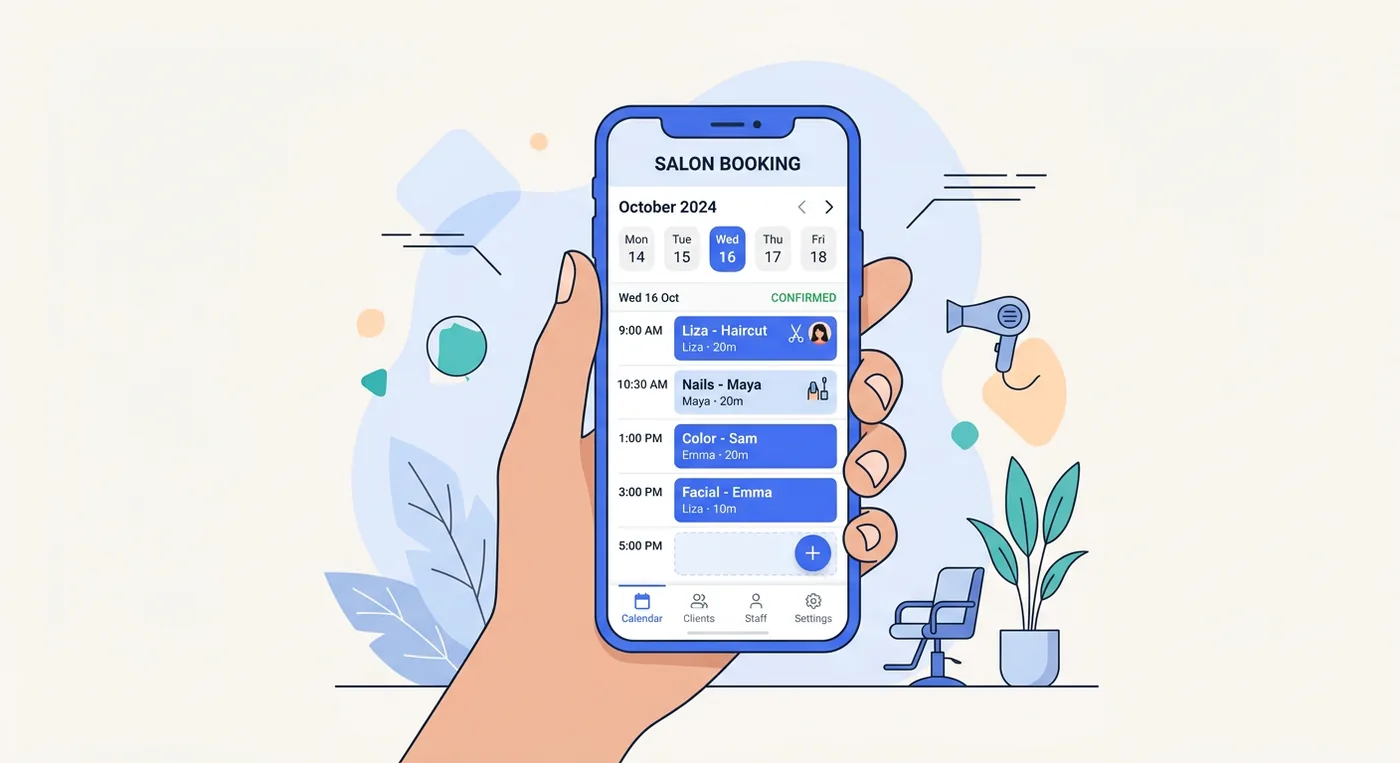
Clients should be able to choose a service, pick a provider, see the price, and confirm the appointment in a few taps. Anything more complicated cuts conversion.
Your booking page should include:
- Clear service names: Use client-friendly labels, not internal terms.
- Transparent pricing: Show the cost before checkout.
- Provider details: Photos, specialties, and availability help clients choose faster.
- Service timing: Set clear duration so expectations match the appointment.
- Self-serve rescheduling: Reduce front-desk calls and save staff time.
- Instant confirmation: Send email or SMS as soon as the appointment is booked.
If your setup still feels clunky, use this guide on how to schedule appointments to fix the basics. If you are still choosing a booking tool, start with the features salon owners look for in salon management software, then compare the best salon software.
Treat booking software like part of your marketing stack
Salon owners often buy scheduling software for calendar management and stop there. That leaves money on the table.
Your system should support conversion and retention automatically. After a client books, send prep instructions, recommend an add-on that fits the service, and trigger a rebooking reminder based on the usual service cycle. That turns one appointment into a higher ticket and increases the odds of a second visit without extra manual work.
This is also where operations and marketing need to connect. If a campaign promotes balayage, your booking page should feature balayage clearly, route clients to the right stylists, and offer a related add-on such as toner or treatment. If the promotion creates demand but the booking flow hides the service or sends people to a generic menu, the campaign underperforms.
Use booking rules to protect revenue
A good appointment experience does more than fill open slots. It helps you control margin.
Set rules that support profitable scheduling. Require deposits for high-value services. Limit how late people can book or cancel online. Build buffer times where complex services need cleanup or consultation. Offer add-ons during checkout instead of asking staff to remember them at the chair.
Multi-stylist salons should also use booking logic to spread demand. If one stylist is booked out, the system should present another qualified option immediately. That keeps revenue inside the business instead of sending the client elsewhere.
The standard is simple. Every ad, email, referral, and search visit should lead into a booking process that is easy to complete and built to increase revenue after the first click.
6. Strategic Partnerships and Cross-Promotions
A partnership earns its place when it sends booked appointments: pick a nearby business that serves the same client at a different moment, build one joint offer and track every booking it produces for 30 days.
If a partnership only gets you likes, foot traffic, or vague “brand awareness,” skip it.
The right partner already has your next client. The wrong partner gives you extra coordination work and no revenue. Pick businesses that serve the same buyer at a different point in the buying cycle. Bridal planners, photographers, gyms, med spas, boutiques, and wellness studios can all work, but only if their clients match your service mix and price point.
Pick partners based on revenue fit
Treat partnerships like acquisition channels. Set a target. Decide what a partner needs to deliver each month in first-time bookings, average ticket size, and repeat potential. A wedding planner is valuable if bridal services are high-margin for your salon. A nearby café is useful if you need weekday traffic and can package quick services that fit lunch-hour demand.
Do not build broad “we should collaborate” arrangements. Build one offer for one audience.
A practical setup looks like this:
- A bridal makeup artist refers clients to your wedding hair package.
- A photographer promotes headshot-ready styling before corporate shoots.
- A gym or yoga studio promotes recovery or self-care packages during slow midweek periods.
- A boutique pushes event styling tied to local parties, graduations, or seasonal events.
Each offer needs its own tracking. Give each partner its own link or code, and note the partner’s name on the client’s record when the booking arrives. If you cannot see which partner produced a booking, you cannot judge the return.
Structure the offer so both businesses get paid
Loose partnerships fade because no one owns execution. Put terms in writing, even if it’s one page.
Define:
- the audience
- the package or service bundle
- the price and any bonus
- who promotes it
- how long the campaign runs
- how results are tracked
Keep the offer simple. One package converts better than a menu of options. For example, a salon, bridal makeup artist, and photographer can sell a wedding-prep package with trial styling, event-day hair, and a photo-ready finishing add-on. Each business sends the same offer to its audience. The salon then tracks bookings by source in the calendar and client notes.
Operations matter. If a partner sends traffic to you, your booking flow should reflect the campaign clearly. List the offer as its own service, assign the right staff, cap how many slots it can take and note the partner on each booking. That turns cross-promotion into an operational system, not a side project.
Cross-promotions also help fill weak time slots without cutting prices across the board. A nail studio and a nearby wellness business can run a Tuesday or Wednesday self-care package and send demand into open inventory you already have. That protects margin better than a salon-wide discount.
Review partner performance every month. Keep the partners that produce booked services, repeat visits, and profitable tickets. End the ones that create activity without revenue.
7. Seasonal Campaigns and Promotions
Seasonal campaigns work when the offer is planned before demand peaks. Prom, wedding season, Mother’s Day, the holidays and back-to-school each open a booking window, and the salons that open their calendars early fill it first.
Seasonal demand is predictable, so plan for it before it arrives.
If you wait until the rush starts, you miss the best clients. They booked earlier with the salon that planned ahead.
Build campaigns around demand peaks
You need timely offers that reach clients when they are already primed to buy.
Strong seasonal campaigns aren’t random discounts. They’re packaged services with a reason to book now.
Examples by season:
- Bridal season: Hair trial plus day-of styling package.
- Holiday period: Blowout bundles, gift card promotions, party-ready makeup.
- Summer: Color gloss refresh, sun-care treatment add-ons, vacation prep nails.
- Back to school: Family haircut blocks or teen skin prep packages.
Seasonal marketing works best when the package solves a timely need. “Holiday glam” is stronger than “10% off.”
Match staffing and promotion timing
Campaign planning isn’t just creative. It’s scheduling.
If you know bridal demand spikes in your market, open your calendar properly, assign staff capacity, and start promoting while preferred dates still exist. If you push the offer after the prime slots are gone, you create frustration instead of sales.
This is also where data helps. Track which campaigns bring new clients, which ones bring existing clients back, and which ones mostly attract bargain shoppers. A spa may find Mother’s Day packages drive gift card buyers. A hair salon may find pre-holiday color appointments perform better than general retail discounts.
8. Paid Advertising on Google and Social Media
Paid ads work for a salon only after the booking page converts. Start with one Google Search campaign for local, high-intent searches, one social campaign built on real results and one retargeting campaign, and judge each by cost per booked appointment.
Paid traffic gets results faster than organic channels, but it also exposes weak operations fast. If your ads send people to a slow site, a confusing service menu, or a booking page with no available slots, you are paying to reveal internal problems.
Start with channels that match buying intent. Google Ads should usually get the first budget because people searching “hair color salon near me” or “bridal makeup artist [city]” are already close to booking. Social ads come next for visually driven services such as balayage, lashes, brows, nails, and bridal packages, especially when you want to retarget visitors who viewed a service page and left.
The right structure is simple. Run one Google campaign for high-intent local searches. Run one Instagram or Facebook campaign built around real before-and-after results. Run one retargeting campaign for people who reached your booking flow but did not finish. Anything broader than that is usually waste in the early stage.
Build campaigns around booked appointments, not clicks
A salon owner should judge paid ads by cost per booked appointment, show-up rate, and client value after the first visit. Cost per click matters, but only as a secondary metric. A cheap click that never becomes a booking is a bad buy.
This is also where scheduling software matters. Connect your ads to pages tied to the exact service being promoted, then track which campaign generated the booking, whether the client rebooked, and which staff member fulfilled the service. That turns advertising from a guessing exercise into a margin decision.
Use this operating standard:
- Target by service and radius: Keep campaigns local and tied to profitable categories.
- Match the ad to the landing page: Hair color ads go to hair color booking pages, not your homepage.
- Use your real team and real work: Stock imagery lowers trust and weakens conversion.
- Retarget booking intent: Follow up with visitors who viewed pricing, service pages, or the appointment form.
- Protect capacity: Pause or limit ads for services that are already booked out.
A practical example is bridal styling. Run search ads for local bridal hair and makeup terms, then retarget site visitors on Instagram with package visuals, trial details, and a direct inquiry path. Sync that campaign with your scheduling system so you can block dates, prioritize high-value packages, and stop spending once prime weekends are close to full.
That is the point of paid media for a salon. It should not just create attention. It should fill the right calendar slots at an acquisition cost your business can support.
Beauty Salon Marketing Compared: Cost, First Step and What to Count
The eight channels differ less in what they cost than in how fast they produce a booking and what you should count. Table 1 sets out each channel’s main cost, a first step and the number to track, and Table 2 turns those numbers into a monthly scorecard.
| Channel | Main cost | First step | Count this |
|---|---|---|---|
| Social media content | Staff time; ads optional | Pin one post per top service with its booking link | Bookings from each post’s link |
| Email and loyalty | Your email tool’s plan and reward costs | Set up aftercare, rebooking and win-back emails | Rebookings and win-back bookings |
| Google Business Profile | Staff time; no fee to Google | Add every service and a direct booking link | Booking-link clicks and new bookings |
| Referrals | The reward, paid after a completed visit | Give each client a shareable link or card | Referred bookings that return |
| Online booking | Your booking software plan | Book your top service on a phone yourself | Share of bookings made online; show-ups |
| Partnerships | Staff time and the joint offer | One offer with one partner for 30 days | Bookings per partner |
| Seasonal campaigns | The offer’s discount or bundle cost | Open the calendar before the peak | Bookings in the window; average ticket |
| Paid ads | Your ad budget | One local Google Search campaign | Cost per booked appointment |
Every channel ends in the same place: a booked appointment that the client attends. Count each channel on that basis, using its own link or code, and the scorecard below does the rest.
| Line | How to count it | Worked example (illustrative) |
|---|---|---|
| Spend in the month | Ad spend plus rewards and discounts given | $300 |
| New bookings from the channel | Counted by the channel’s own link or code | 20 |
| Attended | New bookings the client showed up for | 17 |
| Cost per booked appointment | Spend divided by new bookings | $15.00 |
| Cost per attended appointment | Spend divided by attended bookings | $17.65 |
| Rebooked within the service’s usual cycle | Count, and share of attended clients | 7 of 17 (41%) |
In the example, each booking cost $15.00, but each appointment a client attended cost $17.65: the three no-shows raised the real cost by $2.65 a visit. Compare channels on the attended figure, then on how many of those clients rebook.
A 30-Day Salon Marketing Plan: Where to Start
Set up the four channels closest to a booking over the first three weeks, test one way to reach new clients in week 4 and read the scorecard at day 30 before you spend more.
Salon marketing works when you stop treating it like a collection of disconnected tactics. Social media, email, Google visibility, referrals, booking flow, partnerships, seasonal promotions and paid ads should all lead to the same outcome: more booked appointments from the right clients. If one channel gets attention but the booking path is weak, you lose the sale. If bookings come in but follow-up is poor, you lose the repeat visit.
| Week | Set up | Count at the end of the week |
|---|---|---|
| Week 1 | Google Business Profile: categories, hours, services, photos and a direct booking link; start asking every client for a review | Booking-link clicks and new reviews |
| Week 2 | Booking page: service names, prices, provider photos, confirmations and reminders on; book a test appointment on a phone | Share of bookings made online |
| Week 3 | Referral offer and follow-up emails: aftercare, rebooking and win-back | Referred bookings and rebookings |
| Week 4 | One acquisition test (social, a partnership or paid search) with its own link or code | Cost per booked appointment (Table 2) |
At day 30, keep, change or stop each channel by its scorecard. Keep the measurement simple: track where bookings come from, how many new clients return, which services sell repeatedly, which campaigns trigger rebookings and which channels lead to retail purchases.
Then build outward. Add a tighter social media system with clear before-and-after content. Scale paid ads only after your landing pages and booking process are solid. Create seasonal offers only when you know your staffing can handle the demand. Partner with nearby businesses only when you can track which partnerships send bookable clients. Spend with discipline: fund the channels that bring appointments, not the ones that just create activity.
Retention deserves the same attention as acquisition. Existing clients are easier to rebook than strangers are to convert, which makes client records, post-visit communication, retail follow-up and re-engagement campaigns part of marketing, not just admin.
Hairstylist and YouTube creator Becoming Chanel explains which marketing strategies helped win more clients in 2024.
You don’t need to do everything this month. You need to do the right things in the right order, then stay consistent. That’s how marketing stops feeling random and starts producing predictable bookings.
Where Twizzlo Fits in Your Salon Marketing
Twizzlo is web-based online booking and appointment scheduling software for appointment-based service businesses, and it covers the booking side of this plan: a public booking page you can link from Google, posts and emails, automated confirmations and reminders, client records with visit history and total spend, and insights on bookings, revenue and new customers.
Paste your Twizzlo booking link, one per location, into your Google Business Profile, social bios and campaign emails, so each channel ends on a 24/7 booking page. Clients can reschedule themselves, reminders go out by email, and by SMS on Business Pro, and a prepaid booking takes the full service price.
Free is $0 a month for up to 150 bookings, with no SMS, and it is free forever rather than a trial. Business Pro is $29.99 a month per business, with unlimited bookings, 50 SMS a month included then $0.03 per message, and a 30-day money-back guarantee. Both plans include unlimited staff and locations and 24/7 support by email. Online payments carry your Stripe processing rate plus a 1.5% Twizzlo platform fee. The pricing page, read September 27, 2026, lists both plans.
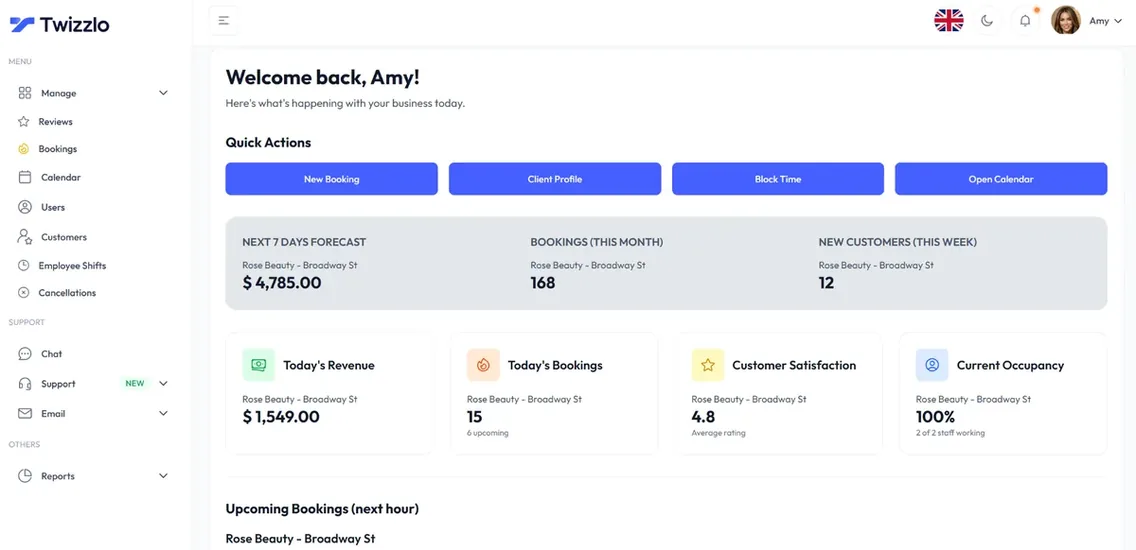
Twizzlo does not run payroll, commission tracking or memberships. If you want every channel in this guide to end on your own booking page, start with Twizzlo’s salon appointment software on the free plan.
Marketing for Beauty Salon FAQ
How do I market a beauty salon?
Start with the channels that have the shortest path to revenue: a complete Google Business Profile, a fast online booking flow, a tracked referral offer, and automated email follow-up. Those four cover discovery, conversion, and retention. Add social content, seasonal packages, partnerships, and paid ads after that base works, and judge every channel by booked appointments rather than likes or reach.
How do I market a new salon on a small budget?
Use the low-cost channels first. Optimizing your Google Business Profile costs time, not money, and captures high-intent “near me” searches. Referral rewards only cost you something when a new client actually completes a visit. Email runs through software you likely already have. Save paid advertising for later, once your booking pages convert well enough to justify the spend.
What is the most effective marketing strategy for a salon?
Email marketing tied to loyalty and rebooking is usually the place to start because it works your existing client list, people you have already paid to win. Local search is often the quickest source of new clients, since someone searching “hair salon near me” usually wants an appointment now. Combine the two: win the local search, then keep that client with automated follow-up.
How do salons get more clients from Google?
Complete your Google Business Profile with accurate categories, current hours, plain-language service names, and a direct booking URL, then keep it active with weekly photos and posts. Reviews are the conversion layer, so ask every client after the visit, not only the ones you expect to be happy, and respond to every review.
Which salon software features matter most for marketing?
Look for a booking page you can link for each service, automated confirmations and reminders by email and SMS, client records with visit history and spend, and reports on bookings, revenue and new clients. Those let you count which campaigns turn into attended appointments.
When should a salon start running paid ads?
After your landing pages and booking process are solid. Paid traffic exposes weak operations fast: if ads send people to a slow site or a booking page with no open slots, you pay to reveal internal problems. Give Google Ads the first budget because local searches carry high intent, then judge results by cost per booked appointment, show-up rate, and repeat client value.
How do I measure whether salon marketing is working?
Count bookings by channel for one month. Divide what you spent on each channel by its booked appointments, then by the appointments clients attended, and note how many of those clients rebooked within the service’s usual cycle. Keep the channels with the lowest cost per attended appointment and the most rebookings.
Is hair salon marketing different from marketing a nail or lash salon?
The channels are the same: Google Business Profile, online booking, referrals, email, social media, partnerships, seasonal offers and ads. What changes is timing and proof. Time rebooking reminders to each service’s usual cycle, and show the results clients judge that service by, such as color, a nail set or a lash fill.
Sources and methodology
- Google, Maps User Generated Content Policy: Prohibited and restricted content (opens in a new tab)Read . Supports: merchants must not discourage or prohibit negative reviews or selectively solicit positive reviews from customers
- Google Business Profile Help, Manage your local business links (opens in a new tab)Read . Supports: up to 10 links per category on a Business Profile, including links that let customers book an appointment
- Google Business Profile product page (opens in a new tab)Read . Supports: the Business Profile is free
- Twizzlo pricing page (opens in a new tab)Read . Supports: Twizzlo plans, booking cap, SMS allowance, money-back guarantee and online payment fee
From our editorial policy
- We do not publish invented quotes, studies, statistics, customer stories or product tests, and we do not imply hands-on use of a product when the research came from the vendor's public documentation.
- To report an error, email support@twizzlo.com with the subject line "Correction: [page URL]". Tell us what is wrong and, if you can, link a source.
Update history
- : Removed unsourced statistics; added a channel cost table, a scorecard and a 30-day plan; corrected review advice and Twizzlo plan facts.
Start free, upgrade when you grow
Flat-rate booking software. No per-seat, per-chair or per-location fees.
- Free plan up to 150 bookings a month, not a trial
- Business Pro is $29.99 a month per business for unlimited bookings, with a 30-day money-back guarantee
- 24/7 support by email