
Best Booking App for Barbers in 2026: 8 Apps Compared

In short
The best booking app for barbers depends on shop size and where clients come from. On pricing pages read September 25, 2026, a solo barber could start at $0 on Square Appointments Free or Setmore Free, while Booksy cost $29.99 a month plus tax for one team member and $20 per added member. Larger shops should compare per-shop plans.
- Per-barber billing adds up: Booksy adds $20 a month per team member, Vagaro $10 per calendar up to seven (read September 25, 2026).
- Marketplace programs take 30% of a new client's first visit on Booksy Boost and StyleSeat, with caps (read September 25 and 27, 2026).
- Square Appointments Free includes text and email reminders; waitlists and no-show fees start on Plus at $49 a month per location (read September 27, 2026).
Source: Booksy pricing page (opens in a new tab), read
In this article16 sections
Barbershop booking software has three jobs: take bookings around the clock, cut no-shows and keep walk-ins from wrecking the day's calendar. If you are choosing an app for barbers to schedule appointments, this guide compares eight of them for shops of one to 10 barbers, priced from each company's own pages, read September 25 to 28, 2026.
What is the best booking app for barbers in 2026?
Match the app to your shop rather than to a ranking. Solo barbers who bring their own clients can start on a free plan, barbers who want new clients from a marketplace pay a fee on each one, and shops with four or more barbers should compare per-barber billing against plans priced per shop.
The eight barber apps below are listed by the lowest monthly price each one prints, not by a score, and Table 1 sets them side by side.
| App | Best for | Starting price as printed | How the bill grows | Fee on new marketplace clients |
|---|---|---|---|---|
| Setmore | Up to four barbers who bring their own clients | Free: $0 for up to 4 users; Pro: $12 per user a month, billed monthly | Per user on Pro | None printed |
| Square Appointments | A $0 start with text and email reminders | Square Free: $0 a month per location; Plus $49; Premium $149 | Per location; unlimited staff calendars | None printed |
| theCut | Barbers who work from a phone app; owners tracking booth rent | Free: $0 a month; PRO: $25 a month for a barber; Shop plan for owners: $0 | Each barber's own plan; the owner's Shop plan stays $0 | Client Discovery: $10 per client on Free, included on PRO |
| StyleSeat | Independent barbers who want marketplace bookings | $19 a month after a free trial, a limited-time rate for new pros (pricing page); $35 Premium Plan (help center) | One account for up to 15 chairs | New Client Connection (optional): 30% of the first appointment, $50 maximum |
| Vagaro | A waitlist and booth rent collection in the base subscription | $23.99 a month, a limited-time rate, with one calendar | $10 a month per added calendar, up to seven licenses | Fill My Books (optional): 20% of a new customer's first booking |
| Booksy | Marketplace bookings with billing per team member | $29.99 a month plus tax, one team member included | $20 a month per added team member | Boost (optional): 30% of a Boost client's first visit, $10 minimum, $100 maximum |
| SQUIRE | Multi-chair shops that pay commission or collect booth rent | Independent: $30 a month (US price from its plan data) | By plan: Pro $50; Executive $150 and Titan $250 per shop | None to the shop printed; plan data lists "$1-3 Client-side booking fees" |
| Fresha | Shops that want marketplace clients | Not printed here (US page not readable to our reader) | Not printed here | A one-time fee on new marketplace clients (no figure printed here) |
Table 1. Apps for barbers to schedule appointments, at a glance. Each app's name links to the page its price comes from. Prices read September 25, 2026, except theCut (September 28, 2026); Boost limits and Fill My Books read September 27, 2026. Monthly billing, before tax and card processing.
There is no single best barber booking app for every shop, but the tables point to these picks:
- Solo barber with your own clients: Square Appointments Free and Setmore Free cost $0 (read September 25, 2026), as does theCut Free for a barber (read September 28, 2026). For what each $0 plan caps and what card fees add, see our free barber booking app guide.
- Solo barber who wants marketplace clients: Booksy or StyleSeat, whose optional programs take 30% of a new client's first visit, or theCut PRO at $25 a month with Client Discovery included.
- Two to six chairs: compare Booksy's $20 per added team member, Vagaro's $10 per added calendar and StyleSeat's one account for up to 15 chairs (Table 2).
- Commission or booth-rent shops: SQUIRE Executive lists "Commission & rent collection," Vagaro lists rent and fee collection, Square Appointments Plus lists commissions tracking and theCut's $0 Shop plan lists booth rent tracking.
- Walk-in-heavy shops: Booksy and Vagaro list waitlists, and Square Appointments adds one on Plus (Table 4).
Owners deciding between Booksy and Square Appointments can read our Booksy vs Square comparison.
How we chose and priced these apps
This list of the best apps for barbers starts with the four vendors whose pages ranked in the US top 10 for this search (Semrush, September 25, 2026): Booksy, SQUIRE, theCut and Setmore (its barbershop page). It adds four platforms our other barbershop guides weigh them against: Square Appointments, StyleSeat, Vagaro and Fresha. Every price comes from the vendor's own pricing page or help center, read September 25 to 28, 2026, from a US view where the page allowed it.
Ties in the price order are alphabetical. Fresha has no price here because its pricing page showed only Canadian prices to our reader, and SQUIRE's US prices come from its page's plan data for the same reason. We ran no paid trial of any app. For businesses other than barbershops, see our guide to the best appointment scheduling software.
1. Setmore
Setmore
Best for: Barbershops of up to four users that want a free plan, or larger teams paying per user.
Starting price: $0 a month for up to 4 users (Free); Pro $12 per user a month, billed monthlyRead on Setmore's pricing page (opens in a new tab)
Pros
- Free plan for up to four users
- Pro includes 500 SMS credits a month
- Pro lists deposits and recurring appointments
Cons
- Pro bills for every user
- No SMS reminders on Free
- No card processing rate printed on its pricing page
Setmore suits a small team that wants a free plan with a per-user upgrade. Its pricing page, read September 25, 2026, listed Free at $0 for up to four users and Pro at $12 per user a month billed monthly ($5 billed annually), with 500 SMS credits a month on Pro.
How Setmore bills
Setmore bills per user. Free covers up to four users; Pro removes the limit, so six barbers on Pro pay $72 a month and 10 pay $120 on monthly billing. A Live Receptionist add-on costs $99 a month, and the pricing page prints no card processing rate. Plan-by-plan detail: Setmore pricing.
What barbers get: Pro alone lists SMS reminders, deposits, recurring appointments and two-way calendar sync, so Free sends no text reminders.
Choose Setmore if you run up to four barbers who bring their own clients, or a larger team that accepts paying per user.
2. Square Appointments
Square Appointments
Best for: Barbers and shops that want a $0 start with text and email reminders.
Starting price: $0 a month per location (Square Free); Plus $49, Premium $149Read on Square's pricing page (opens in a new tab)
Pros
- Unlimited staff calendars on the $0 plan
- Text and email appointment reminders on every plan
- 30-day free trial on Plus and Premium
Cons
- Waitlist and no-show fees start on Plus
- Paid plans bill per location
- No text marketing on Free
Square Appointments suits a barber or shop that wants to start at $0. Its pricing page, read September 25, 2026, listed Free at $0 a month per location with unlimited staff calendars, Plus at $49 and Premium at $149, and charged 2.6% plus 15 cents per in-person card payment on Free.
How Square Appointments bills
Square bills per location, not per barber, and Plus and Premium come with a 30-day free trial. In-person card payments cost 2.6% plus 15 cents on Free, 2.5% plus 15 cents on Plus and 2.4% plus 15 cents on Premium; online payments cost 3.3% plus 30 cents on Free and 2.9% plus 30 cents on the paid plans. Plan-by-plan detail: Square Appointments pricing.
What barbers get: Square's feature grid, captured September 27, 2026, lists automatic text and email appointment reminders, prepayments and deposits on every plan, Free included. Cancellation and no-show fees, a waitlist, multi-staff booking and commissions tracking start on Plus, as does text marketing: 500 messages, then 3 cents each (2,500, then 1.5 cents, on Premium).
Choose Square Appointments if you want a $0 start with reminders, and Plus once you need no-show fees or a waitlist.
3. theCut
theCut
Best for: Barbers who work from a phone app, and owners who want free booth rent tracking.
Starting price: $0 a month (Free, for barbers); PRO $25 a month; Shop plan for owners $0Read on theCut's pricing page (opens in a new tab)
Pros
- Owner's Shop plan is $0, with booth rent tracking
- Client Discovery included on PRO
- 30-day PRO trial with no credit card
Cons
- Client Discovery costs $10 per client on Free
- Text appointment updates only on PRO
- Payment processing listed at 2.75%
Barbers who run their book from a phone app, and owners who want booth rent tracking at no charge, should look at theCut. Its pricing page, read September 28, 2026, listed Free at $0 a month and PRO at $25 a month for barbers, and a Shop plan for owners at $0.
How theCut bills
The owner's Shop plan costs nothing, and each barber picks Free or PRO; PRO has a 30-day trial with no credit card required. Payment processing is listed at 2.75% on both barber plans, with no per-transaction fee printed. Client Discovery, which lets new clients find and book a barber in the app, costs $10 per client on Free and is included on PRO.
What barbers get: both barber plans list a personal booking link, in-app tipping and no-show policies; PRO adds text appointment updates to push and email. The Shop plan lists staff management, several shops in one account, booth rent tracking and reminders, and assigning walk-ins to available barbers.
Choose theCut if your barbers each run their own book from a phone, and the owner wants staff and booth rent tracking without a subscription.
4. StyleSeat
StyleSeat
Best for: Independent barbers who want bookings from StyleSeat's marketplace.
Starting price: $19 a month after the free trial, a limited-time rate for new pros (pricing page); Premium Plan $35 a month (help center)Read on StyleSeat's pricing page (opens in a new tab)
Pros
- One account price for up to 15 chairs
- Staff calendars at no extra seat cost
- New Client Connection is optional
Cons
- 30% of a new marketplace client's first appointment, up to $50
- Clients pay a $2.35 booking fee
- Its pricing page and help center print different prices
StyleSeat suits independent barbers who want bookings from its marketplace. Its pricing page, read September 25, 2026, listed $19 a month after a free trial as a limited-time rate for new pros, one seat for shops of up to 15 chairs; its help center listed a $35 Premium Plan.
How StyleSeat bills
StyleSeat prices the account, not the barber, with staff calendars at no extra seat cost. Neither page says whether $35 applies after the $19 offer ends, so both appear here. New Client Connection, optional per the help center, takes 30% of a new marketplace client's first appointment, up to $50, and clients pay a $2.35 booking fee. Card processing is 2.5% plus 30 cents with the card present and 2.6% plus 30 cents on file (help center); the pricing page offers new pros free payments in the trial, then 1.9% for six months.
What barbers get: one plan covering "Calendar, payments, marketing and new clients," in the pricing page's words. Barbers leaving StyleSeat can compare StyleSeat alternatives.
Choose StyleSeat if marketplace demand matters more to you than the 30% fee on each new client it sends.
5. Vagaro
Vagaro
Best for: Shops that want a waitlist and booth rent collection in the base subscription.
Starting price: $23.99 a month, a limited-time rate (list price not printed), with 1 calendar; $10 a month per extra calendarRead on Vagaro's help center (opens in a new tab)
Pros
- Waitlist and text and email reminders in the base subscription
- Rent and fee collection for booth renters
- Calendar fees stop after seven licenses
Cons
- Card rates set by monthly volume; FANF and Mastercard location fees not priced
- Deposits and cancellation fees need a $10-a-month add-on
- Help center does not say what it costs after the limited-time rate
Vagaro suits a shop that wants a waitlist, reminders and rent collection in one subscription and will add paid features as it grows. Its US help center, read September 25, 2026, listed $23.99 a month as a limited-time rate with one calendar, plus $10 for each added calendar up to seven licenses, a ceiling of $83.99 a month.
How Vagaro bills
After seven licenses, new employees cost nothing more, so a 10-barber shop pays the same $83.99 as a seven-barber shop; the help center does not say what the plan costs once the limited-time rate ends. Deposits and cancellation fees for online bookings need the Online Shopping Cart, a $10-a-month add-on that requires Vagaro's card processing (read September 28, 2026). Card processing is 2.6% + $0.10 per in-person payment under $4,000 a month in card sales; 2.29% + $0.19 above it, with a $10 monthly Large Merchant fee; keyed-in 3.5% + $0.19; FANF and Mastercard location fees apply, amounts not printed (US help center, read September 27, 2026). Plan-by-plan detail: Vagaro pricing.
What barbers get: Vagaro's list of base-subscription features, read September 28, 2026, includes a waitlist, text and email reminders, no-show policies, payroll reporting with custom commission tiers, and rent and fee collection from booth renters. Shops can list on the Vagaro Marketplace, Google, Google Maps and Apple Maps, and the optional Fill My Books tool takes 20% of a new customer's first booking, or 5% for a returning customer when it fills gaps (read September 27, 2026).
Choose Vagaro if you have seven or more barbers on one subscription, or booth renters whose rent you want to collect in the same app.
6. Booksy
Booksy
Best for: Barbers who want marketplace bookings and billing per team member.
Starting price: $29.99 a month plus tax, 1 team member included; $20 a month per added team memberRead on Booksy's pricing page (opens in a new tab)
Pros
- Waitlists and No-Show Protection in the one plan
- 2,000 marketing texts a month; confirmations and reminders free
- 14-day trial with no credit card
Cons
- Each added barber adds $20 a month
- Boost takes 30% of a Boost client's first visit, $10 to $100
- Prices plus tax; no country or currency printed
Booksy suits barbers who want a client marketplace and per-barber billing. Its pricing page, read September 25, 2026, listed $29.99 a month plus tax with one team member included and $20 a month for each added team member, with a 14-day trial and no credit card.
How Booksy bills
Each barber after the first adds $20, so four barbers pay $89.99 a month plus tax and 10 pay $209.99. The page prints no country or currency, so figures appear as printed. Card processing is 2.49% plus 10 cents on the Booksy Card Reader, 2.49% plus 20 cents with Tap to Pay and 2.69% plus 30 cents for mobile and keyed-in payments. Boost, the optional marketplace promotion, takes 30% of a Boost client's first visit, $10 minimum and $100 maximum, per Booksy's help center, read September 27, 2026. Plan-by-plan detail: Booksy pricing.
What barbers get: the included-features list, read September 24, 2026, names waitlists, No-Show Protection (standard mobile payment processing fees apply) and Reserve with Google, plus 2,000 free marketing texts a month and free confirmations and reminders. For the wider field, see apps like Booksy.
Choose Booksy if you want marketplace bookings and run a small team, since each barber after the first adds $20 a month (Table 2).
7. SQUIRE
SQUIRE
Best for: Multi-chair barbershops that pay commission or collect booth rent.
Starting price: Independent $30 a month (US price from the pricing page's plan data); Pro $50; Executive $150 per shopRead on SQUIRE's pricing page (opens in a new tab)
Pros
- Executive lists commission and rent collection
- Executive and Titan are priced per shop, not per barber
- 14-day free trial on Independent
Cons
- US prices not shown on screen to our reader
- Plan data lists $1 to $3 client-side booking fees
- Operator (SQUIRE AI) is a $99-a-month add-on
SQUIRE is built for barbershops and prices its larger plans per shop. Its pricing page's US plan data, read September 25, 2026, listed Independent at $30 a month for an individual barber, Pro at $50 for a single-location shop, Executive at $150 a month per shop and Titan at $250 per shop.
How SQUIRE bills
The page showed Canadian dollars to our reader on September 25 and 27, 2026, so US figures come from its plan data. The Independent plan shows a 14-day free trial. Add-ons include branded landing pages at $25 a month and Operator, powered by SQUIRE AI, at $99, and the plan data lists "$1-3 Client-side booking fees." No card processing rate is printed.
What barbers get: the Executive plan lists "Engage, with unlimited email & SMS marketing," a "Google Reviews Booster" and "Commission & rent collection"; Titan adds multi-location support and inventory tracking and purchase orders (read September 27, 2026).
Choose SQUIRE if you run a multi-chair shop that pays commission or collects booth rent and prefers a per-shop price.
Weighing SQUIRE against Booksy alone? Our Squire vs Booksy comparison prices both at three and six barbers, with the card rates each lists.
8. Fresha
Fresha
Best for: Barbershops that want marketplace clients and accept a one-time fee on each new one.
Pros
- A client marketplace that can send new bookings
- Barbers listed among its business types
Cons
- One-time fee on new clients from its marketplace
- US prices not read for this guide
Fresha suits shops that want new clients from a marketplace. Its for-business page, read September 27, 2026, lists barbers among its business types and a client marketplace. Fresha's pricing page showed only Canadian prices to our reader on September 25, 2026, so this guide prints no Fresha price; check its US page.
Fresha charges a one-time fee on new clients its marketplace brings you. Because the rate was read only in Canadian terms, no figure for it appears here.
Choose Fresha if you want its marketplace to send new clients and you have confirmed its US prices and new-client fee on its own page.
How much does each app cost as your shop adds barbers?
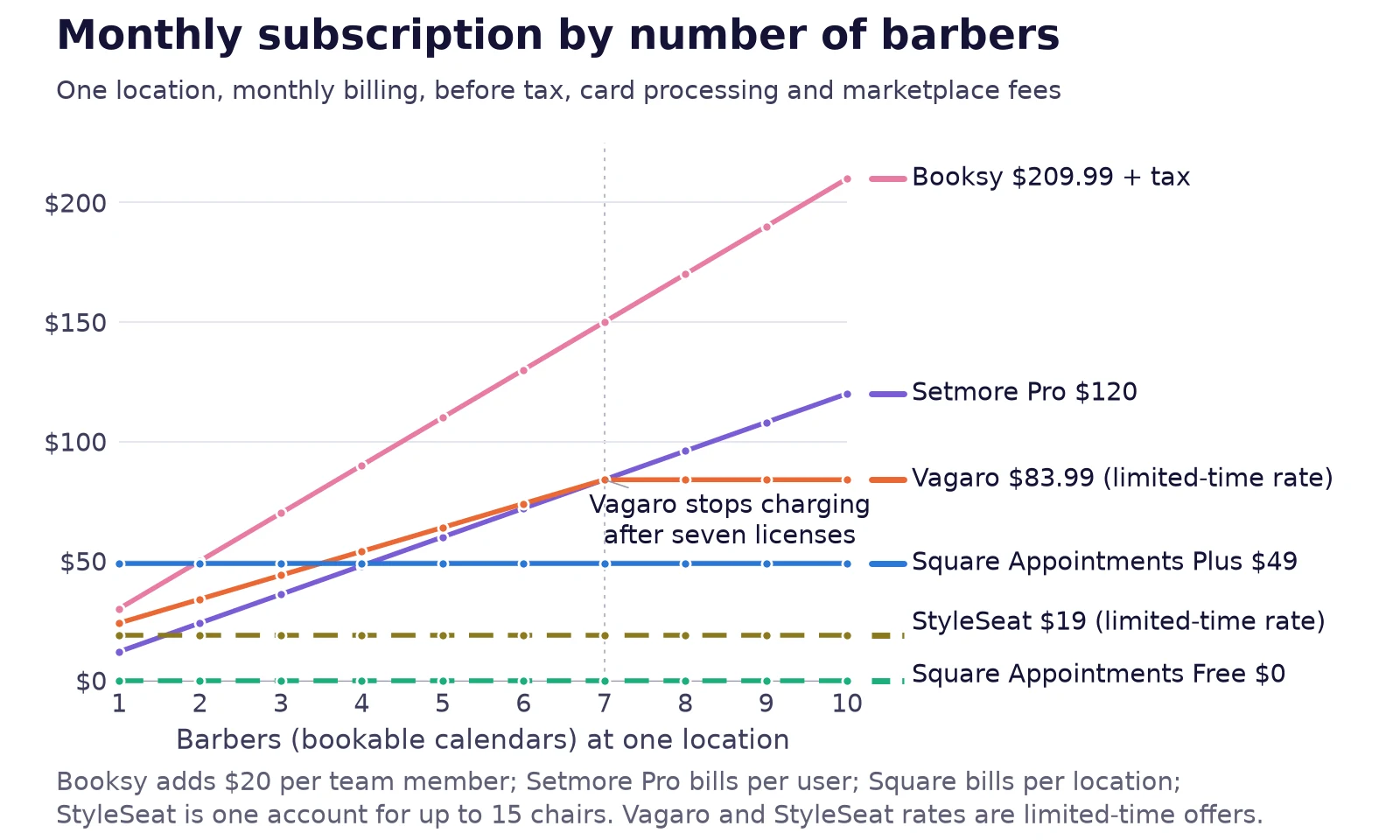
Per-barber billing is where the prices split. On pricing pages read September 25, 2026, one location with six barbers cost $129.99 a month plus tax on Booksy, $73.99 on Vagaro's limited-time rate, $72 on Setmore Pro billed monthly, $49 on Square Appointments Plus and $19 on StyleSeat's limited-time new-pro rate.
On theCut, read September 28, 2026, the owner's plan stays at $0 and each barber pays $0 on Free or $25 on PRO, so six barbers on PRO would pay $150 a month in all.
| App and plan | 1 barber | 2 barbers | 4 barbers | 6 barbers | 10 barbers |
|---|---|---|---|---|---|
| Booksy (plus tax) | $29.99 | $49.99 | $89.99 | $129.99 | $209.99 |
| Vagaro (limited-time rate) | $23.99 | $33.99 | $53.99 | $73.99 | $83.99 |
| Setmore Pro (billed monthly) | $12 | $24 | $48 | $72 | $120 |
| Setmore Free | $0 | $0 | $0 | Not available (Free covers up to 4 users) | Not available |
| Square Appointments Plus | $49 | $49 | $49 | $49 | $49 |
| Square Appointments Free | $0 | $0 | $0 | $0 | $0 |
| StyleSeat (new-pro rate) | $19 | $19 | $19 | $19 | $19 |
| theCut (Free or PRO) | $0 to $25 | $0 to $50 | $0 to $100 | $0 to $150 | $0 to $250 |
Table 2. Monthly subscription at one location, monthly billing, before tax, card processing and marketplace fees. Booksy, Vagaro (US help center), Setmore, Square Appointments and StyleSeat pricing pages, read September 25, 2026; theCut pricing page, read September 28, 2026. StyleSeat's help center lists its Premium Plan at $35 a month. StyleSeat's $19 is its limited-time new-pro rate, for up to 15 chairs.
SQUIRE prices by plan instead: Pro is $50 a month for a single-location shop and Executive $150 per shop (US plan data, read September 25, 2026). Fresha is not priced here. The chart above the article plots the Booksy, Vagaro, Setmore Pro, Square Appointments and StyleSeat rows. Card processing and marketplace fees come on top, as the next two sections show.
What do marketplace apps charge when they send you a new client?
Most take a share of the new client's first visit. On pages read September 25 and 27, 2026, Booksy's optional Boost took 30% of a Boost client's first visit ($10 minimum, $100 maximum), StyleSeat's optional New Client Connection took 30% of the first appointment up to $50, and Vagaro's Fill My Books took 20% of a new customer's first booking.
theCut charges a flat fee instead: $10 per client from Client Discovery on its Free plan, and nothing extra on PRO, where Client Discovery is included (read September 28, 2026).
| App | Program | Fee to the shop | Fee to the client | Shop's fee on a $40 first cut |
|---|---|---|---|---|
| Booksy | Boost (optional) | 30% of a Boost client's first visit, $10 minimum, $100 maximum | None; Booksy says it charges clients nothing to book | $12.00 |
| StyleSeat | New Client Connection (optional) | 30% of the first appointment, $50 maximum | $2.35 booking fee | $12.00 |
| theCut | Client Discovery | $10 per client on Free; included on PRO | Not stated on the pricing page | $10.00 on Free; $0 on PRO |
| Vagaro | Fill My Books (optional) | 20% of a new customer's first booking; 5% for a returning customer when it fills gaps | Not stated on the pages read | $8.00 (new customer) |
| SQUIRE | Client-side booking fees | None printed | "$1-3" in its plan data | None printed |
| Fresha | Marketplace | A one-time fee on new clients (no figure printed here) | Not read | Not printed here |
Table 3. Fees on clients a marketplace sends. Booksy help center (Boost), read September 27, 2026, and its "Is Booksy free for my clients?" article, read the same day; StyleSeat help center, read September 25, 2026; theCut pricing page, read September 28, 2026; Vagaro Fill My Books help article, read September 27, 2026; SQUIRE plan data, read September 25, 2026. The $40 column is our arithmetic.
On a $40 first cut, that is $12.00 to Booksy or StyleSeat, $10.00 to theCut on Free and $8.00 to Vagaro, before card processing. Booksy, StyleSeat and Vagaro describe their programs as optional, and Booksy's help center explains how to claim a client it credits to Boost whom you found yourself; theCut's pricing page does not say whether Client Discovery can be switched off.
How do barbershop booking apps handle walk-ins, no-shows and card payments?
Most handle them through paid tiers, add-ons and card processing. On pages read September 24 to 28, 2026, Square Appointments added waitlists and no-show fees from its $49 Plus plan, Vagaro listed a waitlist in its base subscription but put deposits and cancellation fees in a $10 Online Shopping Cart add-on, and Booksy listed waitlists and No-Show Protection.
| App and plan | Waitlist | Deposits and no-show fees | Reminders | In-person card rate | Card fee on a $40 cut |
|---|---|---|---|---|---|
| Square Appointments Free | From Plus | Deposits and prepayments; no-show fees from Plus | Text and email, all plans | 2.6% + $0.15 | $1.19 |
| Square Appointments Plus ($49) | Yes | Deposits, prepayments, cancellation and no-show fees | Text and email, all plans | 2.5% + $0.15 | $1.15 |
| Vagaro | In the base subscription | Deposits and cancellation fees with the $10-a-month Online Shopping Cart | Text and email, in the base subscription | 2.6% + $0.10 under $4,000 a month in card sales | $1.14 |
| Booksy | Listed | No-Show Protection; standard mobile payment processing fees apply | Confirmations and reminders free | 2.49% + $0.10 on the Booksy Card Reader | $1.10 |
| theCut | Not listed on its pricing page | Cancellation and no-show policies for all clients on Free; customizable per client on PRO | Push and email on Free; text added on PRO | 2.75% payment processing | $1.10 |
| StyleSeat | Not on the pages read | Not on the pages read | Not on the pages read | 2.5% + $0.30 card present (help center) | $1.30 |
| Setmore | Not on its pricing page | Deposits on Pro | SMS reminders on Pro | Not printed | Not printed |
Table 4. Walk-in, no-show and card features as each vendor prints them. Square Appointments feature grid, captured September 27, 2026, and pricing page, read September 25, 2026; Vagaro US help center: base-subscription features and Online Shopping Cart, read September 28, 2026, card rates read September 27, 2026; Booksy included-features list, read September 24, 2026, and pricing page, read September 25, 2026; theCut pricing page, read September 28, 2026; StyleSeat help center and Setmore pricing page, read September 25, 2026. SQUIRE and Fresha were not read for these features; check them in a trial. The $40 column is our arithmetic.
For walk-ins, check how a barber schedule app records one: blocking the walk-in's time on the barber's calendar keeps online availability accurate, and a waitlist fills the gaps that cancellations leave. theCut's Shop plan also lists assigning walk-in clients to available barbers. For a shop where most cuts walk in, our guide to Waitwhile for barbershops checks a queue tool's visit caps against three example shops.
For no-shows, the usual defense is the same in any app: a reminder before the visit and a written cancellation policy, backed by a deposit or a card on file where the app supports it. Our guide to setting a no-show charge covers the policy side.
Where does Twizzlo fit for barbershops?
Twizzlo
Our productBest for: Barbershops that bring in their own clients and want one price per business as they add barbers.
Starting price: Free: $0 a month up to 150 bookings; Business Pro: $29.99 a month per businessRead on the Twizzlo pricing page (opens in a new tab)
Pros
- Unlimited staff and locations on both plans
- Free plan for up to 150 bookings a month, not a trial
- 30-day money-back guarantee on Business Pro
Cons
- Free is capped at 150 bookings a month
- No SMS on the Free plan
- Business Pro includes 50 SMS a month, then $0.03 per message
Twizzlo is web-based online booking and appointment scheduling software for appointment-based service businesses, including barbershops that bring in their own clients. Free is $0 a month for up to 150 bookings with no SMS; Business Pro is $29.99 a month per business for unlimited bookings and 50 SMS a month, and both plans include unlimited staff and locations.
For a barbershop, that means a booking page with a link for each location; a calendar view for each barber, with individual schedules, time off, buffer times and drag-to-reschedule; walk-in bookings; client profiles with notes, visit history and total spend; client self-rescheduling; email reminders on both plans and SMS on Business Pro (50 a month, then $0.03 each); prepaid bookings through Stripe at the full service price; tips at checkout; and no-show fees at the business's discretion. Online payments carry your Stripe processing rate plus a 1.5% Twizzlo platform fee.
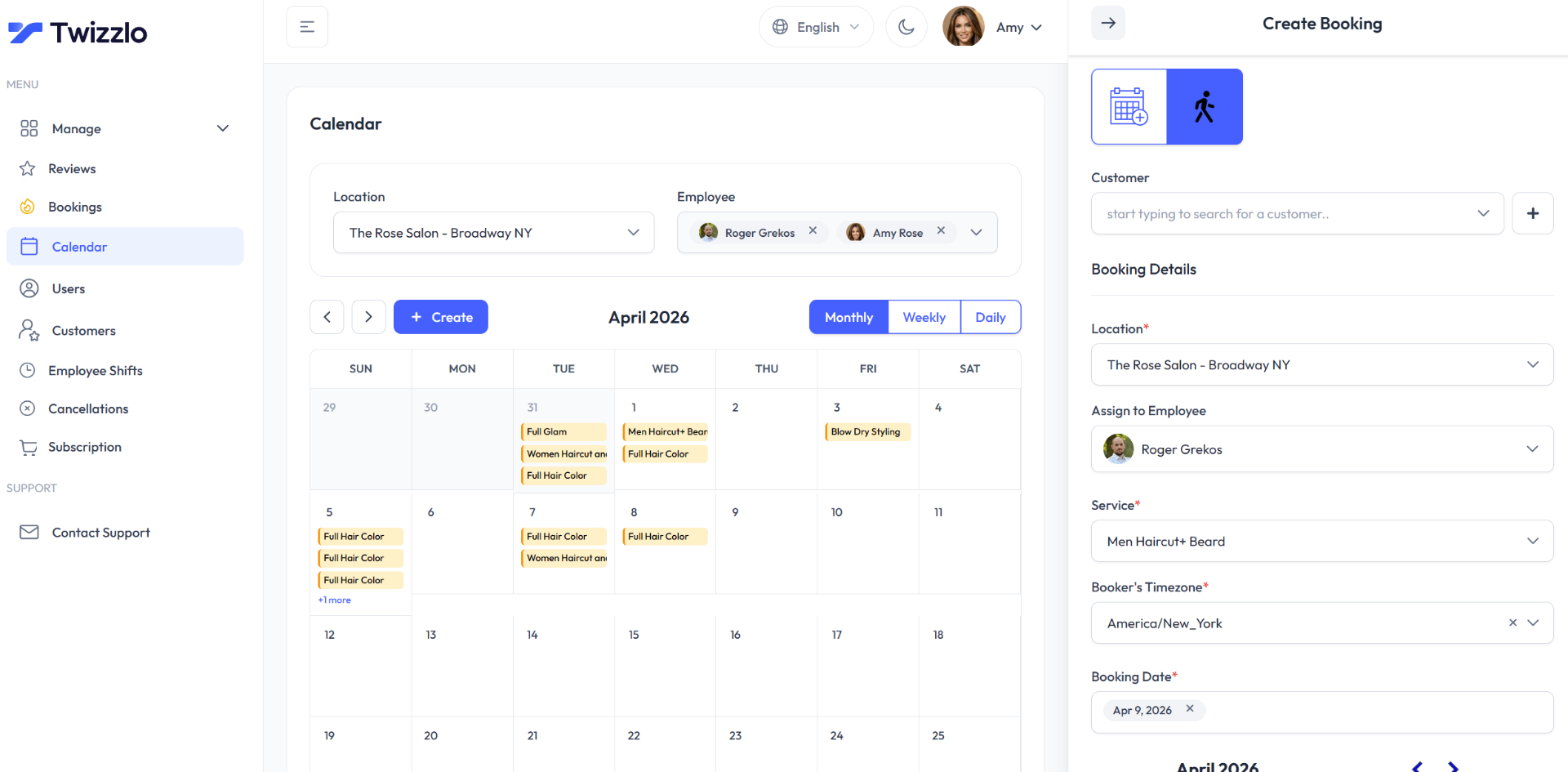
At six barbers, Business Pro stays at $29.99 a month, against $129.99 plus tax on Booksy, $73.99 on Vagaro's limited-time rate and $72 on Setmore Pro (read September 25, 2026). Square Appointments Free and StyleSeat's $19 limited-time rate cost less on subscription, as does Setmore Free for a shop of up to four users, and theCut's Shop plan is $0 for the owner (read September 28, 2026).
Twizzlo does not run a consumer marketplace, so it fits businesses that already bring in their own clients. Twizzlo does not run payroll, commission tracking or memberships. A shop that pays barbers on commission through its booking app is better served by SQUIRE, whose Executive plan lists commission and rent collection, or Vagaro, whose base subscription lists payroll reporting with custom commission tiers and rent and fee collection.
See how Twizzlo works as a barber scheduling app, or compare the Free plan and Business Pro pricing. A shop can start on Free and move to Business Pro when it needs SMS or more than 150 bookings a month.
Switching apps: what to move and when to tell clients
Move client records first, then tell clients. Before you commit, ask each app how it imports client names, phone numbers, emails, visit history and notes, export them from your current app, and share the new booking link with clients about two weeks before launch. Our barber booking website guide shows where to place that link on Google, Instagram and your own site.
- Name the problem. List the three to five problems the new app must fix, such as no-shows or after-hours calls, and test each finalist against them.
- Bring your barbers in. Show them the finalists before you sign up; they will use it every day.
- Plan the data move: contacts, appointment history and notes such as clipper guard numbers. As one vendor example, Booksy's help center, read September 27, 2026, says clients can be imported from a phone's contacts or, on a computer or tablet, an uploaded spreadsheet.
- Tell clients early. Post the change at each station and online, and have barbers book each client's next visit in the new app before they leave the chair.
Opening a new shop instead? Our guide to barber station dimensions, clearances and costs covers the floor plan.
Frequently asked questions
How Much Should a Good Booking App Cost?
It depends on your number of barbers. On pricing pages read September 25, 2026, Square Appointments Free and Setmore Free (up to four users) cost $0 and Booksy $29.99 a month plus tax for one team member. At 10 barbers, Booksy came to $209.99 plus tax and Vagaro to $83.99 on its limited-time rate, before card and marketplace fees.
Will My Clients Actually Bother Using an Online System?
More will if the link is easy to find. Put it on your website, your Google profile and your social media, print it at each station, and have barbers book each client's next visit before they leave the chair. Keep phone and walk-in bookings open while regulars switch over.
Can Booking Software Keep Up With Walk-ins?
Yes, with a waitlist or by blocking time. Vagaro's help center, read September 28, 2026, lists a waitlist in its base subscription; Booksy lists waitlists (read September 24, 2026); and Square Appointments adds one on Plus (grid captured September 27, 2026). Blocking a walk-in's time on the barber's calendar keeps online availability accurate.
How Do Booking Apps Cut Down on No-Shows?
With reminders plus a policy the app can enforce. Square Appointments adds cancellation and no-show fees on Plus (grid captured September 27, 2026), Vagaro puts deposits and cancellation fees in its $10-a-month Online Shopping Cart (read September 28, 2026), and Booksy lists No-Show Protection in its one plan (read September 24, 2026).
How Do I Switch My Barbershop to a New Booking App?
List the three to five problems the new app must fix, and let your barbers see the finalists before you commit. Export client contacts, visit history and notes from your current app and ask how the new one imports them. Announce the change about two weeks before launch, and book each client's next visit in the new app.
Can a Booking App Handle Barber Staff Scheduling?
Yes; the difference is how each one bills for it. On pricing pages read September 25, 2026, Booksy charged $20 a month per added team member, Vagaro $10 per added calendar up to seven licenses and Setmore Pro $12 per user, while Square Appointments listed unlimited staff calendars on its $0 plan.
Which booking apps for barbers charge a fee for new clients?
Five of the barber apps here charge for clients their marketplaces send: Booksy, StyleSeat, Vagaro, theCut and Fresha. Booksy's Boost and StyleSeat's New Client Connection took 30% of the first visit, $12.00 on a $40 cut, and Fill My Books 20%, or $8.00 (read September 25 and 27, 2026); theCut took $10 per client on Free (read September 28, 2026).
What is the best barbershop booking app for a shop with several barbers?
It depends on how the shop pays its barbers. On pricing pages read September 25, 2026, six barbers cost $129.99 a month plus tax on Booksy, $73.99 on Vagaro's limited-time rate, $72 on Setmore Pro and $49 on Square Appointments Plus. SQUIRE prices per shop instead, at $150 a month on Executive (US price from its plan data).
Sources and methodology
Prices read
- Setmore pricing page (opens in a new tab)Read . Supports: Free for up to 4 users; Pro $12 per user a month billed monthly, $5 billed annually; 500 SMS credits; Pro-only SMS reminders, deposits, recurring appointments and two-way sync; Live Receptionist $99 a month
- Square Appointments pricing page (US) (opens in a new tab)Read . Supports: Square Free $0, Plus $49 and Premium $149 a month per location, unlimited staff calendars, 30-day trial and card rates
- Square Appointments feature grid (same pricing page) (opens in a new tab)Read . Supports: reminders, prepayments and deposits on every plan; no-show fees, waitlist, multi-staff booking, commissions tracking and text marketing from Plus
- theCut pricing page (opens in a new tab)Read . Supports: Free $0 and PRO $25 a month for barbers, Shop plan $0 for owners, 30-day PRO trial, 2.75% payment processing, Client Discovery $10 per client on Free, plan features
- StyleSeat pricing page (opens in a new tab)Read . Supports: limited-time $19 a month rate for new pros, up to 15 chairs, staff calendars at no extra seat cost, 1.9% for six months
- StyleSeat help center: How Much Does StyleSeat Cost? (opens in a new tab)Read . Supports: Premium Plan $35 a month, card rates, New Client Connection 30% up to $50 and the $2.35 client booking fee
- Vagaro plans and pricing help article (US) (opens in a new tab)Read . Supports: base rate $23.99 a month, a limited-time rate, and $10 per added calendar up to seven licenses
- Vagaro plans and pricing help article (US): card rates (opens in a new tab)Read . Supports: US card processing rates and the Large Merchant fee
- Vagaro help center: Features Included in Your Base Subscription (opens in a new tab)Read . Supports: waitlist, reminders, no-show policies, payroll reporting with commission tiers, rent and fee collection
- Vagaro help center: Activate the Online Shopping Cart (opens in a new tab)Read . Supports: deposits and cancellation fees for $10 a month; requires card processing
- Vagaro help center: Fill My Books (opens in a new tab)Read . Supports: 20% of a new customer's first booking; 5% for a returning customer when it fills gaps
- Booksy pricing page (opens in a new tab)Read . Supports: subscription, added team members, 14-day trial, card rates and 2,000 marketing texts a month
- Booksy pricing page (included features) (opens in a new tab)Read . Supports: waitlists, No-Show Protection and Reserve with Google in the one plan
- Booksy help center: How does Boost pricing work? (opens in a new tab)Read . Supports: Boost 30% of a Boost client's first visit, $10 minimum and $100 maximum
- Booksy help center: How do I claim a client on Boost? (opens in a new tab)Read . Supports: claiming a client credited to Boost that you found through your own marketing
- Booksy help center: Is Booksy free for my clients? (opens in a new tab)Read . Supports: no booking fee for clients
- Booksy help center: How do I add and invite my clients? (opens in a new tab)Read . Supports: importing clients from a phone's contacts or an uploaded spreadsheet
- SQUIRE pricing page (US prices from its plan data) (opens in a new tab)Read . Supports: Independent $30, Pro $50, Executive $150 and Titan $250 per shop; 14-day trial; add-ons; client-side booking fees
- SQUIRE pricing page: plan features (opens in a new tab)Read . Supports: Executive and Titan feature lines, including commission and rent collection
- Fresha for-business page (opens in a new tab)Read . Supports: barbers among its business types and a client marketplace (no price printed in this guide)
- Twizzlo pricing page (opens in a new tab)Read . Supports: Twizzlo plans, booking cap, SMS allowance, money-back guarantee, unlimited staff and locations and the online payment fee
- Twizzlo features page (opens in a new tab)Read . Supports: Twizzlo booking, calendar, client, payment and no-show features; calendar screenshot (same image)
From our editorial policy
- Twizzlo sells online booking and appointment scheduling software, the same category we write about. Twizzlo appears in our comparisons and roundups, and we have a commercial interest in you choosing it.
- We do not publish invented quotes, studies, statistics, customer stories or product tests, and we do not imply hands-on use of a product when the research came from the vendor's public documentation.
- To report an error, email support@twizzlo.com with the subject line "Correction: [page URL]". Tell us what is wrong and, if you can, link a source.
Update history
- : Rewrote the guide as a dated comparison of eight barber booking apps, with costs by number of barbers, marketplace new-client fees and card costs, read September 25 to 28, 2026.
Start free, upgrade when you grow
Flat-rate booking software. No per-seat, per-chair or per-location fees.
- Free plan up to 150 bookings a month, not a trial
- Business Pro is $29.99 a month per business for unlimited bookings, with a 30-day money-back guarantee
- 24/7 support by email