
Booksy Alternatives: Find Your Ideal Salon Platform

In short
The best Booksy alternatives depend on why you are leaving. If Booksy's charge for each added team member is the problem, compare per-location or per-business plans such as Square Appointments and Twizzlo. If the marketplace stopped filling your book, compare Fresha and StyleSeat. For deeper back-office control, shortlist Boulevard, Mangomint or Zenoti.
In this article20 sections

Your booking software can get more expensive precisely when your business gets healthier. Many teams start with Booksy because it’s easy to launch, but the cost model changes once you add staff, need tighter payment controls, or want better reporting across a busier calendar. If you’re comparing Booksy alternatives, the core issue isn’t feature parity. It’s whether your system keeps costs predictable as operations get more complex.
Booksy's own pricing page, read September 25, 2026, publishes $29.99 a month plus tax with one team member and $20 a month for each additional member; our Booksy pricing page breaks down its fees.
What is a Booksy alternative?
A Booksy alternative is any scheduling platform that replaces Booksy for appointment-based businesses and offers a different mix of pricing, payments, staff management, marketplace exposure, or multi-location control. The best choice depends less on booking basics and more on how the software behaves as your team, locations, and operational complexity grow.
If you mainly want to see what each booking app looks like to your clients and on your phone, our guide to apps like Booksy covers that view; this page compares cost, fit and how to switch.
Key Takeaways
- Judge pricing architecture, not sticker price. Per-staff fees, add-ons, messaging charges, and per-location billing decide what you actually pay once the business grows.
- Match the tool to your business model. Marketplace platforms like Fresha and StyleSeat suit operators who still need client discovery; a flat-rate system like Twizzlo (Business Pro at $29.99 a month per business, with unlimited staff and locations on both plans) suits teams focused on cost control.
- Enterprise tools earn their weight only at scale. Boulevard, Phorest, and Zenoti fit premium and multi-location operations, not solo chairs.
- Buy for the next 12 to 24 months. Payments, client records, and reporting create lock-in fast, so switching costs rise the longer you wait.
1. Twizzlo
Twizzlo
Our productBest for: Teams that want one price per business as they add staff or locations.
Starting price: Free $0 up to 150 bookings a month; Business Pro $29.99 a month per businessRead on the Twizzlo pricing page (opens in a new tab)
Pros
- Unlimited staff and locations on both plans
- Online payments and tips at booking through Stripe
Cons
- Free is capped at 150 bookings a month, with no SMS
- SMS beyond 50 a month costs $0.03 each on Business Pro
Twizzlo is web-based online booking and appointment scheduling software for appointment-based service businesses, with two plans, Free and Business Pro, and both include unlimited staff and locations.
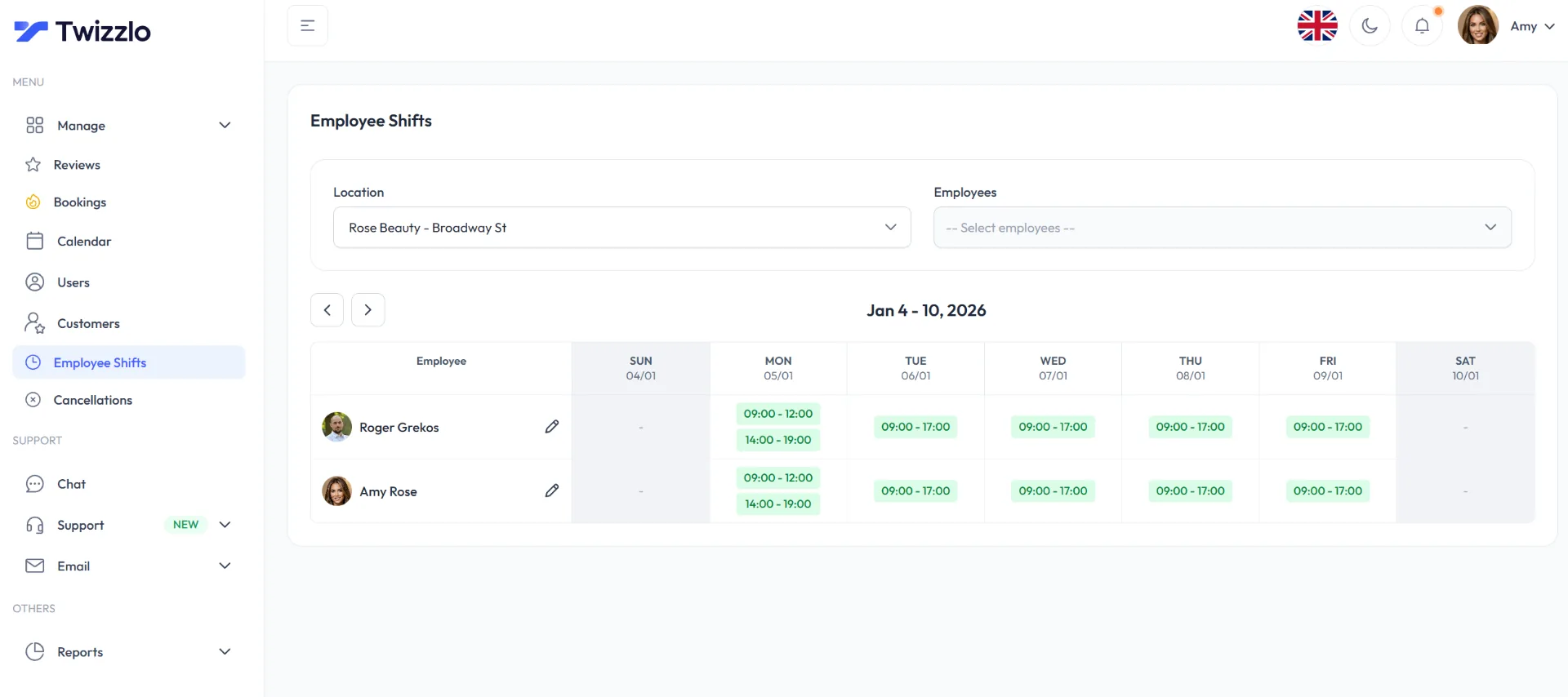
You start solo. Then you add a second provider, extend hours, and split calendars across rooms or locations. That is usually the point where Booksy gets harder to justify. The booking tool still works, but your software bill starts rising with the complexity of the business.
Twizzlo fits operators who want cost control first. It centers the decision on total cost of ownership, not just the entry price. Business Pro is $29.99 a month per business with unlimited bookings, and both plans include unlimited staff, locations and clients, so growth does not force a pricing reset every time you hire or expand. Twizzlo Free is $0 a month for up to 150 bookings, with no SMS; Business Pro includes 50 SMS a month, then $0.03 each, and carries a 30-day money-back guarantee.
Ideal business model
Twizzlo makes the most sense for:
- Solo operators planning to hire soon: You can avoid switching systems after your first growth step.
- Growing salons and studios: You need shared calendars, reminders, payments, and client records in one place.
- Multi-location businesses watching overhead: You want software costs to stay predictable while operations get more complex.
That pricing structure changes the math. If you expect to add providers, rooms, or a second site, flat-rate software protects margin better than seat-based pricing.
What Twizzlo handles day to day
Twizzlo covers the workflows that often turn into extra tools later:
- Online booking and automated reminders: Reduce no-shows and cut manual follow-up.
- Prepaid bookings and online payments: A prepaid booking charges the full service price at booking, which improves cash flow and filters out weak bookings.
- Staff calendars and location oversight: Keep schedules, availability, and service delivery under one system.
For teams tightening checkout and prepayment flow, Twizzlo also supports integrated payment processing for service businesses. Online payments carry your Stripe processing rate plus a 1.5% Twizzlo platform fee.
Twizzlo does not run a consumer marketplace, so it fits businesses that already bring in their own clients. Choose Twizzlo if your business model depends on operational stability, not marketplace discovery. It suits owners who want one system, one predictable bill, and fewer software decisions to revisit next quarter.
2. Fresha
Fresha
Best for: Salons, spas and wellness businesses that want marketplace discovery tied to their calendar.
Pros
- Consumer marketplace that can send new clients
- Point of sale and deposits at booking
Cons
- One-time fee on new clients from its marketplace
Fresha fits businesses that still want marketplace discovery tied directly to operations. It works well when your growth strategy depends on being found inside a booking ecosystem, not only through your own website or client retention flows.
Fresha's pricing page lists paid Independent and Team plans and a one-time fee on new clients who find you through the Fresha marketplace; its US prices were not readable from our location (read September 25, 2026), so confirm the current US price on Fresha's pricing page.
Where Fresha wins
Fresha does well in businesses that want:
- Marketplace exposure: You value client acquisition inside the platform.
- Fast launch: You don’t want a long setup cycle.
- Beauty-first workflows: You want a system designed around salons and wellness businesses.
The trade-off is control over long-term cost. Fresha can be inexpensive to start, but operators need to pay attention to messaging costs, optional add-ons, and any channel-based customer acquisition fees.
Marketplace-led software can help you fill gaps early. It can also make your margin harder to forecast later.
A practical example is a new lash or brow studio that needs discovery more than deep admin structure. Fresha can make sense there. A mature team with repeat business and multiple providers often needs tighter control over reporting, staff permissions, and branded client ownership than marketplace-first systems typically prioritize.
For the two marketplaces side by side, see our Booksy vs Fresha comparison.
3. Vagaro
Vagaro
Best for: Salons, spas and fitness businesses that add paid features one module at a time.
Starting price: $23.99 a month, a limited-time rate (list price not printed), with 1 calendar; $10 a month per extra calendarRead on Vagaro's help center (opens in a new tab)
Pros
- Memberships and classes alongside appointments
- No calendar charge after the seventh license
Cons
- Forms and Payroll are paid add-ons
- No price printed for after the limited-time rate
Vagaro is a general-purpose option built for broad feature coverage. It’s strong when you want a deep feature set and don’t mind managing add-ons, settings, and a more involved setup. For salons, spas, fitness businesses, and hybrid service models, Vagaro gives you room to build a very customized stack.
This is not the best choice for owners who want simplicity. It is the best choice for owners who want feature breadth and can tolerate more operational overhead to get it.
Best for configurable operations
Vagaro fits businesses that need:
- A wide toolset: POS, payroll, forms, memberships, classes, and more.
- Flexible packaging: You want to pay selectively for advanced functionality.
- Mixed service models: You run appointments, retail, memberships, or classes together.
One common scenario is a wellness business that has both service appointments and recurring programs. Vagaro can support that mixed model better than lighter salon-only tools.
The downside is cost visibility. Add-ons can make the monthly bill less predictable, and broader systems usually require more training across the front desk and provider team. That’s why owners comparing it against Booksy should look beyond headline subscription price.
Vagaro's US help center, read September 25, 2026, lists a base of $23.99 a month for one calendar, a rate it marks as available only for a limited time without printing the price after it; each additional calendar is $10 a month up to seven licenses, and add-ons such as Forms ($10 a month) and Payroll ($34 a month plus $5 per employee) are billed separately. The help center prints no subscription price for an added location. See our Vagaro pricing page for the full breakdown.
For a direct operational comparison, review Vagaro vs Booksy for salons.
Choose Vagaro when you want optional complexity. Avoid it when your team struggles with adoption or your manager already spends too much time policing workflow mistakes.
4. Square Appointments
Square Appointments
Best for: Shops that already take payments on Square and want booking in the same account.
Starting price: $0 a month per location (Square Free); Plus $49, Premium $149Read on Square's pricing page (opens in a new tab)
Pros
- Free plan with unlimited staff calendars
- Lower card rates on Plus and Premium
Cons
- Paid plans bill per location
- No-show fees and multi-staff appointments start on Plus
Square Appointments is Square's booking tool, billed per location at $0, $49 or $149 a month on its pricing page, read September 25, 2026. Card rates run from 2.6% plus 15 cents in person and 3.3% plus 30 cents online on Free to 2.4% plus 15 cents and 2.9% plus 30 cents on Premium; Free includes unlimited staff calendars. Our Square Appointments pricing page compares the plans.
You already run checkout on Square. Your staff knows the hardware, your reports flow through one payments system, and retail sales are part of the day-to-day operation. In that setup, Square Appointments is usually the cleanest Booksy alternative because it cuts software sprawl and keeps billing, booking, and point of sale under one vendor.
That matters more than a low headline price. The advantage is lower operational drag. Fewer integrations mean fewer sync issues, less staff retraining, and a simpler support stack when something breaks.
Best for commerce-first service businesses
Square Appointments fits best for:
- Solo operators and small teams: You want to keep fixed costs low and avoid adding another system.
- Retail-heavy salons or studios: Payments, tips, products, and appointments need to stay tied together.
- Square-based businesses: You already use Square readers, terminals, or POS workflows and want one source of truth.
A good fit is a salon with a front desk, steady walk-ins, and meaningful retail revenue. In that model, payment flow is not a side issue. It is the operation. Square is built for that side of the business.
The trade-off is specialization. Square is strong for businesses where commerce infrastructure drives the software decision. It is weaker for owners who need deeper salon-specific controls, more advanced staff and resource logic, or tighter multi-location standardization. If your business is growing into a more complex service operation, those gaps create admin work fast.
Use Square Appointments if your business model is simple, payment-heavy, and already built around Square. Skip it if you need a system designed around service complexity first.
For a head-to-head, read our Booksy vs Square Appointments comparison.
5. GlossGenius
GlossGenius
Best for: Solo beauty professionals and small teams that want a polished booking site.
Starting price: $28 a month (Standard, no staff management); Gold $56 for up to 9 staffRead on GlossGenius' pricing page (opens in a new tab)
Pros
- Flat 2.6% card rate
- Each added location at its plan price less 15%
Cons
- Staff management starts on Gold
- Instant payouts carry an extra 1.8% fee
GlossGenius is the right move for beauty businesses that want a polished, modern client experience without buying a large, enterprise-style system. It’s especially good for solo professionals and small teams that care about brand presentation as much as schedule management.
Where it stands out is usability. Its appeal is that the booking flow feels clean, the branding tools are strong, and the system is easier to live in daily than some older all-in-one platforms.
Best fit
GlossGenius works best for:
- Independent beauty operators: You want a premium-looking booking experience.
- Small teams: You need enough structure without enterprise complexity.
- Brand-led businesses: Your online presentation is part of the sale.
A practical example is a stylist or esthetician building a premium personal brand and wanting clients to book through a polished mobile-friendly flow. GlossGenius supports that well.
The main caution is depth. As the business grows, some teams eventually want broader reporting, more operational controls, or more advanced multi-location capabilities than style-first platforms typically emphasize. If your business model is still compact, that’s not a problem. If you’re standardizing operations across a larger team, it can become one.
GlossGenius' pricing page, read September 25, 2026, lists Standard at $28 a month (no staff management), Gold at $56 a month for businesses with up to nine staff and Platinum at $168 a month for teams of 10 or more, billed monthly, with a flat 2.6% card rate; each added location costs its plan price less 15%. See our GlossGenius pricing page for the annual rates.
6. Boulevard
Boulevard
Best for: Established salons and spas with complex service timing and a busy front desk.
Starting price: $159 a month (Essentials, up to 5 providers); Premier $325 a month per location normally, $260 on a limited-time offerRead on Boulevard's pricing page (opens in a new tab)
Pros
- Unlimited professionals on Premier
- Precision Scheduling calendar optimization
Cons
- Essentials stops at 5 providers
- Premier bills per location
Boulevard is built for service businesses that care greatly about scheduling precision and premium guest experience. If your operation has longer services, room dependencies, staggered timing, or a higher-touch front desk process, Boulevard deserves serious consideration.
This is a more operationally mature product than many entry-level Booksy alternatives. It suits established salons and spas that already know their workflows and want software to enforce them cleanly.
Where Boulevard makes sense
Choose Boulevard when you need:
- Advanced scheduling logic: You have service timing complexity.
- Resource management: Rooms, stations, or equipment affect bookings.
- Premium service delivery: Client experience is part of your brand positioning.
A strong example is a spa with treatment rooms, varying service durations, and front-desk staff coordinating multiple providers across the day. Basic schedulers can handle bookings there. They often struggle to handle the workflow cleanly.
The trade-off is obvious. Boulevard is not positioned like a low-cost starter tool. It’s a better fit for businesses that already have steady volume and want software discipline, not businesses trying to keep every monthly fixed cost at the minimum.
Boulevard's pricing page, read September 25, 2026, lists Essentials at $159 a month for up to five providers and Premier at $325 a month per location normally, with unlimited professionals, or $260 on a limited-time offer for new customers.
7. Mangomint
Mangomint
Best for: Salon and spa teams that want modern software with per-user pricing.
Starting price: $120 a month per location plus $10 a month per userRead on Mangomint's pricing page (opens in a new tab)
Pros
- No fee on appointments booked in the platform
- Express Booking for clients
Cons
- Front desk staff count as paid users
- Phone line add-on costs $70 a month
Mangomint suits salon and spa operators who want modern UX, strong automation, and cleaner back-office workflows. It’s particularly appealing if your team hates clunky admin screens and wants a system staff will adopt.
Its positioning is operationally smart. Mangomint focuses on speed, automation, and clarity rather than marketplace dependence.
Why operators like it
Mangomint is a strong fit for:
- Booth-renter or hybrid models: You need cleaner separation between providers.
- Multi-location salons: You want stronger reporting and organization.
- Teams replacing older software: Adoption matters as much as features.
A common use case is a salon with independent and employed providers under one roof. That model creates friction around access, payouts, schedules, and reporting. Mangomint is more aligned with that complexity than simpler tools.
The downside is that it sits above entry-level options in both ambition and likely spend. If you’re still testing your service mix or running a very small operation, you may not need this much software. If you’re managing provider complexity every day, you probably do.
Mangomint's pricing page, read September 25, 2026, charges $120 a month per location plus $10 a month per user, and anyone with a profile, including front desk staff, counts as a user.
8. Phorest
Phorest
Best for: Established salons that want retention marketing, loyalty and reviews in one system.
Starting price: Quote only, on every planRead on Phorest's US pricing page (opens in a new tab)
Pros
- Unlimited staff and devices on all plans
- Free data migration and onboarding training
Cons
- No published price
- No free trial
Phorest is a retention-focused platform for established salons and spas that want booking, marketing, reputation management, and loyalty tools in one system. It’s built for operators who think beyond appointment volume and care about rebooking, client communication, and brand consistency.
This isn’t a minimalist scheduler. It’s a business management platform designed for businesses that already have a customer base worth nurturing carefully.
Best for retention-led growth
Phorest is a good fit when you want:
- Marketing depth: You need stronger follow-up and re-engagement tools.
- Brand control: Reviews, loyalty, and client communication matter.
- Support during transition: Migration and onboarding are important to your team.
Take a salon with a mature client list that wants to improve repeat visits, memberships, and review generation without bolting separate tools together. Phorest aligns well with that goal.
The trade-off is buying process and pricing visibility. Because pricing is quote-led, owners should be disciplined about scoping exactly what’s included, how user access works, and what happens when locations or advanced marketing needs expand.
Phorest's US pricing page, read September 25, 2026, quotes every plan on request and lists unlimited staff and unlimited devices on all plans. If Phorest is already on your shortlist, our Phorest alternative guide compares it with similar salon suites.
9. Zenoti
Zenoti
Best for: Chains and franchises that need central control across locations.
Starting price: Quote only; multi-location pricing customizedRead on Zenoti's pricing page (opens in a new tab)
Pros
- Built for salon, spa, medspa and fitness businesses
- Point of sale and franchise tools
Cons
- No published price
- AI agents need the AI Plus package
Zenoti is the enterprise answer on this list. If you’re operating multiple sites, enforcing standard operating procedures, and managing performance across locations, Zenoti belongs in the conversation. If you’re a solo stylist or a compact salon team, it probably doesn’t.
Zenoti is most relevant once you run several locations: its pricing page, read September 25, 2026, quotes every plan and says multi-location pricing is customized.
Where Zenoti earns its place
Zenoti is best for:
- Franchises and chains: You need centralized oversight.
- Operational standardization: Permissions, controls, and reporting must be consistent.
- Complex admin teams: Headquarters needs visibility across sites.
Consider a regional spa brand with local managers but centralized ownership. In that setup, weak permissions and fragmented reporting create daily management problems. Zenoti is built for that level of control.
Multi-location businesses shouldn’t buy software like a solo provider. The admin model matters as much as the booking screen.
The trade-off is implementation load. Enterprise-grade control usually means a heavier rollout, more configuration, and more training. That’s worthwhile only if your business complexity is real enough to justify it.
10. StyleSeat
StyleSeat
Best for: Independent stylists and barbers who want marketplace discovery.
Starting price: $19 a month, a limited-time new-pro rate (pricing page); help center lists a $35 Premium planRead on StyleSeat's pricing page (opens in a new tab)
Pros
- Up to 15 chairs on one account
- Staff calendars at no extra seat cost
Cons
- Optional New Client Connection fee: 30% of a new client's first appointment, up to $50
StyleSeat is best viewed as a marketplace business tool for independents, not a full operational platform for scaling teams. It works well when client discovery is still one of your top problems and your business model is centered on a solo professional or a very small team.
That makes it a direct competitor to Booksy for barbers, stylists, and beauty professionals who want bookings plus visibility. It’s less compelling for operators who are trying to standardize team workflows or centralize control across a larger business.
Best fit
StyleSeat makes sense for:
- Independent professionals: You want discovery and bookings in one place.
- Mobile or flexible businesses: You don’t need heavy back-office systems.
- Brand builders in early growth: Exposure matters more than admin depth.
One example is a barber building clientele in a competitive local market. StyleSeat can help surface the business in a way that a standalone scheduler can’t.
StyleSeat's pricing page, read September 25, 2026, offers new pros a $19 a month rate it labels limited time, for stylists and salons with up to 15 chairs and with staff calendars at no extra seat cost; its help center lists a $35 a month Premium plan and an optional New Client Connection fee of 30% of a new client's first appointment, up to $50.
For what each one charges the pro, the team and the client, read our Booksy vs StyleSeat fee comparison.
The caution is strategic. Marketplace-driven systems are useful when demand generation is the bottleneck. Once retention, staffing, reporting, and margin control become the bottlenecks, most operators outgrow that model and move toward software they control more directly.
Booksy competitors: the four groups to compare
Booksy competitors fall into four groups, and the right group depends on why you are leaving Booksy: marketplaces, all-in-one suites, premium and enterprise platforms, and flat-rate booking software.
- Marketplaces (Fresha, StyleSeat): the closest swap if client discovery still fills your book. Fresha lists paid Independent and Team plans and charges a one-time fee on new marketplace clients.
- All-in-one suites (Vagaro, Square Appointments, GlossGenius): booking, payments and checkout in one account. Vagaro adds cost through add-ons, Square suits shops already on Square payments, and GlossGenius suits solo pros and small teams.
- Premium and enterprise (Boulevard, Mangomint, Phorest, Zenoti): deeper staff workflows, retention marketing and multi-site control, at higher prices or by quote.
- Flat-rate booking (Twizzlo): Business Pro is $29.99 a month per business with unlimited staff and locations, so hiring does not change the bill. Twizzlo Free covers up to 150 bookings a month without SMS.
A quick way to pick a Booksy alternative: if per-member fees are the reason you are leaving, compare flat-rate and per-location pricing first; if the marketplace stopped sending clients, compare the other marketplaces; if you need more back-office depth, start with the premium group. Salons can see how the flat-rate model works day to day on the salon scheduling software page, and barbershops on the barbershop booking software page.
What Booksy alternatives cost at 1, 3 and 6 team members
Booksy's price rises by $20 a month for each team member after the first, so the gap to its alternatives grows as you hire. On each vendor's pricing page or help center, read September 25, 2026 (Twizzlo's pricing page on September 27), a six-person team at one location pays $129.99 a month plus tax on Booksy, against $0 on Square Appointments Free, $19 on StyleSeat's limited-time rate, $29.99 on Twizzlo Business Pro, $56 on GlossGenius Gold, $73.99 on Vagaro's limited-time base with five added calendars, $180 on Mangomint and a normal $325 on Boulevard Premier. For one professional the gap closes: Booksy's $29.99 equals Twizzlo Business Pro and sits within $11 of Vagaro's $23.99 limited-time base, GlossGenius Standard's $28 and StyleSeat's $19 limited-time rate, while Square Appointments Free stays at $0. Fresha's US price was not read for this comparison, and Phorest and Zenoti quote every plan.
| Tool | Bills by | 1 team member | 3 team members | 6 team members |
|---|---|---|---|---|
| Booksy | Per business; $20 a month per added member; plus tax | $29.99 | $69.99 | $129.99 |
| Twizzlo Business Pro | Per business (Free: $0 up to 150 bookings a month, no SMS) | $29.99 | $29.99 | $29.99 |
| Square Appointments Free | Per location; unlimited staff calendars; Plus $49, Premium $149 | $0 | $0 | $0 |
| Vagaro | Base plan with 1 calendar, plus $10 a month per added calendar up to seven | $23.99* | $43.99* | $73.99* |
| GlossGenius | Per business; plan set by team size | $28 (Standard) | $56 (Gold, up to 9 staff) | $56 (Gold) |
| StyleSeat | Per account, up to 15 chairs | $19* | $19* | $19* |
| Mangomint | Per location, plus $10 a month per user | $130 | $150 | $180 |
| Boulevard | Essentials up to 5 providers; Premier per location | $159 (Essentials) | $159 (Essentials) | $325 (Premier, normal price; $260 limited-time offer) |
| Fresha | Paid Independent and Team plans | US price not read | US price not read | US price not read |
| Phorest | Quote per plan; unlimited staff | Quote only | Quote only | Quote only |
| Zenoti | Quote; multi-location pricing customized | Quote only | Quote only | Quote only |
Monthly subscription for one location on monthly billing, before tax and card processing. * Limited-time rate; the price after it is not printed. StyleSeat's help center lists a $35 a month Premium plan. Sources: each vendor's pricing page and Vagaro's US help center, read September 25, 2026; Twizzlo from twizzlo.com/pricing/, read September 27, 2026.
Subscription only: card processing, add-ons and any text-message charges are not included. On Twizzlo: Online payments carry your Stripe processing rate plus a 1.5% Twizzlo platform fee.
Square Appointments Free, StyleSeat and Twizzlo do not raise the subscription as you add staff, and Boulevard Premier and Phorest list unlimited professionals or staff on their plans; Booksy, Vagaro (up to seven calendars) and Mangomint charge for each added person.
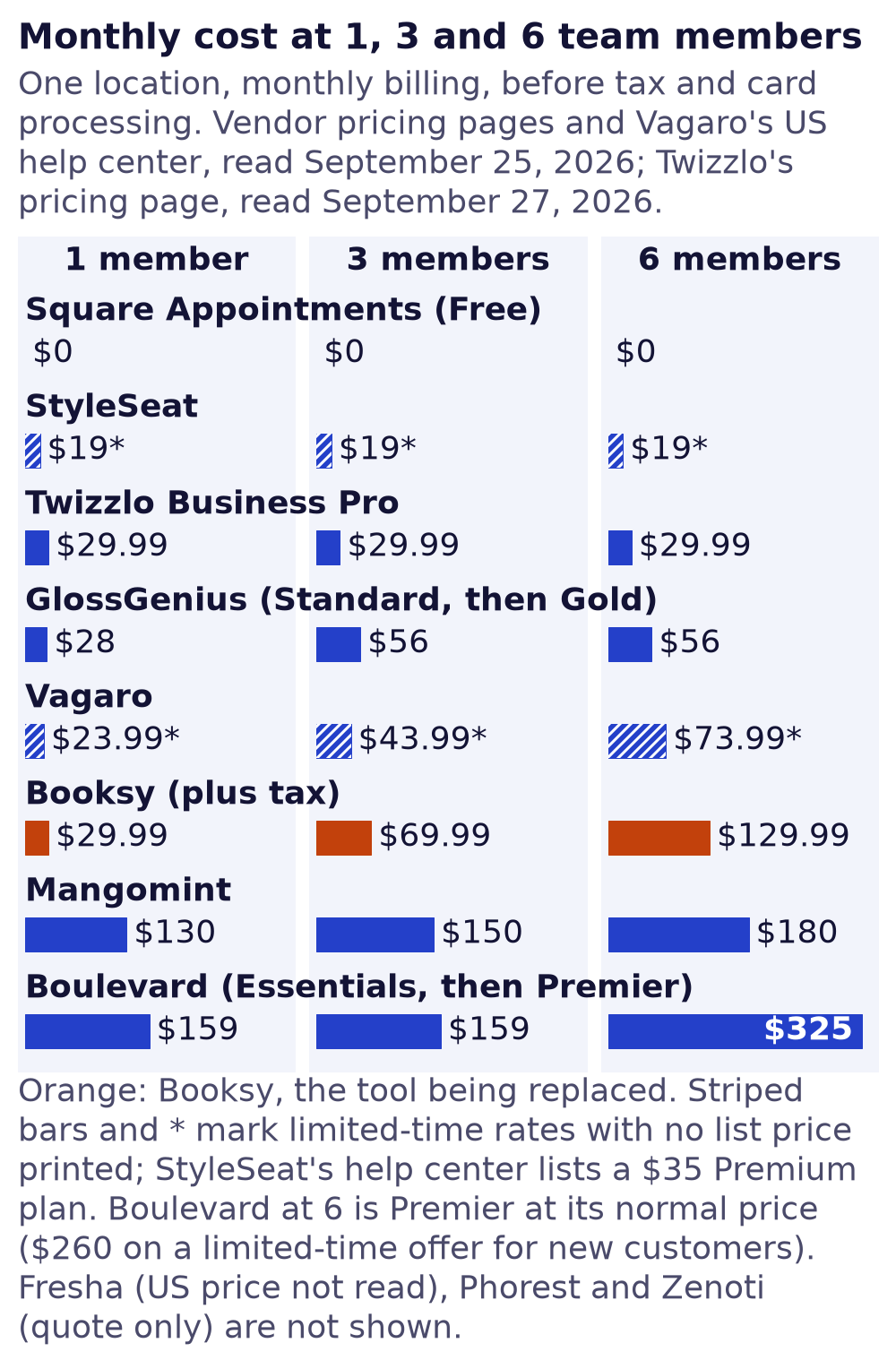
Top 10 Booksy Alternatives Comparison
Booksy alternatives differ most in how they bill: per location (Square Appointments, Boulevard Premier; Mangomint, plus each user), per calendar (Vagaro), by plan (GlossGenius, Boulevard Essentials), per business (Twizzlo) or by quote (Phorest, Zenoti), while Fresha and StyleSeat charge fees on some new marketplace clients. The table compares all 10 by core features, published price and the business each fits best.
If you’re down to a shortlist, this is the point where feature lists stop helping. The key decision is operational fit. Which platform matches your business model, what will it cost once you add staff, locations, messaging, and payments, and how painful will it be to switch again in 12 months?
Use the table below to compare these Booksy alternatives by total cost of ownership and the type of business each one serves best.
| Product | Core features | Pricing & value | Target audience | Unique selling points |
|---|---|---|---|---|
| Twizzlo | Unlimited staff, locations and client records on both plans; unlimited bookings on Business Pro; online payments and tips; reminders | Free: $0 up to 150 bookings a month, no SMS. Business Pro: $29.99 a month per business, 50 SMS then $0.03 each. Online payments carry your Stripe processing rate plus a 1.5% Twizzlo platform fee. | Salons, spas, studios, barbershops, mobile & multi-location operators | One flat Business Pro price, predictable billing, 24/7 online booking, prepaid bookings, real-time insights, 24/7 support, 30-day money-back guarantee on Business Pro |
| Fresha | Booking, POS, deposits, messaging, marketplace | No verified US price; one-time fee on new marketplace clients | Salons & wellness businesses wanting discovery | Built-in consumer marketplace and optional add-ons |
| Vagaro | Booking, POS, inventory, marketing | $23.99 a month limited-time base, $10 per added calendar to seven, add-ons extra | Growing salons, studios & multi-staff businesses | Granular add-ons and a branded app |
| Square Appointments | 24/7 booking, reminders, POS, website builder | $0, $49 or $149 a month per location | Solo pros to growing teams using Square ecosystem | Tight integration with Square POS & hardware |
| GlossGenius | Booking site, notifications, packages, payouts | $28 to $168 a month by plan, flat 2.6% card rate | Solo professionals & small teams | Flat processing fee, instant payouts, beauty-first UI |
| Boulevard | Precision Scheduling, resource management, marketing | $159 Essentials; Premier $325 a month per location normally, $260 limited-time offer | Multi-location, high-end salons & spas | Calendar optimization and enterprise controls |
| Mangomint | Express Booking, reporting, multi-location | $120 a month per location plus $10 per user | Salons, booth-renters, multi-location operators | Booth-renter workflows |
| Phorest | Booking, POS, marketing, loyalty, onboarding | Quote-based (no public pricing) | Established salons and chains | Strong reviews/loyalty toolkit and branded apps |
| Zenoti | Enterprise scheduling, POS, marketing | Quote only; multi-location pricing customized | Franchises, large chains & medspas | Enterprise multi-location management |
| StyleSeat | Booking, deposits, marketplace discovery, messaging | $19 a month limited-time new-pro rate; help center lists $35 Premium | Independent stylists, barbers & solo pros | Marketplace discovery and optional Smart Pricing |
Prices read September 25, 2026 on each vendor's pricing page (Vagaro: its US help center; StyleSeat: its pricing page and help center); Twizzlo from twizzlo.com/pricing/, read September 27, 2026. Feature cells from each vendor's own pages, read September 27, 2026.
A simple way to read this table: pick your business model first, then eliminate anything with the wrong pricing architecture. Solo operators usually do best with GlossGenius, Square Appointments, or StyleSeat. Growing multi-staff businesses should look harder at Twizzlo, Vagaro, and Mangomint. Premium multi-location operators belong in the Boulevard, Phorest, or Zenoti lane.
We also recommend treating “low starting price” with suspicion. Add-ons, marketplace fees, messaging charges, payment requirements, and per-location pricing change the actual number fast. Sticker price is marketing. Total monthly operating cost is the number that matters.
Making the Final Decision: A Quick Checklist
Choose between two close candidates by pricing each at your team size, then by what would be hardest to replace later.
You are at the point where two tools look close enough, the demo went fine, and the sales page says both will save time. Owners make an expensive mistake at this point. The right choice is the platform that still makes operational sense after you add staff, shift payment volume, and clean up the monthly bill.
Use a simple filter. Match the software to your business model first. Then test the actual cost of running it.
Start with these questions:
- How does pricing scale? Check whether cost rises by staff member, location, add-on, SMS volume, or payment requirement. A cheap starting plan can turn into an expensive operating expense once your team grows.
- What will be painful to replace later? Payments, client records, memberships, packages, and reporting create lock-in fast.
- Which business model are you running? Solo operators can tolerate simpler tools and tighter limits. Multi-staff salons, medspas, and multi-location groups need stronger controls, cleaner permissions, and pricing that does not punish headcount growth.
- What work will your team do outside the app? If staff will still text clients manually, patch together reports, or work around weak checkout flows, the sticker price is irrelevant. Labor cost counts too.
- How hard is onboarding? Some systems are quick to launch but shallow. Others require more setup and training, then save time every week after that. Pick based on your actual operating maturity.
Our recommendation framework is straightforward:
- Choose Twizzlo if you want flat pricing, multi-location support, and predictable costs as you add staff.
- Choose Fresha or StyleSeat if marketplace demand is still part of your client acquisition model.
- Choose Square Appointments if Square already runs your payments and front-desk flow.
- Choose Vagaro if you want broad feature coverage and will actively manage add-ons.
- Choose Boulevard or Mangomint if polished staff workflows and front-desk efficiency matter more than entry price.
- Choose Phorest if retention, campaigns, and client marketing drive your growth plan.
- Choose Zenoti if you are buying for multi-site oversight, standardized operations, and executive reporting.
Be strict here. Buy for the business you expect to run in 12 to 24 months, not the one you had six months ago.
Owners who choose the cheapest plan that works for today’s schedule can get hit later by per-seat fees, higher messaging costs, migration friction, and process changes staff hate.
The best Booksy alternative is the one with predictable total cost of ownership, acceptable switching risk, and a fit for your business model. Make the call that protects margin and keeps operations simple as complexity rises.
How to switch from Booksy in seven steps
Switching from Booksy works best when the new tool is fully set up before clients see a new booking link.
- Note your Booksy billing date. Booksy's pricing page, read September 25, 2026, says the subscription is monthly with no commitment, and its help center, read September 27, 2026, says it charges automatically every month.
- Get your records out first. Ask Booksy how to export your client list and upcoming appointments, and save a copy before you change anything else.
- Build the new tool before you announce it. Set up services, prices, staff and hours so the first client who books sees a complete menu.
- Recreate your policies. Set your prepaid booking, cancellation and no-show rules in the new tool, and decide when you will apply them.
- Overlap the calendars. Run both calendars in parallel for a short overlap so no booking falls between systems.
- Replace every booking link. Update your Instagram bio and Book Now button, Google Business Profile, Facebook page and website.
- Close the old account last. Message clients with the new link, confirm Boost is turned off, then cancel Booksy after the last booking it holds; its help center, read September 27, 2026, says to contact Booksy's support team to cancel an account.
Frequently Asked Questions
What is the best Booksy alternative?
It depends on which constraint you’re solving. For predictable costs as you add staff or locations, Twizzlo Business Pro fits: its pricing page, read September 27, 2026, lists $29.99 a month per business with unlimited bookings, staff and locations. If marketplace discovery still drives your growth, Fresha or StyleSeat make more sense. If your payments already run on Square, Square Appointments keeps booking and checkout under one vendor.
Is there a free alternative to Booksy?
Two realistic paths. Square Appointments Free is $0 a month per location with unlimited staff calendars on its pricing page, read September 25, 2026, and Twizzlo’s Free plan covers up to 150 bookings per month at $0 (Twizzlo pricing page, read September 27, 2026). Fresha, often listed as free in older comparisons, now lists paid Independent and Team plans on its pricing page. With any free tier, check what’s gated before you commit: add-ons, messaging charges, and payment requirements change the real cost fast.
Which Booksy alternatives don’t charge per team member?
Twizzlo includes unlimited staff on Free and on Business Pro ($29.99 a month per business), so hiring doesn’t change the bill, according to its pricing page, read September 27, 2026. On the vendors' own pages, read September 25, 2026, Square Appointments bills per location with unlimited staff calendars on Free, StyleSeat covers up to 15 chairs with staff calendars at no extra seat cost, and Boulevard Premier and Phorest list unlimited professionals or staff; Booksy, Vagaro (up to seven calendars) and Mangomint charge for each added person.
What is the best Booksy alternative for barbers?
If marketplace exposure fills your chair, StyleSeat is the closest like-for-like swap: it’s built around discovery for independent barbers and stylists. If your books are already full and you’re optimizing for margin, a flat-rate system like Twizzlo protects you from per-staff fees as the shop grows. Our guide to the best booking app for barbers breaks this decision down in more detail.
How do I switch from Booksy without losing clients?
Export your client list and upcoming appointments first, then set up services, staff, and policies in the new system before you cancel anything. Run both systems in parallel for a short overlap, update your booking links everywhere they live (Instagram bio, Google Business Profile, website) and message clients with the new link. Reconfigure deposits and card-on-file policies on day one so no-show protection never lapses.
Who are Booksy's main competitors?
Fresha and StyleSeat compete most directly as marketplaces. Vagaro, Square Appointments and GlossGenius compete as all-in-one booking and payment suites. Boulevard, Mangomint, Phorest and Zenoti serve premium and multi-location businesses. Twizzlo competes on flat pricing: Business Pro is $29.99 a month per business with unlimited staff and locations, per its pricing page, read September 27, 2026.
Which Booksy alternatives suit a business with more than one location?
Pick a price you can predict per location. On each vendor's pricing page, read September 25, 2026, Square Appointments bills $0, $49 or $149 a month per location, Mangomint $120 per location plus $10 per user, Boulevard Premier $325 per location normally ($260 on a limited-time offer) and GlossGenius each added location at its plan price less 15%; Vagaro's help center prints no subscription price for an added location, and Zenoti quotes multi-location pricing. Twizzlo includes unlimited locations on both plans, according to its pricing page, read September 27, 2026.
When is it worth switching away from Booksy?
Switch when the per-member charge, marketplace fees or missing back-office tools cost more than the move. Booksy's pricing page, read September 25, 2026, lists $29.99 a month plus tax with one team member and $20 a month for each added member, so a six-person team pays $129.99 before tax, and Boost charges a one-time fee of 30% of a Boost client's first visit, according to the same page. Booksy bills month to month with no commitment, so time the switch to your billing date.
Where Twizzlo fits among Booksy alternatives
Several Booksy alternatives charge per staff member or keep features in higher tiers. Twizzlo comes in two plans (see plans and pricing): Free at $0 for up to 150 bookings a month, with no SMS, and Business Pro at $29.99 a month per business with unlimited bookings, 50 SMS a month (then $0.03 each) and a 30-day money-back guarantee. Both plans include unlimited staff and locations, so adding a chair or a second site never raises the price. Online payments carry your Stripe processing rate plus a 1.5% Twizzlo platform fee.
If you want software that stays simple as your business gets more complex, choose Twizzlo. It gives you a free plan to start, one flat price for Business Pro, no per-seat fees, and the operational tools you need to run bookings, staff, clients, and locations without cost creep.
Sources and methodology
Prices read
- Booksy pricing page (opens in a new tab)Read . Supports: Booksy's published price, the charge per added team member, month-to-month billing with no commitment and the Boost fee
- Booksy help center: subscription payments (opens in a new tab)Read . Supports: The subscription charges automatically every month
- Booksy help center: how Boost works (opens in a new tab)Read . Supports: Boost is turned on and off by the business
- Booksy help center: cancelling an account (opens in a new tab)Read . Supports: Accounts are cancelled by contacting Booksy's support team
- Twizzlo pricing page (opens in a new tab)Read . Supports: Twizzlo plans, booking cap, SMS allowance, money-back guarantee and online payment fee
- Twizzlo features page (opens in a new tab)Read . Supports: Multi-location staff shifts (the Employee Shifts screenshot, same image), online payments and tips
- Square Appointments pricing page (US) (opens in a new tab)Read . Supports: Square plans per location, unlimited staff calendars on Free and card rates (plan grid read again September 27, 2026: no-show fees and multi-staff appointments from Plus)
- Square Appointments page (US) (opens in a new tab)Read . Supports: Square point of sale and website products
- Vagaro plans and pricing help article (US) (opens in a new tab)Read . Supports: Vagaro's limited-time base rate, calendar fees, add-ons and the branded app
- Vagaro help center: memberships (opens in a new tab)Read . Supports: Vagaro memberships
- Vagaro help center: classes (opens in a new tab)Read . Supports: Vagaro classes
- Vagaro help center: inventory report (opens in a new tab)Read . Supports: Vagaro inventory and product sales
- GlossGenius pricing page (opens in a new tab)Read . Supports: GlossGenius plans billed monthly, staff limits, card rate, instant payouts and added locations (plan features read again September 27, 2026)
- StyleSeat pricing page (opens in a new tab)Read . Supports: StyleSeat's limited-time $19 new-pro rate, the 15-chair limit and staff calendars
- StyleSeat help center: cost (opens in a new tab)Read . Supports: StyleSeat's $35 Premium plan, New Client Connection fee and Smart Pricing
- StyleSeat for professionals page (opens in a new tab)Read . Supports: StyleSeat deposits, no-show policies, text marketing and optional Smart Pricing
- Boulevard pricing page (opens in a new tab)Read . Supports: Boulevard Essentials and Premier prices, the limited-time offer and unlimited professionals on Premier
- Boulevard scheduling page (opens in a new tab)Read . Supports: Precision Scheduling calendar optimization and resources
- Boulevard Support Center: resource scheduling (opens in a new tab)Read . Supports: Boulevard books rooms, chairs, equipment and machines as resources alongside the provider
- Mangomint pricing page (opens in a new tab)Read . Supports: Mangomint's per-location and per-user prices, who counts as a user, the phone add-on and no fee on bookings (booth-renter FAQ read again September 27, 2026)
- Mangomint homepage (opens in a new tab)Read . Supports: Mangomint Express Booking, multi-location and reporting
- Phorest US pricing page (opens in a new tab)Read . Supports: Phorest quotes every plan; unlimited staff and devices; no free trial
- Phorest US homepage (opens in a new tab)Read . Supports: Phorest point of sale, loyalty, reputation tools, a branded client app, free data migration and onboarding training
- Zenoti pricing page (opens in a new tab)Read . Supports: Zenoti quotes every plan; multi-location pricing is customized; AI agents need the AI Plus package
- Zenoti homepage (opens in a new tab)Read . Supports: Zenoti serves salons, spas, medspas and fitness businesses, with point of sale and franchise tools
- Fresha pricing page (read outside the US) (opens in a new tab)Read . Supports: Fresha's paid Independent and Team plans and the one-time fee on new marketplace clients (wording only; no Fresha figure is stated)
- Fresha for business page (opens in a new tab)Read . Supports: Fresha's marketplace, point of sale, deposits at booking and the salons, spas and wellness businesses it serves
From our editorial policy
- Twizzlo sells online booking and appointment scheduling software, the same category we write about. Twizzlo appears in our comparisons and roundups, and we have a commercial interest in you choosing it.
- We do not publish invented quotes, studies, statistics, customer stories or product tests, and we do not imply hands-on use of a product when the research came from the vendor's public documentation.
- To report an error, email support@twizzlo.com with the subject line "Correction: [page URL]". Tell us what is wrong and, if you can, link a source.
Update history
- : Added Booksy's own price and what each alternative costs at 1, 3 and 6 team members, re-read every vendor price, and added a seven-step switching checklist.
Start free, upgrade when you grow
Flat-rate booking software. No per-seat, per-chair or per-location fees.
- Free plan up to 150 bookings a month, not a trial
- Business Pro is $29.99 a month per business for unlimited bookings, with a 30-day money-back guarantee
- 24/7 support by email